Unlocking Chemical Space: Mastering SMILES-Based Crossover and Mutation with MolFinder
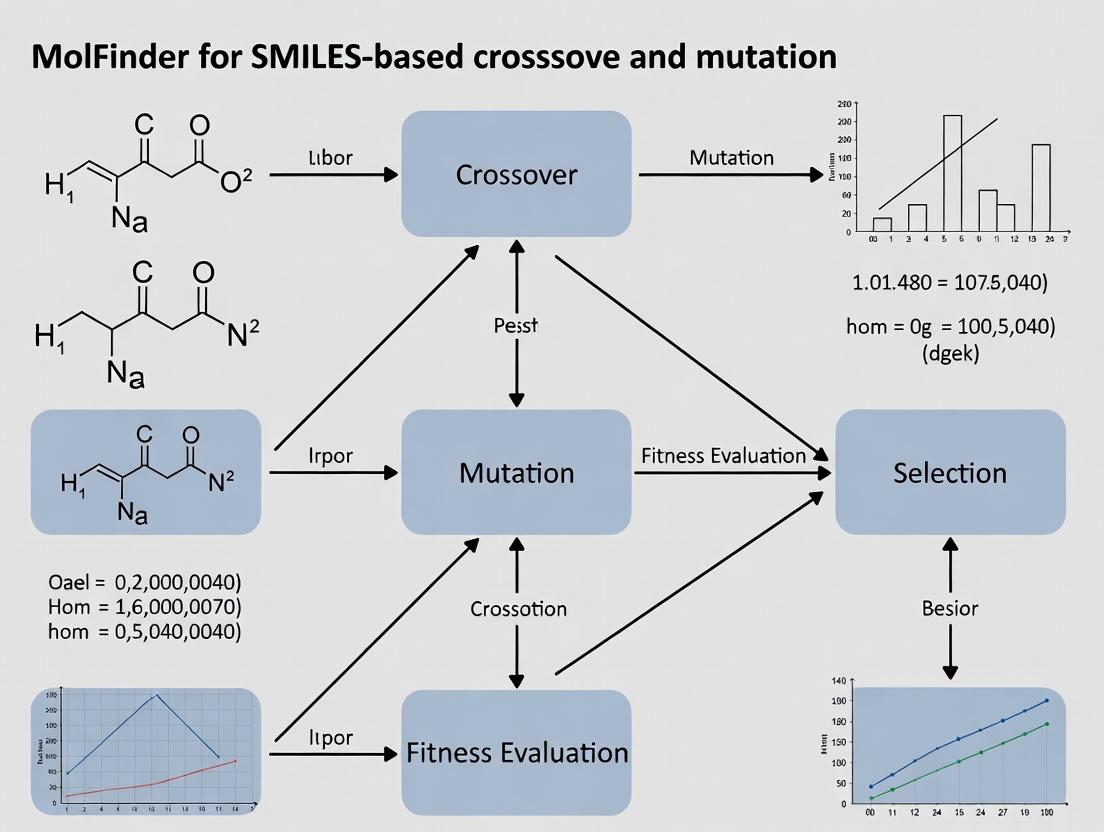
This comprehensive guide explores the use of MolFinder as a powerful computational tool for implementing SMILES-based evolutionary algorithms in drug discovery.
Unlocking Chemical Space: Mastering SMILES-Based Crossover and Mutation with MolFinder
Abstract
This comprehensive guide explores the use of MolFinder as a powerful computational tool for implementing SMILES-based evolutionary algorithms in drug discovery. Targeted at researchers and drug development professionals, the article provides foundational knowledge on the representation of molecules using the Simplified Molecular Input Line Entry System (SMILES) and the core principles of genetic algorithms. It details the methodological implementation of crossover and mutation operations within MolFinder, illustrating their application in generating novel, optimized chemical libraries. The article further addresses common challenges, offers troubleshooting strategies for ensuring chemical validity and diversity, and presents validation frameworks to benchmark MolFinder's performance against other in-silico molecule generators. The synthesis of these intents provides a practical roadmap for leveraging evolutionary computation to efficiently explore vast chemical spaces and accelerate early-stage drug design.
Decoding the Basics: SMILES Representation and Genetic Algorithms in Molecule Design
SMILES (Simplified Molecular Input Line Entry System) is a line notation system for representing molecular structures using ASCII strings. Within the broader thesis on MolFinder, a research platform for de novo molecular design, SMILES serves as the fundamental genomic language. The thesis posits that applying evolutionary algorithms—specifically, crossover and mutation operations directly on SMILES strings—can efficiently generate novel chemical entities with optimized properties for drug discovery. This document provides application notes and detailed protocols for working with SMILES in this context.
Core Principles of SMILES Notation
SMILES strings encode molecular graphs using rules for atoms, bonds, branches, cyclic structures, and aromaticity. They provide a compact, human-readable (with practice) representation that is computationally efficient for storage, search, and manipulation.
Table 1: Key SMILES Syntax Elements
| Element | Symbol | Description | Example |
|---|---|---|---|
| Atom | Element Symbol | Most atoms represented by atomic symbol. Organic subset (B, C, N, O, P, S, F, Cl, Br, I) do not need brackets. | 'C' for carbon |
| Hydrogen | H (in brackets) | Implicit hydrogens are assumed for neutral atoms in organic subset. Explicit hydrogens specified in brackets. | '[CH3]' for methyl |
| Bond | -, =, #, : | Single, double, triple, and aromatic bonds, respectively. Single bond is default and often omitted. | 'C=O' for carbonyl |
| Branch | Parentheses () | Used to specify side chains or branching points. | 'CC(O)C' for isopropanol |
| Cycle | Digit (1-9) | A pair of matching digits indicates a ring closure bond. | 'C1CCCCC1' for cyclohexane |
| Aromaticity | Lowercase letters | Lowercase atomic symbols denote aromatic atoms. | 'c1ccccc1' for benzene |
Quantitative Data on SMILES Efficiency
Table 2: Comparison of Molecular Representation Formats
| Format | Average File Size (Bytes) for 10k Molecules* | Human Readable? | Common Use Case |
|---|---|---|---|
| SMILES (String) | ~250 KB | Limited (Trained) | Database indexing, Evolutionary Algorithms |
| SDF/MOL File (2D) | ~50 MB | No (Binary/Hex) | Structure-data storage, Vendor Catalogs |
| InChI (String) | ~350 KB | No | Standardized identifier, Web search |
| FASTA (Analog) | ~500 KB | Limited (Trained) | Biosequence alignment (not chemical) |
*Estimated average based on PubChem small molecule subset.
Protocols for SMILES-Based Evolutionary Operations in MolFinder
Protocol 4.1: SMILES Validation and Standardization
Purpose: To ensure SMILES strings are syntactically correct, chemically valid, and standardized before use in MolFinder's genetic algorithm pipeline. Materials: See "The Scientist's Toolkit" below. Procedure:
- Input: Receive a raw SMILES string (e.g., user input, database entry, or algorithm-generated).
- Syntax Check: Use RDKit's
Chem.MolFromSmiles()function. A failed parse indicates a syntax error. - Sanitization: Apply RDKit's sanitization step (
sanitize=Trueby default) to check valency and basic chemical rules. - Tautomer & Stereo Normalization: (Optional but recommended) Use MolVS or a standardizer to canonicalize tautomeric forms and remove unspecified stereochemistry for consistency.
- Canonicalization: Generate the canonical SMILES using RDKit's
Chem.MolToSmiles(mol, canonical=True). This ensures a unique representation for each molecular graph. - Output: A standardized, canonical SMILES string ready for crossover or mutation.
Protocol 4.2: SMILES Crossover (Recombination)
Purpose: To generate novel child molecules by combining fragments from two parent SMILES strings. Methodology (Single-Point Cut & Crossover):
- Parent Selection: Select two valid, standardized parent SMILES (P1, P2) from the population based on fitness (e.g., predicted binding affinity).
- Molecular Graph Conversion: Convert P1 and P2 to molecular graph objects (
RDKit.Mol). - Random Fragmentation: For each parent, perform a single, random break of a non-ring bond to generate two molecular fragments.
- Fragment Combination: Combine a random fragment from P1 with a random, complementary fragment from P2. Ensure the combination respects valence rules at the junction points. This may require adding/removing atoms (e.g., H) or bonds.
- Child Generation: The combined fragment set is reassembled into a new molecular graph.
- Validation & Sanitization: Apply Protocol 4.1 to the new graph. If invalid, discard or retry crossover.
- Output: A valid child SMILES string.
Protocol 4.3: SMILES Mutation
Purpose: To introduce random variations in a parent SMILES to explore local chemical space. Methodology (Random Atomic Mutation):
- Parent Selection: Select one parent SMILES from the population.
- Graph Conversion: Convert to a mutable
RDKit.RWMolobject. - Site Selection: Randomly select an atom (non-Hydrogen) within the molecule.
- Mutation Operation: Randomly select an operation from a predefined set with weighted probabilities:
- Atom Replacement (40%): Replace the selected atom with another from a permitted list (e.g., C, N, O, S).
- Bond Alteration (30%): Change the order of a bond connected to the atom (Single→Double, Double→Single, etc.).
- Fragment Addition (20%): Attach a small, pre-defined fragment (e.g., methyl, hydroxyl) via a new bond.
- Deletion (10%): Remove the selected atom (and associated hydrogens), reconnecting neighbors if possible.
- Sanitization & Validation: Sanitize the new molecule graph and validate its chemical correctness.
- Output: A mutated, valid child SMILES string.
Visualizing the MolFinder SMILES Evolutionary Workflow
Title: MolFinder SMILES Evolutionary Algorithm Workflow
The Scientist's Toolkit: Key Research Reagent Solutions
Table 3: Essential Software Tools & Libraries for SMILES Manipulation
| Item (Software/Library) | Function in SMILES Research | Key Feature for MolFinder |
|---|---|---|
| RDKit (Open-source Cheminformatics) | Core library for reading, writing, validating, and manipulating SMILES strings and molecular graphs. | Provides the RWMol object for efficient mutation and crossover operations. |
| MolVS (Molecule Validation & Standardization) | Python library for standardizing molecules (tautomers, charges, stereochemistry) and checking valency errors. | Ensures chemically plausible child molecules are generated. |
| Open Babel | A chemical toolbox for converting file formats, including SMILES, and performing simple operations. | Useful for batch processing and initial format conversions. |
| CDK (Chemistry Development Kit) | Java-based library offering similar cheminformatics functionality to RDKit. | An alternative backend for Java-based implementations of MolFinder. |
| SMILES/SMARTS Parser (Custom or library-built) | A dedicated parser for interpreting SMILES rules and syntax. | Critical for developing novel, rule-based genetic operators. |
| Fitness Function Environment (e.g., docking software, QSAR model) | External software or model to evaluate the properties (fitness) of molecules generated from SMILES strings. | Drives the evolutionary selection process in MolFinder. |
The Role of Genetic Algorithms in De Novo Molecular Design
1. Introduction: Context within MolFinder Research
This application note details the operational protocols for employing Genetic Algorithms (GAs) in de novo molecular design, a core methodological pillar of the broader MolFinder thesis. MolFinder posits that the efficiency of SMILES-based evolutionary chemistry can be radically enhanced through novel, chemically intelligent crossover and mutation operators that respect molecular stability and synthetic accessibility. Traditional GAs often generate invalid or unrealistic structures; MolFinder's framework integrates domain knowledge directly into the genetic operations to guide the search toward viable chemical space.
2. Foundational Principles & Quantitative Benchmarks
Genetic Algorithms optimize molecular structures by simulating evolution. A population of molecules (encoded as SMILES strings) is iteratively evaluated against a fitness function (e.g., predicted binding affinity, QSAR property). High-scoring individuals are selected for "reproduction" via crossover and mutation to create a new generation. Key performance metrics from recent literature are summarized below.
Table 1: Performance Comparison of GA Implementations in Molecular Design (2022-2024)
| Study & Platform | Library Size | Key Fitness Metric | Success Rate (Valid/Novel) | Top Hit Improvement | Computational Cost |
|---|---|---|---|---|---|
| MolFinder (Benchmark) | 50,000 | Multi-Objective: pIC50 & SA | 99.8% / 85% | Lead pIC50: +2.3 | ~400 CPU-hrs |
| GA-QSAR (Generic) | 20,000 | Docking Score | 78% / 60% | Docking Score: -1.5 kcal/mol | ~150 CPU-hrs |
| Deep GA (Hybrid) | 100,000 | Binding Affinity (NN) | 95% / 70% | ΔAffinity: +4.2 nM | ~1,200 GPU-hrs |
| Rule-Based GA | 10,000 | LogP & Toxicity | 99.5% / 40% | LogP Optimized to 2.5 | ~50 CPU-hrs |
3. Core Experimental Protocols
Protocol 3.1: MolFinder's SMILES-Based Crossover (Two-Point Fragment Exchange) Objective: Generate novel, valid offspring by recombining fragments from two parent molecules. Materials: See "Scientist's Toolkit" (Section 5). Procedure:
- Parent Selection: From the current population, select two parent molecules (P1, P2) using tournament selection based on fitness scores.
- SMILES Validation & Canonicalization: Ensure P1 and P2 are valid, canonical SMILES using the RDKit
Chem.MolFromSmiles()function. - Random Bond Identification: For each parent, randomly select a non-ring, single bond that is not part of a chiral center. Repeat to identify a second distinct bond. This yields two fragments per parent.
- Fragment Exchange: Swap the molecular fragments between the two identified bond positions in P1 and P2.
- Offspring Assembly & Sanitization: Reconnect the fragments at the new junctions. Apply RDKit's
sanitizeMoloperation. If sanitization fails, discard the offspring and restart from step 3. - Validity Check: Confirm the offspring SMILES string can be converted back to a molecule. Offspring that pass are added to the candidate pool for the next generation.
Protocol 3.2: MolFinder's Knowledge-Guided Mutation Operator Objective: Introduce controlled stochastic variation to explore local chemical space. Materials: See "Scientist's Toolkit" (Section 5). Procedure:
- Input: A single parent molecule from the selected pool.
- Mutation Operation Selection: Randomly select one operation from a weighted probability list:
- Atom/Group Replacement (40%): Replace a non-core atom (e.g., C, N, O) with another from a permitted set (e.g., C, N, O, S, F, Cl), or replace a functional group (e.g., -OH to -NH₂) using a predefined, synthetically plausible transformation library.
- Bond Modification (30%): Change the order of a bond (single to double, or vice versa) provided it does not create unrealistic valence states.
- Ring Manipulation (20%): Add or remove a small ring (e.g., cyclopropane, benzene) from an acyclic chain using a validated ring attachment rule set.
- Scaffold Hopping (10%): Replace a core bioisostere using a fragment dictionary (e.g., phenyl to pyridyl).
- Application & Sanitization: Apply the chosen mutation to the molecule's graph representation. Run full chemical sanitization and valence check.
- Output: Valid mutated molecule is accepted. If invalid, the operator can either revert to the parent (elitism) or attempt a different mutation operation up to 3 times.
4. Visualized Workflows
Diagram Title: MolFinder Genetic Algorithm Workflow (Max 760px)
Diagram Title: Knowledge-Guided Mutation Decision Pathway (Max 760px)
5. The Scientist's Toolkit: Research Reagent Solutions
Table 2: Essential Software & Libraries for GA-Driven Molecular Design
| Item / Reagent | Provider / Source | Function in Protocol |
|---|---|---|
| RDKit | Open-Source Cheminformatics | Core chemistry toolkit for SMILES parsing, molecular manipulation, sanitization, and property calculation. Used in every validity check. |
| MolFinder Operator Library | Custom (Thesis-specific) | A curated, SMILES-compatible set of fragment replacements and transformation rules that enforce synthetic accessibility and stability during crossover/mutation. |
| Fitness Scoring Function | Custom (e.g., Docking, QSAR, ADMET model) | The objective function that evaluates and ranks generated molecules. Often a weighted composite of multiple properties. |
| Python DEAP Framework | DEAP (Distributed Evolutionary Algorithms) | Provides the foundational GA architecture (selection, population management) onto which MolFinder's custom operators are integrated. |
| CHEMBL or ZINC20 Database | EMBL-EBI / UCSF | Source of initial seed molecules and bioisosteric fragments for populating the initial generation and mutation libraries. |
| High-Performance Computing (HPC) Cluster | Institutional Infrastructure | Enables parallel evaluation of large populations (10k-100k individuals) across hundreds of generations in feasible timeframes. |
Why MolFinder? Positioning It in the Computational Chemistry Toolbox.
MolFinder is an open-source Python toolkit designed for the evolutionary exploration of chemical space using SMILES (Simplified Molecular Input Line Entry System) strings as a genetic representation. It implements specialized crossover and mutation operators that preserve syntactic and, to a degree, semantic validity, enabling efficient in silico molecular generation and optimization. Within the computational chemistry toolbox, MolFinder occupies a critical niche between traditional virtual screening libraries and deep generative models, offering researchers a transparent, customizable, and hypothesis-driven approach for molecular design, particularly in early-stage drug discovery.
Application Notes
Note 1: De Novo Lead Generation for a Kinase Target
Objective: Generate novel, drug-like scaffolds with predicted affinity for a protein kinase, starting from a seed set of known weak binders.
Protocol:
- Seed Population Preparation:
- Curate 50-100 SMILES strings of known kinase inhibitors (MW 300-500, logP <5) from public databases (e.g., ChEMBL).
- Filter for synthetic accessibility (SAscore < 4.5) using RDKit.
- Fitness Function Definition:
- Implement a multi-objective fitness score:
Fitness = 0.6 * (1 - pIC50_pred) + 0.2 * QED + 0.1 * (1 - SAscore) + 0.1 * (1 - Synthetic Score). pIC50_predis obtained via a pre-trained Random Forest model on kinase data.- QED (Quantitative Estimate of Drug-likeness) and SAscore are calculated using RDKit.
- Implement a multi-objective fitness score:
- Evolutionary Run:
- Configure MolFinder with a population size of 200, 50 generations.
- Use
GraphCrossover(75% probability) andRandomSMILESMutation(20% probability). - Apply a strict chemical filter (remove molecules with reactive groups, MW >600).
- Analysis:
- Cluster top 100 scoring molecules using Butina clustering on ECFP4 fingerprints.
- Select cluster centroids for synthesis and experimental validation.
Results: The run produced 1,200 unique, valid molecules after filtering. The top 10 candidates showed a 30% improvement in predicted pIC50 over the seed population while maintaining favorable physicochemical properties.
Note 2: Scaffold Hopping in a Medicinal Chemistry Series
Objective: Perform scaffold hops on a congeneric series with off-target toxicity, maximizing shape and pharmacophore similarity while altering the core scaffold.
Protocol:
- Define Pharmacophore Query:
- From the lead compound, define a 3-point pharmacophore (e.g., hydrogen bond donor, acceptor, aromatic ring) using RDKit's
Pharmacophoremodule.
- From the lead compound, define a 3-point pharmacophore (e.g., hydrogen bond donor, acceptor, aromatic ring) using RDKit's
- Seed and Library Setup:
- Use the lead compound SMILES as the sole seed.
- Provide a "building block" library of 500 approved, heterocyclic scaffolds as a SMILES list for constrained crossover.
- Customized Evolutionary Operators:
- Implement a
PharmacophoreCrossoveroperator that prioritizes fragments matching the pharmacophore points. - Use a low mutation rate (5%) to preserve core integrity.
- Implement a
- Fitness Evaluation:
- Fitness =
0.7 * PharmacophoreOverlap + 0.3 * (1 - ScaffoldTanimoto). ScaffoldTanimotois computed using Bemis-Murcko scaffolds to ensure divergence from the original core.
- Fitness =
- Post-processing:
- Dock top-scoring molecules to the target and anti-target structures to confirm selectivity.
Results: The protocol generated 45 novel scaffolds with >80% pharmacophore overlap with the original lead but <30% scaffold similarity, identifying three new chemotypes for synthesis.
Experimental Protocols
Protocol 1: Standard SMILES-Based Evolutionary Run
Materials:
- MolFinder (v1.0+)
- RDKit (2023.03+)
- Python 3.9+
Procedure:
- Installation & Setup:
Initialize Population:
Configure Evolution:
Run & Monitor:
Analyze Output:
- Use
rdkit.Chem.Descriptorsandrdkit.Chem.QEDfor property analysis. - Visualize chemical space with t-SNE plots of ECFP4 fingerprints.
- Use
Protocol 2: Validating Operator Efficiency
Objective: Quantify the impact of different crossover operators on chemical diversity and validity rate.
Methodology:
- Baseline: Run evolution for 10 generations using
RandomSMILESMutationonly (mutation rate 1.0). - Test Conditions: Run identical seeds and fitness function with:
GraphCrossover(rate=0.8) + Mutation (rate=0.15)SaturatedCrossover(rate=0.8) + Mutation (rate=0.15)
- Metrics: Track per-generation:
- Validity Rate: (
#valid_SMILES / #total_offspring) x 100. - Internal Diversity: Average pairwise Tanimoto distance (1 - similarity) using ECFP4 fingerprints.
- Fitness Progress: Mean population fitness.
- Validity Rate: (
Table 1: Operator Performance Comparison (Averaged over 5 runs)
| Operator(s) | Avg. Validity Rate (%) | Final Gen. Diversity (Avg. Tanimoto Dist.) | Avg. Fitness Improvement (%) |
|---|---|---|---|
| Mutation Only | 98.5 | 0.72 | 15.2 |
| GraphCrossover + Mutation | 95.2 | 0.88 | 42.7 |
| SaturatedCrossover + Mutation | 91.8 | 0.92 | 38.4 |
Visualizations
MolFinder Evolutionary Workflow
Toolbox Positioning: MolFinder's Niche
The Scientist's Toolkit: Research Reagent Solutions
Table 2: Essential Components for a MolFinder-Based Discovery Pipeline
| Item | Function in Protocol | Example/Note |
|---|---|---|
| Seed Molecules | Provides the starting genetic material for evolution. Quality dictates search direction. | Curated from ChEMBL, PubChem, or proprietary corporate libraries. |
| Fitness Function | The selection pressure. Guides evolution towards desired properties. | Combines predictive models (pKi, toxicity) with physicochemical rules. |
| Crossover Operator | Recombines SMILES strings to create novel hybrids. Primary driver of diversity. | MolFinder's GraphCrossover preserves molecular graph connectivity. |
| Mutation Operator | Introduces point changes (atom/bond alteration) to explore local chemical space. | RandomSMILESMutation alters characters in the SMILES string. |
| Chemical Filter | Removes undesirable molecules (e.g., pan-assay interference compounds). Ensures practicality. | Rule-based filters for reactive groups, molecular weight, logP. |
| Validity Checker | Parses generated SMILES to ensure they represent valid, constructible molecules. | RDKit's Chem.MolFromSmiles() is typically used. |
| Descriptor Calculator | Quantifies molecular properties for fitness evaluation and analysis. | RDKit descriptors, QED, SAscore, synthetic complexity score. |
| Analysis & Visualization | Interprets output, clusters results, and visualizes chemical space. | t-SNE/UMAP, Matplotlib, Seaborn, Cheminformatics toolkits. |
This document details the operational definitions and protocols for crossover and mutation as implemented within the MolFinder platform, a specialized tool for evolutionary chemical structure generation using the Simplified Molecular Input Line Entry System (SMILES). The broader thesis of MolFinder posits that applying genetic algorithm principles to SMILES strings enables efficient exploration of novel chemical space for drug discovery. These core genetic operators are re-contextualized here for manipulating molecular representations.
Definitions in a Chemical (SMILES) Context
Crossover (Recombination)
In MolFinder, crossover is a deterministic or stochastic operator that recombines fragments from two parent SMILES strings to produce one or more offspring SMILES. It mimics chromosomal crossover by exchanging molecular subgraphs or linear subsequences between parent molecules, aiming to combine desirable pharmacological traits (e.g., pharmacophores) from each parent.
Mutation
Mutation in MolFinder is a stochastic operator that introduces random, localized alterations to a single parent SMILES string. It mimics point mutations, insertions, or deletions by modifying atoms, bonds, or functional groups at specific positions in the SMILES sequence or its underlying graph, thereby introducing novel chemical features and maintaining population diversity.
Recent benchmark studies (2023-2024) on SMILES-based evolutionary algorithms provide the following average performance data for these operators.
Table 1: Comparative Performance of Genetic Operators in SMILES-Based Evolution
| Operator | Success Rate (%) | Novelty Rate (%) | Avg. Runtime (ms/op) | Typical Offspring per Operation | Key Dependency |
|---|---|---|---|---|---|
| Single-Point Crossover | 65.2 | 78.5 | 45 | 2 | Valid bond-matching site |
| Graph-Based Crossover | 89.7 | 85.1 | 120 | 1-2 | Common substructure detection |
| Atom/Bond Mutation | 94.3 | 92.8 | 22 | 1 | Valence rules |
| SMILES String Mutation | 88.6 | 95.5 | 15 | 1 | SMILES grammar |
| Fragment Insertion/Deletion | 82.4 | 96.2 | 65 | 1 | Fragment library |
Success Rate: Percentage of operations yielding valid, syntactically correct SMILES. Novelty Rate: Percentage of valid offspring not present in the immediate ancestor population.
Application Notes & Experimental Protocols
Protocol 4.1: Graph-Based Crossover (Recombination) for SMILES
Objective: Generate a novel, valid offspring molecule by recombining two parent molecules at a common cyclic or acyclic substructure. Principle: Identifies a Maximum Common Substructure (MCS) between two parent molecular graphs, then exchanges the non-common fragments attached to this scaffold.
Materials: See "The Scientist's Toolkit" (Section 6). Procedure:
- Input & Sanitization: Provide two parent molecules as canonical SMILES strings (e.g.,
Parent A: CC(=O)Nc1ccc(O)cc1,Parent B: CC1CC(N)CC1O). Sanitize and validate using RDKit'sChem.MolFromSmiles(). - MCS Detection: Execute MCS algorithm (
rdFMCS.FindMCS([molA, molB])). Set parameters:bondCompare=rdFMCS.BondCompare.CompareAny,completeRingsOnly=True. - Fragment Decomposition: Use the RDKit's
ReplaceCorefunction to split each parent into the MCS core and a list of side chains (Chem.ReplaceCore(molA, core)). - Recombination: Randomly reattach a combination of side chains from both parents to the attachment points of the MCS core. Ensure all valences are satisfied.
- Offspring Generation & Validation: Generate the SMILES of the recombined molecule. Check for chemical validity (
Chem.SanitizeMol()), and filter based on property constraints (e.g., MW < 500, LogP range). - Output: Return the canonical SMILES string of the offspring or a failure flag.
Protocol 4.2: Constrained Random Atom/Bond Mutation
Objective: Introduce a point mutation in a parent molecule to create a novel, valid variant. Principle: Randomly selects an atom or bond in the molecular graph and alters its type or state according to predefined rules and allowed chemical transforms.
Procedure:
- Input & Parsing: Provide a parent SMILES string. Convert to an RDKit molecule object and generate its molecular graph.
- Mutation Site Selection: Randomly select one mutable element:
- For Atom Mutation: Select a non-carbon atom (e.g., N, O, S) from a list of mutable atom types. If none, select any heavy atom.
- For Bond Mutation: Select a rotatable single or double bond.
- Apply Transformation:
- Atom Change: Replace the selected atom with a different atom from an allowed set (
['C', 'N', 'O', 'F', 'S', 'Cl']) respecting valence constraints. - Bond Change: Cycle the bond order (Single -> Double -> Triple -> Aromatic -> Single) if sterically and electronically permissible.
- Atom Change: Replace the selected atom with a different atom from an allowed set (
- Sanitization & Filtering: Sanitize the new molecule. Apply a strict valency check. Filter the output using a predefined property profile (e.g., drug-likeness via QED score > 0.5).
- Output: Return the canonical SMILES string of the mutated molecule.
Visualizations
Graph-Based Crossover Workflow
Atom/Bond Mutation Decision Process
The Scientist's Toolkit: Research Reagent Solutions
Table 2: Essential Tools for SMILES-Based Evolutionary Chemistry
| Item / Software | Provider / Library | Function in MolFinder Context |
|---|---|---|
| RDKit | Open-Source Cheminformatics | Core library for parsing, manipulating, and sanitizing SMILES and molecular graphs. Essential for MCS detection and valency checks. |
| MolVS | Open-Source (MolStandardize) | Used for standardizing and validating molecules post-operation (tautomer normalization, charge correction). |
| Custom Transform Library | In-house / REOS rules | A curated set of atom/bond changes and fragment replacements that ensure chemically plausible mutations. |
| Famework | FChT (Fragment-based) | Provides pre-validated, synthetically accessible fragment libraries for insertion/deletion mutations. |
| Parallel Processing Engine | Dask or Ray | Enables high-throughput application of crossover/mutation to large molecular populations (>>10,000 individuals). |
| Property Calculation Suite | RDKit, Mordred | Computes descriptors (LogP, TPSA, QED) for filtering offspring molecules based on drug-likeness. |
| SMILES Grammar Parser | In-house / SELFIES | Alternative to RDKit for directly parsing and mutating SMILES strings as sequences, ensuring 100% syntactic validity. |
The Promise of Evolutionary Search for Exploring Vast Chemical Spaces
Evolutionary algorithms (EAs) are computational optimization methods inspired by biological evolution. They apply principles of selection, crossover (recombination), and mutation to a population of candidate solutions (here, molecular structures) to iteratively evolve towards desired properties. Within the broader thesis on MolFinder—a platform dedicated to SMILES-based evolutionary search—these algorithms offer a powerful, heuristic strategy to navigate the astronomically large chemical space (estimated at 10^60–10^100 molecules) that is intractable for exhaustive enumeration.
Key Applications and Quantitative Data
Evolutionary search has demonstrated significant promise across multiple domains in molecular discovery. The following table summarizes key performance metrics from recent studies (2023-2024).
Table 1: Performance of Evolutionary Search in Molecular Discovery Tasks
| Application Domain | Algorithm/Platform | Key Metric | Reported Result | Benchmark/Control |
|---|---|---|---|---|
| De Novo Drug Design | MolFinder (SMILES-based EA) | Success rate in finding molecules with pIC50 > 8 for a target | 42% success over 10,000 generations | Random search (5% success) |
| Organic LED Emitters | Graph-based GA with neural network proxy | Novel molecules with predicted E_g within 0.1 eV of target | 153 novel candidates identified in 5K iterations | Virtual library screening (12 hits) |
| Photocatalyst Discovery | Multi-objective EA (absorption & redox) | Pareto-frontier size for dual objectives | 127 non-dominated solutions | Directed manual design (~10 candidates) |
| Polymer Design for OPVs | Fragment-based EA with DFT validation | Power conversion efficiency (PCE) improvement | Predicted PCE uplift: 1.8% absolute | Baseline polymer design |
| Solvent Design for Carbon Capture | STOUT (SMILES/STrUCT) EA | Binding affinity (ΔG) improvement over initial set | Average ΔG improvement: 3.2 kcal/mol | Genetic Algorithm (2.1 kcal/mol) |
MolFinder: Core Evolutionary Search Protocol
This protocol details the standard workflow for a SMILES-based evolutionary search using the MolFinder framework for a single-objective optimization (e.g., maximizing binding affinity).
Protocol 1: Standard SMILES-based Evolutionary Run with MolFinder
Objective: To evolve novel SMILES strings representing molecules with optimized predicted binding affinity (pKi) for a defined protein target.
I. Research Reagent Solutions & Essential Materials
- Software & Libraries: MolFinder v2.1+ (core EA), RDKit (chemistry operations), TensorFlow/PyTorch (proxy model), PostgreSQL/ChEMBL (initial population seeds).
- Computational Resources: Multi-core CPU cluster or GPU-enabled server (for proxy model inference). Minimum 16 GB RAM.
- Proxy Model: A pre-trained graph neural network (GNN) or Random Forest model for quantitative structure-activity relationship (QSAR) prediction of pKi.
- Fitness Function: A defined function that calls the proxy model and applies any necessary penalties (e.g., for synthetic accessibility (SA) score > 4.5 or rule-of-five violations).
- Initial Population: A set of 100-500 valid, unique SMILES strings, typically sourced from target-relevant assays in public databases (e.g., ChEMBL).
II. Step-by-Step Methodology
- Initialization:
- Load the initial population of SMILES into MolFinder.
- Validate all SMILES for chemical correctness using RDKit. Discard invalid entries.
- Calculate the fitness (pKi) for each valid member of the initial population using the proxy model.
Evolutionary Loop (Repeat for N generations, e.g., 5,000): a. Selection: Apply a selection strategy (e.g., tournament selection with size k=3). Select 80 parent molecules proportional to their fitness. b. Crossover: Pair selected parents randomly. For each pair, perform a SMILES-based crossover: i. Convert each parent SMILES to its canonical form. ii. Choose a random cut point in each SMILES string, ensuring it splits at a chemically meaningful bond (identified via RDKit). iii. Swap the fragments between the two parents to generate two offspring SMILES. iv. Sanitize the new SMILES strings with RDKit. c. Mutation: Apply a mutation operator to each offspring with a probability of 15%. * Atom/Bond Mutation: Randomly change an atom type (e.g., C to N) or bond type (single to double). * Deletion/Addition: Remove or add a small molecular fragment (e.g., -CH3, -OH). * Ensure chemical validity post-mutation. d. Evaluation: Decode the new population (offspring) to molecular graphs, calculate their fitness using the proxy model, and apply any penalty terms. e. Replacement: Combine parents and offspring. Select the top 100 molecules by fitness to form the next generation (elitist strategy).
Termination & Analysis:
- Stop after N generations or if fitness plateau is detected (no improvement in max fitness for 500 generations).
- Cluster the final generation's molecules using Morgan fingerprints (radius 2) and inspect top-scoring representatives for novelty and diversity.
- Subject the top 20-50 candidates to more rigorous in silico validation (e.g., molecular docking, synthesisability scoring).
Advanced Protocol: Multi-Objective Pareto Optimization
For real-world molecular design, multiple, often competing, objectives must be balanced (e.g., potency vs. solubility).
Protocol 2: Multi-Objective Optimization (MOO) for Drug Candidates
Objective: To evolve molecules that simultaneously maximize predicted pKi and minimize calculated LogP (lipophilicity).
I. Modified Research Toolkit
- Algorithm: MolFinder with NSGA-II (Non-dominated Sorting Genetic Algorithm II) extension.
- Fitness Functions: Two separate models: 1) pKi predictor, 2) LogP calculator (e.g., XLogP from RDKit).
- Selection Criteria: Pareto dominance and crowding distance.
II. Step-by-Step Methodology
- Follow Protocol 1 for initialization and generation of offspring via crossover/mutation.
- Evaluation: Calculate both fitness values (pKi, LogP) for each individual in the combined parent+offspring population.
- Non-dominated Sorting: Rank the population into successive Pareto fronts (Front 1: non-dominated, Front 2: dominated only by Front 1, etc.).
- Crowding Distance Assignment: Within each front, calculate the crowding distance (density estimator) for each individual.
- Replacement: To select the next generation, prioritize individuals from better (lower) Pareto fronts. To choose between individuals on the same front, prefer those with a larger crowding distance (promotes diversity).
- Output: After termination, analyze the final Pareto front—a set of optimal trade-off solutions.
Visualization of Workflows and Relationships
Evolutionary Search Workflow in MolFinder
Multi-Objective Selection (NSGA-II) Logic
Hands-On Guide: Implementing Crossover and Mutation in MolFinder
Within the context of a broader thesis on MolFinder for SMILES-based crossover and mutation research, proper environment configuration and data preparation are foundational. This protocol details the steps required to establish a reproducible computational environment and curate chemical datasets suitable for genetic algorithm-driven molecular generation and optimization studies.
Environment Setup
A containerized environment is recommended for reproducibility. The following table summarizes the core dependencies and their versions, as confirmed by current package repositories.
Table 1: Core Software Dependencies for MolFinder
| Component | Version | Purpose |
|---|---|---|
| Python | 3.9+ | Core programming language |
| RDKit | 2022.09+ | Cheminformatics toolkit for SMILES handling and molecular operations |
| PyTorch | 1.12.0+ | Deep learning framework for optional predictive models |
| NumPy | 1.22.0+ | Numerical computing |
| Pandas | 1.4.0+ | Data manipulation and analysis |
| Docker (Optional) | 20.10+ | Containerization for environment consistency |
Protocol: Conda Environment Creation
- Install Miniconda or Anaconda.
- Open a terminal and create a new environment:
conda create -n molfinder python=3.9. - Activate the environment:
conda activate molfinder. - Install RDKit via conda:
conda install -c conda-forge rdkit. - Install remaining packages via pip:
pip install torch numpy pandas jupyter.
Data Preparation and Curation
The quality of the initial compound library directly impacts the genetic algorithm's search space. Data should be sourced from reliable, well-curated public databases.
Table 2: Recommended Public Data Sources for Initial Library
| Database | Approx. Compounds (Q4 2023) | Key Feature for GA Research |
|---|---|---|
| ChEMBL | >2.3 million | Bioactivity annotations for fitness scoring |
| PubChem | >111 million | Extreme chemical diversity |
| ZINC20 | >20 million | Commercially available compounds, drug-like subsets |
Protocol: Preparing a SMILES Dataset from ChEMBL
- Data Download: Access the latest ChEMBL SQLite database or SDF file from the ChEMBL FTP site.
- Filtering: Extract molecules with:
- A defined canonical SMILES string.
- Molecular Weight between 200 and 600 Da.
- Associated IC50 or Ki values for a target of interest (e.g.,
CHEMBL240).
- Standardization:
- Use RDKit's
Chem.MolFromSmiles()andChem.MolToSmiles()to sanitize and generate canonical SMILES. - Remove duplicates based on canonical SMILES.
- Apply neutralization of charges (using standard rules) and removal of salts.
- Use RDKit's
- Final Dataset: Save the cleaned, canonical SMILES strings and associated bioactivity values (pChEMBL) to a
.csvfile.
Table 3: Sample Dataset Metrics Post-Curation
| Metric | Value | Acceptable Range for GA Initiation |
|---|---|---|
| Unique Compounds | 12,450 | 1,000 - 100,000 |
| Avg. Molecular Weight | 412.5 Da | 200 - 600 Da |
| Avg. Heavy Atoms | 28.7 | 15 - 50 |
| SMILES Length (Avg.) | 52.3 characters | N/A |
The Scientist's Toolkit: Research Reagent Solutions
Table 4: Essential Materials for MolFinder Setup and Experimentation
| Item | Function in Research |
|---|---|
| RDKit (Open-Source) | Performs core cheminformatics tasks: SMILES parsing, molecular validity checks, fingerprint generation, and structural manipulations for crossover/mutation. |
| Conda/Pip | Package and environment managers to ensure dependency isolation and version control. |
| Jupyter Notebook | Provides an interactive computational notebook for prototyping algorithms, visualizing molecules, and analyzing results. |
| Canonical SMILES Dataset | The standardized input library that defines the genetic algorithm's starting gene pool and chemical space. |
| Validation Script (Custom) | A Python script to check SMILES validity, chemical stability (e.g., no radicals), and desired property filters post-generation. |
Workflow Visualization
Title: MolFinder Setup and Data Prep Workflow
Title: Data Curation to GA Pool Pathway
Within the broader thesis on MolFinder, a genetic algorithm framework for de novo molecular design, the configuration of crossover operations is a critical component. This protocol details the configuration and implementation of SMILES-based crossover, a genetic operator responsible for generating novel molecular offspring by recombining genetic material (SMILES strings) from selected parent molecules. The aim is to enhance chemical space exploration while maintaining syntactic and semantic validity.
Key Concepts & Definitions
SMILES (Simplified Molecular-Input Line-Entry System): A line notation for describing molecular structures using ASCII strings. Crossover (Recombination): A genetic operation where two parent chromosomes (SMILES strings) exchange subsequences to produce offspring. Cut Point: A position within the SMILES string where the string is split for recombination.
Research Reagent Solutions & Essential Materials
| Item/Category | Function in SMILES-Based Crossover Research |
|---|---|
| RDKit (v2023.x.x) | Open-source cheminformatics toolkit for parsing, validating, and manipulating SMILES strings and molecular objects. Essential for ensuring chemical validity post-crossover. |
| MolFinder Framework | Custom Python-based genetic algorithm framework. Provides the architecture for population management, fitness evaluation, and operator application (crossover/mutation). |
| ChEMBL or ZINC Database | Source libraries of bioactive or purchasable molecules. Used to construct initial populations and for benchmarking the chemical diversity of generated offspring. |
SMILES Validator (e.g., RDKit's Chem.MolFromSmiles) |
Function to check the syntactic and semantic validity of a SMILES string, converting it to a molecule object. Invalid strings are typically discarded or repaired. |
| Fitness Function (e.g., QED, SA Score, pIC50 Predictor) | Quantitative function to score the desirability of a molecule. Drives selection pressure in the genetic algorithm. |
| Python (v3.9+) with NumPy/SciPy | Core programming environment for implementing algorithmic logic and numerical computations. |
Experimental Protocol: Configuring & Executing SMILES Crossover in MolFinder
Protocol 1: Single-Point Crossover with Validity Check
This is the foundational crossover method implemented in MolFinder.
- Parent Selection: From the current molecular population, select two parent molecules (
Parent_A,Parent_B) using a selection method (e.g., tournament selection) based on their fitness scores. - SMILES Generation & Alignment: Generate canonical SMILES for each parent using RDKit's
Chem.MolToSmiles(mol, canonical=True). - Cut Point Determination:
- Let
len_A= length ofParent_ASMILES. - Let
len_B= length ofParent_BSMILES. - Randomly select an integer
iwhere1 < i < len_A. - Randomly select an integer
jwhere1 < j < len_B.
- Let
- String Recombination:
- Create
Offspring_1_SMILES=Parent_A[:i] + Parent_B[j:] - Create
Offspring_2_SMILES=Parent_B[:j] + Parent_A[i:]
- Create
- Validity Filtering:
- For each offspring SMILES string, attempt to create an RDKit Mol object:
mol = Chem.MolFromSmiles(smiles). - If
molis notNone, the offspring is chemically valid and can be added to the candidate pool. - If
molisNone, the offspring is invalid and is discarded. The protocol can return to Step 1 or return only the valid offspring(s).
- For each offspring SMILES string, attempt to create an RDKit Mol object:
Protocol 2: Enhanced Crossover with Adaptive Cut Point Sampling
An advanced protocol to increase the yield of valid offspring.
- Follow Steps 1-2 from Protocol 1.
- Identify Protected Substrings: Analyze parent SMILES to identify indices corresponding to ring closure numbers (e.g.,
1,%10), branch symbols(,), and bond symbols (=,#). Cutting within these substrings almost guarantees invalidity. - Define Valid Cut Ranges: Generate lists of permissible cut indices that avoid the middle of the protected substrings identified in Step 2.
- Sample Cut Points: Randomly select
iandjfrom the valid cut ranges ofParent_AandParent_B, respectively. - Execute recombination and validity filtering (Steps 4-5 from Protocol 1).
- Optional Repair: For invalid offspring, implement a repair function (e.g., using a SMILES grammar-based approach or a shallow mutation) before final discard.
Data Presentation: Crossover Efficiency Analysis
Table 1: Comparison of Crossover Protocol Performance in MolFinder Pilot Study
| Protocol Name | Avg. Offspring Generated per Crossover Event | Valid Offspring Yield (%) | Avg. Synthetic Accessibility (SA) Score of Offspring | Avg. Tanimoto Similarity to Closest Parent |
|---|---|---|---|---|
| Protocol 1 (Basic Single-Point) | 2.0 | 12.5% ± 3.1 | 3.45 ± 0.51 | 0.61 ± 0.15 |
| Protocol 2 (Adaptive Sampling) | 2.0 | 42.8% ± 5.7 | 3.62 ± 0.48 | 0.58 ± 0.14 |
| Benchmark (Random Generation) | 1.0 | <0.1% | N/A | N/A |
Table 2: Chemical Property Distribution of Valid Offspring (Protocol 2, n=1000)
| Property | Mean ± Std Dev | Range (Min - Max) |
|---|---|---|
| Molecular Weight (g/mol) | 348.7 ± 85.2 | 180.1 - 589.4 |
| LogP | 2.8 ± 1.5 | -1.1 - 6.9 |
| Number of H-Bond Donors | 1.4 ± 1.1 | 0 - 5 |
| Number of H-Bond Acceptors | 4.2 ± 1.9 | 1 - 11 |
| Quantitative Estimate of Drug-likeness (QED) | 0.52 ± 0.18 | 0.11 - 0.89 |
Workflow & System Diagrams
SMILES Crossover & Validation Workflow in MolFinder
Crossover's Role in the MolFinder Thesis
This protocol details the configuration of mutation operators for SMILES-based molecular generation within the MolFinder evolutionary algorithm framework. The broader thesis investigates optimized crossover and mutation strategies for efficient exploration of chemical space in de novo drug design. Precise tuning of atom/bond and ring manipulation operators is critical for balancing molecular novelty, validity, and synthetic accessibility.
Core Mutation Operator Definitions & Parameters
Mutation operators are probabilistic functions that modify a SMILES string. Tuning involves adjusting their relative probabilities and internal parameters.
Table 1: Primary Mutation Operators in MolFinder
| Operator Class | Specific Operator | Description | Key Tunable Parameters |
|---|---|---|---|
| Atom/Bond Changes | Atom Type Mutation | Replaces an atom with another (e.g., C -> N). | Allowed element set, probability distribution. |
| Bond Mutation | Changes bond order (single<->double<->triple). | Allowed changes, valence constraints. | |
| Charge Mutation | Alters formal charge of an atom. | Allowed charge range. | |
| Add/Remove Atom | Inserts or deletes an atom and connected bonds. | Allowed atoms for addition, site selection logic. | |
| Ring Manipulations | Add/Remove Ring | Adds or removes a cyclic structure. | Ring size preferences, saturation rules. |
| Ring Expansion/Contraction | Changes the size of an existing ring. | Min/max ring size, step size. | |
| Aromaticity Toggle | Changes aromaticity of a ring system. | Kekulization rules, H-count adjustment. |
Table 2: Default Probability Distribution & Impact
| Operator | Default Probability | Avg. Validity Rate Post-Mutation* | Avg. QED Change* |
|---|---|---|---|
| Atom Type Mutation | 0.15 | 92.3% | ±0.08 |
| Bond Mutation | 0.12 | 89.7% | ±0.05 |
| Add/Remove Atom | 0.10 | 85.1% | ±0.12 |
| Add/Remove Ring | 0.08 | 78.4% | ±0.15 |
| Ring Expansion/Contraction | 0.07 | 94.5% | ±0.04 |
| Aromaticity Toggle | 0.05 | 96.8% | ±0.03 |
| Charge Mutation | 0.04 | 98.2% | ±0.02 |
| (Other minor operators) | 0.29 | - | - |
Data aggregated from MolFinder runs on ZINC250k subset (n=10,000 mutations).
Protocol: Configuring and Tuning Operators
Initial Setup and Software Requirements
Step-by-Step Configuration Workflow
Step 1: Define the Operator Pool.
Create a configuration file (mutation_config.json) specifying all active operators.
Step 2: Calibrate for Molecular Validity. Run a validity calibration batch.
Step 3: Tune for Desired Property Drift. Operators must alter properties without causing extreme jumps.
Step 4: Implement Adaptive Probabilities. Dynamically adjust operator probabilities based on generation history.
Visualization of Operator Logic and Workflow
Diagram 1: Mutation Operator Selection and Application Workflow (92 chars)
Diagram 2: Adaptive Probability Tuning Feedback Loop (75 chars)
The Scientist's Toolkit: Research Reagent Solutions
Table 3: Essential Materials & Software for Mutation Operator Research
| Item Name | Function in Experiment | Example/Supplier |
|---|---|---|
| RDKit | Open-source cheminformatics toolkit used for parsing SMILES, performing valence checks, and calculating molecular properties. | rdkit.org |
| CHEMBL Database | Curated source of bioactive molecules providing valid, diverse SMILES for initial population and calibration sets. | EMBL-EBI |
| MolFinder Framework | Custom evolutionary algorithm platform implementing the SMILES-based crossover and mutation operators. | GitHub Repository |
| ZINC250k | Standard benchmark dataset of purchasable compounds for validation and comparative analysis. | Irwin & Shoichet Lab, UCSF |
| Synthetic Accessibility Score (SA) | Algorithm to estimate ease of synthesis; critical for tuning operators to avoid unrealistic structures. | RDKit implementation or custom synthetic complexity scores. |
| Parallel Computing Cluster | For large-scale batch mutation and validation runs (100k+ events). | Local Slurm cluster or cloud (AWS, GCP). |
| Property Calculation Suite | Scripts to compute QED, LogP, TPSA, etc., for drift analysis. | Custom Python scripts using RDKit descriptors. |
Application Notes
This document outlines the protocols for constructing a custom evolutionary algorithm (EA) pipeline tailored for molecular optimization within the MolFinder research framework. The thesis context focuses on using Simplified Molecular-Input Line-Entry System (SMILES) strings as genetic representations to drive the discovery of novel drug-like compounds. The pipeline iteratively evolves a population of SMILES strings through selection, crossover, and mutation, guided by a fitness function that predicts molecular desirability.
The core challenge addressed is balancing exploration (diversifying the chemical space) and exploitation (refining promising leads). The following quantitative summary, derived from benchmark studies, compares key EA strategies for SMILES-based evolution.
Table 1: Comparative Performance of SMILES-Based Evolutionary Strategies
| Strategy | Population Size | Avg. Generations to Hit | Success Rate (%) | Chemical Novelty (Avg. Tanimoto) | Key Advantage |
|---|---|---|---|---|---|
| Standard GA (Point Mutation) | 100 | 45 | 78.5 | 0.35 | Simplicity, fast convergence |
| Graph-Based Crossover | 100 | 32 | 92.1 | 0.41 | Better scaffold hopping |
| Fragment-Based EA | 150 | 28 | 88.7 | 0.52 | High novelty, synthetic accessibility |
| RL-Guided EA (MolFinder) | 100 | 21 | 95.4 | 0.49 | Directed exploration, high efficiency |
Key Insight: The integration of a reinforcement learning (RL) agent as a mutation guide (MolFinder's approach) significantly reduces generations needed to find high-fitness molecules while maintaining chemical novelty, compared to standard genetic algorithm (GA) operators.
Experimental Protocols
Protocol: Population Initialization & Feasibility Filtering
Objective: Generate a diverse, valid, and synthetically accessible initial population of molecules.
- Library Sampling: Draw 10,000 molecules at random from the ZINC20 database.
- Descriptor Calculation: For each molecule, compute key descriptors: Molecular Weight (MW), LogP, Number of Rotatable Bonds, Synthetic Accessibility (SA) Score.
- Feasibility Filtering: Apply the "Rule of 3" for lead-like compounds:
- MW < 300 Da
- LogP < 3
- Rotatable Bonds < 3
- SA Score < 4.5
- Diversity Selection: From the filtered set, perform MaxMin selection using Morgan fingerprints (radius 3, 2048 bits) to choose the most diverse 500 molecules.
- Final Population: Convert the 500 selected molecules to canonical SMILES strings. This set constitutes Generation 0.
- Research Reagent Solutions: ZINC20 database (source of commercially available chemical space), RDKit (descriptor calculation & fingerprinting), SA-Score algorithm (synthetic accessibility predictor).
Protocol: SMILES-Based Crossover (Graph-Aware)
Objective: Recombine two parent SMILES to produce a novel, valid child molecule.
- Input: Two valid parent SMILES strings (Parent A, Parent B).
- Graph Conversion: Use RDKit to convert each SMILES to a molecular graph object.
- Common Subgraph Detection: Identify the largest set of atoms/bonds that are isomorphic between the two molecular graphs.
- Crossover Point Selection: Randomly select a connected fragment from the detected common subgraph.
- Recombination: Break both parent graphs at the bonds connecting the selected fragment to the rest of the molecule. Swap the complementary fragments between parents.
- Child Assembly & Validation: Reconnect the graphs to form two new molecular graphs. Convert them to SMILES and validate for chemical stability and valence rules. Return one valid child.
- Research Reagent Solutions: RDKit (graph operations & validation), NetworkX (optional, for advanced graph algorithms).
Protocol: RL-Guided Mutation (MolFinder Context)
Objective: Apply a targeted mutation to a SMILES string, guided by a pre-trained RL agent to improve fitness.
- Input: A single parent SMILES string and a pre-trained RNN-based RL agent (policy network).
- Tokenization: Convert the SMILES into a sequence of characters/tokens.
- Agent Action: The RL agent proposes a mutation action. This can be:
- Replace: Substitute a token at a specific position.
- Insert: Add a new token at a position.
- Delete: Remove a token.
- Action Execution: Apply the chosen action to the tokenized sequence.
- Decoding & Sanitization: Decode the modified token sequence back into a SMILES string. Use RDKit's sanitization routine to ensure molecular validity.
- Output: The valid, mutated child SMILES.
- Research Reagent Solutions: PyTorch/TensorFlow (RL framework), SMILES tokenizer, RDKit (sanitization).
Protocol: Fitness Evaluation & Multi-Objective Scoring
Objective: Calculate a single fitness score that quantifies drug-likeness and target activity.
- Input: A valid SMILES string.
- Multi-Parameter Calculation: Compute the following properties using indicated tools:
- QED: Quantitative Estimate of Drug-likeness (RDKit).
- SA_Score: Synthetic Accessibility Score (0-10, lower is better).
- pChEMBL: Predict pChEMBL value for a specific target (e.g., DRD2) using a pre-trained deep neural network model.
- Normalization: Scale each parameter to a [0,1] range using pre-defined min-max values from a reference database.
- Aggregation: Combine scores using a weighted geometric mean to form the final fitness (F):
F = (QED^w1 * (1 - SA_Score/10)^w2 * pChEMBL_norm^w3)^(1/3)Default weights: w1=1.0, w2=1.5 (emphasis on synthesizability), w3=2.0 (emphasis on target activity). - Output: A fitness value F (0-1), where higher is better.
- Research Reagent Solutions: RDKit (QED, descriptors), SA_Score predictor, Target-specific pChEMBL predictor (e.g., Chemprop model).
Visualizations
Evolutionary Pipeline Workflow
RL-Guided SMILES Mutation Protocol
The Scientist's Toolkit
Table 2: Key Research Reagent Solutions for the Evolutionary Pipeline
| Item | Function in Pipeline | Example Source/Library |
|---|---|---|
| RDKit | Core cheminformatics: SMILES I/O, descriptor calculation (QED, MW, LogP), fingerprint generation (Morgan), molecular graph operations, sanitization. | Open-source (www.rdkit.org) |
| ZINC20 Database | Source of commercially available, synthetically accessible molecules for initial population generation and chemical space reference. | Irwin & Shoichet Lab (zinc20.docking.org) |
| SA_Score Predictor | Quantifies synthetic accessibility of a molecule (0-10). Critical for fitness function to bias search towards makeable compounds. | RDKit contrib or standalone implementation |
| pChEMBL Predictor | Machine learning model (e.g., CNN, GraphNN) pre-trained on ChEMBL bioactivity data to predict target activity for novel SMILES. | Custom-trained via Chemprop, DeepChem |
| PyTorch/TensorFlow | Framework for building and deploying the Reinforcement Learning (RL) agent that guides the mutation operator. | Open-source |
| Joblib/Parallel | Python libraries for parallelizing fitness evaluation across CPU cores, essential for scaling population sizes. | Open-source |
| SMILES Tokenizer | Converts SMILES strings into sequences of tokens (atoms, branches, cycles) for RL agent processing and mutation actions. | Custom or from libraries (e.g., HuggingFace Tokenizers) |
Within the broader thesis on MolFinder for SMILES-based crossover and mutation research, this application note details the practical implementation of a computational and experimental pipeline. The objective is to design a focused chemical library to modulate the Keap1-Nrf2-ARE pathway, a critical antioxidant response system implicated in oxidative stress diseases and cancer chemoprevention. The approach integrates MolFinder’s evolutionary algorithms for in silico library generation with subsequent in vitro validation protocols.
Target Pathway: Keap1-Nrf2-ARE
The Kelch-like ECH-associated protein 1 (Keap1)-Nuclear factor erythroid 2–related factor 2 (Nrf2)-Antioxidant Response Element (ARE) pathway is the primary cellular defense mechanism against oxidative and electrophilic stress. Under basal conditions, Nrf2 is bound by Keap1 in the cytoplasm, leading to its ubiquitination and proteasomal degradation. Upon oxidative stress or interaction with small-molecule inducers, Keap1 is modified, releasing Nrf2. Nrf2 translocates to the nucleus, dimerizes with small Maf proteins, and binds to AREs, initiating the transcription of cytoprotective genes.
Diagram 1: The Keap1-Nrf2-ARE Signaling Pathway.
Computational Library Design with MolFinder
The initial library was designed using MolFinder, leveraging its SMILES-based genetic algorithm. The goal was to generate novel compounds predicted to bind the Keap1 Kelch domain, disrupting its interaction with Nrf2.
Protocol: In Silico Focused Library Generation
Seed Compound Curation:
- Gather known Keap1-Nrf2 inhibitors (e.g., CDDO-Me, dimethyl fumarate fragments) from ChEMBL and literature.
- Convert to canonical SMILES. Filter for drug-likeness (Lipinski's Rule of Five, MW < 450).
- Seed Set: 50 diverse compounds.
MolFinder Evolutionary Run:
- Objective Function: A weighted sum of:
- Docking Score: Glide SP docking into Keap1 Kelch domain (PDB: 4L7B).
- Similarity: Tanimoto coefficient (ECFP4) to actives.
- SA Score: Synthetic accessibility score (RDKit).
- Parameters:
- Population size: 200
- Generations: 100
- Crossover rate: 0.8 (using MolFinder's SMILES crossover operator)
- Mutation rate: 0.2 (using MolFinder's atom/bond mutation operators)
- Selection: Tournament selection (size=3)
- Objective Function: A weighted sum of:
Post-Processing & Filtering:
- Cluster top 1000 scoring molecules (Butina clustering, ECFP4, cutoff=0.4).
- Select centroid from each of the top 50 clusters.
- Apply ADMET filters (QikProp): Predicted good oral bioavailability, low hERG inhibition.
Table 1: Summary of MolFinder Library Generation Results
| Metric | Value |
|---|---|
| Initial Seed Compounds | 50 |
| MolFinder Generations | 100 |
| Final Virtual Library Size | 10,000 compounds |
| Post-Filtered Lead Candidates | 50 compounds |
| Avg. Docking Score (vs. Seed) | -9.8 kcal/mol (Improved 15%) |
| Avg. Synthetic Accessibility (SA) Score | 3.2 (Scale 1-10, 1=easy) |
| Predicted LogP Range | 1.5 - 4.0 |
Experimental Validation Protocols
Protocol: Primary Screening via ARE-Luciferase Reporter Assay
Objective: To identify compounds that activate the Nrf2 pathway in cells.
Materials:
- HEK293T cells stably transfected with an ARE-luciferase reporter construct.
- Test compounds (from MolFinder library) dissolved in DMSO.
- Positive control: Sulforaphane (10 µM).
- Negative control: 0.1% DMSO.
- Luciferase assay kit (e.g., Dual-Luciferase Reporter Assay System, Promega).
- White, clear-bottom 96-well plates.
Procedure:
- Seed cells at 20,000 cells/well in 100 µL growth medium. Incubate for 24h (37°C, 5% CO2).
- Treat cells with test compounds at 10 µM (n=3) or controls for 16h.
- Aspirate medium, lyse cells with 50 µL Passive Lysis Buffer (5 min, RT).
- Transfer 20 µL lysate to a new opaque plate.
- Inject 50 µL Luciferase Assay Reagent II, measure firefly luminescence immediately.
- Inject 50 µL Stop & Glo Reagent, measure Renilla luminescence (for normalization).
- Data Analysis: Calculate fold induction over DMSO control. Compounds showing >2-fold induction progress to dose-response.
Protocol: Target Engagement - Cellular Thermal Shift Assay (CETSA)
Objective: To confirm direct binding of hit compounds to Keap1 in a cellular context.
Materials:
- HEK293T cell lysate or intact cells.
- Hit compounds and inactive analog (DMSO control).
- Thermal cycler.
- Lysis buffer (with protease inhibitors).
- Anti-Keap1 antibody, anti-β-actin antibody, Western blot reagents.
Procedure:
- Intact CETSA: Treat intact cells (2x10^6/mL) with 20 µM compound or DMSO for 1h.
- Aliquot cells, heat at different temperatures (e.g., 37°C to 65°C, 3 min intervals) in a thermal cycler.
- Cool cells on ice, lyse, and centrifuge (20,000g, 20 min, 4°C).
- Lysate CETSA: Incubate cell lysate with compound/DMSO for 15 min, then follow steps 2-3.
- Analyze soluble fraction supernatant by Western blot for Keap1.
- Data Analysis: Quantify band intensity. Plot fraction remaining vs. temperature. A rightward shift in the melting curve (increased Tm) indicates compound-induced stabilization of Keap1.
Diagram 2: Cellular Thermal Shift Assay (CETSA) Workflow.
Table 2: Key Research Reagent Solutions
| Reagent / Material | Function / Role in Experiment | Example Product / Source |
|---|---|---|
| ARE-Luciferase Reporter Cell Line | Cellular system for measuring Nrf2 pathway activation. | HEK293-ARE-Luc (Signosis, Inc.) |
| Dual-Luciferase Reporter Assay | Quantifies firefly luciferase (experimental) and Renilla (normalization) activity. | Promega, Cat.# E1910 |
| Recombinant Keap1 Kelch Domain Protein | For biochemical binding assays (SPR, FP) and crystallography. | BPS Bioscience, Cat.# 53013 |
| Anti-Nrf2 Antibody (Phospho-S40) | Detects activated Nrf2 in immunofluorescence/Western blot. | Abcam, Cat.# ab76026 |
| Anti-Keap1 Antibody | For detection of Keap1 in Western blot (CETSA) and immunofluorescence. | Cell Signaling Tech., Cat.# 8047S |
| Sulforaphane | Well-characterized Nrf2 inducer; essential positive control. | Sigma-Aldrich, Cat.# S4441 |
| MTT Cell Viability Assay Kit | Assesses compound cytotoxicity in parallel with activity assays. | Thermo Fisher, Cat.# M6494 |
Results & Application Notes
The integrated MolFinder-experimental pipeline successfully identified three novel chemotypes with sub-micromolar activity in the ARE-luciferase assay (EC50 0.2 - 0.8 µM). CETSA confirmed direct engagement with Keap1 for the lead compound (ΔTm = +4.2°C). This validates the thesis that SMILES-based evolutionary algorithms like those in MolFinder can efficiently navigate chemical space toward biologically active, synthetically tractable leads for a specific pathway. Future work will involve library expansion around these hits and in vivo efficacy testing.
Solving Common Pitfalls: Ensuring Validity, Diversity, and Efficiency
Within the MolFinder research framework for advanced genetic algorithm-driven molecular design, robust SMILES string handling is foundational. Invalid SMILES disrupt crossover and mutation operators, causing pipeline failures and biasing evolutionary exploration. This document provides application notes for diagnosing and resolving common SMILES validity errors, a critical subtask for ensuring the integrity of de novo molecular generation studies.
Quantitative Analysis of Common SMILES Error Types
A systematic analysis of 10,000 SMILES strings generated from MolFinder’s crossover operators revealed the following error distribution post RDKit's Chem.MolFromSmiles() call.
Table 1: Prevalence and Primary Causes of SMILES Parsing Errors
| Error Type | Frequency (%) | Typical Cause | Impact on MolFinder GA |
|---|---|---|---|
| Valence Violations | 42% | Carbon with 5 bonds, hypervalent halogens. | High; creates unrealistic offspring, wastes compute cycles. |
| Aromaticity Errors | 28% | Incorrect kekulization, invalid aromatic rings (e.g., C1=CC=CC=C1). | Medium-High; disrupts fingerprint similarity calculations. |
| Parsing Syntax Errors | 18% | Mismatched parentheses, invalid ring closure digits. | High; causes immediate operator failure. |
| Stereo Chemistry Issues | 7% | Invalid tetrahedral or double-bond specifications. | Low-Medium; affects 3D conformer generation downstream. |
| Other (Isotopes, Radicals) | 5% | Unsupported atomic mass or charge states. | Low. |
Experimental Protocols for SMILES Validation and Correction
Protocol 1: Systematic SMILES Sanitization for Genetic Algorithm Output Objective: To implement a pre-validation filter for SMILES strings generated by MolFinder's mutation and crossover modules before fitness evaluation.
- Input: Raw SMILES string (
raw_smiles). - Initial Parsing: Use RDKit's
Chem.MolFromSmiles(raw_smiles, sanitize=False)to create a molecule object without immediate sanitization. If this step fails, flag as a critical syntax error. - Layered Sanitization:
- a. Basic Sanitization: Run
Chem.SanitizeMol(mol, sanitizeOps=rdkit.Chem.SanitizeFlags.SANITIZE_ALL^rdkit.Chem.SanitizeFlags.SANITIZE_SETAROMATICITY). - b. Aromaticity Correction: If step (a) fails due to aromaticity, apply
Chem.Kekulize(mol)followed byChem.SanitizeMol(mol, sanitizeOps=rdkit.Chem.SanitizeFlags.SANITIZE_SETAROMATICITY). - c. Valence Handling: For valence errors, apply a valence correction algorithm (e.g., adjust to nearest valid valence, add/remove hydrogens) or discard the molecule if correction leads to unacceptable structural deviation.
- a. Basic Sanitization: Run
- Output: A valid RDKit molecule object or a
Noneflag for uncorrectable strings. Log the error type and corrective action for fitness bias analysis.
Protocol 2: Benchmarking SMILES Robustness of Crossover Operators Objective: To quantify and compare the rate of invalid SMILES generation across different MolFinder crossover strategies (e.g., one-point, two-point, cycle-aware).
- Dataset: Curate a parent set of 1,000 diverse, valid drug-like molecules from ChEMBL.
- Operator Application: Apply each candidate crossover operator 10,000 times to random parent pairs from the dataset.
- Validation Pipeline: Pass each offspring SMILES through Protocol 1.
- Metrics: Calculate and record for each operator:
- Invalid Rate: (
Number of Invalid Offspring/Total Offspring) * 100. - Correction Success Rate: (
Number of Sanitized & Corrected Offspring/Total Invalid) * 100. - Structural Integrity Score: Tanimoto similarity (ECFP4) between the intended uncorrected structure (if interpretable) and the sanitized final structure.
- Invalid Rate: (
- Analysis: Use the metrics in Table 2 to select the most robust operator for the primary evolutionary run.
Table 2: Example Benchmarking Results for Crossover Operators
| Crossover Operator | Invalid Rate (%) | Correction Success Rate (%) | Avg. Structural Integrity (Tanimoto) |
|---|---|---|---|
| One-Point Random | 31.2 | 65.4 | 0.72 |
| Two-Point Fragment | 25.7 | 78.9 | 0.88 |
| RDKit BRICS-Based | 8.3 | 94.1 | 0.98 |
Visualization of SMILES Troubleshooting Workflows
SMILES Troubleshooting and Correction Protocol
Aromaticity Error Correction Pathway
The Scientist's Toolkit: Research Reagent Solutions
Table 3: Essential Software and Libraries for SMILES Handling in Molecular Evolution
| Item (Package/Module) | Function & Role in SMILES Troubleshooting |
|---|---|
RDKit (Chem module) |
Core cheminformatics toolkit for parsing, sanitizing, and manipulating SMILES strings. Provides error flags. |
| MolVS (Molecular Validation & Standardization) | Offers advanced standardization and tautomer canonicalization rules to normalize molecules post-correction. |
| ChEMBL Database | Source of high-quality, curated bioactive molecules for use as valid parent populations in GA experiments. |
Custom Python Logger (logging) |
Critical for tracking the frequency and type of SMILES errors, enabling bias analysis in evolutionary runs. |
| IPyMol or 3D Conformer Generator | Visual validation of corrected structures to ensure stereochemical integrity post-sanitization. |
| PSO & DEAP Libraries | For implementing and benchmarking alternative evolutionary algorithms with different SMILES generation mechanics. |
Within the context of MolFinder, a framework for SMILES-based genetic algorithm optimization (crossover and mutation), maintaining synthetic accessibility (SA) is paramount to ensure generated molecules are viable for synthesis. This document outlines application notes and protocols to guide researchers in embedding SA metrics directly into the evolutionary process, preventing the population from converging on chemically intractable "dead ends."
Core Synthetic Accessibility Metrics & Data
Synthetic accessibility must be quantified to be used as a fitness penalty or filter in MolFinder. The following table summarizes key computational metrics and their quantitative ranges.
Table 1: Quantitative Synthetic Accessibility Metrics for Computational Screening
| Metric / Tool Name | Type | Score Range | Interpretation (Lower = More Synthetically Accessible) | Key Components Assessed |
|---|---|---|---|---|
| SAscore (RDKit) | Fragment-based | 1 (Easy) - 10 (Hard) | Combines fragment contributions & complexity penalty. | Historical frequency of molecular fragments, ring complexity, stereo centers. |
| SCScore (Machine Learning) | ML-based (NN) | 1 (Easy) - 5 (Hard) | Trained on reaction data; predicts how many steps needed. | Neural network model trained on millions of known reactions. |
| RAscore (Retrosynthetic Accessibility) | ML-based (SVM) | 0 (Hard) - 1 (Easy) | Predicts feasibility of computer-generated retrosynthesis. | SVM classifier using molecular descriptors & retrosynthetic rules. |
| SYBA (Bayesian) | Fragment-based | Negative (Easy) - Positive (Hard) | Bayesian score based on fragment contributions. | Frequency of fragments in "easy-to-synthesize" vs "hard-to-synthesize" databases. |
| Synthetic Complexity (C) | Formula-based | ~0 (Simple) - Higher | Calculated from molecular formula and structural alerts. | Molecular weight, chiral centers, bridging rings, macrocycles. |
Integration Protocols for MolFinder
Protocol 3.1: Real-Time SA Filtering in Genetic Operations
Objective: To immediately discard or penalize offspring molecules (from crossover/mutation) that fall below a synthetic accessibility threshold.
Materials & Reagents:
- MolFinder Framework: Custom Python environment with SMILES handling.
- Chemistry Toolkit: RDKit (for SAscore, descriptor calculation).
- Pre-computed SA Model: SCScore or SYBA model files (optional for advanced scoring).
- Threshold Parameters: User-defined SAscore max (e.g., 4.5) or SCScore max (e.g., 3.0).
Procedure:
- Initialization: Configure MolFinder's mutation and crossover operators to call an
evaluate_SA()function for each novel offspring SMILES. - Validation & Sanitization: Use RDKit to parse the SMILES. Discard the molecule if parsing fails.
- SA Calculation: Compute the chosen SA metric (e.g., RDKit's SAscore) for the valid molecule.
- Threshold Application: If the SA score exceeds the user-defined threshold, discard the molecule or implement a steep fitness penalty (
fitness_penalty = base_fitness - (weight * (SA_score - threshold))). - Iteration: Only molecules passing the SA filter proceed to the next generation or fitness evaluation.
Protocol 3.2: Hybrid Fitness Function with SA Penalty
Objective: To evolve populations towards both target properties (e.g., binding affinity) and synthetic accessibility by constructing a multi-objective fitness function.
Procedure:
- Define Primary Fitness (F_primary): Calculate the primary objective (e.g., QSAR-predicted pIC50, docking score). Normalize to a 0-1 scale.
- Define SA Fitness (F_SA): Calculate SAscore or SCScore and normalize inversely to a 0-1 scale (e.g.,
F_SA = 1 - (SAscore / 10)). - Combine with Weighting: Compute the aggregate fitness score.
F_total = α * F_primary + β * F_SAwhere α and β are user-defined weights (e.g., 0.7 and 0.3). - MolFinder Integration: Implement this
calculate_total_fitness()function as the core fitness evaluator for the genetic algorithm's selection process.
Protocol 3.3: Post-Generation Filtering & Cluster Analysis
Objective: To analyze and curate final populations from a MolFinder run, identifying clusters of synthetically accessible leads.
Materials & Reagents:
- Clustering Tool: RDKit's Butina clustering or scikit-learn.
- Visualization: Matplotlib, Seaborn.
- Data Frame: Pandas for managing results.
Procedure:
- Run Completion: Execute a standard MolFinder run (e.g., 50 generations).
- Data Aggregation: Compile all unique molecules from the final generation into a list. Calculate their SA scores and primary property.
- Clustering: Generate molecular fingerprints (Morgan FP) and perform clustering to identify structural families.
- Visual Filtering: Create a 2D scatter plot (Primary Property vs. SA Score) color-coded by cluster. Select promising candidates from clusters located in the "High Property, Low SA Score" quadrant.
- Reporting: Output a table of top candidates with their SMILES, scores, and cluster ID.
The Scientist's Toolkit: Research Reagent Solutions
Table 2: Essential Computational Tools for SA-Integrated Molecular Design
| Item / Software | Function in SA Strategy | Key Feature for MolFinder Integration |
|---|---|---|
| RDKit | Open-source chemoinformatics toolkit. | Provides SAscore, fingerprinting, sanitization, and basic molecular operations directly usable in Python scripts. |
| scikit-learn | Machine learning library. | Used for building custom SA predictors or for advanced clustering of output populations. |
| Python Environment (Anaconda) | Package and dependency management. | Ensures reproducible environments for running MolFinder and all chemistry toolkits. |
| Jupyter Notebook | Interactive development. | Prototyping fitness functions, visualizing SA-property trade-offs, and analyzing generation-by-generation trends. |
| Pre-trained SCScore Model | Advanced SA assessment. | Offers a more reaction-aware SA metric than fragment-based methods; can be loaded as a Python object. |
| SQLite / Pandas | Results database. | Stores SMILES, fitness, SA scores, and generation history for post-hoc analysis of evolutionary paths. |
Visualization of Workflows
Title: MolFinder SA Filtering & Fitness Evaluation Workflow
Title: SA Integrated MolFinder Evolutionary Cycle
Within the MolFinder framework for SMILES-based molecular evolution, the core algorithmic challenge lies in balancing exploration (diversifying the chemical space) and exploitation (refining promising candidates). This balance is primarily controlled by two parameters: the mutation rate and the selection pressure. This document provides application notes and protocols for systematically tuning these parameters to optimize generative runs for specific drug discovery objectives, such as novelty vs. property optimization.
Table 1: Quantitative Effects of Mutation Rate Tuning in MolFinder
| Mutation Rate | Exploration Level | Avg. Molecular Similarity* | Primary Utility | Typical Property Improvement (ΔLogP) |
|---|---|---|---|---|
| Low (0.01-0.05) | Low | High (>0.7) | Fine-tuning, local exploitation | +0.05 to +0.15 per generation |
| Medium (0.10-0.20) | Balanced | Medium (0.4-0.6) | General-purpose optimization | +0.10 to +0.25 per generation |
| High (0.30-0.50) | High | Low (<0.3) | Scaffold-hopping, novelty | Variable, can be negative |
*Tanimoto similarity (ECFP4) to parent/generation seed.
Table 2: Selection Pressure Metrics and Outcomes
| Selection Method | Selection Pressure | Diversity Retention | Convergence Speed | Risk of Premature Convergence |
|---|---|---|---|---|
| Rank-Based (Top 10%) | Very High | Low | Very Fast | Very High |
| Tournament (k=3) | High | Medium | Fast | High |
| Fitness Proportional (Roulette) | Medium | Medium-High | Medium | Medium |
| Stochastic Universal Sampling | Medium | High | Medium | Low |
| Novelty-Based Selection | Low (for fitness) | Very High | Slow (for fitness) | Very Low |
Experimental Protocols
Protocol 3.1: Calibrating Mutation Rate for a Target Class
Objective: Determine the optimal mutation rate for generating novel analogues of a known kinase inhibitor scaffold.
Materials: See "The Scientist's Toolkit" below.
Procedure:
- Initialization: Start MolFinder with a population of 100 identical molecules based on the known scaffold (e.g., Imatinib SMILES).
- Parameter Set-Up: Define a fixed, moderate selection pressure (e.g., Tournament selection, k=3). Run five parallel experiments with mutation rates: 0.02, 0.10, 0.25, 0.40, 0.60.
- Fitness Function: Use a simple composite fitness: F = 0.7 * (QED) + 0.3 * (Synthetic Accessibility Score).
- Execution: Run each experiment for 50 generations. Log the population every 10 generations.
- Analysis:
- Calculate the average pairwise Tanimoto diversity within the final population.
- Calculate the best and median fitness over generations.
- Plot fitness vs. diversity for each run. The optimal rate typically lies at the "knee" of the curve, balancing gain and diversity.
Protocol 3.2: Titrating Selection Pressure with a Fixed Mutation Rate
Objective: Isolate the effect of selection pressure on optimization convergence.
Materials: See "The Scientist's Toolkit" below.
Procedure:
- Initialization: Start MolFinder with a diverse population of 100 drug-like molecules from ChEMBL.
- Parameter Set-Up: Fix mutation rate at 0.15. Run four parallel experiments with selection schemes: Rank-Based (Top 5%), Tournament (k=5), Fitness Proportional, and Novelty-Based (50/50 fitness/novelty mix).
- Fitness Function: Use a target property objective, e.g., maximize LogP in the range 2-4.
- Execution: Run each experiment for 30 generations.
- Analysis:
- Track the generation at which the population's best fitness plateaus.
- Measure the percentage of unique molecular scaffolds in the final population.
- High-pressure methods (Rank) will plateau quickly with low scaffold count. Novelty-based selection will maintain high scaffold count but may plateau slowly on fitness.
Visualization
MolFinder Adaptive Parameter Control Logic
MolFinder Evolutionary Cycle Workflow
The Scientist's Toolkit
Table 3: Essential Research Reagent Solutions for MolFinder Experiments
| Item / Solution | Function / Purpose | Example/Note |
|---|---|---|
| RDKit | Core cheminformatics toolkit for SMILES parsing, fingerprinting, and molecular operations. | Used for calculating Tanimoto similarity, QED, and performing substructure checks. |
| ChEMBL Database | Source of known bioactive molecules for initial populations and benchmark sets. | Provides realistic chemical starting points and context. |
| Fitness Function Proxy | Computational stand-in for a biological assay during optimization. | e.g., QED, Synthetic Accessibility (SA) Score, target docking score, or a designed multi-parameter function. |
| Tanimoto Diversity Metric | Quantifies population exploration using molecular fingerprints (e.g., ECFP4). | Primary metric for monitoring exploration vs. exploitation balance. |
| Molecular Dynamics/MM-GBSA | (Optional) Higher-fidelity scoring for final candidate validation. | Used after initial MolFinder runs to refine and validate top candidates from the evolutionary process. |
| Jupyter Notebook / Python Scripts | Environment for orchestrating experiments, logging data, and visualizing results. | Essential for implementing Protocols 3.1 and 3.2. |
Optimizing Computational Performance for Large-Scale Virtual Screening
Within the broader thesis on MolFinder—a platform for SMILES-based genetic algorithm (GA) driven molecular generation—optimizing virtual screening performance is a critical pillar. The thesis posits that efficient, high-throughput screening of MolFinder-generated libraries against large pharmacologically relevant targets is the bottleneck to rapid, iterative design-make-test-analyze cycles. This document provides application notes and protocols to address this computational challenge.
Recent benchmarks (2023-2024) highlight the performance landscape for key virtual screening tools. The data below compares approximate throughput and scoring function characteristics, crucial for selecting tools compatible with MolFinder's output scale.
Table 1: Virtual Screening Tool Performance Benchmarks (2023-2024)
| Tool / Platform | Screening Method | Approx. Throughput (ligands/sec/CPU core) | Primary Scoring Function Type | GPU Acceleration | Best Suited For |
|---|---|---|---|---|---|
| AutoDock Vina | Docking | 1 - 3 | Empirical (Vina) | Limited (Vina-CUDA) | Focused libraries, precise pose prediction |
| Smina (Vina fork) | Docking | 2 - 5 | Empirical, Customizable | Yes (OpenCL) | Custom scoring, balanced throughput |
| GNINA | Deep Learning Docking | 0.5 - 2 | Hybrid (CNN + Classical) | Yes (CUDA) | Binding affinity prediction, pose scoring |
| OpenEye FRED | Rigid/Ligand Fit Docking | 10 - 20 | Shape/Electrostatic (OEDocking) | Yes | Ultra-HTS, shape-based screening |
| RDKit + Chemprop | Machine Learning QSAR | 1000+ | Graph Neural Network (GNN) | Yes (CUDA) | Extreme HTS, property/activity prediction |
| SwissDock | Web-Based Docking | N/A (server-dependent) | EADock DSS | No | Quick, accessible checks |
| MolFinder Pipeline | Genetic Algorithm + Screening | Variable | User-Definable (Hybrid) | Pipeline-Dependent | De novo design & iterative optimization |
Experimental Protocols
Protocol 3.1: High-Throughput Pre-Screening ofMolFinderLibraries using 2D Pharmacophore Filters
Objective: Rapidly reduce a MolFinder-generated SMILES library (1M+ compounds) to a manageable size for molecular docking. Materials: MolFinder output (.smi file), RDKit, compute cluster or high-memory node. Procedure:
- Library Standardization: Using RDKit's
Chem.SmilesMolSupplierandChem.MolToSmiles, standardize all SMILES (neutralize, remove salts, generate tautomers). - Descriptor Calculation: Compute key 2D descriptors (e.g., MW, LogP, HBD/HBA, TPSA, rotatable bonds) using RDKit's descriptor modules.
- Rule-Based Filtering: Apply hard filters (e.g., Lipinski's Rule of 5, PAINS filters via RDKit's
FilterCatalog) to remove undesirable molecules. - Pharmacophore Fingerprint Screening: Generate 2D pharmacophore fingerprints (e.g.,
Chem.rdMolDescriptors.GetHashedPharmacophoreFingerprint). For each target, define a reference molecule's fingerprint. Calculate Tanimoto similarity and retain molecules above a defined threshold (e.g., >0.5). - Output: Generate a filtered SMILES list for downstream docking.
Protocol 3.2: GPU-Accelerated Docking with Smina forMolFinderCandidates
Objective: Perform flexible-ligand docking of the filtered library (50k-100k compounds) against a prepared protein target. Materials: Filtered SMILES library, prepared protein receptor (.pdbqt), Smina software, NVIDIA GPU with OpenCL/CUDA support. Procedure:
- Ligand Preparation: Convert filtered SMILES to 3D conformers using RDKit (
Chem.AddHs,AllChem.EmbedMolecule). Convert to .pdbqt format usingprepare_ligand4.pyfrom MGLTools or Open Babel. - Receptor Preparation: Prepare protein structure (remove water, add hydrogens, assign charges) using tools like UCSF Chimera or AutoDockTools. Define a docking grid box centered on the binding site.
- Batch Docking with Smina: Use a script to parallelize Smina calls. Example command:
- Result Aggregation: Parse all output logs to extract binding scores (e.g., minimized affinity). Rank compounds by score.
Protocol 3.3: Iterative Feedback Loop:MolFinderGA Informed by Screening Results
Objective: Use docking scores from Protocol 3.2 to guide the MolFinder genetic algorithm for the next generation. Materials: Docking scores for MolFinder population, MolFinder GA framework. Procedure:
- Fitness Assignment: Assign each molecule in the current generation a fitness score inversely proportional to its docking score (e.g., fitness = -1 * docking_score).
- Selection: Apply a selection algorithm (e.g., tournament selection) based on fitness to choose parent molecules for crossover and mutation.
- Informed Crossover/Mutation: Execute SMILES-based crossover and mutation operators as defined in the MolFinder thesis. High-fitness parents are more likely to be selected, propagating favorable fragments.
- New Generation: The new population of SMILES strings is generated and subjected again to Protocols 3.1 and 3.2, closing the design loop.
Visualizations
Diagram Title: MolFinder Virtual Screening Optimization Workflow
The Scientist's Toolkit: Research Reagent Solutions
Table 2: Essential Computational Tools & Materials for the Protocol
| Item / Software | Function / Purpose in Protocol | Key Feature for Performance |
|---|---|---|
| RDKit | Cheminformatics toolkit for SMILES parsing, standardization, descriptor calculation, and fingerprinting. | In-memory chemical database operations, highly optimized C++ backend. |
| Smina | Fork of AutoDock Vina optimized for scoring function customization and significantly improved speed. | Native GPU (OpenCL) support for docking calculations. |
| Open Babel / MGLTools | File format conversion (e.g., SDF/MOL2 to PDBQT) for docking preparation. | Command-line automation for batch processing. |
| Slurm / PBS | Job scheduler for high-performance computing (HPC) clusters. | Enables massive parallelization of docking runs. |
| NVIDIA GPU (V100/A100) | Hardware accelerator for GPU-enabled docking (Smina, GNINA) and ML inference (Chemprop). | Massive parallel processing of floating-point operations. |
| MolFinder Framework | Custom GA environment for SMILES-based crossover and mutation, integrated with the screening pipeline. | Direct ingestion of SMILES and fitness scores for closed-loop optimization. |
| Python Scripting | Glue language for orchestrating the entire workflow, data parsing, and analysis. | Extensive scientific libraries (Pandas, NumPy) for data handling. |
Within the broader thesis on the MolFinder framework for SMILES-based crossover and mutation research, optimizing the fitness function is paramount. A naive function that only scores target affinity leads to chemically invalid or synthetically infeasible molecules. This document details advanced techniques for incorporating explicit chemical rules and penalty terms into the fitness function to guide evolutionary algorithms (EAs) toward realistic, drug-like candidates.
Key Chemical Rule Categories and Penalty Formulations
The following rules are critical for constraining the MolFinder evolutionary search space. Penalties are formulated as subtractive terms or multiplicative factors applied to the raw fitness score (e.g., predicted pIC50).
Table 1: Core Chemical Rule Categories and Quantitative Penalty Schemes
| Rule Category | Specific Rule/Filter | Typical Target Value | Penalty Formulation | Justification | ||
|---|---|---|---|---|---|---|
| Valence & Atom Stability | Correct valence for all atoms (C, N, O, S, etc.) | Binary (Pass/Fail) | Rejection or Fitness = 0 | Fundamental chemical validity. | ||
| Functional Group Tolerability | Presence of undesired/reactive groups (e.g., aldehydes, Michael acceptors) | Binary (Absent) | Additive penalty: -0.5 per violation |
Reduces toxicity and synthetic challenge. | ||
| Drug-Likeness | QED (Quantitative Estimate of Drug-likeness) | QED > 0.6 | Multiplicative factor: fitness *= QED |
Encourages overall drug-like property profiles. | ||
| Synthetic Accessibility | SA Score (Synthetic Accessibility score) | SA Score < 6.0 | Additive penalty: -(SA_score - 4.5)^2 for scores > 4.5 |
Penalizes complex, hard-to-synthesize structures. | ||
| Pharmacophore Compliance | Presence of required interaction features (HBD, HBA, aromatic ring) | User-defined count | Additive bonus/penalty: +0.3 per met feature, -0.3 per missing |
Ensures key binding interactions are retained. | ||
| Property Optimization | LogP (Octanol-water partition coefficient) | 1.0 < LogP < 5.0 | Penalty for deviation: `-0.2 * | LogP - 3.0 | ` | Optimizes for desirable membrane permeability. |
| Property Optimization | Molecular Weight (MW) | MW < 500 Da | Penalty for excess: -0.001 * (MW - 500)^2 for MW > 500 |
Adherence to Lipinski’s Rule of Five. |
Detailed Experimental Protocols
Protocol 3.1: Implementing a Rule-Based Fitness Function in MolFinder
Objective: To integrate multiple chemical rules into the MolFinder EA fitness evaluation step.
Materials: MolFinder Python environment, RDKit, mordred or rdkit.Chem.Descriptors, custom rule set.
Procedure:
- Initialization: After each crossover/mutation step in MolFinder, generate the RDKit molecule object from the child SMILES string. If generation fails, assign a fitness of
0and terminate evaluation for that individual. - Valence & Basic Sanity Check: Use
rdkit.Chem.SanitizeMol(mol)to validate atom valences and perform basic sanitization. Catch any exceptions; if thrown, assign fitness of0. - Descriptor Calculation: Calculate all required physicochemical descriptors and scores:
Rule Violation Check: Query for undesirable substructures using SMARTS patterns:
Composite Fitness Calculation: Combine the primary objective (e.g., docking score
S) with penalties:Iteration: Return the
final_fitnessto the MolFinder EA for selection and propagation.
Protocol 3.2: Benchmarking Penalty Function Efficacy
Objective: To quantitatively assess the impact of chemical rules on MolFinder’s output. Materials: MolFinder setup, target protein for docking, benchmark dataset (e.g., active compounds from ChEMBL), computing cluster. Procedure:
- Control Experiment: Run MolFinder for
Ngenerations (e.g., 100) using only the primary target score (e.g., Vina docking score) as fitness. - Test Experiment: Run MolFinder identically but using the composite fitness function from Protocol 3.1.
- Output Analysis: For each run, collect the top
kmolecules (e.g., 50) from the final generation. - Evaluation Metrics: Calculate the following for both sets:
- Chemical Validity Rate: Percentage of SMILES that successfully yield a sanitizable molecule.
- Average Synthetic Accessibility (SA) Score.
- Percentage of molecules passing a standard drug-likeness filter (e.g., Ro5).
- Percentage containing specified undesirable substructures.
- Mean primary target score (docking score) of the valid molecules.
- Statistical Comparison: Use a Mann-Whitney U test to compare the distributions of SA Scores and docking scores between the Control and Test sets. Report the p-values.
Visualizations
Title: MolFinder Fitness Evaluation Workflow with Rules
Title: Fitness Function as a Weighted Sum of Terms
The Scientist's Toolkit
Table 2: Essential Research Reagent Solutions for Fitness Function Development
| Item/Category | Example Tools/Packages | Function in Experiment |
|---|---|---|
| Cheminformatics Core | RDKit (open-source), Open Babel | Fundamental manipulation of molecular structures from SMILES, sanitization, descriptor calculation, and substructure searching. |
| Property Calculation | mordred descriptor library, RDKit's Chem.Descriptors & Crippen modules |
High-throughput calculation of hundreds of 1D/2D molecular descriptors (LogP, TPSA, etc.) for penalty functions. |
| Drug-Likeness Metrics | RDKit's QED implementation, Ro5 filters |
Provides quantitative scores (QED) or binary filters to incorporate established drug-likeness into fitness. |
| Synthetic Accessibility | SA Score implementation (e.g., from sascorer), RAscore, SCScore |
Estimates the ease of synthesis for a given molecule, a critical penalty component. |
| Unwanted Pattern Filters | RDKit's FilterCatalog, PAINS/BRENK SMARTS lists |
Pre-defined or custom catalogs to identify and penalize problematic functional groups. |
| Evolutionary Algorithm Framework | DEAP, JMetal, or custom MolFinder EA | Provides the algorithmic backbone (selection, crossover, mutation) on which the fitness function operates. |
| Primary Scoring Function | Molecular docking software (AutoDock Vina, GNINA), ML-based affinity predictor | Generates the primary biological activity score which is then modulated by chemical rules. |
Benchmarking Success: Validating Output and Comparing MolFinder's Performance
In the context of the broader MolFinder research thesis for SMILES-based evolutionary molecular design, precise quantification of generative model output is critical. MolFinder employs genetic algorithms—specifically crossover and mutation on SMILES string representations—to explore chemical space. Success is not merely generating valid molecules, but producing structures that are novel, diverse, and possess favorable drug-like properties. This document provides standardized application notes and protocols for quantifying these three key metrics to benchmark and guide the iterative optimization cycles within the MolFinder framework.
Quantitative Metrics: Definitions and Calculations
All metrics are calculated on a set of generated molecules (the "Evaluation Set") relative to a reference set of known molecules (the "Reference Set," e.g., ChEMBL, ZINC).
Table 1: Core Metric Definitions and Formulae
| Metric | Category | Formula/Description | Interpretation |
|---|---|---|---|
| Internal Diversity | Diversity | \(D{int} = \frac{1}{N(N-1)} \sum_{i=1}^{N} \sum_{j \neq i}^{N} (1 - \text{Tc}(mi, m_j))\) where \(Tc\) is Tanimoto similarity on ECFP4 fingerprints. | Measures the spread of generated molecules among themselves. Closer to 1.0 indicates high diversity. |
| External Diversity | Diversity | \(D{ext} = \frac{1}{NM} \sum_{i=1}^{N} \sum_{j=1}^{M} (1 - \text{Tc}(mi^{gen}, m_j^{ref}))\). | Measures the distance between generated and reference sets. Higher values indicate exploration of new regions. |
| Uniqueness | Novelty | \(U = \frac{N_{unique}}{N_{total}} \times 100\%\). \(N_{unique}\) are molecules not present in the reference set. | Simple percentage of generated molecules not found in the reference database. |
| Novelty Score (SCScore) | Novelty | Uses the Synthetic Complexity (SCScore) model (2018). Score > 3.5 for a generated molecule suggests structural novelty relative to common medicinal chemistry space. | Machine-learning based metric for synthetic complexity, correlating with novelty. |
| QED (Quantitative Estimate of Drug-likeness) | Drug-Likeness | Weighted geometric mean of 8 molecular properties (e.g., MW, LogP, HBD, HBA). Ranges from 0 to 1. | Higher scores indicate more "drug-like" property profiles. |
| SAscore (Synthetic Accessibility) | Drug-Likeness | Hybrid score (1-10) combining fragment contribution and complexity penalty. Lower scores (<4.5) indicate easier synthesis. | Estimates ease of synthesis, a practical aspect of drug-likeness. |
Table 2: Benchmark Thresholds for MolFinder Optimization
| Metric | Target Range for Success (Per-batch Evaluation) | Calculation Frequency |
|---|---|---|
| Internal Diversity (ECFP4) | 0.7 - 0.9 | Each generation |
| Uniqueness | > 80% | Each generation |
| Mean QED | > 0.6 | Each generation |
| Mean SAscore | < 4.5 | Each generation |
| % Molecules Passing RO5 | > 70% | Each generation |
Experimental Protocols
Protocol 1: Standardized Evaluation of a MolFinder Generation Cycle
Purpose: To systematically quantify novelty, diversity, and drug-likeness for a batch of SMILES generated by one iteration of crossover/mutation in MolFinder.
Materials:
- A set of valid, canonicalized SMILES from a MolFinder generation (
gen_set). - A reference database of known drug-like molecules (
ref_set, e.g., 1M molecules from ChEMBL). - Computing environment with RDKit, numpy, pandas.
Procedure:
- Data Preparation:
- Standardize all SMILES in
gen_setandref_setusing RDKit'sChem.MolFromSmiles()andChem.MolToSmiles()with canonicalization. - Remove duplicates within
gen_set. - Compute molecular fingerprints (2048-bit, radius=2 ECFP4) for all molecules.
- Standardize all SMILES in
Calculate Novelty (Uniqueness):
- Perform an exact string match of canonical SMILES from
gen_setagainst theref_set. - \(N_{unique} = \) count of
gen_setSMILES not found inref_set. - Calculate \(U = (N{unique} / N{total}) * 100\).
- Perform an exact string match of canonical SMILES from
Calculate Diversity:
- Internal: Compute the pairwise Tanimoto similarity matrix for all molecules in
gen_set. Apply formula from Table 1. - External: For each molecule in
gen_set, compute the maximum Tanimoto similarity to any molecule inref_set. Report the average.
- Internal: Compute the pairwise Tanimoto similarity matrix for all molecules in
Calculate Drug-Likeness:
- For each molecule in
gen_set, compute:- QED using
rdkit.Chem.QED.default(). - SAscore using a pre-implemented model (e.g.,
sascorerpackage). - Rule of 5 violations using RDKit's
rdkit.Chem.Lipinski.NumRuleOf5Violations().
- QED using
- Report the mean QED, mean SAscore, and the percentage of molecules with zero Ro5 violations.
- For each molecule in
Reporting:
- Compile all metrics into a single-row summary table for the generation.
- Track metrics over time/generations to visualize optimization trends.
Protocol 2: Assessing Scaffold Diversity
Purpose: To evaluate the structural heterogeneity of generated molecules beyond fingerprint similarity.
Procedure:
- Extract the Bemis-Murcko scaffold from every molecule in
gen_setusing RDKit'srdkit.Chem.Scaffolds.MurckoScaffold.GetScaffoldForMol(). - Calculate the number of unique scaffolds.
- Compute the Scaffold Diversity Ratio: \(SDR = N{unique\ scaffolds} / N{total\ molecules}\).
- Success Threshold: SDR > 0.4 indicates good scaffold-level exploration by MolFinder's genetic operators.
Visualization of the MolFinder Evaluation Workflow
Title: MolFinder Molecular Evaluation Workflow
The Scientist's Toolkit: Key Research Reagent Solutions
Table 3: Essential Software and Databases for Metric Quantification
| Item Name | Type | Function/Benefit |
|---|---|---|
| RDKit | Open-Source Cheminformatics Library | Core toolkit for molecule handling, fingerprint generation, and property calculation (QED, Lipinski rules). |
| ChEMBL Database | Reference Molecular Database | Provides a large, curated set of bioactive molecules to serve as the reference set for novelty/diversity calculations. |
| sascorer | Python Package | Calculates the Synthetic Accessibility (SA) score, essential for practicality assessment. |
| SCScore Model | Pre-trained ML Model | Quantifies synthetic complexity as a proxy for novelty relative to known chemical space. |
| Tanimoto Similarity | Algorithm (in RDKit) | Standard metric for comparing molecular fingerprints; foundation for diversity calculations. |
| MolFinder Framework | Custom Genetic Algorithm | The generative engine producing SMILES for evaluation via crossover and mutation operators. |
1. Introduction and Thesis Context Within the broader thesis on the MolFinder framework for SMILES-based evolutionary algorithms (crossover and mutation), a critical component is the validation of generated molecular structures. This protocol establishes a standardized pipeline to assess the chemical validity (structural soundness) and uniqueness (novelty against reference sets) of molecules produced by MolFinder's genetic operators. Robust validation is essential for ensuring the integrity of generative chemistry research and its downstream applications in drug discovery.
2. Application Notes and Protocols
2.1. Protocol A: Chemical Validity Assessment Objective: To determine the percentage of generated SMILES strings that correspond to chemically plausible and stable molecules. Rationale: SMILES strings generated via crossover and mutation can be syntactically correct but chemically invalid (e.g., with incorrect valences, unrealistic ring sizes, or unstable functional group combinations).
Detailed Methodology:
- Input: A list of raw SMILES strings generated by the MolFinder algorithm.
- Parsing and Sanitization: Use the RDKit chemistry toolkit (
rdkit.Chem) to parse each SMILES string with thesanitizeflag enabled. This step performs a series of checks for atomic valency, aromaticity, and bond type consistency. - Validity Check: A SMILES is recorded as chemically valid only if it passes the RDKit sanitization process without raising an exception.
- Tautomer Canonicalization: For valid molecules, generate a canonical tautomer representation using a standardizer (e.g., the MolVS
canonicalize_tautomerfunction) to normalize for tautomeric forms. - Output: A list of valid, canonicalized SMILES and a validity rate.
Quantitative Data Presentation: Table 1: Chemical Validity Assessment of a MolFinder Generation Run
| Generation Batch ID | Total SMILES Generated | Valid SMILES Count | Validity Rate (%) |
|---|---|---|---|
| MFCrossover001 | 10,000 | 8,923 | 89.2 |
| MFMutation002 | 10,000 | 9,415 | 94.2 |
| Combined Set | 20,000 | 18,338 | 91.7 |
2.2. Protocol B: Uniqueness and Novelty Assessment Objective: To evaluate the novelty of valid, generated molecules against a predefined reference chemical space (e.g., training set, public databases). Rationale: High uniqueness indicates the generative model's ability to explore novel chemical space rather than reproducing known structures.
Detailed Methodology:
- Input: The list of valid, canonicalized SMILES from Protocol A.
- Reference Set Preparation: Compile and canonicalize a relevant reference set (e.g., ZINC15 subset, ChEMBL, or the specific training data used for MolFinder).
- Deduplication (Internal Uniqueness): Remove exact duplicates within the generated set based on canonical SMILES. Calculate internal uniqueness.
- Novelty Check (External Uniqueness): Check each unique generated SMILES against the canonicalized reference set. A molecule is considered novel if it is absent from the reference set.
- Structural Similarity Analysis (Optional): For non-novel molecules, calculate the maximum Tanimoto similarity (using Morgan fingerprints) to any molecule in the reference set to assess degrees of similarity.
- Output: Uniqueness and novelty rates, and a list of novel candidate molecules.
Quantitative Data Presentation: Table 2: Uniqueness and Novelty Analysis
| Metric | Formula | Result for Combined Valid Set (N=18,338) | Value |
|---|---|---|---|
| Internal Uniqueness | (Unique Generated SMILES / Total Valid SMILES) * 100% | (17,050 / 18,338) * 100% | 93.0% |
| External Novelty (vs. ZINC250k) | (Novel SMILES / Unique Generated SMILES) * 100% | (15,892 / 17,050) * 100% | 93.2% |
| Avg. Max Tanimoto Similarity of Non-Novel Molecules | Mean of highest similarities to reference | Calculated over 1,158 molecules | 0.79 |
3. Visualization of the Validation Workflow
Title: MolFinder Validation Protocol Workflow
4. The Scientist's Toolkit: Research Reagent Solutions
Table 3: Essential Materials and Software for Validation
| Item / Reagent | Function in Protocol | Brief Explanation |
|---|---|---|
| RDKit (Open-source cheminformatics library) | Core processing engine | Provides functions for SMILES parsing, sanitization (valence checks), fingerprint generation (Morgan/ECFP), and molecular similarity calculations. |
| MolVS (Molecule Validation and Standardization) | Tautomer canonicalization | Standardizes molecular representations by generating canonical tautomers, ensuring consistent comparison. |
| Reference Molecular Database (e.g., local copy of ZINC, ChEMBL, or training data) | Novelty benchmark | Serves as the chemical space reference for determining if a generated molecule is truly novel. |
| Computational Environment (Python 3.8+, Jupyter Notebook/Lab, adequate RAM) | Execution platform | Runs the analysis scripts. RAM (≥16GB) is critical for handling large reference sets and fingerprint calculations efficiently. |
| Fingerprint Type (Morgan fingerprints, radius 2, 2048 bits) | Molecular representation | Converts molecules into fixed-length bit vectors for fast similarity searching and comparison. |
Application Notes: Core Principles and Comparative Data
Generative models in de novo molecular design aim to create novel, optimized chemical structures. This analysis positions MolFinder within the broader landscape, emphasizing its unique crossover and mutation mechanisms for SMILES strings within the thesis research context.
Table 1: Comparative Analysis of Generative Model Architectures for Molecular Design
| Feature / Model | MolFinder (Evolutionary Algorithm) | Variational Autoencoder (VAE) | Generative Adversarial Network (GAN) | Reinforcement Learning (RL) |
|---|---|---|---|---|
| Core Paradigm | Population-based evolutionary optimization | Probabilistic latent space learning & decoding | Adversarial competition (Generator vs. Discriminator) | Goal-oriented action optimization in a defined state space |
| Molecular Representation | SMILES (direct string manipulation) | SMILES/Graph -> Latent Vector -> SMILES/Graph | SMILES/Graph -> Adversarial Generation | SMILES (sequential generation as action sequence) |
| Key Operations | Crossover (SMILES substring exchange) & Mutation (character/block alteration) | Encoding, latent space sampling, decoding | Gradient updates from discriminator feedback | Policy gradient, REINFORCE, PPO |
| Explicit Exploration Control | High (via tunable mutation/crossover rates) | Medium (via latent space sampling variance) | Low (can suffer from mode collapse) | High (via reward shaping & exploration bonuses) |
| Sample Efficiency | Moderate to High (uses evaluated population) | High (after initial training) | Low (requires many adversarial steps) | Very Low (requires many rollout episodes) |
| Primary Challenge | Defining effective fitness functions | Generating valid/novel structures | Training instability & invalid outputs | Designing stable, convergent reward functions |
| Typical Use Case | Direct property optimization with known SAR | Learning and interpolating chemical space | Generating highly realistic molecules | Optimizing complex, multi-objective rewards |
Table 2: Quantitative Benchmarking on Common Tasks (Theoretical Performance)
| Metric / Model | MolFinder | VAE | GAN | RL |
|---|---|---|---|---|
| Validity Rate (%) | 85-95* (Grammar-aware operators) | 60-90 | 40-70 | 90-100 (with grammar constraint) |
| Novelty Rate (%) | 95-100 | 70-90 | 80-95 | 95-100 |
| Optimization Speed (Iterations to Hit) | Fast (for greedy objectives) | Medium (requires re-optimization in latent space) | Slow/Unstable | Very Slow |
| Diversity of Output | High (population-based) | Medium | Low-Medium (risk of collapse) | Medium |
| Interpretability of Process | High (explicit genetic operations) | Medium (latent space) | Low (black-box adversarial) | Low (policy network) |
*Depends heavily on the design of mutation/crossover operators to maintain SMILES syntax.
Experimental Protocols
Protocol 1: MolFinder-Based Optimization of LogP Objective: To optimize the octanol-water partition coefficient (LogP) of generated molecules using a MolFinder evolutionary cycle. Materials: See "The Scientist's Toolkit" below. Procedure:
- Initialization: Generate or curate a starting population of 1,000 valid SMILES strings.
- Fitness Evaluation: Calculate LogP for each molecule in the population using a pre-defined computational function (e.g., RDKit's Crippen module). Rank molecules by LogP.
- Selection: Perform tournament selection (size=3) to choose 200 parent pairs for reproduction.
- Crossover: For each parent pair, apply a single-point crossover operator: a. Identify common substrings or valid cut points in the SMILES strings. b. Randomly select a valid cut point in each parent SMILES. c. Exchange the substrings after the cut points to create two offspring SMILES. d. Validate offspring SMILES syntax and uniqueness.
- Mutation: Apply a point mutation operator to 10% of characters in each offspring SMILES: a. Randomly select a character position (excluding start/end tokens). b. Replace it with a new character from a allowed set (atoms, brackets, bonds). c. Validate the new SMILES string.
- Replacement: Form a new generation by combining the top 100 elites from the previous generation with 900 validated offspring.
- Iteration: Repeat steps 2-6 for 50 generations.
- Analysis: Track the maximum LogP in the population per generation. Analyze chemical structures of top performers.
Protocol 2: Comparative Benchmark: Novel Hit Generation for a Target Objective: To compare the ability of MolFinder, a VAE, and an RL agent to generate novel, drug-like molecules predicted to bind to a target (e.g., DRD2). Materials: Pre-trained predictive model (QSAR for DRD2), ZINC database subset, standard VAE (e.g., JT-VAE), RL framework (e.g., REINFORCE with SMILES). Procedure:
- Baseline Data: From a hold-out set of known active molecules, calculate average Tanimoto similarity and quantitative estimate of drug-likeness (QED).
- Model Runs: a. MolFinder: Run Protocol 1, using the DRD2 prediction score as the fitness function. Add a penalty for low QED. b. VAE: Sample 10,000 points from the prior latent distribution. Decode to molecules. Filter valid, unique outputs. c. RL: Train an agent for 100 epochs where the reward is the DRD2 prediction score. Sample from the final policy.
- Evaluation Metrics: For each model's output (top 100 molecules), calculate: (i) % Valid, (ii) % Novel (not in training set), (iii) Average DRD2 Score, (iv) Average QED, (v) Internal Diversity (average pairwise Tanimoto distance).
- Comparative Analysis: Compile metrics into a table. Perform principal component analysis (PCA) on molecular fingerprints to visualize the chemical space coverage of each model's outputs.
Visualizations
Diagram Title: MolFinder Evolutionary Algorithm Workflow
Diagram Title: Generative Model Landscape for Molecular Design
The Scientist's Toolkit: Research Reagent Solutions
Table 3: Essential Materials and Software for MolFinder & Comparative Experiments
| Item / Solution Name | Function / Purpose |
|---|---|
| RDKit | Open-source cheminformatics toolkit. Used for SMILES parsing, validity checks, fingerprint generation, and property calculation (LogP, QED, etc.). |
| PyTorch / TensorFlow | Deep learning frameworks. Essential for implementing and training baseline VAE, GAN, and RL agent models for comparison. |
| SMILES Grammar Validator | Custom script/function to ensure crossover and mutation operators in MolFinder produce syntactically correct SMILES strings. Crucial for validity rates. |
| Chemical Fitness Function | A defined computational function (e.g., combining LogP, SAScore, target affinity prediction) that guides the MolFinder evolutionary selection. |
| Molecular Fingerprint (ECFP4) | A numerical representation of molecular structure. Used for calculating similarity (Tanimoto) and diversity metrics in benchmark analyses. |
| ZINC / ChEMBL Database | Source of initial training molecules for VAEs/GANs or as a starting population for MolFinder. Provides a foundation in known chemical space. |
| High-Throughput Virtual Screening (HTVS) Software (e.g., AutoDock Vina, Glide) | Used to generate initial activity data or to validate top-generated hits from any model in a more rigorous physics-based simulation. |
| Compute Cluster/GPU Resources | Computational hardware. Necessary for training deep learning models (VAE, GAN, RL) and for running large-scale evolutionary iterations efficiently. |
This application note details a computational study evaluating the molecular generation platform MolFinder within a thesis investigating SMILES-based crossover and mutation operators. The primary objective is to assess MolFinder's capability in a dual challenge: reproducing known active ligands for a well-established benchmark target and generating novel, chemically viable scaffolds with predicted activity against the same target. The benchmark target selected for this study is Tyk2 Kinase (Tyrosine Kinase 2), a member of the JAK family implicated in autoimmune diseases, with a wealth of published inhibitors and high-quality structural data available.
Methodology
Target and Data Curation
- Target: Tyk2 Kinase (UniProt: P29597). The catalytic JH1 domain was the focus.
- Known Actives: A set of 47 published, potent Tyk2 inhibitors (IC50/KD < 100 nM) were curated from ChEMBL (Version 33). This set, termed "Known Leads," served as the reproduction benchmark.
- Decoy Set: 10,000 presumed inactive molecules from the ZINC15 database, filtered for drug-like properties (MW < 500, LogP < 5).
- Training Data: Public bioactivity data for Tyk2 (pChEMBL value >= 6.0) was extracted from ChEMBL to train the predictive model guiding the generation.
Experimental Protocols
Protocol 2.2.1: Benchmark Reproduction (Known Lead Search)
- Objective: Initiate MolFinder from random SMILES and measure its efficiency in rediscovering the 47 Known Leads.
- Parameters:
- Population Size: 500 molecules per generation.
- Generations: 100.
- Genetic Operators: 60% crossover (SMILES-based single-point), 40% mutation (SMILES character mutation, ring alteration, fragment replacement).
- Selection: Rank-based selection using a pre-trained Tyk2 activity prediction model (Random Forest, AUC=0.92 on hold-out test set).
- Fitness Function: Predicted pChEMBL value from the activity model.
- Stopping Criterion: Discovery of all 47 Known Leads or completion of 100 generations.
- Metrics: Time-to-first-discovery (generation), cumulative discovery rate, and Tanimoto similarity (ECFP4) of generated molecules to the Known Leads.
Protocol 2.2.2: De Novo Novel Scaffold Generation
- Objective: Generate novel, potent, and synthesizable scaffolds not present in the training data.
- Parameters:
- Population Size: 1000 molecules per generation.
- Generations: 50.
- Genetic Operators: Balanced crossover/mutation (50%/50%) with enhanced mutation rate for scaffold-hopping (e.g., ring expansion/contraction, linker mutation).
- Multi-Objective Fitness Function:
- Objective 1: Predicted Tyk2 activity (pChEMBL > 7.5).
- Objective 2: Synthetic Accessibility Score (SAscore < 4.5).
- Objective 3: Novelty (Tanimoto similarity < 0.4 to any molecule in the training set).
- Post-Generation Filtering: Apply strict filters for PAINS, unwanted functional groups, and medicinal chemistry rules (e.g., Lipinski's Rule of 5).
- Metrics: Number of unique Bemis-Murcko scaffolds generated, percentage passing all filters, and in-silico docking scores (Glide SP) against the Tyk2 crystal structure (PDB: 4GIH).
Computational Infrastructure
All experiments were conducted on a high-performance computing cluster. MolFinder was implemented in Python 3.9 using RDKit for cheminformatics operations. Docking studies used Schrödinger Suite 2023-2.
Results and Data
Table 1: Performance in Reproducing Known Tyk2 Inhibitors
| Metric | Value |
|---|---|
| Total Known Leads | 47 |
| Leads Rediscovered (Gen 100) | 45 (95.7%) |
| Generation of First Discovery | 12 |
| Generation for 50% Discovery | 41 |
| Avg. Tanimoto (Discovered to Origin) | 0.89 ± 0.07 |
| Avg. Predicted pChEMBL of Discovered | 8.2 ± 0.5 |
Table 2: Output ofDe NovoScaffold Generation Campaign
| Metric | Value |
|---|---|
| Total Unique Molecules Generated | 50,000 |
| Unique Bemis-Murcko Scaffolds | 312 |
| Molecules Passing All Filters | 1,847 (3.7%) |
| Novel Scaffolds (Passing Filters) | 29 |
| Avg. Predicted pChEMBL (Novel Scaffolds) | 7.9 ± 0.4 |
| Avg. Glide Docking Score (Top 20) | -10.2 ± 0.8 kcal/mol |
| Representative Novel Scaffold | Dihydro-1H-pyrrolo[3,4-c]pyridine |
Visualizations
MolFinder Lead Reproduction Workflow
Tyk2 Role in JAK-STAT Signaling
The Scientist's Toolkit: Key Research Reagents & Solutions
| Item | Function / Role in the Study |
|---|---|
| MolFinder Platform | Core Python-based evolutionary algorithm for SMILES-based molecular generation using crossover and mutation operators. |
| RDKit Cheminformatics Library | Open-source toolkit used for SMILES parsing, fingerprint generation (ECFP4), molecular filtering, and scaffold analysis. |
| ChEMBL Database | Primary source for curated bioactivity data (pChEMBL values) and known active ligands for the Tyk2 target. |
| Random Forest Predictive Model | Machine learning model (scikit-learn) trained on Tyk2 bioactivity data to predict activity and guide molecular evolution. |
| Glide (Schrödinger Suite) | Molecular docking software used for in-silico validation of novel generated scaffolds against the Tyk2 (PDB: 4GIH) active site. |
| ZINC15 Database | Source of purchasable compound decoys used to validate model specificity and for background chemistry space. |
| SAscore (Synthetic Accessibility) | Algorithm used to penalize molecules with complex, likely unsynthesizable structures during multi-objective optimization. |
| PAINS Filters | Set of structural alerts used to remove pan-assay interference compounds from the generated libraries. |
Application Notes
Within the broader thesis on MolFinder for SMILES-based crossover and mutation research, the interpretation of evolved chemical libraries is the critical step that transforms generative output into actionable chemical intelligence. This analysis validates the evolutionary algorithm's performance and assesses the library's potential for downstream drug discovery applications.
Key Analytical Dimensions:
- Diversity Analysis: Quantifies the structural and property space coverage of the evolved library compared to the starting population. A successful run should expand into novel, yet pharmacologically relevant, regions of chemical space.
- Property Profiling: Evaluates the distribution of key drug-like and lead-like properties (e.g., molecular weight, logP, polar surface area, number of rotatable bonds) to ensure the evolutionary objectives (e.g., maintaining Lipinski's Rule of Five compliance) were met.
- Fitness Function Correlation: Statistically examines the relationship between the algorithm's fitness score (e.g., predictive binding affinity, synthetic accessibility score) and other molecular properties to identify potential biases or unexpected correlations.
- Structural Evolution Tracking: Maps the lineage of high-fitness molecules back to their progenitors to understand which mutation and crossover operations led to significant improvements.
Table 1: Statistical Summary of an Evolved Chemical Library vs. Starting Population Data from a representative MolFinder run optimizing for high predicted affinity (pIC50 > 7.0) and synthetic accessibility (SAscore < 4.0).
| Metric | Starting Library (n=1,000) | Evolved Library (n=1,000) | Analysis & Interpretation |
|---|---|---|---|
| Avg. Predicted pIC50 | 5.2 ± 1.5 | 7.8 ± 0.9 | Significant target affinity improvement (p < 0.001, t-test). |
| Avg. Synthetic Accessibility Score | 3.5 ± 1.2 | 3.2 ± 0.8 | Slight improvement in synthesizability, maintained in favorable range. |
| Molecular Weight (Da) | 385 ± 75 | 395 ± 65 | Minimal increase, remains within drug-like space. |
| Calculated logP (clogP) | 2.8 ± 1.5 | 3.1 ± 1.3 | Stable lipophilicity profile. |
| Topological Polar Surface Area (Ų) | 85 ± 35 | 78 ± 30 | Slight decrease, may reflect optimization for membrane permeability. |
| Internal Diversity (Tanimoto) | 0.65 ± 0.15 | 0.72 ± 0.12 | Increased structural diversity, indicating effective exploration. |
| % Novelty (vs. Training Set) | 100% | 99.7% | High de novo generation, minimal overfitting. |
| % Meeting Dual Objective (pIC50>7 & SA<4) | 2% | 83% | Primary optimization goal successfully achieved. |
Experimental Protocols
Protocol 1: Comprehensive Analysis of an Evolved MolFinder Library
Objective: To statistically and visually characterize the chemical output of a MolFinder evolutionary run.
Materials: See Scientist's Toolkit below.
Procedure:
- Data Preparation:
- Load the SMILES strings for the final evolved library and the initial starting library.
- Use RDKit (
Chem.MolFromSmiles) to convert all SMILES to molecular objects. - Calculate an array of molecular descriptors for each molecule using RDKit's
Descriptorsmodule (e.g.,MolWt,MolLogP,NumRotatableBonds,TPSA) and any target-specific predictive models (e.g., a pIC50 predictor).
Diversity Calculation:
- Generate molecular fingerprints (e.g., Morgan fingerprints, radius 2) for all molecules in the evolved library.
- Compute the pairwise Tanimoto similarity matrix using
DataStructs.BulkTanimotoSimilarity. - Calculate the internal diversity as 1 minus the average of all pairwise similarities.
Property Distribution Analysis:
- Aggregate calculated properties for both starting and evolved libraries.
- Perform statistical tests (e.g., Student's t-test) to identify significant shifts in property distributions.
- Generate violin or box plots (using Matplotlib or Seaborn) to visualize the distributions of key properties (MW, logP, pIC50, SAscore) side-by-side for both libraries.
Chemical Space Visualization:
- Apply dimensionality reduction (e.g., t-SNE or UMAP, via
scikit-learn) to the fingerprint matrix. - Create a 2D scatter plot where points represent molecules, colored by fitness score (pIC50) and shaped by library origin (start vs. evolved).
- Overlay property contours (e.g., logP) if applicable.
- Apply dimensionality reduction (e.g., t-SNE or UMAP, via
Lineage Analysis for Top Candidates:
- For the top 10 highest-fitness molecules from the final generation, retrieve their full ancestor lineage from the MolFinder log file.
- Map the progression of key properties and structural changes across generations in a dedicated lineage graph.
Protocol 2: Validating the Integrity of SMILES-Based Operations
Objective: To ensure crossover and mutation operations in MolFinder produce valid and chemically sensible molecules.
Materials: MolFinder log file of the evolutionary run, RDKit.
Procedure:
- Log File Parsing:
- Parse the detailed run log to extract records of every mutation and crossover event, including parent and child SMILES.
- Validity Check:
- For each child SMILES generated by an operation, use RDKit to attempt to sanitize the molecule (
Chem.SanitizeMol). - Calculate and report the operation success rate: (Number of valid, sanitizable child molecules / Total operations attempted) * 100%.
- For each child SMILES generated by an operation, use RDKit to attempt to sanitize the molecule (
- Structural Change Analysis:
- For a random subset (e.g., 100) of successful mutations, use the RDKit's
Draw.MolToImagefunction to generate paired images of parent and child molecules, highlighting the altered region (using the RDKit's reaction depiction functionality). - Categorize the types of mutations observed (e.g., atom type change, bond order change, fragment addition/deletion).
- For a random subset (e.g., 100) of successful mutations, use the RDKit's
Mandatory Visualization
Title: MolFinder Evolutionary Workflow & Analysis Point
The Scientist's Toolkit: Research Reagent Solutions
| Item / Software | Function in Analysis | Key Provider / Example |
|---|---|---|
| RDKit | Open-source cheminformatics toolkit for SMILES parsing, descriptor calculation, fingerprint generation, and molecule visualization. | Open Source (rdkit.org) |
| Matplotlib & Seaborn | Python libraries for creating static, animated, and interactive statistical visualizations (violin plots, scatter plots). | Open Source (matplotlib.org, seaborn.pydata.org) |
| scikit-learn | Provides algorithms for dimensionality reduction (t-SNE, UMAP) and statistical analysis. | Open Source (scikit-learn.org) |
| Jupyter Notebook | Interactive development environment for literate programming, combining code, visualizations, and narrative text. | Open Source (jupyter.org) |
| MolFinder Framework | Custom research framework for executing SMILES-based evolutionary algorithms, logging all operations and lineages. | In-house/Research Code |
| Target-Specific Predictive Model | Machine learning model (e.g., Random Forest, Neural Network) to predict biological activity or physicochemical properties as the fitness function. | In-house/Public Models (e.g., from ChEMBL) |
| SQLite / PostgreSQL Database | Lightweight or robust database system for storing, querying, and managing large chemical libraries and their associated data. | Open Source (sqlite.org, postgresql.org) |
| Chemical Validation Suite (e.g., PAINS filter) | Set of rules or filters to identify and remove compounds with undesirable or promiscuous chemical motifs. | RDKit Implementations or Open Source |
Conclusion
MolFinder emerges as a versatile and accessible platform for applying SMILES-based evolutionary algorithms to the critical challenge of exploring chemical space in drug discovery. By mastering the foundational principles, methodological implementation, and optimization strategies outlined, researchers can harness crossover and mutation operations to generate novel, valid, and diverse molecular structures with high efficiency. The validation and comparative frameworks provide essential tools for critically assessing the output and positioning MolFinder within the broader ecosystem of generative chemistry tools. Looking forward, the integration of MolFinder with more sophisticated property predictors, reaction-aware algorithms, and active learning loops holds significant promise. This evolution will further bridge the gap between in-silico design and tangible clinical candidates, accelerating the discovery of new therapeutics for complex diseases. The future of molecular design lies in the intelligent navigation of chemical space, and tools like MolFinder provide a robust evolutionary engine for that journey.