Protein Side-Chain Conformation Prediction: Methods, Benchmarks, and Applications in Drug Discovery
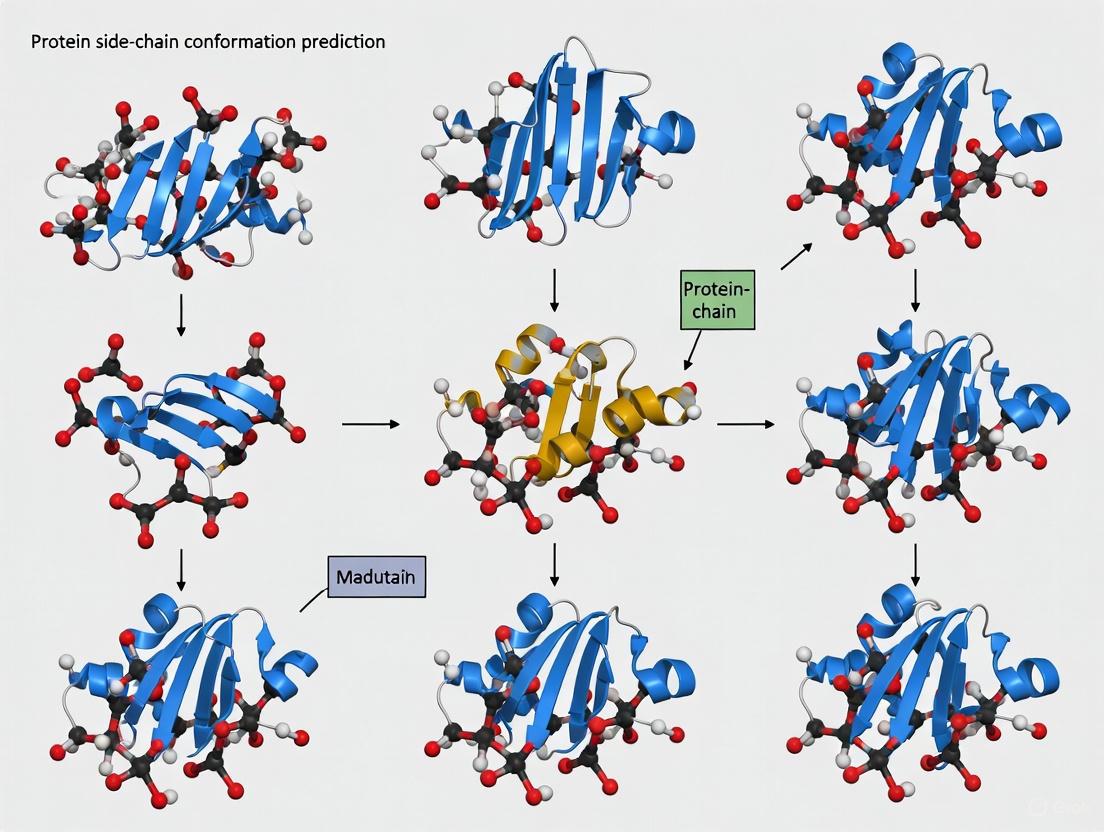
Accurate prediction of protein side-chain conformations is a critical challenge in computational structural biology, with profound implications for protein design, docking, and understanding mutation effects.
Protein Side-Chain Conformation Prediction: Methods, Benchmarks, and Applications in Drug Discovery
Abstract
Accurate prediction of protein side-chain conformations is a critical challenge in computational structural biology, with profound implications for protein design, docking, and understanding mutation effects. This article provides a comprehensive analysis for researchers and drug development professionals, exploring the foundational principles of side-chain packing, from rotamer libraries to hard-sphere models. It details the evolution of methodological approaches, including Monte Carlo sampling, dead-end elimination, and modern diffusion models like PackPPI. The review systematically addresses troubleshooting for diverse residue environments and data limitations, while offering a rigorous validation of current methods against benchmarks like CASP. By synthesizing performance across soluble proteins, interfaces, and membrane environments, this resource equips scientists to select appropriate tools for applications in therapeutic design and precision medicine.
The Foundations of Protein Side-Chain Packing: From Rotamers to Structural Biology
The Critical Role of Side-Chain Conformation in Protein Function and Drug Design
Protein side-chain conformations are critically important for understanding the atomic details of biological functions, including catalysis, signaling, and molecular recognition. The precise three-dimensional arrangement of side-chain atoms determines how proteins interact with other molecules, form complexes, and perform their biological roles. Accurate prediction of side-chain conformations is essential for practical applications that require atomic-resolution models, such as rational drug design and protein engineering. Over the past decades, numerous computational methods have been developed to address the protein side-chain packing (PSCP) problem—predicting the 3D configuration of side-chain atoms given the arrangement of backbone atoms. The groundbreaking advances in protein structure prediction by AlphaFold have further accelerated this field, though significant challenges remain in achieving consistent atomic-level accuracy, particularly for alternative conformations and protein-protein interfaces [1] [2].
The side-chain conformation prediction problem is fundamentally important because protein structures determined by experimental methods like NMR spectroscopy often have more precisely defined backbone coordinates than side-chain atoms. Additionally, residues at protein-protein interfaces exhibit different conformations than the same residues in isolation, making accurate side-chain prediction crucial for modeling protein complexes and understanding allosteric regulation. With the increasing application of computational models in drug discovery and protein design, the ability to reliably predict side-chain conformations has become indispensable for advancing structural biology research and therapeutic development [3] [4].
Methodologies for Side-Chain Conformation Prediction
Computational methods for side-chain conformation prediction can be broadly categorized into three classes: rotamer library-based algorithms, probabilistic or machine learning approaches, and deep learning or generative modeling-based methods. Rotamer library-based methods leverage the observation that side-chains tend to adopt discrete sets of conformations known as rotamers. These methods typically formulate side-chain prediction as a combinatorial optimization problem, searching for the rotamer combination that minimizes the global energy of the protein structure. Popular implementations include SCWRL4, Rosetta Packer, and FASPR, which employ different search algorithms and scoring functions to identify optimal side-chain arrangements [3] [1].
More recently, deep learning-based methods have demonstrated promising results by leveraging various neural network architectures. These include DLPacker, which uses a voxelized representation of each residue's local environment with a U-net-style architecture; AttnPacker, an end-to-end SE(3)-equivariant deep graph transformer for direct prediction of side-chain coordinates; and diffusion-based approaches like DiffPack that leverage torsional diffusion models for autoregressive side-chain packing. These methods represent the state of the art in PSCP, achieving impressive accuracy when experimentally resolved backbone coordinates are used as input [1].
Performance Comparison of Prediction Methods
Table 1: Comparison of Side-Chain Prediction Methods and Their Accuracy
| Method | Approach Category | Key Features | Reported χ1 Accuracy | Strengths |
|---|---|---|---|---|
| SCWRL4 | Rotamer-based | Graph theory, dead-end elimination | >80% [3] | Fast, widely used |
| Rosetta Packer | Rotamer-based | Monte Carlo, energy minimization | >80% [3] | High accuracy, physically realistic |
| FASPR | Rotamer-based | Optimized scoring, deterministic search | >80% [3] | Fast, optimized scoring |
| OSCAR | Rotamer-based | Genetic algorithm, simulated annealing | >80% [3] | Flexible rotamer model |
| Sccomp | Rotamer-based | Surface complementarity, solvation | >80% [3] | Chemical similarity scoring |
| AlphaFold2/ColabFold | Deep Learning | Evoformer, attention mechanisms | ~86% χ1, ~52% χ3 [5] | End-to-end structure prediction |
| AlphaFold3 | Deep Learning | Improved architecture | Slightly better than AF2 [5] | Enhanced side-chain accuracy |
| AttnPacker | Deep Learning | Graph transformer, coordinate prediction | Varies by backbone source [1] | Direct coordinate prediction |
| DiffPack | Deep Learning | Torsional diffusion | Varies by backbone source [1] | State-of-the-art accuracy |
Table 2: Side-Chain Prediction Accuracy by Structural Environment
| Structural Environment | Prediction Accuracy | Notes |
|---|---|---|
| Buried residues | Highest accuracy [3] | Restricted conformational space |
| Protein-protein interfaces | Better than surface residues [3] | Despite limited training on complexes |
| Membrane-spanning regions | Better than surface residues [3] | Despite limited training on membrane proteins |
| Surface residues | Lower accuracy [3] | High flexibility and solvent exposure |
Experimental Protocols for Side-Chain Conformation Studies
Protocol 1: Assessment of Side-Chain Prediction Accuracy Using Native Backbones
Purpose: To evaluate the performance of side-chain prediction methods using experimentally determined backbone structures as input.
Materials:
- Experimentally determined protein structures (e.g., from PDB)
- Side-chain prediction software (SCWRL4, Rosetta, etc.)
- Computing resources appropriate for the selected methods
Procedure:
- Dataset Preparation: Select a non-redundant set of protein structures from the PDB. Ensure structures cover diverse protein folds and include various structural environments (buried, surface, interface).
- Backbone Extraction: Prepare input files containing only backbone atoms (N, Cα, C, O) for each protein, removing all side-chain atoms beyond Cβ.
- Method Execution: Run each side-chain prediction method using the backbone-only structures as input. Use default parameters for each method unless specifically testing parameter sensitivity.
- Accuracy Assessment: Compare predicted side-chain conformations with experimental structures using the following metrics:
- χ angle accuracy: Calculate the percentage of χ1, χ2, χ3, and χ4 dihedral angles predicted within specific thresholds (typically 20° or 40° of experimental values)
- Root-mean-square deviation (RMSD) of side-chain heavy atoms
- Rotamer recovery rate: Percentage of residues predicted in the correct rotameric state
Notes: This protocol establishes baseline performance for each method and reveals systematic strengths and weaknesses across different amino acid types and structural environments [3].
Protocol 2: Validation of NMR Side-Chain Conformations via Packing Calculations
Purpose: To independently validate side-chain conformations in NMR-derived structures using computational packing algorithms.
Materials:
- Ensemble of NMR protein structures
- Side-chain packing software (e.g., based on rotamer libraries)
- X-ray crystal structure of the same protein (for validation)
Procedure:
- Backbone Extraction: Extract backbone coordinates from each conformer in the NMR ensemble.
- Side-Chain Prediction: Apply side-chain packing algorithms to predict side-chain conformations compatible with each NMR-derived backbone.
- Comparison: Compare the packing-predicted side-chain conformations with both the NMR models and available X-ray structures.
- Validation Metrics:
- Calculate agreement percentage between packing predictions and NMR models
- Determine how often agreement between NMR and prediction correlates with agreement with X-ray structure
- Identify questionable conformations in NMR models where predictions disagree
Notes: This approach provides independent validation for side-chain conformations in NMR structures, with reported accuracy of ~78% for confirming correct conformations and ~60% for identifying questionable conformations [4].
Protocol 3: Side-Chain Repacking on AlphaFold-Generated Structures
Purpose: To evaluate and improve side-chain conformations on protein structures predicted by AlphaFold.
Materials:
- AlphaFold-predicted protein structures
- Multiple PSCP methods (SCWRL4, Rosetta Packer, AttnPacker, DiffPack, etc.)
- Scripting environment for integrative approach
Procedure:
- Backbone Preparation: Extract backbone coordinates from AlphaFold-predicted structures.
- Confidence Score Extraction: Extract per-residue pLDDT confidence scores from AlphaFold output.
- Multiple Method Repacking: Repack side-chains using various PSCP methods with AlphaFold backbones as input.
- Integrative Refinement: Implement a confidence-aware greedy energy minimization:
- Initialize structure with AlphaFold's output
- Generate variations using different repacking tools
- Iteratively update χ angles using weighted averages based on backbone pLDDT scores
- Accept changes only when they decrease the overall energy (e.g., calculated with REF2015)
- Validation: Compare repacked structures with experimental data when available, or use internal quality metrics.
Notes: This protocol addresses the challenge that traditional PSCP methods often fail to generalize well when using AlphaFold-predicted backbones instead of experimental ones [1].
Table 3: Key Research Reagent Solutions for Side-Chain Conformation Studies
| Resource | Type | Function | Access |
|---|---|---|---|
| SCWRL4 | Software | Rotamer-based side-chain prediction | http://dunbrack.fccc.edu/scwrl4/ |
| Rosetta3 | Software Suite | Monte Carlo side-chain packing with energy minimization | https://www.rosettacommons.org/ |
| FoldX | Software | Side-chain modeling with energy computation | http://foldx.org/ |
| AlphaFold2/ColabFold | Software | End-to-end structure prediction including side-chains | https://github.com/deepmind/alphafold; https://github.com/sokrypton/ColabFold |
| AlphaFold3 | Software | Improved side-chain accuracy | https://alphafoldserver.com/ |
| AttnPacker | Software | Deep learning-based coordinate prediction | https://github.com/ protein-qa/AttnPacker |
| DiffPack | Software | Diffusion-based side-chain packing | https://github.com/ protein-qa/DiffPack |
| Protein Data Bank | Database | Experimental structures for training and validation | https://www.rcsb.org/ |
| Dunbrack Rotamer Library | Database | Backbone-dependent rotamer distributions | http://dunbrack.fccc.edu/bbdep2019/ |
Applications in Drug Design and Protein Engineering
Accurate side-chain conformation prediction enables critical applications in drug discovery and protein design. In structure-based drug design, precise modeling of binding site side-chains allows for more effective virtual screening and rational ligand optimization. Particularly for protein-protein interactions, which often represent challenging drug targets, the ability to predict interface side-chain conformations is essential for designing inhibitors that disrupt these interactions. Side-chain prediction methods have proven valuable for estimating binding affinities and optimizing protein-ligand interactions [3].
In protein engineering, side-chain packing algorithms facilitate the design of proteins with novel functions and modified properties. Examples include designing enzymes with altered substrate specificity, improving protein stability for industrial applications, and creating novel protein-protein interactions for therapeutic purposes. The integration of side-chain prediction with sequence-based models, such as the Potts model, enables exploration of the relationship between mutations, cooperative structural changes, and fitness, providing powerful tools for protein design [5].
Recent advances have demonstrated that integration of sequence-based Potts models with AlphaFold creates a pipeline for exploring the structural consequences of cooperative mutations on side-chain rearrangements. This approach enables large-scale mutational scans to identify strongly cooperative mutational pairs and predict their structural signatures on interacting side-chains, opening new possibilities for understanding sequence-structure-function relationships [5].
Signaling Pathways and Workflow Diagrams
Diagram 1: Relationship between side-chain conformation and protein function. This workflow illustrates how sequence information leads to backbone and side-chain conformation prediction, ultimately enabling applications in drug design and protein engineering.
Diagram 2: Experimental workflow for side-chain conformation prediction studies. This diagram outlines the key steps in predicting and validating protein side-chain conformations using different methodological approaches.
Side-chain conformation prediction remains an active and evolving field despite decades of research. The development of AlphaFold and related deep learning methods has dramatically improved our ability to predict protein structures, but challenges in consistently achieving atomic-level accuracy for side-chains persist. Current methods perform well across diverse structural environments, including buried residues, protein interfaces, and membrane-spanning regions, often exceeding expectations given their training primarily on monomeric soluble proteins [3].
The emerging integration of physical principles with evolutionary information in methods like AlphaFold represents a promising direction. Additionally, the development of specialized approaches for predicting alternative conformations, such as Cfold, expands the applicability of these tools for understanding protein dynamics and allosteric mechanisms. As these methods continue to improve, their impact on drug discovery, protein design, and structural biology will undoubtedly grow, enabling more precise manipulation of protein function and more effective therapeutic development [6].
Future advances will likely focus on improving accuracy for surface residues, which currently show lower prediction accuracy due to their flexibility and solvent exposure, and developing better methods for predicting the side-chain conformations of protein complexes. The incorporation of explicit physical constraints with learned statistical potentials may further enhance prediction reliability, particularly for novel protein folds and engineered proteins not represented in training datasets. As these computational methods mature, they will increasingly become standard tools in structural biology and drug discovery research.
In the intricate field of protein structural biology, rotamer libraries serve as fundamental tools for classifying and predicting the conformations of amino acid side-chains. The term "rotamer" originates from "rotational isomer," describing the discrete, low-energy conformations that side-chains adopt based on rotations around their torsional (χ) angles [7]. These libraries systematically catalog the frequencies, mean dihedral angles, and standard deviations of these conformations, providing a critical foundation for computational methods in protein structure prediction, homology modeling, and protein design [8]. The development of rotamer libraries represents a pivotal advancement in addressing the combinatorial complexity of side-chain packing, as they effectively reduce the vast conformational space to a manageable set of statistically probable states observed in experimental structures or sampled through molecular dynamics simulations [7] [9].
The evolution of rotamer libraries has progressed from backbone-independent collections to more sophisticated backbone-dependent libraries that account for the profound influence of local main-chain conformation on side-chain rotamer preferences [8]. This backbone dependency arises primarily from steric repulsions between backbone atoms, whose positions are determined by the φ and ψ dihedral angles of the Ramachandran map, and the side-chain γ heavy atoms (e.g., CG, OG, SG) [8]. These steric interactions create predictable patterns where certain rotamers become energetically unfavorable at specific backbone conformations, leading to the observed backbone dependence of rotamer populations [8]. The implementation of backbone-dependent rotamer libraries has significantly enhanced the accuracy and efficiency of side-chain prediction algorithms, establishing them as an indispensable component in the computational structural biologist's toolkit [9] [8].
Backbone-Dependent Rotamer Libraries: Core Principles and Development
Historical Development and Theoretical Foundation
The conceptual foundation for backbone-dependent rotamer libraries was established in 1993 when Roland Dunbrack developed the first comprehensive library to assist in predicting side-chain Cartesian coordinates given experimentally determined or predicted main-chain coordinates [8]. This pioneering library was derived from statistical analysis of 132 high-resolution protein structures from the Protein Data Bank, organizing the counts and frequencies of χ1 or χ1+χ2 rotamers for 18 amino acids (excluding glycine and alanine) across 20° × 20° bins of the Ramachandran map [8]. The theoretical underpinning of this approach recognizes that side-chain conformations are not independent of their structural context but are significantly constrained by the local backbone geometry through quantum mechanical and steric effects [9] [8].
A substantial advancement came in 1997 when Dunbrack and Cohen introduced a Bayesian statistical framework for rotamer library construction, enabling more robust probability estimates by incorporating a prior distribution that assumed independent effects of φ and ψ dihedral angles [8]. This Bayesian approach utilized a periodic kernel with 180° periodicity, similar to a von Mises distribution, to smoothly account for side-chain observations across bin boundaries [8]. Further refinement occurred in 2011 with the development of a smoothed backbone-dependent rotamer library employing kernel density estimates and kernel regressions with von Mises distribution kernels, creating continuous probability functions with smooth derivatives essential for mathematical optimization algorithms used in protein design [8]. This evolution from discrete binning to continuous probability distributions represents the increasing sophistication in modeling the complex relationship between backbone conformation and side-chain rotamer preferences.
Molecular Basis of Backbone Dependence
The fundamental mechanism underlying backbone-dependent rotamer preferences stems from steric repulsions between backbone atoms and side-chain heavy atoms. These interactions occur in predictable combinations dependent on the dihedral angles connecting the backbone to the side-chain atoms [8]. Specifically, steric clashes arise when the connecting dihedral angles form specific pairs of values ({-60°,+60°} or {+60°,-60°}) due to a phenomenon related to pentane interference [8].
Table: Backbone-Dependent Steric Interactions for χ1 Rotamers
| Rotamer | N(i+1) Interaction | O(i) Interaction | C(i-1) Interaction | HBond to NH(i) Interaction |
|---|---|---|---|---|
| g+ | ψ = -60° | ψ = +120° | φ = +60° | φ = -120° |
| trans | ψ = 180° | ψ = 0° | - | - |
| g- | - | - | φ = -180° | φ = 0° |
These steric constraints create distinct population patterns observable in Ramachandran plots, where certain rotamers exhibit significantly reduced frequencies at specific φ,ψ combinations [8]. For example, valine exhibits unique behavior among amino acids due to its two γ heavy atoms (CG1 and CG2), which simultaneously interact with the backbone across different χ1 rotamers. This dual interaction explains why valine predominantly adopts the trans rotamer (χ1~180°) across most backbone conformations, unlike other residues [8]. Understanding these molecular principles enables more accurate prediction of side-chain conformations and informs the development of improved energy functions for protein modeling.
Quantitative Analysis of Rotamer Libraries
The effectiveness of rotamer libraries in computational protein modeling can be quantitatively assessed through various statistical measures and performance metrics. Backbone-dependent rotamer libraries typically provide frequency distributions, mean dihedral angles, and standard deviations for each rotamer across different regions of the Ramachandran map [8]. These statistical parameters enable the calculation of probabilistic energy terms (often formulated as E = -ln(p(rotamer(i) | φ,ψ))) that guide side-chain packing algorithms toward biophysically realistic conformations [8].
Performance benchmarking of side-chain packing methods utilizing different rotamer libraries reveals significant differences in accuracy. Traditional metrics include χ angle accuracy (the percentage of correctly predicted χ angles within a specified tolerance, typically 20°-40°) and root-mean-square deviation (RMSD) of side-chain atomic positions from native structures [10] [11] [9]. Studies have demonstrated that methods employing backbone-dependent rotamer libraries, such as SCWRL, achieve approximately 74% accuracy for χ1 and 60% for χ1+χ2 angles when placing side-chains on their native backbones, approaching the theoretical limits imposed by experimental uncertainty in the underlying structural data [9]. In more challenging homology modeling scenarios where side-chains are placed on non-native backbones, accuracy decreases to approximately 65% for χ1 and 45% for χ1+χ2 angles, yet still represents a significant improvement over backbone-independent approaches [9].
Table: Performance Comparison of Protein Side-Chain Packing Methods
| Method | Approach | χ1 Accuracy (%) | Runtime (Relative) | Key Features |
|---|---|---|---|---|
| SCWRL4 | Rotamer library-based | ~74 | 1x | Backbone-dependent rotamers, graph theory |
| Rosetta Packer | Rotamer library-based | ~76 | 1000x | Monte Carlo minimization, full-atom energy function |
| FASPR | Rotamer library-based | ~75 | 1.5x | Fast search algorithm, optimized scoring |
| AttnPacker | Deep learning | ~79 | 10x | SE(3)-equivariant transformer, no rotamer library |
| DLPacker | Deep learning | ~72 | 100x | Voxelized environment, U-net architecture |
| DiffPack | Deep learning | ~78 | 500x | Torsional diffusion model, generative approach |
Recent large-scale benchmarking in the post-AlphaFold era reveals that while traditional rotamer-based methods perform well with experimental backbone inputs, they often struggle to maintain accuracy when repacking side-chains on AlphaFold-predicted backbone structures [10]. This challenge has prompted the development of hybrid approaches that integrate confidence metrics from AlphaFold (such as pLDDT) with rotamer-based packing algorithms to improve performance on predicted structures [10].
Experimental Protocols for Rotamer Analysis
Protocol 1: Rotamer Dynamics Analysis from MD Simulations
The analysis of rotamer dynamics (RD) from molecular dynamics (MD) simulations provides insights into side-chain conformational flexibility in solution environments, complementing static observations from crystal structures [7]. The following protocol outlines a method for extracting and classifying rotamers from MD trajectories:
Step 1: MD Simulation Setup and Execution
- Perform MD simulations using packages such as AMBER, GROMACS, or CHARMM with appropriate force fields and solvation parameters [7].
- For the example system described in [7], implicit water MD simulations of protein-peptide complexes (e.g., pNGF peptide with TrkA receptor) were conducted using the sander module in AMBER 14 with protonation states optimized for physiological pH (7.4) [7].
Step 2: Trajectory Processing and Frame Extraction
- Convert the trajectory file to PDB format using trajectory processing tools (e.g., cpptraj module in AMBER) [7].
- Extract and save individual frames as separate PDB files to enable sequential analysis of each conformation sampled during the simulation [7].
Step 3: Torsional Angle Calculation
- Calculate torsional angles for each residue across all frames using structural analysis tools (e.g., Bio3D module in R) [7].
- The Bio3D module is particularly efficient as it requires only residue definition rather than manual specification of the four atoms defining each dihedral angle [7].
- Transform the data to organize angle values (columns) by simulation frames (rows) for subsequent analysis [7].
Step 4: Rotamer Classification
- Classify the calculated torsional angles into specific rotamers using a reference library (e.g., the penultimate rotamer library) [7].
- Implement classification rules using conditional (if/else) statements based on the angular ranges defined in the rotamer library [7].
- The penultimate rotamer library is particularly suitable for this analysis due to its backbone independence, countable number of rotamers, and simple nomenclature (e.g., ptp rotamer for Methionine indicates p for χ1, t for χ2, and p for χ3) [7].
Step 5: Data Visualization and Interpretation
- Generate graphical representations of rotamer distributions and transitions over the simulation timeframe [7].
- Analyze rotamer-rotamer relationships, correlations with secondary structure elements, and flexibility metrics for functional interpretation [7].
Diagram 1: Workflow for rotamer dynamics analysis from MD simulations illustrating the five major protocol steps and required resources.
Protocol 2: Side-Chain Prediction with SCWRL for Homology Modeling
SCWRL (Side-Chains With a Rotamer Library) employs a backbone-dependent rotamer library to efficiently predict side-chain conformations in homology modeling [9]. The algorithm operates through the following methodological steps:
Step 1: Input Structure Preparation
- Obtain main-chain atom coordinates (N, Cα, C, O) from an experimentally determined structure or homology model [9].
- For homology modeling, ensure proper alignment between target sequence and template structure [9].
Step 2: Initial Rotamer Placement
- Assign the most probable rotamer from a backbone-dependent rotamer library to each residue position based on its local φ and ψ angles [9].
- Use the Dunbrack backbone-dependent rotamer library, which provides rotamer probabilities conditional on backbone conformation [9] [8].
Step 3: Steric Clash Detection
- Identify steric clashes between initially placed side-chains using a modified van der Waals energy function [9].
- Define clashes based on atomic overlap beyond tolerated distances [9].
Step 4: Combinatorial Search for Clash Resolution
- For residues involved in steric clashes, perform a combinatorial search through alternative rotamer assignments [9].
- Search order is prioritized by rotamer probabilities from the library and the severity of steric interactions [9].
- Implement efficient pruning strategies to reduce the combinatorial complexity of the search space [9].
Step 5: Final Model Output
- Output the final model with optimized side-chain conformations in standard PDB format [9].
- Validation metrics may include calculation of χ angle accuracies and RMSD when native structures are available for comparison [9].
Diagram 2: SCWRL algorithm workflow for side-chain prediction showing the sequential process from input preparation to final model generation.
Table: Essential Resources for Rotamer Library Research and Application
| Resource Name | Type | Function/Application | Availability |
|---|---|---|---|
| Dunbrack Rotamer Library | Backbone-dependent rotamer library | Provides probabilities and mean angles for side-chain conformations dependent on backbone φ,ψ angles | http://dunbrack.fccc.edu/rotlib/ |
| Penultimate Rotamer Library | Backbone-independent rotamer library | Classification of rotamers with simple nomenclature; useful for MD analysis | Richardson Lab (Duke University) |
| SCWRL4 | Software tool | Fast side-chain prediction using graph theory and backbone-dependent rotamers | http://dunbrack.fccc.edu/scwrl/ |
| Rosetta/PyRosetta | Software suite | Protein structure prediction and design with Monte Carlo rotamer packing | https://www.rosettacommons.org/ |
| AttnPacker | Deep learning tool | SE(3)-equivariant transformer for side-chain packing without discrete rotamer sampling | https://github.com/ protein-qa/AttnPacker |
| AMBER with cpptraj | MD software and analysis | MD simulations and trajectory processing for rotamer dynamics studies | https://ambermd.org/ |
| Bio3D (R package) | Analysis tool | Extraction of torsional angles from protein structures for rotamer classification | https://cran.r-project.org/package=bio3d |
| Dynameomics Library | MD-derived rotamer library | Rotamer distributions from molecular dynamics simulations | Daggett Lab (University of Washington) |
Advanced Applications and Future Directions
Emerging Deep Learning Approaches
The field of protein side-chain packing is undergoing a significant transformation with the emergence of deep learning methods that challenge traditional rotamer-based approaches. Methods such as AttnPacker employ SE(3)-equivariant transformer architectures to directly predict side-chain coordinates without delegating to discrete rotamer libraries or performing expensive conformational sampling [11]. These approaches demonstrate several advantages, including significantly improved computational efficiency (over 100× faster than some traditional methods), reduced steric clashes, and enhanced accuracy on both native and non-native backbone structures [11]. Unlike rotamer-based methods that select from predefined conformations, deep learning approaches can explore a continuous conformational space, potentially capturing novel side-chain arrangements beyond those cataloged in existing libraries [10] [11].
Other innovative deep learning architectures include DiffPack, which leverages torsional diffusion models for autoregressive side-chain packing, and FlowPacker, which employs torsional flow matching with continuous normalizing flow models [10]. These generative approaches represent the cutting edge of side-chain conformation prediction, achieving impressive accuracy when experimental backbone coordinates are used as input [10]. However, benchmarking studies reveal that these methods, like their traditional counterparts, face challenges in maintaining accuracy when processing AlphaFold-predicted backbone structures rather than experimental ones [10]. This limitation highlights the ongoing need for improved methods that can effectively leverage predicted protein structures from tools like AlphaFold2 and AlphaFold3.
Continuous Rotamers in Protein Design
The concept of continuous rotamers represents another significant advancement beyond traditional discrete rotamer libraries. Rather than representing each side-chain conformation as a single discrete state, continuous rotamer models allow side-chains to explore the continuous conformational space around low-energy regions [12]. This approach addresses a fundamental limitation of rigid rotamer models: the inability to account for small conformational adjustments that can resolve steric clashes and optimize packing interactions without completely changing rotameric state [12].
Research has demonstrated that protein design using continuous rotamers produces sequences that are more similar to native sequences and have lower energies compared to those obtained through rigid rotamer models [12]. Importantly, simply increasing the sampling of discrete rotamers within the continuous space does not provide a practical alternative to true continuous rotamer models, as computationally feasible sampling densities consistently yield higher energies than continuous approaches [12]. Algorithms such as iMinDEE (improved Minimized Dead-End Elimination) have been developed to make continuous rotamer search feasible for larger systems, providing guarantees of finding the optimal solution while maintaining computational efficiency comparable to discrete DEE algorithms [12]. These advances in continuous rotamer methods highlight the importance of modeling realistic protein flexibility in computational design, with significant implications for applications in enzyme design, drug discovery, and protein therapeutics.
Challenges in the Post-AlphaFold Era
Despite remarkable progress in protein structure prediction through AlphaFold, significant challenges remain for rotamer-based methods in the post-AlphaFold era. Large-scale benchmarking reveals that traditional protein side-chain packing methods perform well with experimental backbone inputs but struggle to generalize when repacking side-chains on AlphaFold-generated structures [10]. This performance gap persists even when integrating AlphaFold's self-assessment confidence scores (pLDDT) into the packing process [10]. While confidence-aware integrative approaches can yield modest improvements over AlphaFold's native side-chain predictions, these gains are often statistically insignificant and lack consistency across different targets [10].
These limitations underscore the need for next-generation side-chain packing methods specifically optimized for predicted backbone structures rather than experimental ones. Future directions may include the development of end-to-end deep learning approaches that jointly predict backbone and side-chain conformations, hybrid methods that combine physical principles with learned statistical preferences, and rotamer libraries specifically derived from AlphaFold-predicted structures to capture any systematic biases in these models. As the structural coverage of the protein universe expands through computational prediction rather than experimental determination, the evolution of rotamer libraries and side-chain packing methods will continue to play a crucial role in translating these structural models into biologically meaningful insights for drug development and protein engineering.
Protein function is intimately tied to the three-dimensional arrangement of its structure, with side-chain conformations playing a critical role in molecular interactions, binding specificity, and catalytic activity [13] [14]. While the protein backbone provides the structural framework, the side chains confer functional diversity through their chemical properties and spatial arrangements. Understanding side-chain conformational diversity is therefore essential for research in protein engineering, drug discovery, and structural biology.
Traditional structural biology often depicts proteins as static entities, yet in reality, side chains exhibit significant dynamic behavior [13]. This article systematizes side-chain conformations into four distinct categories—fixed, discrete, cloud, and flexible—based on extensive analysis of experimental data from X-ray crystallography and cryo-EM studies. This classification provides researchers with a framework for interpreting structural data, predicting functional mechanisms, and designing experiments that account for protein dynamics.
The accurate prediction of these conformational states remains a formidable challenge in computational structural biology. While advances in deep learning, such as AlphaFold2, have revolutionized protein structure prediction, limitations persist in capturing the full spectrum of side-chain dynamics, particularly for alternative conformations [15] [6] [16]. This article details experimental protocols for characterizing side-chain conformations and discusses their implications for structure-based drug design.
Classification of Side-Chain Conformations
Based on comprehensive analysis of electron density maps and structural variability in the Protein Data Bank, side-chain conformations can be systematically categorized into four distinct types [13]. Each type represents a different mode of structural flexibility with implications for protein function and molecular recognition.
Fixed Conformations
Fixed conformations represent side chains constrained to a single, well-defined spatial arrangement. These residues are typically buried within the protein core or tightly involved in specific structural motifs, where their movements are restricted by extensive packing interactions with neighboring atoms [17] [13].
Characteristics:
- Electron density maps show clear, continuous density for all side-chain atoms
- No significant alternative locations observed in crystallographic data
- Low B-factors (temperature factors) indicating minimal vibrational motion
- Typically found in hydrophobic cores or specific binding sites where precise positioning is functionally critical
Functional significance: Fixed side chains often contribute to protein stability through hydrophobic interactions or serve as critical components in catalytic sites where precise geometry is essential for function. Their constrained nature makes them highly predictable in structure modeling approaches.
Discrete Conformations
Discrete conformations occur when a side chain adopts two or more distinct, well-defined spatial arrangements. These alternative states are often stabilized by different molecular environments or represent intermediate states in functional mechanisms [13].
Characteristics:
- Electron density maps reveal separate, distinct densities for the same side chain
- Documented as alternate locations (e.g., 'A' and 'B') in PDB files with specific occupancy values
- Each discrete state has clear electron density support
- Transitions between states may occur in response to ligand binding or environmental changes
Functional significance: Discrete conformations are frequently observed in proteins with allosteric regulation, enzyme active sites with multiple substrate specificities, and molecular switches. They enable proteins to adopt different functional states without major backbone rearrangements.
Cloud Conformations
Cloud conformations describe side chains that occupy a continuous region of space rather than discrete positions. The electron density suggests a dynamic equilibrium between multiple similar states or a single state with substantial spatial fluctuation [13].
Characteristics:
- Electron density maps show broad, continuous regions of density covering more area than a single atom would occupy
- Often represented as a single conformational model with elevated B-factors
- Occupancy values may sum to 1.0 but represent an average across multiple similar states
- More common in longer side chains with multiple rotatable bonds
Functional significance: Cloud conformations provide a mechanism for entropy-driven processes and enable structural adaptability in molecular recognition. They may serve as intermediate states in conformational selection mechanisms or facilitate binding to multiple partners with slightly different geometries.
Flexible Conformations
Flexible conformations represent side chains with high mobility that cannot be precisely determined from experimental electron density maps. These residues lack clear electron density for some or all of their side-chain atoms, indicating either dynamic disorder or multiple highly divergent conformations [13].
Characteristics:
- Incomplete or absent electron density for side-chain atoms even at moderate resolutions
- High B-factors indicating significant thermal motion
- Often found in surface-exposed regions or flexible loops
- May represent genuinely disordered states that only become ordered upon binding
Functional significance: Flexible side chains are common in protein-protein interaction interfaces, ligand-binding sites that accommodate multiple substrates, and intrinsically disordered regions. Their conformational entropy can contribute significantly to binding thermodynamics and specificity.
Table 1: Characteristics of the Four Side-Chain Conformation Types
| Conformation Type | Electron Density Pattern | B-Factor Range | Structural Context | Predictability |
|---|---|---|---|---|
| Fixed | Clear, continuous density for all atoms | Low | Buried cores, active sites | High |
| Discrete | Separate distinct densities | Variable between states | Allosteric sites, molecular switches | Moderate |
| Cloud | Broad, continuous density | Moderate to high | Surface regions, binding interfaces | Low to moderate |
| Flexible | Weak or absent density | High | Surface loops, disordered regions | Low |
Quantitative Analysis of Conformational Variations
Systematic analysis of protein structures reveals distinct patterns in side-chain conformational variability across different environments and residue types. Understanding these quantitative relationships is essential for accurate interpretation of structural data and improvement of prediction algorithms.
Environmental Influence on Conformational Flexibility
The protein environment significantly influences side-chain conformational preferences. Statistical analyses demonstrate that 71% of protein complexes exhibit Cα RMSD < 2Å between bound and unbound forms, indicating that side-chain rearrangements often dominate binding-induced conformational changes [17]. Core residues demonstrate significantly smaller conformational changes compared to surface residues, with the average root-square deviation of dihedral angles (RSD) for interface residues increasing from 40.5° for residues with one dihedral angle to 135.0° for residues with four dihedral angles [17].
Solvent accessibility strongly correlates with conformational flexibility. Quantitative studies show that approximately 72% of surface residues have reliable side-chain atom coordinates in high-resolution structures, compared to over 90% of core residues [13]. This environmental influence extends to binding interfaces, where conformational changes upon complex formation increase both polar and nonpolar surface areas, with a disproportionately larger increase in nonpolar area across all classes of protein complexes [17].
Residue-Specific Conformational Propensities
Different amino acids exhibit distinct tendencies for conformational variability based on their chemical properties and side-chain topology:
Long side chains (e.g., Arg, Lys, Glu) with three or more dihedral angles frequently undergo large conformational transitions (~120° χ angle changes) and are more likely to adopt discrete or cloud conformations [17]. These residues account for the majority of significant conformational changes observed in protein-protein associations.
Short side chains (e.g., Val, Ile, Phe) with one or two dihedral angles typically undergo local readjustments (~40° RSD) rather than full rotamer transitions [17]. These residues more commonly adopt fixed conformations, particularly when buried.
Aromatic and charged residues (Phe, Tyr, Asp, Glu) show distinct patterns where the χ angle closest to the backbone often changes most significantly, contrary to the general trend where the most distant dihedral angle shows largest changes [17].
Table 2: Side-Chain Conformational Statistics by Residue Type
| Residue Type | Average RSD (°) | Preferred Conformation Types | Interface Propensity |
|---|---|---|---|
| Arginine (Arg) | 135.0° | Discrete, Cloud | High |
| Lysine (Lys) | 135.0° | Discrete, Cloud | High |
| Methionine (Met) | 135.0° | Cloud, Flexible | Moderate |
| Glutamate (Glu) | 111.3° | Discrete, Cloud | High |
| Aspartate (Asp) | 55.1° | Fixed, Discrete | High |
| Phenylalanine (Phe) | 40.5° | Fixed, Discrete | High |
| Valine (Val) | 40.5° | Fixed | Moderate |
| Cysteine (Cys) | 40.5° | Fixed | Low |
Experimental Protocols for Conformational Analysis
Electron Density Map Analysis Protocol
Purpose: To classify side-chain conformations based on experimental electron density maps from X-ray crystallography.
Materials:
- High-resolution crystal structure (≤2.5Å recommended)
- Structure factors file (.mtz format)
- Molecular graphics software (Coot, PyMOL, or Chimera)
- Electron density visualization tools
Procedure:
- Load the refined structural model and corresponding electron density map (2mFo-DFc map) into molecular graphics software
- Set the electron density contour level to 1.0σ for initial assessment
- Systematically examine each residue, adjusting contour levels to detect weak density (0.5-0.7σ)
- Classify side chains according to the following electron density characteristics:
- Fixed: Continuous density for all atoms at 1.0σ with no significant disconnected density
- Discrete: Separate distinct densities for the same side chain, often with assigned alternate locations
- Cloud: Broad, continuous density covering more space than individual atoms would occupy
- Flexible: Incomplete or absent density for some side-chain atoms at 0.5σ
- Record occupancy values for residues with alternate locations
- Calculate electron density values for each atom using map statistics
- Correlate conformational classifications with B-factors and solvent accessibility
Interpretation: Residues with reliable electron density (>1σ in 2mFo-DFc map) for all side-chain atoms can be confidently modeled. Atoms with density <1σ indicate flexibility or disorder. Approximately 81.6% of residues in high-resolution structures show reliable density for all atoms [13].
Conformational Variability Assessment Protocol
Purpose: To quantify side-chain conformational variations across multiple structures of the same protein.
Materials:
- Multiple crystal structures of the same protein (same or different conditions)
- Structure alignment software (PyMOL, Chimera, or custom scripts)
- Dihedral angle calculation tools
- Rotamer library reference
Procedure:
- Collect multiple structures of the same protein from the PDB
- Align structures using backbone Cα atoms to minimize RMSD
- Calculate side-chain dihedral angles (χ1, χ2, χ3, χ4) for each residue in all structures
- Identify residues with significant dihedral angle variations (>40° for χ1, >60° for later χ angles)
- Calculate root-square deviation (RSD) of dihedral angles for variable residues:
[ RSD = \sqrt{\frac{1}{N}\sum{i=1}^{N}(\chi{i,bound} - \chi_{i,unbound})^2} ]
- Correlate conformational changes with structural context (interface vs. core, ligand binding, etc.)
- Classify variable residues into discrete, cloud, or flexible categories based on the pattern of variation
Interpretation: Residues showing consistent dihedral angles across structures suggest fixed conformations. Those with discrete clusters of angles indicate discrete conformations, while continuous distributions suggest cloud conformations. On average, interface residues show RSD values of 40.5-135.0° depending on side-chain length [17].
Figure 1: Experimental workflow for side-chain conformation classification
Computational Prediction of Side-Chain Conformations
AI-Based Structure Prediction Accuracy
Recent advances in deep learning have revolutionized protein structure prediction, yet significant challenges remain in accurately predicting side-chain conformations. AlphaFold2 and its implementations such as ColabFold achieve varying accuracy across different dihedral angles [15]:
- χ1 angles: ~14% prediction error on average
- χ3 angles: Error increases to ~48% on average
- χ4 angles: Highest error rates due to increased flexibility
Non-polar side chains demonstrate higher prediction accuracy than polar residues, and the use of structural templates improves χ1 prediction by approximately 31% on average [15]. However, these methods exhibit bias toward the most prevalent rotamer states in the PDB, limiting their ability to capture rare conformations effectively.
Alternative Conformation Prediction Methods
Novel approaches specifically target the prediction of alternative side-chain conformations:
Cfold: This AlphaFold2-derived network trained on conformationally split PDB data successfully predicts over 50% of experimentally known nonredundant alternative conformations with high accuracy (TM-score > 0.8) [6]. Two primary sampling strategies enable this capability:
- MSA Clustering: Sampling different subsets of the multiple sequence alignment to generate diverse coevolutionary representations
- Dropout: Using dropout at inference time to exclude different information randomly from each prediction
Deep Generative Models (DGMs): Variational autoencoders, generative adversarial networks, and diffusion models learn parametric models of the equilibrium distribution of protein conformations, enabling rapid generation of diverse structural samples [18]. These approaches effectively explore conformational landscapes that are prohibitively expensive to access with conventional molecular dynamics simulations.
Table 3: Computational Methods for Side-Chain Conformation Prediction
| Method | Strengths | Limitations | Best Application Context |
|---|---|---|---|
| AlphaFold2/ColabFold | High overall accuracy, fast prediction | Bias toward common rotamers, limited alternative conformations | Single-state prediction of stable structures |
| Cfold | Specialized for alternative conformations, uses conformational splits | Requires specific training, limited to seen conformation types | Proteins with known multiple states |
| Deep Generative Models | Samples full conformational landscape, physics-informed | Computationally intensive, training data requirements | Exploring conformational diversity, flexible regions |
| Molecular Dynamics | Physically realistic dynamics, environmental effects | Extremely computationally expensive, limited timescales | Detailed mechanistic studies of specific systems |
Figure 2: Computational workflow for predicting side-chain conformations
Research Reagent Solutions
Table 4: Essential Research Reagents and Tools for Side-Chain Conformational Studies
| Reagent/Tool | Function | Application Context | Key Features |
|---|---|---|---|
| High-resolution Crystal Structures | Experimental reference for conformation classification | All conformational studies | Provides electron density maps, B-factors, occupancy data |
| AlphaFold2/ColabFold | AI-based structure prediction | Initial structure modeling, single-state prediction | Fast prediction, high accuracy for common conformations |
| Cfold | Alternative conformation prediction | Proteins with known multiple states | Specialized for conformational diversity, uses structural partitions |
| Molecular Dynamics Software | Sampling conformational landscape | Detailed dynamics studies, flexible regions | Physically realistic simulation, environmental effects |
| Rotamer Libraries | Reference for preferred side-chain conformations | Structure validation, prediction | Statistics-based probabilities, backbone-dependent preferences |
| Cryo-EM Structures | Alternative to crystallography for conformation analysis | Large complexes, flexible proteins | Captures near-native states, different conformational preferences |
Applications in Drug Discovery
Understanding side-chain conformational diversity has profound implications for structure-based drug design. Each conformation type presents distinct challenges and opportunities for therapeutic development:
Fixed conformations provide well-defined targets for drug design, enabling precise optimization of complementary interactions. These residues are ideal for anchoring specific interactions in binding pockets.
Discrete conformations require consideration of multiple binding modes or the design of conformation-selective compounds that stabilize specific functional states. Allosteric modulators often target residues with discrete conformations to lock proteins in active or inactive states.
Cloud conformations present challenges for traditional structure-based design but offer opportunities for designing compounds that exploit conformational entropy or induce conformational selection.
Flexible conformations in binding sites may necessitate dynamic docking approaches or the design of compounds that can accommodate structural heterogeneity.
Recent studies indicate that incorporating conformational diversity into drug discovery pipelines improves success rates, particularly for targets with known conformational heterogeneity. Experimental protocols for classifying side-chain conformations enable researchers to identify critical flexible residues that contribute to binding and specificity.
The classification of side-chain conformations into fixed, discrete, cloud, and flexible categories provides a valuable framework for understanding protein function and guiding structure-based drug design. Experimental protocols for conformational analysis enable researchers to accurately characterize these states, while computational methods continue to advance in their ability to predict conformational diversity.
As structural biology continues to recognize the importance of protein dynamics, accounting for side-chain conformational heterogeneity will become increasingly critical for explaining biological mechanisms and designing effective therapeutics. The integration of experimental data with improved computational sampling techniques promises to enhance our ability to predict and exploit the full conformational landscape of protein side chains in pharmaceutical applications.
Within the field of computational structural biology, the prediction of protein side-chain conformations is a critical task for applications ranging from protein design and docking to understanding the effects of mutations [3] [13]. Despite decades of research, two fundamental challenges persistently limit prediction accuracy: the combinatorial explosion of possible conformations and the limitations of current energy functions to accurately score them [3] [19]. This Application Note dissects these core challenges, provides quantitative data on their impact, and outlines detailed protocols for researchers to benchmark and improve their side-chain prediction methodologies, particularly for difficult cases like surface residues.
The Combinatorial Problem in Side-Chain Packing
Nature of the Problem
The combinatorial problem arises because each amino acid side-chain can adopt multiple low-energy conformations known as rotamers [3]. The task of selecting the optimal rotamer for every residue in a protein, such that the overall energy is minimized and no atomic clashes occur, becomes a problem of immense scale. The total number of possible combinations grows exponentially with the number of residues. For a protein with N residues, each having an average of R rotamers, the total conformational space to search is on the order of RN. This makes an exhaustive search computationally intractable for all but the smallest proteins [3].
Algorithmic Strategies and Their Limitations
To tackle this, developers have employed a range of optimization algorithms. Table 1 summarizes the primary strategies used by various prediction methods.
Table 1: Search Algorithms in Side-Chain Prediction Methods
| Method | Primary Search Algorithm | Key Features and Limitations |
|---|---|---|
| SCWRL4 [3] | Graph Decomposition & Dead-End Elimination (DEE) | Represents residue interactions as a graph; uses DEE to prune rotamers that cannot be part of the global minimum energy conformation. Efficient for many proteins but can struggle with highly connected networks. |
| Rosetta-fixbb [3] | Monte Carlo (MC) | Initializes multiple runs with random structures; uses MC sampling to find low-energy states. Can escape local minima but offers no guarantee of finding the global minimum. |
| OSCAR [3] | Genetic Algorithm & Simulated Annealing | Uses a population of structures, applies crossover and mutation operations. Good for exploring diverse regions of conformational space, but computationally intensive. |
| Sccomp-I [3] | Iterative Greedy Optimization | Builds side-chains sequentially in order of neighbor count. Fast but highly sensitive to the initial build order, leading to suboptimal solutions. |
| Sccomp-S [3] | Stochastic (Boltzmann) Sampling | Chooses rotamers based on a Boltzmann distribution. Better at modeling conformational diversity but may not converge to the single lowest-energy state. |
| RASP [3] | Hybrid (DEE + Branch-and-Terminate/MC) | Applies DEE first to reduce search space, then solves remaining problem with exact or stochastic methods. Balances efficiency and thoroughness. |
The following diagram illustrates the typical decision workflow and algorithmic strategies employed to manage the combinatorial complexity of side-chain packing.
Figure 1: Algorithmic strategies to solve the combinatorial problem in side-chain prediction. DEE, Graph Decomposition, Monte Carlo, Genetic Algorithms, and Iterative methods are used to navigate the vast conformational space.
Limitations of Energy Functions
Components of Energy Functions
Even with a perfect search algorithm, prediction accuracy is ultimately limited by the quality of the energy function used to score conformations. Most force fields are a weighted sum of several terms, which typically include [3] [19]:
- Van der Waals forces: Attractive and repulsive atomic interactions.
- Hydrogen bonding: Directional interactions critical for polar residues.
- Solvation effects: Models for interactions with the solvent environment.
- Electrostatics: Interactions between charged groups.
- Torsional potentials: Preferences for certain dihedral angles based on rotamer libraries.
A significant challenge is that these energy terms are often inexact and poorly balanced. For instance, inaccuracies in modeling solvation and entropic effects are a major source of error, especially for surface residues which are highly exposed to solvent [19].
The Entropy Challenge and the Colony Energy Solution
Surface side-chains are more flexible and have higher conformational entropy than buried residues. Traditional energy functions that focus solely on enthalpy (e.g., van der Waals and hydrogen bonding) fail to capture this entropy, leading to poor prediction accuracy for surface residues [19].
The colony energy approach is a phenomenological method developed to address this limitation by approximating entropic effects [19]. It favors rotamers located in densely populated, low-energy regions of conformational space, effectively smoothing the potential energy landscape. The colony energy Gi for a rotamer i is calculated as:
Gi = -RT * ln[ Σj exp( -Ej/(RT) - β(RMSDij/RMSDavg)γ ) ]
where Ej is the conformational energy of rotamer j, the sum is over all rotamers of the residue, and RMSDij is the heavy-atom root-mean-square deviation between rotamers i and j [19]. The use of colony energy has been shown to improve χ1 prediction accuracy for surface side-chains from 65% to 74% [19].
Quantitative Assessment of Prediction Accuracy
The interplay of the combinatorial problem and energy function limitations results in variable prediction accuracy across different residue environments and types. The data in Table 2 and Table 3, compiled from large-scale assessments, quantify these performance disparities.
Table 2: Side-Chain Prediction Accuracy by Structural Environment [3]
| Structural Environment | χ1 Angle Accuracy (≈ within 40°) | Key Challenges |
|---|---|---|
| Buried | Highest (~90% for χ1 in high-pLDDT AF2 models [15]) | Fewer rotamers, high packing density. Steric clashes are the primary concern. |
| Protein Interface | Better than surface residues | Geometry is constrained by partner protein, simplifying the problem. |
| Membrane-Spanning | Better than surface residues | Lipid bilayer imposes constraints on side-chain orientations. |
| Surface | Lowest (e.g., 73-82% for χ1 [19]) | High flexibility, solvent interactions, and inaccurate entropy modeling. |
Table 3: Side-Chain Prediction Error by Dihedral Angle and Residue Type (Example Data from ColabFold) [15]
| Amino Acid | χ1 Error (%) | χ2 Error (%) | χ3 Error (%) | Notes |
|---|---|---|---|---|
| All Residues | ~14-17% (with/without templates) | N/A | ~47-50% (with/without templates) | Accuracy decreases for higher χ angles [15]. |
| Non-polar | Lower error | N/A | N/A | Easier to predict due to dominant van der Waals interactions. |
| Polar (General) | Higher error | N/A | N/A | Difficult due to hydrogen bonding and solvent interactions. |
| Polar (H-bonded) | 79% Accuracy [19] | N/A | N/A | Defined H-bond partners greatly improve prediction. |
Experimental Protocols
Protocol 1: Benchmarking Side-Chain Prediction Methods
Objective: To quantitatively evaluate and compare the performance of different side-chain prediction methods on a set of high-resolution protein structures.
Materials:
- Software: SCWRL4, Rosetta-fixbb, FoldX, OSCAR, or other methods [3].
- Dataset: A curated non-redundant set of high-resolution (<2.0 Å) crystal structures from the PDB. The set should include monomeric, multimeric, and membrane proteins to test generality [3] [20].
- Computing Environment: Linux-based high-performance computing cluster.
Procedure:
- Dataset Preparation:
- Download your selected PDB structures.
- Remove all heteroatoms (water, ions, ligands) and alternate conformations to create a clean input structure.
- Generate the "native" backbone structure by stripping all side-chains beyond Cβ.
Run Predictions:
- For each method and each protein, input the native backbone and predict the side-chain conformations.
- Use each software's default parameters unless specifically testing parameter sensitivity.
Accuracy Calculation:
- Compare the predicted structure to the original experimental structure.
- For each residue, calculate the root-mean-square deviation (RMSD) of heavy side-chain atoms and the deviation of dihedral angles (χ1, χ2, etc.).
- A χ angle is typically considered correctly predicted if it is within 40° of the experimental value [15] [19].
- Calculate the percentage of correctly predicted χ angles (% within 40°) for the entire protein and for subgroups: buried vs. surface, by amino acid type, etc. [3] [19].
Analysis:
- Use the data to create tables like Table 2 and Table 3 above.
- Identify which methods perform best for specific environments (e.g., surfaces, interfaces).
Protocol 2: Assessing Energy Function Components with In Silico Mutagenesis
Objective: To probe the limitations of an energy function by measuring its ability to predict the stability changes caused by point mutations (ΔΔG).
Materials:
- Software: A method with a customizable energy function, such as FoldX [3] or Rosetta.
- Dataset: A set of proteins with experimentally measured ΔΔG values upon mutation (e.g., from thermal denaturation studies).
Procedure:
- Structure Preparation:
- Use the wild-type crystal structure. Repair any structural defects (e.g., missing atoms, bad rotamers) using the software's repair function.
Generate Mutants:
- For each mutant in the benchmark set, use the software's mutagenesis function to introduce the mutation and repack the side-chains.
Energy Calculation:
- Calculate the folded state energy for both the wild-type and mutant structures.
- The software will often compute and output the predicted ΔΔG directly.
Validation:
- Plot predicted ΔΔG vs. experimental ΔΔG.
- Calculate the correlation coefficient (Pearson's r) and the root-mean-square error (RMSE). A low correlation or high RMSE highlights inaccuracies in the energy function, such as poor modeling of solvation or electrostatic effects.
The Scientist's Toolkit
Table 4: Essential Research Reagents and Computational Tools
| Item Name | Function/Application | Specifications & Notes |
|---|---|---|
| SCWRL4 [3] | Side-chain prediction for homology modeling and protein design. | Uses graph decomposition and DEE; fast and accurate for core residues. |
| Rosetta-fixbb [3] | High-resolution structure refinement and design. | Uses Monte Carlo sampling with a detailed physical- and knowledge-based energy function. |
| FoldX [3] | Protein engineering & stability prediction (ΔΔG). | Its RepairPDB function is useful for preparing structures for benchmarking. |
| Colony Energy [19] | Improve prediction of surface and flexible residues. | A computational term to approximate side-chain entropy; can be implemented in custom protocols. |
| Dunbrack Rotamer Library [3] | Provides discrete side-chain conformations for prediction. | A backbone-dependent rotamer library used by many methods (e.g., SCWRL4, Rosetta). |
| PDB Structures | Source of "native" conformations for benchmarking. | Use high-resolution (<1.8 Å) structures with clear electron density for reliable ground truth [13]. |
| AlphaFold2/ColabFold [15] [2] | State-of-the-art backbone and side-chain prediction. | Useful for generating starting models; but assess side-chain confidence (pLDDT) critically, as χ accuracy can be low [15]. |
Relationship Between Packing Density, Solvent Accessibility, and Predictability
The accurate prediction of protein side-chain conformations is a critical determinant of success in computational structural biology, impacting applications ranging from protein design to drug development. The predictability of a side-chain's conformation is not uniform across a protein structure but is heavily influenced by its local structural environment. This application note examines the central relationship between two key structural properties—local packing density and solvent accessibility—and their combined influence on the predictability of side-chain conformations. Framed within a broader thesis on protein side-chain conformation prediction methods, this document provides a detailed analysis of this relationship, supported by quantitative data, experimental protocols, and practical guidelines for researchers. Evidence consistently demonstrates that while both factors are important, local packing density, often quantified by metrics such as Weighted Contact Number (WCN), is the dominant structural determinant of side-chain conformational variability and prediction accuracy [21] [22].
The correlation between structural features and predictability has been quantified through various studies. The table below summarizes key findings on how packing density and solvent accessibility influence side-chain conformational predictability.
Table 1: Influence of Packing Density and Solvent Accessibility on Side-Chain Predictability
| Structural Feature | Quantitative Measure | Impact on Predictability | Key Evidence |
|---|---|---|---|
| Local Packing Density (Core Regions) | High Weighted Contact Number (WCN) / Contact Number (CN) | >90% prediction accuracy for core residues in soluble proteins, protein-protein interfaces, and transmembrane proteins [23]. | Core residues are densely packed, restricting side-chains to a limited set of stable rotamers [23]. |
| Solvent Accessibility (Non-Core Regions) | Relative Solvent Accessibility (rSASA) | High predictability (~80% within 30°) is maintained up to rSASA ≈ 0.3 [23]. | Predictability decreases as solvent accessibility increases, but a threshold exists where packing still dominates [23]. |
| Comparative Influence | Correlation with evolutionary rate (a proxy for constraint/predictability) | Local packing density (WCN/CN) is a ~4x stronger determinant of sequence variability than solvent accessibility (RSA) [21]. | Packing density provides a superior explanation for site-specific evolutionary constraints compared to solvent accessibility [21]. |
| Protein-Protein Interfaces | Normalized WCN (zWCN) of unbound subunit interfaces | Central interface residues are more rigid (higher WCN) than non-interface residues; peripheral interface residues are more flexible (lower WCN) [22]. | Interfaces have a distinct dynamic pattern that influences side-chain conformations even before binding [22]. |
Experimental Protocols
Protocol 1: Quantifying Packing Density and Solvent Accessibility
This protocol details the calculation of Weighted Contact Number (WCN) and Relative Solvent Accessibility (rSASA), two fundamental metrics for characterizing a residue's local environment.
- Objective: To compute standardized measures of local packing density and solvent accessibility for each residue in a protein structure.
- Input: A protein structure file in PDB format.
Software Requirements:
Methodology:
- Calculate Weighted Contact Number (WCN):
- For a given residue
i, the WCN is calculated using the formula:w_i = Σ_{j≠i} (1 / r_ij^2)wherer_ijis the distance between the Cα atoms of residueiand residuej[21] [22]. - Summation is typically performed over all other residues
jin the same protein chain. - The resulting WCN value is a residue-specific measure of its local packing density, with higher values indicating a more densely packed environment [22].
- For a given residue
- Calculate Solvent Accessibility:
- Compute the Absolute Solvent Accessibility (ASA) for each residue by rolling a probe of 1.4 Å (representing a water molecule) over the residue's molecular surface [21].
- Calculate the Relative Solvent Accessibility (rSASA) by normalizing the ASA by the maximum solvent accessibility for that specific amino acid type found in an extended Gly-X-Gly tripeptide conformation [22].
rSASA = ASA / ASA_max
- Data Normalization (for cross-protein comparison):
- To compare WCN across proteins of different sizes, normalize the WCN values to z-scores for all surface residues within a single subunit:
z = (w - μ_w) / σ_w, whereμ_wandσ_ware the mean and standard deviation of WCN for that subunit [22].
- To compare WCN across proteins of different sizes, normalize the WCN values to z-scores for all surface residues within a single subunit:
- Calculate Weighted Contact Number (WCN):
Protocol 2: Benchmarking Side-Chain Prediction Accuracy
This protocol outlines a standard procedure for evaluating the performance of side-chain packing (PSCP) methods on experimental and predicted protein structures.
- Objective: To assess the accuracy of a PSCP method in predicting side-chain conformations given a fixed backbone structure.
- Input:
- A set of high-resolution protein crystal structures (e.g., from CASP datasets).
- AlphaFold2/3-predicted structures for the corresponding sequences [10].
Software Requirements:
Methodology:
- Data Preparation:
- Obtain a benchmarking dataset, such as single-chain targets from CASP14 or CASP15, with lengths under 2,000 residues [10].
- For each target, gather the experimental (native) structure and the corresponding AlphaFold-predicted structure.
- Run Side-Chain Packing:
- Using the native backbone as input, run the PSCP method to repack all side-chains. This establishes a baseline performance on ideal inputs.
- Using the AlphaFold-predicted backbone as input, run the same PSCP method to repack the side-chains. This tests the method's robustness to inaccuracies in predicted backbones [10].
- Accuracy Assessment:
- For each residue, calculate the deviation between the predicted dihedral angles (χ₁, χ₂, etc.) and the angles in the experimental reference structure.
- A prediction is typically considered correct if all χ angles are within 40° of the experimental values [15].
- Calculate the overall accuracy for the entire protein, as well as stratified by residue type, secondary structure, and SASA/rSASA bins (e.g., core: rSASA < 0.1, boundary: 0.1 ≤ rSASA < 0.3, surface: rSASA ≥ 0.3) [23].
- Analysis:
- Compare the accuracy of side-chain predictions on native vs. AlphaFold-predicted backbones.
- Correlate prediction accuracy with the local packing density (WCN) and solvent accessibility (rSASA) of residues to identify environments where prediction fails or succeeds.
- Data Preparation:
Diagram 1: Workflow for Side-Chain Predictability Analysis. This diagram outlines the logical sequence for analyzing how packing density and solvent accessibility influence side-chain prediction accuracy.
The Scientist's Toolkit: Research Reagent Solutions
The following table lists essential computational tools and resources for conducting research on protein side-chain conformations.
Table 2: Essential Research Reagents and Tools for Side-Chain Conformation Research
| Tool/Resource | Type | Primary Function in Research |
|---|---|---|
| SCWRL4 [10] | Software Algorithm | Widely-used rotamer library-based method for Protein Side-Chain Packing (PSCP). |
| Rosetta/PyRosetta [10] | Software Suite | Provides the "Packer" function for PSCP using rotamer libraries and energy minimization; used for structural refinement and design. |
| AlphaFold2/3 [15] [10] [6] | Deep Learning Model | Provides highly accurate protein structure predictions, including side-chain coordinates, which serve as a baseline or input for further packing. |
| AttnPacker & DiffPack [10] | Deep Learning Model | State-of-the-art, end-to-end deep learning methods for direct side-chain coordinate prediction. |
| DSSP [22] | Software Algorithm | Standard tool for assigning secondary structure and calculating solvent accessibility from 3D structures. |
| CATH [24] | Database | Provides protein domain classification, used for creating non-redundant benchmarking datasets. |
| Binding Interface Database (BID) [24] | Database | Source of protein-protein interface data for training and testing predictive models of interaction hot spots. |
| Protein Data Bank (PDB) [24] | Database | Primary repository for experimentally-determined 3D structures of proteins and nucleic acids, serving as the source of "ground truth" data. |
Advanced Considerations and Future Directions
The Challenge of Predicting Alternative Conformations
Proteins are dynamic and can adopt multiple conformations. Predicting these alternative states remains a significant challenge. While traditional PSCP methods assume a single, fixed backbone, new approaches are emerging. For example, the Cfold network, trained on a conformational split of the PDB, uses techniques like MSA clustering and dropout during inference to sample alternative side-chain arrangements and backbone shifts from a single input sequence [6]. Conformational changes can be categorized into hinge motions, domain rearrangements, and rare fold switches, each presenting different challenges for side-chain packing algorithms [6].
AlphaFold's Role and Limitations in Side-Chain Prediction
AlphaFold has revolutionized structure prediction, but its side-chain predictions require careful evaluation. Studies show that while AlphaFold's overall structure accuracy is high, its side-chain dihedral angle predictions can have significant errors, particularly for χ₂ and χ₃ angles, with accuracy decreasing as the rotamer index increases [15]. Furthermore, when AlphaFold-predicted backbones are used as input for specialized PSCP methods, the resulting side-chain repacking often does not yield consistent or pronounced improvements over AlphaFold's own initial side-chain predictions [10]. This suggests that the current PSCP methods are highly optimized for experimental backbones and may not fully generalize to the subtle inaccuracies present in predicted backbones. For protein complexes, while AlphaFold3 shows high overall accuracy, it can exhibit major inconsistencies in interfacial contacts and apolar-apolar packing, which are critical for understanding binding affinity and hot spots [25].
Diagram 2: Advanced Multi-Conformation Prediction Workflow. This diagram illustrates a strategy for predicting alternative protein conformations, which can involve different side-chain packing states, using methods like MSA clustering with structure prediction networks.
Methodological Approaches and Practical Applications in Biomedicine
The precise three-dimensional arrangement of amino acid side-chains, a process known as side-chain packing, is a fundamental determinant of protein structure, function, and stability. Accurate prediction of side-chain conformations given a fixed backbone structure is therefore an essential component of protein structure prediction, homology modeling, and protein design [26] [3]. Traditional algorithms such as SCWRL4, Rosetta Packer, and FoldX have been widely adopted by researchers and drug development professionals for these tasks. These methods primarily operate on a rotamer library-based approach, where side-chain conformations are sampled from discrete, statistically clustered libraries observed in known protein structures, and the optimal combination is selected using combinatorial optimization guided by energy functions [26] [3]. This application note provides a detailed overview of these three key algorithms, their methodologies, performance, and practical protocols for their application in computational research.
Core Principles and Commonalities
SCWRL4, Rosetta Packer, and FoldX share a common conceptual framework for solving the side-chain packing problem. Each method uses a backbone-dependent rotamer library to define the conformational search space, thereby reducing the problem from a continuous search over dihedral angles to a discrete optimization problem [26] [3]. They employ sophisticated scoring functions that balance various energy terms, such as steric repulsion, rotamer probability, and hydrogen bonding, to evaluate candidate conformations. Finally, each utilizes specialized search algorithms to navigate the vast combinatorial space and identify the global or a near-global minimum energy configuration [26] [27] [3].
SCWRL4 (Side-Chains With a Rotamer Library)
SCWRL4 is one of the most widely used side-chain prediction programs, renowned for its speed, accuracy, and usability in homology modeling [26] [3].
- Rotamer Library: It uses a backbone-dependent rotamer library based on kernel density estimates, which provides rotamer frequencies, mean angles, and variances as a smooth, continuous function of the backbone dihedral angles Φ and Ψ [26] [3].
- Scoring Function: The energy function includes:
- A short-range, soft van der Waals atom-atom interaction potential.
- An anisotropic hydrogen bonding function.
- Rotamer probability terms [26].
- Search Algorithm: SCWRL4 represents residue interactions as a graph. It employs a tree decomposition algorithm to solve the combinatorial problem efficiently. To handle cases where the graph is not easily decomposable, it includes a heuristic that projects pairwise energies onto self-energies, ensuring the calculation completes quickly [26].
- Key Features: The algorithm is designed to always finish in a reasonable time, making it highly reliable for automated pipelines. Its accuracy is notably higher for side-chains with high electron density, suggesting it performs best on well-ordered residues [26].
Rosetta Packer
The Packer is the primary algorithm within the Rosetta software suite for optimizing side-chain conformations and designing protein sequences [27].
- Rotamer Library: Utilizes the backbone-dependent rotamer library by Dunbrack and Cohen [3].
- Scoring Function: The Rosetta energy function is comprehensive and includes:
- Search Algorithm: The Packer uses a Monte Carlo (MC) simulated annealing approach. It does not exhaustively explore the search space but instead performs stochastic searches to find low-energy combinations. The algorithm can be controlled via TaskOperations, which allow users to specify which residues can be repacked or designed, and which amino acid types and rotamers are allowed at each position [27]. This makes it extremely versatile for both prediction and design tasks.
- Key Features: The Packer is seamlessly integrated into nearly all Rosetta protocols. Its default behavior is to design at every position, meaning it will sample all 20 canonical amino acids unless explicitly restricted by the user via a resfile or TaskOperations [27].
FoldX
While FoldX's primary purpose is the prediction of free energy changes upon mutation, it includes robust functionality for modeling side-chains as part of its energy computation workflow [3].
- Side-Chain Modeling: FoldX models side-chains using the
mutatefunction of WHAT IF, which is based on a rotamer library [3]. - Scoring Function: The FoldX energy function is a linear combination of several terms:
- Van der Waals interactions.
- Solvation effects (hydrogen bonds and water bridges).
- Electrostatics.
- Entropic contributions from the backbone and side-chains [3].
- Search Algorithm: The specific search algorithm used for side-chain packing in FoldX is less documented in the provided results, but it is part of a larger suite of tools for analyzing protein stability and interactions.
- Key Features: FoldX is particularly valued for its speed and accuracy in predicting the energetic effects of point mutations, making it a popular tool for guiding protein engineering and assessing the impact of SNPs [3].
Table 1: Summary of Core Features of SCWRL4, Rosetta Packer, and FoldX
| Feature | SCWRL4 | Rosetta Packer | FoldX |
|---|---|---|---|
| Primary Purpose | Side-chain conformation prediction | Side-chain optimization & protein design | Stability change prediction upon mutation |
| Rotamer Library | Backbone-dependent (kernel density) [3] | Backbone-dependent (Dunbrack) [3] | Library-based (via WHAT IF) [3] |
| Core Scoring Terms | Soft vdW, H-bond, rotamer probability [26] | Lennard-Jones, solvation, H-bond, statistical rotamer [3] | vdW, solvation, electrostatics, entropy [3] |
| Search Algorithm | Tree decomposition [26] | Monte Carlo simulated annealing [27] [3] | Not Specified |
| Key Strength | Speed and reliability [26] | Flexibility and integration with design [27] | Rapid stability calculation [3] |
Performance Benchmarking and Quantitative Comparison
Understanding the relative performance of these algorithms is critical for selecting the appropriate tool for a given application. Independent benchmarking studies have evaluated these methods across different protein environments.
- Overall Accuracy: A benchmark study on 379 proteins reported that SCWRL4 correctly predicted 86% of χ1 angles and 75% of χ1+2 angles within 40° of the X-ray positions. For side-chains with higher electron density (less disorder), these accuracies rose to 89% and 80%, respectively [26]. Another independent assessment found that for most methods, overall χ1 angle accuracy exceeded 80% [3].
- Performance by Structural Environment: Accuracy is highly dependent on the local protein environment. Buried residues are typically predicted with the highest accuracy. Notably, side-chains at protein-protein interfaces and membrane-spanning regions were found to be better predicted than surface residues, even though most methods were trained primarily on monomeric, soluble proteins [3]. This makes these tools practically useful for modeling complexes and membrane proteins.
- Comparative Performance:
- SCWRL4 was noted for its state-of-the-art accuracy at the time of its publication and remains a popular benchmark due to its speed [26] [3].
- Rosetta Packer offers high accuracy but can be computationally more expensive than SCWRL4, especially when using more rotamers or during design tasks [27] [3].
- FoldX, while accurate for its intended purpose, is generally not considered a dedicated side-chain packing tool and its standalone packing accuracy may not surpass specialized methods [3].
Table 2: Representative Performance Benchmarks on Native Backbones (within 40° of X-ray)
| Method | χ1 Accuracy (%) | χ1+2 Accuracy (%) | Notes | Source |
|---|---|---|---|---|
| SCWRL4 | 86 | 75 | Testing set of 379 proteins | [26] |
| SCWRL4 (High electron density) | 89 | 80 | 25th-100th percentile density | [26] |
| Rosetta Packer | >80 (χ1) | - | Typical of state-of-the-art methods | [3] |
| FoldX | >80 (χ1) | - | Typical of state-of-the-art methods | [3] |
Experimental Protocols
General Workflow for Side-Chain Packing
The following diagram illustrates the high-level logical workflow common to applications of these traditional packing algorithms.
Protocol 1: Repacking with Rosetta Packer via thefixbbApplication
This protocol details the use of the Rosetta Packer for repacking side-chains without changing the amino acid sequence, using the fixbb application [27].
- Input Preparation: Obtain a protein structure file (e.g.,
1l2y.pdb) in full-atom format. The backbone atoms (N, Cα, C, O) must be present and properly formatted. - Resfile Creation (Optional but Recommended): Create a resfile (
resfile.txt) to control packer behavior. To allow all positions to repack but not design, the resfile should start withALLAA x(for all amino acids, extra rotamers) orNATAA x(for native amino acids, extra rotamers). This file provides precise control over which residues are repacked and which rotamers are sampled. - Command Line Execution:
-in:file:s: Specifies the input PDB file.-resfile: Points to the resfile.-nstruct 5: Number of independent packing runs to perform.-ex1 -ex2: Flags to enable extra rotamers for χ1 and χ2 angles, increasing sampling at a computational cost [27].
- Output Analysis: The application will produce multiple output structures (e.g.,
1l2y_0001.pdb). Compare these to the input structure to assess conformational changes. The log file will report the number of rotamers built and the computed energy.
Protocol 2: Fixed-Backbone Sequence Design with Rosetta Packer
The same fixbb application can be used for sequence design, where the Packer selects optimal amino acids in addition to rotamers [27].
- Input Preparation: Same as Protocol 1.
- Resfile Creation for Design: To allow design at specific positions, create a resfile. For example, to allow only polar amino acids at position 10 and the native amino acid at all others: Without a resfile, the packer will default to designing with all 20 canonical amino acids at every position [27].
- Command Line Execution: A simple command without a resfile will trigger full-sequence design.
- Output Analysis: The output PDB will have a potentially altered sequence. The designed sequence should be evaluated for compatibility with the backbone fold and the intended function.
Protocol 3: Side-Chain Prediction with SCWRL4
SCWRL4 is typically run as a standalone command-line tool, designed for simplicity and speed in homology modeling [26].
- Input Preparation: Provide an input PDB file containing the backbone atoms. SCWRL4 will automatically calculate backbone dihedral angles φ and ψ.
- Command Line Execution: The command-line interface is straightforward, requiring minimal parameters for basic operation.
- Output Analysis: The
output.pdbwill contain the input structure with predicted side-chains added. The program maintains the original residue numbering and chain identifiers, making it easy to integrate into modeling pipelines [26].
The Scientist's Toolkit: Essential Research Reagents and Materials
Table 3: Key Software and Data Resources for Side-Chain Packing
| Item Name | Function/Description | Source/Availability |
|---|---|---|
| Dunbrack Rotamer Library | A backbone-dependent rotamer library used by SCWRL4, Rosetta, and others to define probable side-chain conformations based on local backbone geometry. | http://dunbrack.fccc.edu/bbdep2010/ [3] |
| Protein Data Bank (PDB) | The primary repository of experimentally solved protein structures. Used as a source of input backbones for repacking and as a gold standard for benchmarking prediction accuracy. | https://www.rcsb.org/ [29] |
| Rosetta Software Suite | A comprehensive platform for macromolecular modeling, including the Packer algorithm. Requires a license for academic use. | https://www.rosettacommons.org/ [27] |
| SCWRL4 Software | A dedicated, fast, and accurate program for protein side-chain conformation prediction. | Available from the Dunbrack lab website [26] [3] |
| FoldX Software | A tool for the rapid evaluation of protein stability and the effects of mutations, which includes side-chain modeling capabilities. | http://foldx.org/ [3] |
| Resfile | A configuration file for the Rosetta Packer that provides residue-level control over amino acid identity and rotamer sampling during packing and design runs. | Defined in Rosetta documentation [27] |
Protein side-chain conformation prediction, or Protein Side-Chain Packing (PSCP), is a critical component of computational structural biology. The objective is to predict the precise three-dimensional configuration of a protein's side-chain atoms given the fixed spatial arrangement of its backbone atoms [10]. Accurate solution of the PSCP problem is indispensable for high-accuracy modeling of macromolecular structures and interactions, with direct applications in rational drug design and protein engineering [3] [10]. The challenge is inherently combinatorial and NP-hard; each side-chain has multiple degrees of freedom (dihedral angles χ1, χ2, etc.), leading to an exponential explosion of possible conformations as protein size increases.
Advanced sampling strategies, particularly Monte Carlo (MC) and Configurational-Bias Monte Carlo (CBMC), have been developed to navigate this complex conformational landscape efficiently. Unlike molecular dynamics, which can be limited by short time steps and high computational cost, these methods excel at sampling rare events and overcoming energy barriers [18]. This document details the application of these advanced sampling techniques within the broader context of a research thesis on protein side-chain conformation prediction methods.
Theoretical Foundations
The Protein Side-Chain Packing Problem
The PSCP problem can be formally defined as finding the set of side-chain conformations that minimizes the global energy of the system for a fixed backbone. The equilibrium distribution of conformations is governed by Boltzmann statistics, where the probability of a conformation ( x ) is given by: [ p{\text{eq}}(x) = \frac{1}{Z} e^{-\beta E(x)} ] Here, ( E(x) ) is the potential energy of conformation ( x ), ( \beta = 1/(kB T) ) is the inverse thermal energy, and ( Z ) is the partition function [18]. The energy function ( E(x) ) typically includes terms for van der Waals interactions, hydrogen bonding, electrostatics, and solvation [3].
Monte Carlo Sampling in Conformational Space
The standard Monte Carlo algorithm provides a foundation for exploring conformational space. It operates through a cycle of random moves, which are accepted or rejected based on the Metropolis criterion to ensure detailed balance and convergence to the Boltzmann distribution. A trial move from an old conformation ( o ) to a new conformation ( n ) is accepted with probability: [ \text{acc}(o \rightarrow n) = \min \left[ 1, \exp\left(-\beta \left[ E(n) - E(o) \right] \right) \right] ] For protein side-chains, these moves can involve random changes to individual dihedral angles. However, the standard MC method becomes inefficient for large proteins due to low acceptance rates of random moves, a problem exacerbated by steric clashes.
Principles of Configurational-Bias Monte Carlo
The Configurational-Bias Monte Carlo (CBMC) technique is an advanced sampling strategy designed to overcome the limitations of standard MC. Instead of making a random, potentially high-energy move, CBMC grows a side-chain (or a group of side-chains) segment by segment in a biased manner that favors low-energy configurations [30] [31]. The core principle involves generating multiple trial orientations for the next segment of the chain and probabilistically selecting one based on its Boltzmann weight. This bias is then exactly removed during the acceptance step, ensuring correct sampling.
The key steps for a CBMC algorithm applied to a polymer (or side-chain) of length ( \ell ) are [31]:
- Trial Conformation Generation: A new conformation ( n ) is grown from scratch. For each segment ( i ), ( k ) trial directions are generated. The energy ( ui(j) ) for each trial ( j ) is computed, and one is selected with probability ( pi(n) = \exp[-\beta ui(n)] / wi(n) ), where ( wi(n) = \sum{j=1}^k \exp[-\beta ui(j)] ). The Rosenbluth factor for the new conformation is ( W(n) = \prod{i=1}^{\ell} w_i(n) ).
- Old Conformation Retracing: The Rosenbluth factor ( W(o) ) for the old conformation is computed by "retracing" it, considering its energy and the energies of ( k-1 ) alternative trial directions at each segment.
- Acceptance/Rejection: The trial move is accepted with probability ( \text{acc}(o \rightarrow n) = \min \left[ 1, W(n) / W(o) \right] ).
This approach allows the algorithm to efficiently find low-energy pathways through the conformational space while maintaining detailed balance.
Performance Data and Comparative Analysis
The performance of side-chain prediction methods, many of which employ advanced sampling strategies, is quantitatively assessed by their accuracy in predicting dihedral angles, typically within a deviation threshold (e.g., 20°) from the native structure.
Table 1: Performance Benchmarks of Side-Chain Prediction Methods
| Method / Algorithm | Core Approach | Reported Accuracy (χ1) | Reported Accuracy (χ1+χ2) | Key Features |
|---|---|---|---|---|
| Configurational-Bias Sampling [30] | Advanced MC (CBMC) with continuous rotamer exploration | 83.3% | 65.4% | Uses AMBER99 force field; continuous exploration around primary rotamers |
| SCWRL4 [3] | Graph-theory & dead-end elimination on rotamer library | >80% (overall) | N/A | Fast, widely used; backbone-dependent rotamer library |
| Rosetta Packer [3] | Monte Carlo with rotamer library & minimization | >80% (overall) | N/A | Uses REF2015 energy function; stochastic search |
| OSCAR [3] | Genetic Algorithm & Monte Carlo | >80% (overall) | N/A | Power series energy function; simulated annealing |
| Sccomp [3] | Iterative/Stochastic neighbor-based modeling | >80% (overall) | N/A | Surface complementarity and solvation terms |
Different structural environments pose varying challenges for prediction. A comprehensive assessment reveals that prediction accuracy is not uniform across a protein's structure.
Table 2: Prediction Accuracy Across Protein Structural Environments
| Structural Environment | Relative Prediction Difficulty | Key Observations |
|---|---|---|
| Buried Residues | Easiest / Highest Accuracy | Restricted conformational space and strong packing constraints lead to higher accuracy [3]. |
| Surface Residues | Most Challenging / Lower Accuracy | High flexibility and solvent exposure make conformation prediction more difficult [3]. |
| Protein-Protein Interfaces | Intermediate Difficulty | Side-chains are better predicted than surface residues, despite methods not always being trained on complexes [3]. |
| Membrane-Spanning Regions | Intermediate Difficulty | Similar to interfaces, lipid-exposed residues are predicted with useful accuracy, enabling membrane protein modeling [3]. |
Experimental Protocols
Protocol: Configurational-Bias MC for Side-Chain Conformations
This protocol is adapted from the method detailed in Protein Science (2006) for predicting side-chain conformations using a cooperative, group-based CBMC approach [30].
1. Research Objective To determine the optimal side-chain conformations for a fixed protein backbone structure by minimizing the global molecular mechanics energy through configurational-bias sampling.
2. Materials and Reagents
- Input Protein Structure: A protein data bank (PDB) file containing the atomic coordinates of the target protein backbone.
- Force Field Parameters: Parameter files for the AMBER99 all-atom force field.
- Rotamer Library: A backbone-dependent rotamer library (e.g., Dunbrack's library).
- Computational Environment: A high-performance computing (HPC) cluster or workstation with sufficient memory and CPU cores to run the energy calculations.
3. Step-by-Step Procedure Step 1: System Initialization.
- Load the protein backbone structure from the PDB file.
- Remove all existing side-chains beyond the Cβ atom.
- Identify a group of neighboring side-chains within a defined region for cooperative rearrangement.
Step 2: Trial Deletion and Growth.
- Delete all atoms belonging to the selected group of side-chains.
- Begin the regrowth process for the first side-chain in the group:
- For the first new atom, generate multiple random trial positions.
- Compute the interaction energy ( u1(j) ) for each trial position ( j ), considering interactions with the fixed backbone and other side-chains not in the group.
- Calculate the Rosenbluth weight for this segment: ( w1(n) = \sum \exp[-\beta u1(j)] ).
- Select one trial position with a probability proportional to ( \exp[-\beta u1(n)] ).
- Repeat the process for subsequent atoms and side-chains in the group, each time calculating the partial Rosenbluth weight. The energy calculation for each new segment includes interactions with the fixed environment and the already-regrown parts of the group.
Step 3: Rosenbluth Factor Calculation.
- After the entire group has been regrown, compute the total Rosenbluth factor for the new trial conformation ( n ): ( W(n) = \prod w_i(n) ).
Step 4: Old Conformation Retracing.
- To compute the Rosenbluth factor ( W(o) ) for the old conformation, "retrace" the old positions of the deleted side-chains.
- For each atom in the old conformation, calculate its energy and the energies of ( k-1 ) other random trial positions. The Rosenbluth factor for each segment is ( wi(o) = \exp[-\beta ui(o)] + \sum{j=2}^k \exp[-\beta ui(j)] ).
- Compute the total Rosenbluth factor for the old conformation: ( W(o) = \prod w_i(o) ).
Step 5: Move Acceptance.
- Accept the new trial conformation ( n ) with probability: ( \text{acc}(o \rightarrow n) = \min [1, W(n) / W(o)] ).
- If the move is rejected, revert to the old side-chain conformation.
Step 6: Iteration and Convergence.
- Repeat steps 2-5 for different groups of side-chains across the protein.
- Continue the cycle for thousands of iterations until the system energy converges and the root-mean-square deviation (RMSD) of side-chain dihedrals stabilizes.
4. Data Analysis
- Accuracy Assessment: Compare the final predicted dihedral angles (χ1, χ2, etc.) to the native experimental structure. A prediction is considered correct if the angle is within 20° of the native value [30].
- Energy Monitoring: Plot the total potential energy of the system versus the number of MC steps to ensure convergence.
- Clash Analysis: Use tools like MolProbity to check for steric clashes in the final model, ensuring a physically realistic structure.
Workflow Visualization: Configurational-Bias Monte Carlo
The following diagram illustrates the core workflow of the CBMC algorithm for protein side-chain packing.
Diagram Title: CBMC Algorithm for Side-Chain Packing
The Scientist's Toolkit: Research Reagent Solutions
Table 3: Essential Software and Resources for Side-Chain Prediction Research
| Tool / Resource | Type | Primary Function in Research |
|---|---|---|
| AMBER99 Force Field [30] | Molecular Mechanics Force Field | Provides the energy function (van der Waals, electrostatics, etc.) for evaluating side-chain conformations during sampling. |
| Backbone-Dependent Rotamer Library [3] | Rotamer Library | Defines the discrete set of probable side-chain torsion angles based on the local backbone dihedrals (Φ and Ψ), constraining the initial search space. |
| SCWRL4 [3] [10] | Software Algorithm | A benchmark rotamer-based method that uses graph theory and dead-end elimination for rapid side-chain packing. |
| Rosetta/PyRosetta [3] [10] | Software Suite | Provides a Monte Carlo-based "Packer" algorithm for side-chain optimization, using a full-atom energy function and a rotamer library. |
| AlphaFold-predicted Structures [10] | Structural Input | Provides highly accurate protein backbone structures which can be used as input for side-chain repacking algorithms in the absence of experimental data. |
| PlDDT Confidence Score [10] | Quality Metric | A per-residue confidence score from AlphaFold that can be integrated into repacking algorithms to bias predictions towards more reliable backbone regions. |
Advanced sampling strategies, particularly Configurational-Bias Monte Carlo, provide a powerful and theoretically robust framework for tackling the complex problem of protein side-chain conformation prediction. By enabling efficient, cooperative exploration of the conformational space beyond the limitations of discrete rotamer libraries, these methods achieve high predictive accuracy, as evidenced by χ1 accuracies exceeding 83% [30]. The integration of these physics-based sampling approaches with emerging deep learning and generative models [18] [10] represents the cutting edge of the field. As the demand for atomic-level accuracy in structure-based drug design and protein engineering grows, the continued refinement and application of these advanced sampling protocols will be crucial for generating reliable, high-fidelity structural models.
The accurate prediction of protein side-chain conformations and the quantification of how mutations affect protein-protein interactions represent two of the most challenging problems in computational structural biology. Traditionally, these tasks—side-chain packing and mutation-induced binding affinity change (ΔΔG) prediction—have been addressed by separate computational frameworks, potentially overlooking their intrinsic relationship [32] [33]. Deep learning methods have revolutionized both areas but often lack effective post-processing, leading to sub-optimal conformations with atomic clashes and limited plausibility [32].
Recently, integrated frameworks that unify these predictions have emerged, promising more consistent and accurate results. At the forefront of this integration is PackPPI, a comprehensive framework that leverages diffusion models to simultaneously advance side-chain packing and ΔΔG prediction for protein complexes [32]. Diffusion models, which iteratively generate structures by learning to remove noise from corrupted inputs, have shown remarkable success in protein structure generation [34] [35]. Their application to side-chain conformations represents a natural evolution, enabling the generation of physically realistic atomic coordinates while maintaining spatial relationships through equivariant graph neural networks [35].
This paradigm shift toward unified frameworks is significant for protein engineering and drug development. By learning shared structural representations that inform both conformational sampling and energy-based predictions, these methods offer researchers a more coherent toolkit for probing protein interactions and designing therapeutic interventions.
The PackPPI Framework: Architecture and Components
PackPPI addresses the traditional separation between side-chain packing and mutation effect prediction through an integrated architecture comprising three specialized modules that share learned structural representations.
Core Modules and Workflow
The framework operates through a coordinated pipeline where each module addresses a specific aspect of the prediction task while contributing to an integrated solution:
PackPPI-MSC (Side-Chain Packing) Module This module forms the foundation of the framework by implementing a diffusion model specifically designed for side-chain torsion angles. For each protein complex, the module defines a joint noise process on the four torsion angles (χ₁, χ₂, χ₃, χ₄) of side chains. A conditional encoding network then learns the denoising process, progressively removing noise from initially random torsion angles to generate physically realistic side-chain conformations [33]. Throughout this process, the network learns rich protein structure representations that capture essential features of the protein-protein interface, which subsequently inform the other modules.
PackPPI-PROX (Proximal Optimization) Module To address the critical issue of atomic clashes—where adjacent atoms unrealistically occupy the same spatial region—this module implements a proximal gradient descent method. This advanced optimization technique acts as a post-processing step that refines the generated conformations by minimizing steric clashes while maintaining a low-energy landscape [32]. The result is more reliable and physically plausible side-chain predictions that avoid the unrealistic atomic overlaps that plague many structure prediction methods.
PackPPI-AP (Affinity Prediction) Module Leveraging the shared representations learned by the PackPPI-MSC encoder, this module predicts changes in binding affinity (ΔΔG) resulting from mutations. The process involves extracting pre-trained structural representations for both wild-type and mutant complexes, then using a specialized mutation encoder to capture representation differences caused by the mutations [33]. Finally, a multi-layer perceptron decodes these differential representations into quantitative ΔΔG predictions, connecting structural changes to functional consequences.
Experimental Protocols and Validation
Benchmarking Datasets and Evaluation Metrics
The performance of PackPPI was rigorously validated against standard datasets and compared with state-of-the-art methods using established evaluation metrics.
Table 1: Performance Benchmarks of PackPPI on Standard Datasets
| Dataset | Task | Metric | PackPPI Performance | Comparative Methods |
|---|---|---|---|---|
| CASP15 | Side-Chain Packing | Atom RMSD (Å) | 0.982 | Higher than other methods |
| SKEMPI v2.0 | Multi-point Mutation ΔΔG | Correlation/AUC | State-of-the-art | Outperforms existing methods |
Side-Chain Packing Protocol
- Input Preparation: Obtain protein complex structures from the Protein Data Bank (PDB). For CASP15 benchmark, use the official test targets.
- Parameter Initialization: Initialize the four torsion angles for each side chain, with optional seeding from rotamer libraries.
- Diffusion Sampling:
- Apply noise to torsion angles following a defined noise schedule.
- Employ the conditional encoding network for denoising over multiple iterations.
- Generate candidate side-chain conformations through iterative refinement.
- Proximal Optimization:
- Apply gradient descent to minimize atomic clashes while preserving conformational energy.
- Use constraint satisfaction to maintain proper bond lengths and angles.
- Output clash-free, energetically favorable conformations.
- Evaluation: Calculate atomic Root Mean Square Deviation (RMSD) between predicted and experimental structures, with lower values indicating better accuracy.
ΔΔG Prediction Protocol
- Representation Extraction:
- Process wild-type complex structure through pre-trained PackPPI-MSC encoder.
- Process mutant complex structure through the same encoder.
- For multiple mutations, apply the same procedure for all variants.
- Mutation Encoding:
- Compute differential representations between wild-type and mutant structures.
- Encode mutation-specific features using the mutation encoder.
- Concatenate structural and mutation representations.
- Affinity Prediction:
- Process combined representations through multi-layer perceptron.
- Output quantitative ΔΔG value indicating binding affinity change.
- For multi-point mutations, aggregate effects across mutation sites.
- Validation: Evaluate predictions against experimental ΔΔG values using correlation coefficients and AUC metrics on the SKEMPI v2.0 dataset.
Performance Analysis and Comparative Advantages
PackPPI's integrated approach demonstrates clear advantages over traditional methods that treat side-chain packing and ΔΔG prediction as separate tasks. The framework achieved the lowest atom RMSD (0.982 Å) on the CASP15 dataset, indicating superior accuracy in positioning side-chain atoms [32]. Furthermore, it reached state-of-the-art performance in predicting binding affinity changes induced by multi-point mutations on the SKEMPI v2.0 dataset [32].
The proximal optimization algorithm proved particularly effective at reducing spatial clashes between side-chain atoms while maintaining a low-energy landscape, addressing a critical limitation of many deep learning approaches that generate physically implausible structures with atomic overlaps [32]. This capability is essential for real-world applications in drug design and protein engineering, where structural realism directly impacts experimental success rates.
The Scientist's Toolkit: Essential Research Reagents
Implementation and application of integrated frameworks like PackPPI require specific computational tools and resources. The following table summarizes key components for researchers seeking to utilize these methods:
Table 2: Research Reagent Solutions for Protein Side-Chain Prediction
| Research Reagent | Function | Implementation in PackPPI |
|---|---|---|
| Diffusion Model | Generates realistic conformations through iterative denoising | Applied to side-chain torsion angles in PackPPI-MSC |
| Proximal Optimization Algorithm | Reduces atomic clashes in predicted structures | Gradient descent method in PackPPI-PROX |
| Pre-trained Encoder Networks | Extracts structural features from protein complexes | Shared between PackPPI-MSC and PackPPI-AP |
| Mutation Effect Encoder | Captures differential representations from mutations | Translates structural changes to energy predictions |
| Multi-Layer Perceptron | Decodes representations into quantitative predictions | Final component of PackPPI-AP for ΔΔG output |
Advanced Applications and Integration with Emerging Methods
The principles underlying PackPPI align with broader advances in protein structure prediction and generation. Recent methods like salad (sparse all-atom denoising) address limitations in generating large protein structures through sparse transformer architectures, successfully generating structures for proteins up to 1,000 amino acids long [34]. These approaches use sub-quadratic complexity to overcome the computational bottlenecks of traditional methods that scale at O(N³), making large-scale protein design more accessible.
For predicting alternative protein conformations—a challenge distinct from static structure prediction—Cfold has demonstrated capability in exploring conformational landscapes. Using strategies like MSA clustering and dropout during inference, Cfold can predict over 50% of experimentally known nonredundant alternative protein conformations with high accuracy (TM-score > 0.8) [6]. This capability is crucial for understanding proteins that adopt multiple functional states.
The integration of physics-based methods with deep learning approaches represents another frontier. QresFEP-2, a hybrid-topology free energy protocol, combines computational efficiency with excellent accuracy in predicting mutation effects on protein stability and binding [36]. When used complementarily with deep learning tools, such methods can provide robust validation and enhance predictive reliability.
Implementation Protocol and Best Practices
Practical Workflow for Researchers
Implementing PackPPI for protein design applications follows a structured workflow that maximizes predictive accuracy and experimental relevance:
Structure Preparation
- Obtain initial protein complex structures from experimental sources (X-ray crystallography, cryo-EM) or prediction tools (AlphaFold2, ESMFold).
- Clean structures by removing non-protein atoms except essential cofactors, then add hydrogen atoms using molecular modeling tools.
- For mutation studies, prepare both wild-type and mutant structures, ensuring consistent atom naming and residue numbering.
Side-Chain Packing Execution
- Input the prepared structure into PackPPI-MSC, specifying parameters for the diffusion sampling process.
- Generate multiple conformational candidates to account for structural flexibility and uncertainty.
- Apply PackPPI-PROX to eliminate atomic clashes while maintaining proper stereochemistry.
- Select optimal conformations based on energy scores and structural quality metrics.
Affinity Prediction and Validation
- For mutation studies, extract structural features from both wild-type and mutant complexes using the shared encoder.
- Compute ΔΔG predictions using PackPPI-AP, generating quantitative estimates of binding affinity changes.
- For critical applications, validate predictions using complementary methods such as molecular dynamics or free energy perturbation.
- Prioritize mutations with favorable ΔΔG values for experimental testing, considering both stability and binding interface implications.
Troubleshooting and Optimization
Researchers may encounter specific challenges when implementing these protocols. The following strategies can address common issues:
- High Atomic Clashes: Increase the number of proximal optimization iterations or adjust the clash detection threshold. Ensure proper initial structure preparation and hydrogen placement.
- Inaccurate ΔΔG Predictions: Verify the quality of input structures, particularly at protein-protein interfaces. For multi-point mutations, consider epistatic effects that may require specialized training.
- Long Runtime for Large Complexes: Utilize GPU acceleration and consider implementing sparse attention mechanisms similar to those used in salad models for improved computational efficiency [34].
- Limited Diversity in Conformations: Adjust the sampling temperature in the diffusion process or employ alternative sampling strategies like MSA clustering to explore broader conformational landscapes [6].
The integration of side-chain packing and mutation effect prediction within unified frameworks like PackPPI represents a significant advancement in computational structural biology. By leveraging diffusion models and shared structural representations, these approaches provide more consistent and accurate predictions than treating these tasks separately. The incorporation of physical constraints through proximal optimization further enhances the biological relevance of generated structures.
As the field evolves, the convergence of these integrated frameworks with emerging methods for predicting alternative conformations and large protein structures promises to expand capabilities for protein design and engineering. These tools collectively empower researchers to tackle increasingly complex challenges in therapeutic development and fundamental biology with greater precision and efficiency.
Predicting the functional consequences of amino acid substitutions is a cornerstone of modern protein science, with critical applications in protein engineering and drug discovery. Two of the most fundamental quantitative measures are the change in protein folding stability (ΔΔG) and the change in binding affinity (ΔΔG_bind). Accurate prediction of these values relies heavily on an understanding of protein side-chain conformations, as the structural rearrangements upon mutation or binding are often dominated by side-chain repacking. This Application Note provides a detailed framework for employing current computational methods to predict these effects, placing special emphasis on the critical role of structural model quality and the integration of these predictions into a robust research workflow for researchers and drug development professionals.
Key Concepts and Biological Significance
Protein Stability (ΔΔG) and Binding Affinity
The change in Gibbs free energy for protein folding stability (ΔΔG) upon mutation quantifies whether a mutation stabilizes (ΔΔG < 0) or destabilizes (ΔΔG > 0) the native structure [37]. Similarly, the change in binding affinity (ΔΔG_bind) measures the impact of a mutation on the strength of a protein-protein or protein-ligand interaction. Accurately predicting these parameters is central to interpreting genomic variants and designing optimized proteins [37] [38].
The strength of a protein-ligand interaction is described by the dissociation constant (Kd), which is the ligand concentration at which half of the protein binding sites are occupied. Kd is inversely related to the binding affinity and is governed by the ratio of the dissociation rate constant (koff) to the association rate constant (kon): Kd = koff / k_on [38]. This relationship means that binding affinity is determined by both the rate of complex formation and its dissociation.
The Central Role of Side-Chain Conformations
The accurate prediction of side-chain conformations is a prerequisite for reliable ΔΔG and binding affinity calculations. The side-chain packing problem involves predicting the precise 3D configuration of side-chain atoms given a fixed protein backbone [10]. The fidelity of this packing directly influences the calculated energy of the system. Current state-of-the-art methods include rotamer-library based algorithms (SCWRL4, Rosetta Packer), deep learning approaches (AttnPacker, DiffPack), and hybrid methods [10]. In the post-AlphaFold era, a key challenge is that many packing methods perform well with experimental backbone inputs but fail to generalize effectively when repacking AlphaFold-generated structures [10].
Quantitative Performance of Prediction Methods
Performance Benchmarks for ΔΔG Prediction
The following table summarizes the performance and characteristics of widely used ΔΔG prediction tools, highlighting the trade-offs between accuracy, speed, and structural sensitivity.
Table 1: Performance Comparison of ΔΔG Prediction Methods
| Method | Principle | Reported Performance | Structural Sensitivity (SSprot)* | Speed | Best Use Case |
|---|---|---|---|---|---|
| Rosetta cartesian_ddg | Energy-based force field, robust backbone minimization | High accuracy on homology models (≥40% seq. identity) [37] | ~0.6 - 0.8 kcal/mol [39] | Slow | High-accuracy prediction when computational resources allow |
| FoldX | Empirical force field | Good correlation with experimental ΔΔG (r ~0.7) [37] | ~0.6 - 0.8 kcal/mol [39] | Medium | General-purpose stability screening |
| Pythia | Self-supervised Graph Neural Network | State-of-the-art accuracy, high correlation with experiment [40] | ~0.1 kcal/mol [39] | Very Fast (up to 10^5x faster than force fields) [40] | Large-scale mutational scans, zero-shot prediction |
| mCSM | Machine learning (graph-based signatures) | Competitive with supervised models [39] | ~0.1 kcal/mol [39] | Fast | Rapid assessment with low structural sensitivity |
| PoPMuSiC | Statistical potential from contact probabilities | Useful for consensus predictions [39] | ~0.1 kcal/mol [39] | Fast | Quick initial estimate |
*Structural Sensitivity (SSprot): The average standard deviation of predicted ΔΔG values when using different experimental structures of the same protein. Lower values indicate lower sensitivity to the input structure [39].
Performance Benchmarks for Binding Affinity Prediction
The field of binding affinity prediction is rapidly evolving with new AI models offering significant speed advantages.
Table 2: Performance Comparison of Binding Affinity Prediction Methods
| Method | Principle | Reported Performance | Speed | Scope |
|---|---|---|---|---|
| Boltz-2 | Deep learning trained on lab measurements | Predictions接近 full-physics simulations (e.g., FEP), high accuracy [41] | >1,000x faster than FEP [41] | Protein-ligand binding |
| Free Energy Perturbation (FEP) | Physics-based simulation | High accuracy, considered a "gold standard" [41] | Very Slow (hours/days per mutation) [41] | Protein-ligand binding |
| Docking Scoring Functions | Empirical, force-field, or knowledge-based | Good pose prediction; often poor affinity correlation [38] | Fast | General protein-ligand screening |
| PPB-Affinity Benchmark Models | Deep learning on comprehensive dataset | Foundational models for protein-protein affinity [42] | Fast | Protein-protein binding |
Experimental Protocols
Protocol 1: Predicting ΔΔG Using a High-Quality Experimental Structure
This protocol is ideal when a high-resolution experimental structure of the wild-type protein is available.
Step 1: Structure Preparation
- Obtain the wild-type protein structure from the PDB.
- Pre-process the structure using the RepairPDB function in FoldX or relaxation in Rosetta to fix steric clashes and optimize side-chain rotamers. This step minimizes initial structural artifacts [39].
- Minimization should be minimal. The maximum all-atom RMSD between the pre-processed and original structure should ideally be less than 0.01 Å to preserve the native conformation [39].
Step 2: In Silico Mutagenesis and Calculation
- For force-field methods (Rosetta, FoldX), use the built-in mutation commands (
cartesian_ddgin Rosetta,BuildModelin FoldX) to generate the mutant model and calculate the energy difference. - For machine learning methods (Pythia, mCSM), provide the pre-processed structure and mutation details in the required format.
Step 3: Triplicate Calculation and Precision Estimation
- To account for structural sensitivity, repeat the ΔΔG calculation using three different experimental structures of the same protein, if available.
- Report the mean predicted ΔΔG and its standard deviation across the three structures as a measure of precision [39].
Protocol 2: Predicting ΔΔG Using Homology Models
This protocol extends the applicability of stability predictions to proteins without experimental structures.
Step 1: Template Selection and Model Building
- Identify a template structure with a sequence identity of at least 40% to your target protein. Prediction accuracy drops significantly below this threshold [37].
- Use Modeller or a similar tool to build the homology model of the wild-type target.
Step 2: Model Refinement and Validation
- Critical Step: Subject the initial homology model to the same structure preparation and minimization steps as an experimental structure (see Protocol 1, Step 1).
- If available, validate the overall fold of the model against experimental data, such as Small-Angle X-ray Scattering (SAXS) profiles, to ensure it represents a biologically relevant conformation [43].
Step 3: ΔΔG Calculation
- Use Rosetta cartesian_ddg for calculations on homology models, as it has been shown to be particularly robust to the small structural perturbations introduced by homology modeling [37].
- Follow the same triplicate calculation principle if multiple homology models (from different templates) are available.
Protocol 3: Predicting Changes in Protein-Protein Binding Affinity
This protocol leverages new datasets and models specifically designed for protein-protein interactions.
Step 1: Complex Structure Preparation
- Obtain the structure of the protein-protein complex. The PPB-Affinity dataset can be a source for curated complex structures [42].
- Clearly identify and annotate the receptor chains and ligand chains in the complex, as affinity is a directional property [42].
- Pre-process the complex structure to optimize side-chains and remove clashes.
Step 2: In Silico Mutagenesis at the Interface
- Introduce the mutation into the relevant chain of the complex structure using a tool like FoldX or Rosetta.
Step 3: Affinity Change Calculation
- Use a method benchmarked on protein-protein affinity data. Options include:
- The output is typically a predicted ΔΔG_bind, indicating whether the mutation strengthens or weakens the interaction.
The following workflow diagram illustrates the decision process for selecting and applying the appropriate computational protocol.
Table 3: Key Software Tools and Datasets for Predicting Mutation Effects
| Item Name | Type | Function/Application | Access |
|---|---|---|---|
| Rosetta | Software Suite | Gold-standard for physics-based ΔΔG (ddgmonomer,\ncartesianddg) and side-chain repacking (Packer) [37] [10] | https://www.rosettacommons.org/ |
| FoldX | Software | Fast empirical force field for ΔΔG calculation and in silico mutagenesis [37] [39] | http://foldx.org/ |
| Pythia Web Server | Web Tool | Ultra-fast, self-supervised ΔΔG prediction for large-scale scans [40] | https://pythia.wulab.xyz |
| AlphaFold2/3 | Web Tool/Server | Provides high-accuracy predicted protein structures for use when experimental structures are unavailable [10] | https://alphafold.ebi.ac.uk/ |
| PPB-Affinity Dataset | Dataset | Largest public dataset of protein-protein binding affinities for training and benchmarking models [42] | Described in [42] |
| SCWRL4 | Software | Accurate side-chain packing tool for experimental backbones [10] | http://dunbrack.fccc.edu/scwrl4/ |
| Modeller | Software | Builds homology models from a target sequence and a related template structure [37] | https://salilab.org/modeller/ |
| FoXS / BILBOMD | Web Tool | Calculates SAXS profile from atomic model and fits it to experimental data for structure validation [43] | https://modbase.compbio.ucsf.edu/fxs/ |
Discussion and Best Practices
Integrating Side-Chain Conformation Prediction
The accuracy of ΔΔG and affinity predictions is intrinsically linked to solving the protein side-chain packing (PSCP) problem. When using predicted structures (e.g., from AlphaFold), be aware that traditional PSCP methods often fail to repack side-chains more accurately than the original AlphaFold prediction itself [10]. An emerging solution is to use integrative approaches that leverage AlphaFold's self-reported confidence (plDDT) to guide side-chain repacking, though these methods do not yet yield consistent and pronounced improvements [10].
Navigating the Trade-offs: Speed vs. Sensitivity
A clear trade-off exists between the computational speed of a method and its sensitivity to structural details.
- Machine Learning (ML) Methods (Pythia, mCSM): Offer tremendous speed (up to 10^5x faster) and low structural sensitivity (~0.1 kcal/mol), making them ideal for scanning thousands of mutations or working with low-quality structures [39] [40].
- Physics/Energy-Based Methods (Rosetta, FoldX): Are slower but show higher accuracy on high-quality structures. They are more sensitive to structural input (~0.6-0.8 kcal/mol), which can be both a pro and a con. This sensitivity makes them more precise when given a correct structure but also more vulnerable to inaccuracies in the input model [39].
Recommendations for Robust Experimental Design
- Assess Precision with Triplicate Structures: Whenever possible, use three different structural models of your protein and report the standard deviation of your predictions. This provides a crucial measure of precision and should become a standard in the field [39].
- Validate Computational Predictions Experimentally: Computational predictions should be used to prioritize variants for experimental validation. Techniques like cellular abundance assays for stability [37] or biophysical techniques like Surface Plasmon Resonance (SPR) for binding affinity are essential for ground-truthing.
- Use SAXS for Solution-State Validation: When working with predicted or homology models, validate the overall conformation and oligomeric state in solution by comparing the model's theoretical SAXS profile with experimentally collected data [43]. This ensures the model represents a biologically relevant state.
Application Note: Protein-Protein Docking
Protein-protein interactions are fundamental to nearly all biological processes, and the ability to predict the three-dimensional structure of these complexes is crucial for understanding cellular function, signaling, and pathogenesis. Protein-protein docking refers to the computational prediction of the structure of a protein complex starting from the structures of its individual components. The central challenge lies in efficiently sampling the vast conformational space of the interacting partners while accurately scoring the resulting poses to identify native-like structures. This challenge is compounded when proteins undergo binding-induced conformational changes, a phenomenon that has traditionally plagued docking algorithms [44].
Recent advances have emerged from the integration of deep learning (DL) approaches with physics-based methods. While DL tools like AlphaFold-multimer (AFm) have revolutionized structure prediction, they often generate static structures and can fail to accurately model interfaces, particularly for antibody-antigen complexes where evolutionary information is sparse. In one comprehensive study, AFm predicted accurate protein complexes in only about 43% of cases [44]. This limitation has spurred the development of hybrid pipelines that leverage the strengths of both deep learning and biophysical sampling.
Key Protocols and Workflows
The AlphaRED Integrated Docking Pipeline
The AlphaRED (AlphaFold-initiated Replica Exchange Docking) protocol represents a state-of-the-art framework that combines deep learning with physics-based refinement for robust protein complex prediction [44].
Experimental Protocol:
- Input Preparation: Provide the amino acid sequences of the interacting protein partners.
- Template Generation with AlphaFold-multimer: Use AFm (v2.3.0 or later) to generate an initial structural model of the complex. The top-ranked model often serves as a valuable starting point for refinement.
- Flexibility and Confidence Analysis: Extract residue-specific confidence metrics (pLDDT) from the AFm output. These scores are repurposed to estimate protein flexibility and identify regions of low confidence, which often correspond to mobile residues involved in conformational changes upon binding.
- Physics-Based Refinement with ReplicaDock:
- Feed the AFm-generated structural template and the flexibility metrics into the ReplicaDock 2.0 protocol.
- The replica-exchange molecular dynamics algorithm focuses backbone moves on the identified mobile residues, enabling enhanced sampling of binding-induced conformational changes.
- The physics-based energy functions guide the sampling toward energetically favorable binding states.
This protocol is particularly powerful for targets with significant conformational flexibility, a known weakness of AFm. It has demonstrated a success rate of 43% on challenging antibody-antigen targets, a substantial improvement over AFm's 20% success rate for such complexes [44].
The PackPPI Framework for Side-Chain Packing and Affinity Prediction
For specific tasks involving side-chain conformations at interfaces, the PackPPI framework offers an integrated solution. This method uses a diffusion model followed by a proximal optimization algorithm to refine side-chain predictions for protein complexes. A key advantage is its ability to simultaneously predict side-chain conformations and the binding affinity changes (ΔΔG) resulting from mutations. On the standard CASP15 dataset, PackPPI achieved an atom-level RMSD of 0.98 Å, and it shows state-of-the-art performance in predicting the effect of multi-point mutations on the SKEMPI v2.0 dataset [32].
Quantitative Performance Data
Table 1: Performance Comparison of Protein-Protein Docking Methods
| Method / Protocol | Type | Key Feature | Reported Success Rate (Database) | Strengths |
|---|---|---|---|---|
| AlphaRED Pipeline [44] | Hybrid (DL + Physics) | Integrates AFm with replica-exchange docking | 63% (DB5.5 Benchmark) | Excellent for flexible targets and antibody-antigen complexes |
| AlphaFold-multimer (AFm) [44] | Deep Learning | Evolutionary information & sequence co-variance | ~43% (General) / ~20% (Ab-Ag) | Very fast; good for rigid targets |
| ReplicaDock 2.0 [44] | Physics-Based | Temperature replica exchange | 80% (Rigid), 61% (Medium), 33% (Flexible) | Strong sampling where flexible residues are known |
| PackPPI [32] | Deep Learning | Diffusion model for side-chains | 0.98 Å Atom RMSD (CASP15) | Integrated side-chain packing and ΔΔG prediction |
Research Reagent Solutions
Table 2: Key Software Tools for Protein-Protein Docking
| Tool Name | Type/Function | Primary Use Case |
|---|---|---|
| AlphaFold-multimer (AFm) [44] | Deep Learning Complex Prediction | Generating initial structural templates for complexes from sequence. |
| ReplicaDock 2.0 [44] | Physics-Based Docking Sampler | Refining initial models, especially for flexible regions and induced-fit docking. |
| PackPPI [32] | Side-Chain Packing & ΔΔG | Predicting atomic-level side-chain conformations at interfaces and mutation effects. |
| QresFEP-2 [36] | Free Energy Perturbation | Calculating binding affinity changes (ΔΔG) for complex mutants with high accuracy. |
Workflow Visualization
AlphaRED Integrated Docking Workflow
Application Note: Protein Design
Protein design is the discipline of creating novel protein sequences and structures with tailored functions, holding immense potential for medicine, materials science, and sustainable biotechnology. The core problem is navigating the astronomically vast sequence-structure space to find designs that fold into stable structures and perform desired functions. Traditional methods like directed evolution and rational design were often slow and limited by incomplete understanding of biophysical rules [45].
The field is undergoing a transformation driven by artificial intelligence (AI). Breakthroughs like AlphaFold2, which accurately predicts protein structure from sequence, and inverse-folding tools like ProteinMPNN and structure generators like RFDiffusion, have provided powerful, yet often disconnected, capabilities [45]. A major current challenge is the integration of these specialized tools into coherent, end-to-end workflows to systematically address protein design challenges.
Key Protocols and Workflows
The Unified AI-Driven Protein Design Roadmap
A landmark 2025 review established a systematic, seven-toolkit framework that maps AI tools to specific stages of the design lifecycle, transforming protein design from a complex art into a systematic engineering discipline [45].
Experimental Protocol: This framework is modular, allowing researchers to combine toolkits based on their specific design goal (e.g., de novo creation, functional optimization).
- T1: Database Search: Identify homologous sequences and structures for inspiration or as starting scaffolds.
- T2: Structure Prediction: Use tools like AlphaFold2 to predict the 3D structure of initial designs or to model conformational states.
- T3: Function Prediction: Annotate putative function, predict binding sites, or identify key functional residues.
- T4: Sequence Generation: Design novel protein sequences using models like ProteinMPNN, which can generate sequences for a given backbone structure.
- T5: Structure Generation: Create novel protein backbones de novo or from templates using generative models like RFDiffusion.
- T6: Virtual Screening: Computationally assess and rank candidate designs for properties like stability, binding affinity, and solubility before experimental testing.
- T7: DNA Synthesis & Cloning: Translate the final optimized protein design into a DNA sequence for synthesis and expression in a biological system.
Application Case Studies:
- Functional Optimization: AI-guided mutation suggestions (leveraging T3 and T6) were used to rapidly evolve a β-lactamase enzyme, accelerating the discovery of drug-resistant variants [45].
- De Novo Structural Design: Researchers created a novel COVID-19 binding protein by combining de novo structure generation (T5), sequence design for that structure (T4), and virtual screening (T6) [45].
- Developability Engineering: An AI-driven directed evolution workflow enhanced the thermal stability of an industrial lipase, solving a practical biomanufacturing challenge [45].
Research Reagent Solutions
Table 3: The AI-Driven Protein Design Toolkit
| Toolkit Category | Representative Tools | Function in Workflow |
|---|---|---|
| Structure Prediction (T2) | AlphaFold2 [45] | Predicts 3D structure from an amino acid sequence. |
| Sequence Generation (T4) | ProteinMPNN [45] | Solves the "inverse folding" problem; designs sequences for a given structure. |
| Structure Generation (T5) | RFDiffusion [45] | Generates novel protein backbone structures from scratch or based on constraints. |
| Virtual Screening (T6) | QresFEP-2 [36], PackPPI [32] | Computationally assesses and ranks designs for stability, affinity, etc. |
Workflow Visualization
AI-Driven Protein Design Roadmap
Application Note: Mutagenesis Studies
Mutagenesis studies are essential for deciphering the relationship between protein sequence, structure, and function. By introducing specific changes and observing their effects, researchers can pinpoint residues critical for stability, binding, and catalysis. This knowledge is vital for understanding genetic diseases and engineering improved proteins. The key challenge lies in accurately predicting the functional impacts of these variants, particularly for the vast number of variants of unknown significance (VUS) found in genetic studies [46].
High-throughput experimental techniques like saturation mutagenesis allow for the systematic testing of thousands of variants in a single experiment. However, the scale of possible mutations makes computational prediction an indispensable partner. The field has seen a divergence between fast, machine-learning methods that can lack generalizability and highly accurate, physics-based methods that are computationally expensive [36]. The current frontier involves developing protocols that balance speed with physical accuracy and can be seamlessly integrated with experimental data.
Key Protocols and Workflows
SMuRF Protocol for High-Throughput Functional Assays
The Saturation Mutagenesis-Reinforced Functional (SMuRF) assay is a detailed experimental protocol for generating functional scores for small-sized variants in disease-related genes at scale [46].
Experimental Protocol:
- PALS-C Cloning: Use Programmed Allelic Series with Common procedures (PALS-C) cloning to introduce a library of small-sized variants (e.g., single amino acid substitutions) into a gene of interest.
- Cell Line Establishment: Deliver the variant plasmid pool into recipient cells via nucleofection to create a stable cell line platform expressing the variant library.
- Functional Sorting via FACS: Use a fluorescence-based cell sorting (FACS) assay to separate cells based on functional signaling activity (e.g., pathway activation). This physically partitions variants according to their functional impact.
- Sequencing and Score Generation: Isolate DNA from the sorted cell populations and use next-generation sequencing to quantify variant enrichment in functional vs. non-functional groups. Calculate a functional score for each variant based on its enrichment.
This framework is designed to be a high-throughput and cost-effective method for interpreting unresolved variants across a broad array of disease genes [46].
QresFEP-2 for Predicting Mutational Effects on Stability and Binding
For computational prediction, QresFEP-2 is a novel, physics-based Free Energy Perturbation (FEP) protocol designed for high accuracy and computational efficiency. It uses a hybrid-topology approach to calculate the change in free energy (ΔΔG) resulting from a point mutation, which correlates with changes in protein stability or binding affinity [36].
Computational Protocol:
- System Preparation: Obtain the 3D structure of the wild-type protein (or complex). The protocol is compatible with experimentally determined structures or those predicted by AlphaFold2.
- Hybrid Topology Construction: For the mutation of interest, the protocol creates a hybrid molecular topology that combines a single-topology representation for the conserved backbone atoms with a dual-topology representation for the changing side-chain atoms. This avoids transforming atom types, enhancing convergence and automation.
- Molecular Dynamics Sampling: Run alchemical FEP simulations along the defined pathway, which gradually transforms the wild-type side chain into the mutant side chain.
- Free Energy Analysis: Use thermodynamic integration to calculate the relative free energy difference (ΔΔG) between the wild-type and mutant states.
QresFEP-2 has been comprehensively benchmarked on nearly 600 mutations across 10 protein systems and has been successfully applied to predict the effects of mutations on protein stability, protein-ligand binding (e.g., for GPCRs), and protein-protein interactions (e.g., the barnase/barstar complex) [36].
Quantitative Performance Data
Table 4: Performance of Mutational Effect Prediction Methods
| Method / Protocol | Type | Key Application | Reported Performance | Key Advantage |
|---|---|---|---|---|
| SMuRF Assay [46] | Experimental Functional Screen | High-throughput variant scoring | N/A (Experimental Protocol) | Provides empirical functional data for thousands of variants. |
| QresFEP-2 [36] | Physics-Based (FEP) | ΔΔG for Stability & Binding | High accuracy on 600+ mutation benchmark | Excellent balance of accuracy and computational efficiency. |
| PackPPI [32] | Deep Learning | ΔΔG for Protein Complexes | State-of-the-art on SKEMPI v2.0 dataset | Integrates side-chain packing with affinity prediction. |
Research Reagent Solutions
Table 5: Key Reagents and Tools for Mutagenesis Studies
| Tool/Reagent | Type | Primary Use Case |
|---|---|---|
| PALS-C Cloning [46] | Molecular Biology Method | High-throughput generation of variant plasmid libraries for saturation mutagenesis. |
| SMuRF Assay [46] | Cellular Functional Assay | Functional scoring of genetic variants via FACS and sequencing. |
| QresFEP-2 [36] | Computational FEP | Predicting changes in protein stability and binding affinity upon mutation. |
Workflow Visualization
Integrated Computational & Experimental Mutagenesis
Troubleshooting Prediction Challenges Across Diverse Protein Environments
In protein science, residues are categorized based on their solvent accessibility, a property that profoundly influences their conformational dynamics, evolutionary constraints, and functional roles. These categories—buried, surface, and interface—exhibit distinct behaviors in response to environmental variability, posing a significant challenge for accurate side-chain conformation prediction. This application note details the structural definitions, quantitative characteristics, and experimental protocols for classifying protein residues, providing a framework for improving the accuracy of structural models, especially in the context of protein-protein interactions and ligand binding.
Structural Definitions and Quantitative Characterization
Defining Residue Environments
The classification of a residue's environment is primarily determined by its Relative Solvent Accessible Surface Area (rASA), which measures the extent to which a residue is exposed to solvent. The following operational definitions are widely used:
- Buried Residues: Residues with rASA ≤ 5% are considered fully buried within the protein core. In the context of protein-protein interfaces, a more stringent cutoff of rASA ≤ 1% is sometimes used to define the interface core.
- Surface Residues: Residues with rASA > 25% are classified as surface residues.
- Interface Residues: These are residues that become buried upon the formation of a protein complex. The interface itself can be partitioned into sub-regions based on an rASA cutoff of 25%, leading to a tripartite model [47]:
- Core: Residues with rASA ≤ 25% in the complex. This region is hydrophobic, enriched in evolutionary conserved residues, and often contains binding energy "hot spots."
- Rim: Residues with rASA > 25% in the complex. This region is more hydrophilic and resembles the rest of the protein surface.
- Support: A region adjacent to the core but not part of the interface itself; it supports the core structurally.
Comparative Properties of Residue Classes
The table below summarizes the key physicochemical and evolutionary properties that distinguish buried, surface, and interface residues.
Table 1: Characteristics of Buried, Surface, and Interface Residues
| Property | Buried Residues | Surface Residues | Interface Core Residues | Interface Rim Residues |
|---|---|---|---|---|
| Solvent Access (rASA) | ≤ 5% | > 25% | ≤ 25% | > 25% |
| Amino Acid Composition | Hydrophobic, non-polar | Hydrophilic, charged | Hydrophobic, non-polar | Hydrophilic, polar/charged |
| Evolutionary Rate | Slow (highly conserved) | Fast (more variable) | Slow (highly conserved) | Moderate |
| Structural Flexibility (B-factor) | Low | High | Low (in bound state) | Moderate |
| Role in Protein Stability | Stabilize protein core | Solvent interaction, protein solubility | Contribute majority of binding free energy | Optimize binding specificity and solvation |
| Prevalence in Hot Spots | Not applicable | Not applicable | High | Low |
Experimental Protocols for Residue Classification and Analysis
Protocol 1: Calculating Solvent Accessible Surface Area (SASA)
This protocol determines the SASA for each residue in a protein structure, which is the prerequisite for its classification.
Materials:
- Input Data: Atomic coordinates of the protein structure in PDB or mmCIF format.
- Software: Tools like FreeSASA (an open-source C library and command-line tool) or modules within structural analysis suites (e.g., Biopython, PyMol, ChimeraX).
- Parameters: A probe radius of 1.4 Å (representing a water molecule) is standard.
Procedure:
- Input Preparation: Obtain the protein structure file. If working with a complex, the biological unit or specific chains of interest must be selected.
- SASA Calculation: Execute the SASA calculation tool. The algorithm (e.g., Lee & Richards) rolls the probe sphere over the van der Waals surface of the protein to compute the accessible area for each atom [48].
- Data Extraction: The output is typically a per-residue SASA value in Ų.
- Normalization (rASA): Calculate the rASA by dividing the residue's SASA in the folded protein by its SASA in an extended Gly-X-Gly tripeptide conformation. This controls for the inherent surface area differences between amino acid types.
Protocol 2: Identifying Protein-Protein Interface Residues
This protocol identifies residues involved in a protein-protein interface by comparing the SASA of the unbound monomers to the SASA within the complex.
Materials:
- Input Data: Atomic coordinates for the protein complex and, ideally, the unbound structures of the individual components.
- Software: Web servers like FACE2FACE or EPPIC, or standalone software like PSAIA [49] [50] [51].
Procedure:
- Structure Input: Provide the complex structure to the analysis tool, either by PDB ID or file upload.
- Chain Selection: Select the two interacting chains or specific regions to analyze.
- Interface Calculation: The software calculates the SASA for each selected chain in isolation and within the complex.
- Residue Identification: A residue is defined as being part of the interface if the difference in its SASA between the isolated and complexed states (ΔSASA) exceeds a threshold, often 1.0 Ų [51].
- Sub-classification: Use the rASA value of the residue within the complex (from Step 3.1) to classify interface residues into core (rASA ≤ 25%) and rim (rASA > 25%) [47].
Protocol 3: Predicting Interface Hot Spots
This protocol uses a machine learning approach to predict "hot spot" residues that contribute significantly to the binding free energy.
Materials:
- Training Data: A set of experimentally characterized hot spots (e.g., from alanine scanning mutagenesis with ∆∆G ≥ 2.0 kcal/mol).
- Features: A feature set for each residue, which may include [50]:
- Evolutionary Conservation: Sequence entropy scores from tools like ConSurf.
- Structural Features: B-factors, solvent accessibility, and atom density.
- Physicochemical Properties: Hydrophobicity, amino acid type.
- Software: A machine learning classifier (e.g., Support Vector Machine, Random Forest) and feature selection tools (e.g., mRMR).
Procedure:
- Feature Generation: For a set of known hot spot and non-hot spot residues, compute the 82+ relevant features.
- Feature Selection: Apply a hybrid feature selection strategy (e.g., combining decision tree and mRMR) to identify a compact, optimal feature subset (e.g., 6-12 features) that minimizes redundancy and maximizes predictive power [50].
- Model Training & Validation: Train a classifier on the selected features and validate its performance using cross-validation and independent test sets.
- Prediction: Apply the trained model to new interface residues to classify them as hot spots or non-hot spots.
The Scientist's Toolkit
Table 2: Essential Research Reagents and Computational Tools
| Tool/Reagent | Type | Primary Function |
|---|---|---|
| FreeSASA | Software Library/CLI Tool | Calculates Solvent Accessible Surface Area (SASA) from a structure file. |
| FACE2FACE Web Server | Web Server | Analyzes macromolecular interfaces, providing contact lists, maps, and visualization scripts. |
| EPPIC (Evolutionary Protein-Protein Interface Classifier) | Web Server/Software | Uses evolutionary analysis and geometry to distinguish biological interfaces from crystal contacts. |
| PyMol / ChimeraX | Visualization Software | Visualizes 3D structures, highlights different residue classes, and renders interface analyses. |
| ConSurf | Web Server | Calculates evolutionary conservation scores for protein residues based on homologous sequences. |
| Alanine Scanning Mutagenesis | Experimental Technique | Empirically determines the energetic contribution of a residue to binding (defines hot spots). |
| Protein Data Bank (PDB) | Database | Repository for experimentally determined 3D structures of proteins and nucleic acids. |
Workflow Visualization
The following diagram illustrates the logical workflow for classifying residue environments and analyzing their properties, integrating the protocols described above.
The precise classification of residues into buried, surface, and interface categories is a foundational step for advanced research in protein structure and function. The definitions, quantitative data, and standardized protocols provided here equip researchers with a clear roadmap for conducting these analyses. Integrating this knowledge—particularly the distinct behaviors of interface core residues—into the development of protein side-chain conformation prediction methods will be critical for enhancing the accuracy of computational models. This is especially vital for applications in rational drug design and protein engineering, where a deep understanding of molecular recognition is paramount.
Integral membrane proteins are crucial components of cellular machinery, involved in diverse processes such as signal transduction, molecular transport, and catalysis. Despite representing approximately 25% of all proteins in most organisms and comprising over 40% of drug targets, they remain significantly underrepresented in structural databases [52]. This disparity stems from the unique challenges these proteins present for structural characterization, primarily due to their hydrophobic surfaces, inherent flexibility, and complexity of their lipid-bilayer environment [52] [53].
A critical aspect of understanding membrane protein function lies in accurately predicting their three-dimensional structures, particularly the conformations of amino acid side-chains. These side-chain arrangements determine how proteins interact with substrates, drugs, and other molecules. However, the unique packing environment of the lipid bilayer presents distinct challenges that differ markedly from those of soluble proteins. This application note examines the performance of side-chain conformation prediction methods in the context of membrane proteins and outlines advanced experimental protocols to overcome the obstacles inherent in their structural analysis.
Performance of Side-Chain Prediction Methods in Membrane Environments
Computational prediction of side-chain conformation is an essential component of protein structure prediction, with critical applications in protein and ligand design. Accurate prediction is particularly valuable for membrane proteins, where experimental structure determination remains resource-intensive [3].
Benchmarking in Diverse Structural Environments
Recent comprehensive evaluations have assessed the accuracy of various side-chain prediction methods across different protein environments, including buried residues, surface residues, protein-protein interfaces, and membrane-spanning regions [20] [3]. These studies analyzed eight different prediction algorithms, revealing important insights into their performance characteristics.
Table 1: Side-Chain Prediction Accuracy Across Different Structural Environments
| Structural Environment | Prediction Accuracy | Key Observations |
|---|---|---|
| Buried Residues | Highest accuracy | Restricted side-chain mobility enhances prediction reliability |
| Membrane-Spanning Regions | Better than surface residues | Lipid-exposed environments show favorable prediction conditions |
| Protein Interface Residues | Better than surface residues | Protein-exposed interfaces demonstrate manageable complexity |
| Surface Residues | Lowest accuracy | High flexibility and solvent exposure challenge prediction |
Notably, side-chains at protein interfaces and membrane-spanning regions were predicted with higher accuracy than surface residues, even though most methods were not specifically trained on multimeric or membrane protein datasets [3]. This finding indicates that current side-chain prediction methods remain practically useful for modeling membrane protein structures and protein docking interfaces.
Available Prediction Methods and Their Approaches
Several computational methods are available for side-chain conformation prediction, employing different algorithms and scoring functions:
- SCWRL4: Utilizes a graph-based approach with a backbone-dependent rotamer library and employs dead-end elimination for optimization [3].
- Rosetta-fixbb: Implements a Monte Carlo search strategy with a scoring function that combines van der Waals interactions, rotamer probabilities, and solvation energy [3].
- FoldX: Although primarily designed for predicting free energy changes from mutations, it models side-chains using the WHAT IF algorithm during energy computation [3].
- OSCAR: Uses a genetic algorithm followed by Monte Carlo simulation with simulated annealing, incorporating both distance-dependent and orientation-dependent energy functions [3].
- RASP: Reduces search space with dead-end elimination before solving interaction graphs with branch-and-terminate or Monte Carlo methods [3].
- Sccomp: Offers both iterative and stochastic algorithms, with scoring based on surface complementarity, excluded volume, and solvation [3].
Advanced Methodologies for Membrane Protein Analysis
Expression and Purification Strategies
Membrane protein structural biology faces challenges at all stages, from expression to structure solution. Successful approaches often require tailored strategies for different protein types:
Table 2: Expression Systems for Membrane Proteins
| Expression System | Applicability | Advantages | Limitations |
|---|---|---|---|
| E. coli | Bacterial membrane proteins | Rapid, inexpensive, high-throughput screening | Limited for complex eukaryotic proteins |
| Yeast Systems (P. pastoris, S. cerevisiae) | Eukaryotic membrane proteins | Proper targeting and folding for some eukaryotic proteins | Limited post-translational modifications |
| Insect Cells | Eukaryotic membrane proteins | Improved folding and processing | More costly and time-consuming |
| Mammalian Cell Lines | Complex eukaryotic proteins | Full post-translational modification machinery | Highest cost and technical complexity |
Membrane proteins must be extracted from host cell membranes using detergents that cover hydrophobic surfaces and enable solubilization in aqueous solutions. Dodecyl maltoside (DDM) is frequently employed as it effectively extracts proteins while maintaining stability [52]. Recent innovations include the use of membrane mimetics such as lipid nanosheets, nanodiscs, and SMALPs (styrene maleic acid lipid particles) that better mimic the native lipid environment and enhance protein stability [53].
Advanced analytical techniques like mass photometry have emerged as valuable tools for characterizing membrane protein samples during purification. This method provides detailed information on mass distribution and sample homogeneity with minimal sample requirements, helping researchers identify aggregation and impurities before proceeding to more resource-intensive structural methods [54].
Protein Stabilization and Crystallization Techniques
Membrane proteins often exhibit inherent flexibility that impedes crystallization. Innovative stabilization strategies have been developed to address this challenge:
- Fusion Partners: Target proteins are fused with stable protein domains that lock them into conformations more conducive to crystallization [53].
- Stabilizing Agents: Specific compounds that interact with membrane proteins to enhance stability and reduce conformational variability [53].
- Point Mutations: Engineering thermostable variants through systematic mutagenesis, as demonstrated with the β1-adrenergic receptor where six mutations increased Tm by 21°C [52].
- Antibody Fragment Complexes: Co-crystallization with Fab or Fv fragments of antibodies to provide additional crystal contacts [52].
Specialized crystallization screens such as MemStart, MemGold, and MemSys have been optimized specifically for membrane proteins [52]. Alternative approaches including lipidic cubic phases and bicelles have also proven successful, as they provide a more native lipid environment that supports proper protein folding and interactions [52].
Protocol: Visualizing Transmembrane Protein Interactions via Proximity Ligation Assay
Studying dynamic interactions between transmembrane proteins and intracellular binding partners is crucial for understanding signal transduction mechanisms. This protocol details an approach to visualize conditional interactions induced by clusterization of transmembrane proteins using a proximity ligation assay (PLA).
Experimental Workflow
The following diagram illustrates the key steps in visualizing transmembrane protein interactions using antibody-mediated clustering and proximity ligation assay:
Materials and Reagents
Table 3: Essential Research Reagents for Transmembrane Protein Interaction Studies
| Reagent/Category | Specific Examples | Function/Purpose |
|---|---|---|
| Cell Culture Substrate | Collagen (Cell matrix Type I-C), Poly-L-lysine | Enhances cell adhesion and spreading on coverslips |
| Clustering Antibodies | Anti-CD44 (IM7 rat monoclonal) | Recognizes extracellular domains to induce oligomerization |
| Control Antibodies | Normal rat IgG | Controls for non-specific antibody effects |
| Detection Antibodies | Anti-YAP rabbit mAb, Anti-PAR1b rabbit mAb | Binds intracellular interaction partners for PLA |
| PLA Reagents | Species-specific PLA probes, Ligation solution, Amplification solution | Detects protein-protein proximity (<40 nm) |
| Visualization Reagents | DAPI, Mounting medium with glycerol | Nuclear staining and sample preservation |
| Key Equipment | Fluorescence microscope, Cell culture facility | Imaging and experimental execution |
Detailed Procedure
Preparation of Collagen-Coated Coverslips
- Clean coverslips by washing with 0.1% tween 20 in MilliQ water for 3-4 hours with stirring, followed by overnight washing in ddH₂O (with at least three water changes) [55].
- Sterilize coverslips by washing with 100% ethanol for 30-60 minutes, then briefly passing through a flame for sterilization [55].
- Apply collagen coating by adding collagen solution (3 mg/mL) to coverslips in a 12-well plate, spreading evenly, and recovering excess solution after 30-60 seconds [55].
- Repeat coating process 3-5 times, allowing coverslips to dry between applications, then store at room temperature until use [55].
Antibody-Mediated Clustering and PLA
- Induce clustering by incubating cells with primary antibody against the extracellular domain of the target transmembrane protein (e.g., anti-CD44 at 10 μg/mL) for 30-60 minutes at appropriate temperature [55].
- Cross-link receptors by adding species-specific secondary antibody (e.g., goat anti-rat IgG at 1 μg/mL) for 30 minutes to promote oligomerization [55].
- Fix and permeabilize cells using appropriate fixatives (e.g., 4% paraformaldehyde) followed by permeabilization with 0.1-0.5% Triton X-100 [55].
- Detect interactions by incubating with primary antibodies against both the transmembrane protein and intracellular partner, followed by species-specific PLA probes according to manufacturer instructions [55].
- Perform ligation and amplification using PLA enzymatic reactions to generate fluorescent signals at sites where proteins are in close proximity (<40 nm) [55].
- Visualize and quantify using fluorescence microscopy, with DAPI for nuclear counterstaining, and analyze PLA signal density per cell using image analysis software [55].
Critical Considerations
- Antibody Selection: Choose antibodies targeting extracellular domains with high specificity. Antibodies for clustering and PLA must be from different species [55].
- Appropriate Controls: Include isotype control antibodies to distinguish specific from non-specific signals [55].
- Optimization: Titrate antibody concentrations and incubation times for each target protein to maximize signal-to-noise ratio [55].
- Applicability: This method works for various transmembrane proteins including GPCRs, cytokine receptors, and cell adhesion molecules [55].
Membrane proteins present unique packing challenges that require specialized approaches for both computational prediction and experimental characterization. Current side-chain conformation prediction methods demonstrate robust performance for membrane-spanning regions, despite not being specifically trained on membrane protein datasets. This suggests their underlying algorithms capture fundamental principles of protein packing that transfer well to the membrane environment.
Advances in experimental techniques—including lipid nanosheet technology, mass photometry for quality control, and innovative methods for studying protein interactions—are progressively overcoming the historical bottlenecks in membrane protein structural biology. The integration of computational prediction with these experimental approaches provides a powerful framework for elucidating the structure and function of these critical cellular components.
As these methodologies continue to evolve, researchers are better equipped to tackle the unique challenges posed by membrane proteins, accelerating both fundamental understanding and drug discovery efforts targeting these biologically and therapeutically important molecules.
Managing Data Limitations and Variability in Experimental ΔΔG Measurements
The accurate prediction of changes in protein stability upon mutation (ΔΔG) is a cornerstone of computational structural biology, with direct implications for understanding genetic diseases and engineering novel proteins for therapeutic applications [56] [57]. The reliability of these predictions, however, is fundamentally constrained by the quality and scope of the experimental ΔΔG data used for method development and validation [56]. This application note examines the principal challenges associated with experimental ΔΔG datasets and outlines standardized protocols to manage data limitations and intrinsic variability, thereby enhancing the robustness of computational predictions within the broader context of protein side-chain conformation research.
Data Challenges in Experimental ΔΔG Measurements
Key Limitations of Existing Datasets
Experimental ΔΔG values, which quantify the difference in unfolding free energy between wild-type and mutant proteins, are subject to several critical limitations that directly impact predictive model performance [56] [57].
Table 1: Primary Limitations of Experimental ΔΔG Datasets
| Limitation | Description | Impact on Prediction |
|---|---|---|
| Limited Data Volume | The main repository, ProTherm, contained ~17,000 entries from 771 proteins before becoming unavailable. Fewer than 30% of these represent stabilizing mutations [56] [57]. | Models are trained on sparse, unbalanced data, leading to poor generalization, especially for stabilizing variants [57]. |
| High Data Variability | Experimental ΔΔG measurements for the same mutation can vary significantly due to differences in experimental conditions (e.g., pH, temperature) and techniques [56]. | Introduces noise and uncertainty, making it difficult to establish a reliable ground truth for training and benchmarking [56]. |
| Sequence Redundancy | Proteins in training and test sets often share high sequence similarity, leading to over-optimistic performance metrics [56]. | Predictive accuracy is artificially inflated and does not reflect true performance on novel protein targets [56]. |
A salient example of data variability comes from a single mutation (H180A in human prolactin), where measured ΔΔG values were 1.39 kcal/mol at pH 5.8 and -0.04 kcal/mol at pH 7.8, demonstrating the profound influence of experimental conditions [56]. Furthermore, the systematic under-representation of stabilizing mutations creates a significant prediction bias, as most computational methods are inherently better at identifying destabilizing variants [57].
Standardized Data Curation Protocol
To ensure consistent and high-quality data for analysis, we propose the following curation protocol.
Objective: To create a cleaned, non-redundant dataset of experimental ΔΔG values for reliable computational modeling.
Materials:
- Source Data: Raw experimental data from public repositories (e.g., ThermoMutDB) or in-house measurements [57].
- Software: Sequence alignment software (e.g., BLAST, Clustal Omega) and a data analysis environment (e.g., Python/R).
Procedure:
- Data Aggregation: Compile raw ΔΔG data from all available sources.
- Condition Annotation: For each data point, record all available experimental conditions: pH, temperature, salt concentration, and experimental method (e.g., circular dichroism, differential scanning calorimetry) [56].
- Data Filtering:
- Remove entries with missing critical information (e.g., ΔΔG value, mutation position).
- Apply a sequence identity cutoff (e.g., ≤25%) to the parent proteins to eliminate redundancy [57]. This ensures no two proteins in the final dataset share more than 25% sequence identity.
- Variant Classification: Classify each mutation as:
- Destabilizing: ΔΔG < -0.5 kcal/mol
- Neutral: -0.5 ≤ ΔΔG ≤ 0.5 kcal/mol
- Stabilizing: ΔΔG > 0.5 kcal/mol The 0.5 kcal/mol threshold accounts for average experimental error [57].
- Dataset Splitting: Partition the final curated dataset into training and test sets, ensuring that proteins in the test set are not homologous to those in the training set.
Computational Strategies to Mitigate Data Limitations
Exploiting Thermodynamic Principles
The antisymmetry property of ΔΔG provides a powerful mechanism to augment datasets and balance variant classes [57]. For a direct mutation from wild-type (W) to mutant (M), the reverse mutation (M to W) has a ΔΔG of equal magnitude but opposite sign: ΔΔGWM = -ΔΔGMW [57]. By systematically adding these reverse mutations to a dataset, the number of stabilizing and destabilizing variants can be artificially balanced, which has been shown to improve the prediction accuracy for stabilizing mutations [57].
Leveraging Physics-Based and Synthetic Data
When experimental data is insufficient, synthetic data generated by physics-based tools can be used to pre-train or augment models.
Table 2: Computational Tools for Data Augmentation and Prediction
| Tool Name | Type | Primary Function | Role in Managing Data Limits |
|---|---|---|---|
| FoldX [58] | Physics-based/Empirical | Calculates protein stability and binding affinity changes. | Generates large-scale synthetic ΔΔG datasets for initial model training. |
| Rosetta Flex ddG [58] | Physics-based/Statistical | Predicts changes in protein stability upon mutation. | Provides higher-quality but computationally expensive synthetic data. |
| QresFEP-2 [36] | Physics-based (FEP) | Uses hybrid-topology free energy perturbation for ΔΔG. | Provides high-accuracy, physics-grounded predictions to supplement sparse experimental data. |
| Graphinity [58] | Machine Learning (EGNN) | Predicts antibody-antigen binding ΔΔG from structures. | Demonstrates the data volume (potentially millions of points) required for generalizable ML models. |
Recent research indicates that achieving generalizable machine learning models for ΔΔG prediction may require datasets on the order of hundreds of thousands to millions of mutations, a volume currently only achievable through synthetic data generation [58]. Training on such large FoldX-generated datasets has been shown to produce models with robust performance (Pearson correlations >0.9) that withstand stringent train-test splits [58].
Workflow for Robust ΔΔG Prediction
The following diagram illustrates a recommended workflow that integrates the aforementioned strategies to develop a robust ΔΔG prediction pipeline, even in the face of significant data limitations.
Table 3: Key Resources for ΔΔG Research
| Resource Name | Type | Function & Application |
|---|---|---|
| ThermoMutDB [57] | Database | A curated database of protein thermodynamic data and stability changes upon mutation, useful for sourcing experimental data. |
| ProTherm [56] | Database | Former main repository of thermodynamic measurements for wild-type and mutant proteins (now unavailable, but legacy datasets are used in benchmarks). |
| FoldX [58] | Software | Force field-based tool for quickly calculating the effect of mutations on protein stability, interaction, and folding; used for large-scale in silico mutagenesis. |
| Q Software Suite [36] | Software | Molecular dynamics software integrating the QresFEP-2 protocol for high-accuracy, physics-based free energy calculations. |
| AB-Bind Dataset [58] | Benchmark Dataset | A dataset of 645 experimental ΔΔG values for antibody-antigen complexes, used for training and testing affinity prediction methods. |
| S669 Dataset [57] | Benchmark Dataset | A manually-curated dataset of 669 mutations from proteins with low sequence similarity to common training sets, enabling realistic performance assessment. |
Managing the limitations and variability inherent in experimental ΔΔG data is not a preliminary step but a continuous, integral part of computational method development. By adopting rigorous data curation standards, strategically augmenting datasets using thermodynamic principles and synthetic data, and enforcing strict validation protocols, researchers can significantly enhance the accuracy and generalizability of stability predictions. These practices are essential for advancing reliable protein design and engineering, ultimately contributing to more effective therapeutic development.
Optimization Strategies for Multi-Point Mutations and Conformational Flexibility
The engineering of proteins through multi-point mutations is a cornerstone of modern biotechnology, enabling the development of enzymes, therapeutics, and diagnostic tools with enhanced properties. A significant challenge in this field is epistasis, where the combined effect of multiple mutations is not additive, complicating the prediction of optimal variants [59]. Furthermore, the conformational flexibility of proteins, particularly side-chain dynamics, plays a crucial role in determining function, stability, and binding affinity. The integration of advanced machine learning methods with experimental biophysics has created a powerful paradigm for addressing these challenges. This Application Note details protocols and strategies for optimizing multi-point mutations while accounting for protein flexibility, providing a structured framework for researchers and drug development professionals.
Computational Design of Multi-Point Mutants
AI-Aided Strategy for Thermostability Engineering
The use of protein language models (PLMs) represents a transformative approach for designing combinatorial mutants. One effective strategy involves fine-tuning a temperature-guided PLM, such as Pro-PRIME, with experimental thermostability data (e.g., melting temperature (Tm) and half-life (t{1/2})) from single- and low-order (double, triple, quadruple) point mutants [59].
- Workflow: The model is first fine-tuned on a dataset of characterized mutants to create regression models for stability ((T_m)) and discriminant models for activity (relative activity). The fine-tuned model then predicts the stability and activity of all possible combinatorial mutants within the vast sequence space.
- Success Metrics: This approach has achieved a 100% success rate in experimental validation, producing 50 combinatorial mutants with superior thermostability in just two design rounds. The best-performing mutant, 13M4, contained 13 mutation sites and exhibited a 10.19°C increase in melting temperature and a 655-fold increase in half-life at 58°C, while maintaining nearly wild-type catalytic activity [59].
- Epistasis Capture: A key strength of this method is its ability to capture complex epistatic interactions, including sign epistasis (where a beneficial single mutation becomes deleterious in combination) and synergistic epistasis (where the combined effect is greater than additive) [59].
Active-Site Library Design with htFuncLib
For engineering protein active sites, which are densely packed and functionally critical, the htFuncLib (high-throughput FuncLib) method enables the design of large combinatorial mutation libraries [60].
- Principle: FuncLib uses evolutionary information and Rosetta design calculations to identify clusters of residues in the active site where simultaneous mutations are likely to be tolerated or even improve function. htFuncLib extends this to generate specific, compatible sets of mutations for high-throughput experimental screening.
- Application: This method is particularly useful for designing multipoint mutants in active sites to optimize or create new enzymatic activities or to engineer protein binders like antibodies. It has successfully generated thousands of active enzymes and fluorescent proteins with diverse functional properties [60].
- Accessibility: The method is accessible via the FuncLib web server, which provides tools for designing libraries for low-, medium-, and high-throughput experiments [60].
Predicting Mutation Effects on Protein-Protein Interactions
The mmCSM-PPI machine learning model is specifically designed to predict the effects of single and multiple missense mutations on protein-protein binding affinity [61].
- Feature Integration: The model integrates graph-based structural signatures that capture the physicochemical and geometrical properties of the wild-type residue environments. These are combined with evolutionary substitution scores, dynamics terms from normal mode analysis, and changes in non-covalent interactions [61].
- Performance: On a blind test, mmCSM-PPI achieved a Pearson's correlation of 0.70 between predicted and experimental changes in binding affinity ((\Delta\Delta G_{binding})), with a root mean square error of 2.06 kcal/mol [61].
- Accessibility: It is available as a user-friendly web server and API, allowing both the analysis of user-specified mutation lists and systematic evaluation of all double and triple mutants at a protein-protein interface [61].
Table 1: Comparison of Computational Methods for Multi-Point Mutation Design
| Method | Primary Application | Underlying Technology | Key Features | Performance Metrics |
|---|---|---|---|---|
| Pro-PRIME [59] | Enzyme thermostability | Protein Language Model (PLM) | Captures epistasis; Predicts high-order combinatorial mutants | 100% experimental success rate; 655-fold half-life increase |
| htFuncLib [60] | Active-site engineering (enzymes, antibodies) | Evolutionary & Rosetta-based design | Designs mutation libraries for high-throughput screening | Generated thousands of active variants |
| mmCSM-PPI [61] | Protein-protein interaction affinity | Graph-based signatures & Machine Learning | Predicts (\Delta\Delta G) for single/multiple mutations | Pearson's r = 0.70, RMSE = 2.06 kcal/mol |
Predicting Conformational Flexibility for Mutation Analysis
Assessing Side-Chain Conformations with AlphaFold2
Accurate prediction of side-chain conformations (rotamer states) is vital for understanding the structural consequences of mutations. AlphaFold2 (AF2), particularly via the ColabFold implementation, provides a powerful tool for this purpose [15].
- Performance Analysis: A benchmark study on ten proteins revealed that ColabFold's accuracy in predicting side-chain dihedral angles is highest for (\chi1) angles and decreases for higher-order angles ((\chi3), (\chi4)). The average prediction error for (\chi1) angles is approximately 14%, rising to ~48% for (\chi_3) angles [15].
- Impact of Templates: Using structural templates during prediction significantly improves accuracy, particularly for (\chi_1) angles, where the error can be reduced by about 31% on average [15].
- Rotamer Bias: ColabFold demonstrates a bias toward the most prevalent rotamer states found in the Protein Data Bank (PDB), which can limit its ability to accurately predict rare side-chain conformations [15].
Machine Learning for Backbone Flexibility
Protein backbone dynamics on the picosecond to nanosecond timescale, crucial for function, can be quantified using the square of the generalized order parameter, (S^2), from NMR relaxation experiments. Machine learning models can predict these parameters from static 3D structures [62].
- Model Architecture: A multi-layered feed-forward neural network can be trained to predict backbone (^{15}\text{N}) (S^2) order parameters using features derived from protein structures [62].
- Input Features: Key features influencing prediction accuracy include local packing density and the probability of a residue being located in a regular secondary structure element [62].
- Performance: Such a model can achieve a Pearson correlation coefficient of >0.70 between experimental and predicted (S^2) values, providing a rapid, knowledge-based assessment of flexibility without extensive molecular dynamics simulations [62].
Integrated Experimental Protocols
Protocol: AI-Guided Thermostability Engineering
This protocol describes the process for combining multiple beneficial mutations using a fine-tuned protein language model, based on the successful application with creatinase [59].
Materials and Data Requirements
- Wild-type protein: With known 3D structure (experimental or predicted).
- Initial mutant dataset: A set of characterized single- and low-order (double, triple) mutants with measured thermostability parameters (e.g., (Tm), (t{1/2})) and catalytic activities.
- Computational resources: Access to a high-performance computing cluster for model fine-tuning and prediction.
Step-by-Step Procedure
Data Curation
- Compile a dataset of mutant sequences and their corresponding experimental labels: melting temperature ((T_m)) for stability and relative activity (e.g., % of wild-type activity) for function.
- Ensure consistent measurement conditions (e.g., pH, buffer) for all data points.
Model Fine-Tuning
- Start with a pre-trained protein language model (e.g., Pro-PRIME).
- Fine-tune the model on the curated dataset to create two separate models:
- A regression model with (T_m) as the continuous output.
- A discriminant model classifying mutants as "active" (e.g., >60% relative activity) or "inactive."
- Validate model performance using cross-validation or a hold-out test set.
In Silico Screening and Design
- Use the fine-tuned models to predict the (T_m) and activity class for all possible combinations of the single-point mutations in the dataset (e.g., 2^n combinations for n mutations).
- Filter the predictions to select combinatorial mutants that are predicted to have significantly higher (T_m) than the wild-type and are classified as "active."
Experimental Validation
- Synthesize the top-ranking predicted combinatorial mutants.
- Purify the proteins and experimentally characterize their thermostability ((Tm), (t{1/2}) at a defined temperature) and catalytic activity.
- Use the new experimental data to further fine-tune the model in an iterative design cycle.
Critical Steps and Troubleshooting
- Data Quality: The accuracy of the fine-tuned model is highly dependent on the quality and consistency of the initial experimental dataset.
- Activity-Stability Trade-off: The activity discriminant threshold (e.g., 60% relative activity) can be adjusted based on project goals—a lower threshold may capture mutants with vastly improved stability but moderately reduced activity.
- Handling Epistasis: If the model fails to predict beneficial high-order combinations, ensure the training data includes some low-order combinatorial mutants (doubles, triples) to provide a signal for epistatic interactions.
Protocol: Systematic Affinity Disruption Analysis with mmCSM-PPI
This protocol uses the mmCSM-PPI web server to systematically assess the impact of all possible double and triple mutations at a protein-protein interface [61].
Materials
- Protein complex structure: A PDB file of the wild-type protein-protein complex.
- List of mutations (Optional): For analyzing specific multiple mutations.
Step-by-Step Procedure
Structure Preparation
- Obtain the 3D structure of the protein-protein complex in PDB format. If an experimental structure is unavailable, a high-confidence predicted structure (e.g., from AlphaFold-Multimer) can be used.
- Ensure the file includes correct chain identifiers.
Server Submission
- Access the mmCSM-PPI web server at http://biosig.unimelb.edu.au/mmcsm_ppi.
- Choose the "Systematic Evaluation" option.
- Input the PDB code or upload the PDB file.
- Specify the chain identifier for which interfaces will be analyzed.
- Select the mutation order (e.g., double, triple) for the systematic scan.
Output Analysis
- The server returns a table of all evaluated multiple mutations with their predicted (\Delta\Delta G_{binding}) in kcal/mol.
- Positive (\Delta\Delta G) values indicate mutations that decrease binding affinity (destabilizing), while negative values indicate increased affinity (stabilizing).
- The results for the top 100 increasing/decreasing affinity mutations are displayed on the website, and the full dataset is downloadable.
Critical Steps and Troubleshooting
- Structure Quality: Predictions are most reliable when based on high-resolution experimental structures.
- Interpretation: The predicted (\Delta\Delta G) is a binding energy change. Correlate these predictions with the location and type of mutations (e.g., disrupting key salt bridges, hydrophobic patches) for mechanistic insight.
- Validation: Select a subset of predictions (both stabilizing and destabilizing) for experimental validation (e.g., surface plasmon resonance) to confirm model accuracy for your specific system.
The Scientist's Toolkit
Table 2: Essential Research Reagent Solutions and Computational Tools
| Tool/Reagent | Function/Application | Key Features | Access |
|---|---|---|---|
| Pro-PRIME [59] | Protein Language Model for thermostability engineering | Pre-trained on bacterial OGTs; Can be fine-tuned with experimental data | Research code (requires implementation) |
| FuncLib Web Server [60] | Designing multipoint mutants in active sites | Integrates evolutionary data & Rosetta; Generates libraries for screening | https://FuncLib.weizmann.ac.il/ |
| mmCSM-PPI Web Server [61] | Predicting effects of mutations on protein-protein affinity | Handles single & multiple mutations; Graph-based signatures | http://biosig.unimelb.edu.au/mmcsm_ppi |
| ColabFold [15] | Protein structure & side-chain conformation prediction | Fast, user-friendly implementation of AlphaFold2; Uses MMseqs2 | https://colabfold.mmseqs.com |
| SKEMPI2 Database [61] | Curated database of mutation effects on protein-protein complexes | Provides experimental binding affinity changes for training & benchmarking | Publicly available dataset |
Workflow Visualization
The following diagram illustrates the integrated workflow for optimizing multi-point mutations, combining the computational and experimental strategies detailed in this note.
Integrated Optimization Workflow
The synergistic application of AI-driven design and empirical flexibility prediction marks a significant advancement in protein engineering. The strategies outlined herein—utilizing protein language models for epistasis-aware design, structure-based methods for predicting interaction affinity changes, and leveraging state-of-the-art tools for conformational analysis—provide a comprehensive framework for tackling the complexity of multi-point mutations. By adopting these integrated protocols, researchers can systematically navigate the vast combinatorial sequence space, de-risk experimental efforts, and accelerate the development of proteins with tailored properties for therapeutic and industrial applications.
Improving Accuracy Through Proximal Optimization and Clash Reduction
The precise prediction of protein side-chain conformations is a fundamental challenge in structural biology with profound implications for understanding protein function, stability, and interactions. In the post-AlphaFold era, where backbone prediction has reached remarkable accuracy, the focus has shifted to the critical problem of side-chain packing—determining the optimal rotameric states of amino acid side chains given a fixed backbone structure. Despite advancements, traditional side-chain packing methods often generate structures with steric clashes and suboptimal energetics, limiting their practical utility in protein design and engineering. This application note explores the integration of proximal optimization algorithms with deep learning architectures to address these limitations, significantly improving structural plausibility while maintaining accurate conformational predictions. The PackPPI framework exemplifies this approach, employing a diffusion model coupled with proximal optimization to refine side-chain conformations in protein complexes while simultaneously enabling accurate prediction of binding affinity changes upon mutation.
Key Methodological Approaches
Integration of Diffusion Models with Proximal Optimization
The PackPPI framework represents a significant advancement in side-chain packing methodology by combining a diffusion model with a proximal optimization algorithm. This integrated approach addresses two critical aspects of structure prediction: generative modeling of conformational space and physical plausibility of the final structure.
The diffusion model progressively denoises side-chain conformations, starting from random initial states and iteratively refining them toward native-like structures. This generative process allows for extensive exploration of the conformational landscape. The proximal optimization algorithm then acts as an effective post-processing step that specifically targets the reduction of spatial clashes between side-chain atoms while maintaining a low-energy landscape [32]. This dual approach ensures that predicted structures are not only accurate in terms of positional metrics but also physically realistic and suitable for downstream applications like drug discovery and protein engineering.
Backbone Confidence-Aware Integrative Repacking
For structures generated by AlphaFold, a backbone confidence-aware integrative approach has been developed to leverage the self-assessment capabilities of these prediction systems. This method utilizes AlphaFold's predicted lDDT (plDDT) scores—with residue-level granularity for AlphaFold2 and atom-level granularity for AlphaFold3—as weights in a greedy energy minimization scheme [10].
The algorithm initializes a structure equal to AlphaFold's output, then generates variations by repacking side-chains using multiple tools. It repeatedly selects χ angles from specific residues and tools, updating the angle in the current structure to a weighted average of itself and the corresponding angle from the tool's prediction only if that operation lowers the overall energy of the structure. The residue's backbone plDDT is integrated as the weight of the current structure's χ angle, effectively biasing the search process to stick closer to more confident AlphaFold predictions [10].
Performance Benchmarks and Quantitative Analysis
Comparative Performance of Side-Chain Packing Methods
Recent large-scale benchmarking studies have evaluated the performance of various protein side-chain packing (PSCP) methods on datasets from the Critical Assessment of Structure Prediction (CASP) challenges using multiple evaluation metrics. The table below summarizes the performance of representative methods:
Table 1: Performance comparison of side-chain packing methods on CASP datasets
| Method | Approach Category | Key Features | Reported Performance |
|---|---|---|---|
| PackPPI | Deep learning/Generative | Diffusion model with proximal optimization | Lowest atom RMSD (0.982Å) on CASP15; state-of-the-art ΔΔG prediction on SKEMPI v2.0 [32] |
| SCWRL4 | Rotamer library-based | Backbone-dependent rotamer conformations | Widely used baseline method [10] |
| Rosetta Packer | Rotamer library-based | Rosetta energy minimization | Uses REF2015 scoring function [10] |
| FASPR | Rotamer library-based | Optimized scoring function with deterministic search | [10] |
| DLPacker | Deep learning-based | Voxelized representation with U-net architecture | Early deep learning approach [10] |
| AttnPacker | Deep learning-based | SE(3)-equivariant graph transformer with clash reduction | Direct coordinate prediction [10] |
| DiffPack | Deep learning/Generative | Torsional diffusion model with autoregressive packing | State-of-the-art generative approach [10] |
| PIPPack | Deep learning-based | χ-angle distributions with invariant point message passing | Generalization of AlphaFold2's IPA module [10] |
| FlowPacker | Deep learning/Generative | Torsional flow matching with continuous normalizing flow | [10] |
Accuracy Metrics and Limitations
Empirical results demonstrate that PSCP methods perform well in packing side-chains with experimental backbone inputs but fail to generalize as effectively when repacking AlphaFold-generated structures [10]. While backbone confidence-aware protocols can lead to performance improvements, they typically yield only modest accuracy gains over the AlphaFold baseline rather than consistent and pronounced improvements.
The PackPPI framework demonstrates the effectiveness of combining physical optimization with deep learning. The integration of proximal optimization specifically reduces steric clashes while maintaining accurate conformational predictions, addressing a key limitation of purely statistical or energy-based approaches [32].
Experimental Protocols
PackPPI Framework Implementation Protocol
Purpose: To implement the PackPPI framework for protein-protein complex side-chain packing and ΔΔG prediction.
Materials and Software:
- PackPPI implementation (available at https://github.com/Jackz915/PackPPI)
- PyRosetta or Rosetta3 software suite
- Python 3.8+ with deep learning libraries (PyTorch)
- Protein structure files in PDB format
Procedure:
- Input Preparation:
- Prepare protein complex structures with fixed backbone coordinates
- For ΔΔG prediction, include wild-type and mutant sequence information
Diffusion Model Initialization:
- Initialize side-chain conformations using the diffusion model
- Set parameters for the denoising process (number of steps, noise levels)
Side-Chain Prediction:
- Execute the diffusion-based packing algorithm
- Generate multiple candidate conformations for each residue
Proximal Optimization:
- Apply proximal optimization to reduce steric clashes
- Minimize energy function while maintaining structural accuracy
- Iterate until convergence criteria are met (e.g., clash score reduction >80%)
Structure Refinement:
- Perform final energy minimization using the REF2015 energy function
- Validate structures using geometric quality assessment tools
ΔΔG Prediction (Optional):
- Extract learned representations from the packed structures
- Predict binding affinity changes for specified mutations
Validation:
- Calculate atom RMSD against experimental structures when available
- Assess clash scores using MolProbity or similar tools
- Compare ΔΔG predictions with experimental data from SKEMPI v2.0 dataset
Backbone Confidence-Aware Repacking Protocol
Purpose: To improve side-chain predictions on AlphaFold-generated structures by integrating plDDT confidence scores.
Materials and Software:
- AlphaFold2 or AlphaFold3 predictions with plDDT scores
- Multiple side-chain packing tools (SCWRL4, Rosetta Packer, AttnPacker, etc.)
- Custom script implementation (available at https://github.com/Bhattacharya-Lab/PackBench)
Procedure:
- Input Preparation:
- Obtain AlphaFold-predicted structure with plDDT confidence scores
- Extract residue-level plDDT values for weighting
Structure Initialization:
- Initialize current structure with AlphaFold's output coordinates
Multi-Tool Repacking:
- Run multiple side-chain packing tools on the current structure
- Generate alternative χ angle predictions for each residue
Confidence-Weighted Optimization:
- For each residue i and tool k:
- Calculate proposed χ angle update as weighted average:
χ_new = w * χ_current + (1-w) * χ_toolkwhere weight w is derived from plDDT score - Accept update only if it reduces Rosetta REF2015 energy
- Calculate proposed χ angle update as weighted average:
- Iterate until energy convergence or maximum iterations reached
- For each residue i and tool k:
Validation:
- Compare repacked structures with original AlphaFold predictions
- Assess improvement in steric clash scores and hydrogen bonding networks
Workflow Visualization
Diagram 1: PackPPI side-chain packing and optimization workflow. The process begins with protein backbone input, proceeds through diffusion-based conformational sampling, undergoes proximal optimization for clash reduction, and concludes with refined structures suitable for ΔΔG prediction.
The Scientist's Toolkit
Table 2: Essential research reagents and computational tools for side-chain packing
| Tool/Resource | Type | Function | Availability |
|---|---|---|---|
| PackPPI | Software framework | Protein-protein complex side-chain packing and ΔΔG prediction | https://github.com/Jackz915/PackPPI [32] |
| PackBench | Benchmarking suite | Performance evaluation of PSCP methods on AlphaFold structures | https://github.com/Bhattacharya-Lab/PackBench [10] |
| AlphaFold2/3 | Structure prediction | High-accuracy protein structure prediction with confidence scores | https://github.com/deepmind/alphafold [10] [2] |
| Rosetta3/PyRosetta | Molecular modeling software | Energy-based packing and refinement using REF2015 scoring | Commercial license [10] |
| SCWRL4 | Side-chain packing tool | Rotamer library-based packing algorithm | Academic license [10] |
| AttnPacker | Deep learning tool | SE(3)-equivariant transformer for direct coordinate prediction | https://github.com/蛋白质结构预测 [10] |
| DiffPack | Generative model | Torsional diffusion for autoregressive side-chain packing | https://github.com/蛋白质结构预测 [10] |
| PDBbind | Database | Experimentally determined protein-ligand complexes for validation | http://www.pdbbind.org.cn/ [63] |
| SKEMPI v2.0 | Database | Binding affinity changes upon mutation for method validation | https://生命科学数据库 [32] |
Discussion and Future Directions
The integration of proximal optimization with deep learning represents a paradigm shift in side-chain conformation prediction. By explicitly addressing steric clashes and energetic plausibility, these methods bridge the gap between statistical accuracy and physical realism. The PackPPI framework demonstrates that combining diffusion-based generative modeling with rigorous optimization can simultaneously advance both structure prediction and mutation effect quantification [32].
Future development directions include more sophisticated integration of protein flexibility, especially for docking applications where induced fit effects significantly impact binding poses [63]. Additionally, extending these approaches to model conformational changes in response to mutations using hybrid physical-statistical energies shows promise for understanding cooperativity and allostery [15]. As AlphaFold-derived models become increasingly prevalent, methods that specifically optimize side-chain packing on predicted backbones will grow in importance, particularly for therapeutic applications where accurate molecular interfaces are critical for drug design.
The continued development of benchmarks like PackBench will enable rigorous evaluation of these methods across diverse protein classes and structural scenarios [10]. By establishing standardized protocols and performance metrics, the field can systematically address remaining challenges in side-chain packing, ultimately enabling more reliable protein design and engineering for biomedical and industrial applications.
Validation, Benchmarking, and Comparative Performance Analysis
Within the broader context of protein side-chain conformation prediction research, standardized benchmarks are indispensable for driving methodological progress. Accurate side-chain packing is critical for understanding protein-protein interactions, protein-ligand binding, and the functional consequences of genetic variations. Benchmarks such as the Critical Assessment of Structure Prediction (CASP) and the SKEMPI 2.0 database provide the foundation for rigorous, community-wide evaluation of computational methods. These resources establish standardized datasets and assessment criteria, enabling researchers to compare performance objectively, identify limitations in current approaches, and guide the development of next-generation algorithms for applications in protein engineering and drug development.
SKEMPI 2.0: A Benchmark for Protein-Protein Interactions
SKEMPI 2.0 is a manually curated database specifically designed for studying the effects of mutations on protein-protein interactions. It represents a substantial expansion over its predecessor, providing quantitative data essential for developing and validating methods that predict how mutations alter binding affinity, kinetics, and thermodynamics [64].
Table 1: Key Features of the SKEMPI 2.0 Database
| Feature | SKEMPI 1.1 | SKEMPI 2.0 | Description |
|---|---|---|---|
| Total Mutations | 3,047 | 7,085 (133% increase) | Changes in binding free energy upon mutation [64] |
| Kinetic Data | 713 | 1,844 | Association ((k{on})) and dissociation ((k{off})) rates [64] |
| Thermodynamic Data | 127 | 443 | Enthalpy ((\Delta{H})) and entropy ((\Delta{S})) changes [64] |
| Abolished Binding | 0 | 440 | Mutations that abolish detectable binding [64] |
| Number of Structures | 158 PDB entries | 345 PDB entries | Structurally resolved protein-protein interactions [64] |
The database is particularly valuable because it links mutational data to three-dimensional structural contexts. Each entry includes the PDB code, interacting chains, mutation details, wild-type and mutant affinities, experimental temperature, and measurement method [64]. This allows researchers to correlate structural features, such as side-chain conformations at interfaces, with changes in binding properties.
CASP: The Community-Wide Experiment for Structure Prediction
The Critical Assessment of Structure Prediction (CASP) is a community-wide experiment run every two years to objectively assess the state of the art in protein structure modeling. With the advent of highly accurate deep learning methods like AlphaFold2, CASP has shifted its focus toward more granular assessments, including side-chain accuracy and the modeling of complexes and alternative conformations [65].
For CASP15, the assessment categories were revised to reflect these new challenges. The "Single Protein and Domain Modeling" category now emphasizes "fine-grained accuracy of models, such as local main chain motifs and side chains" [65]. New categories were also added, including "Protein-ligand complexes" and "Protein conformational ensembles," which are highly relevant for evaluating how well methods can predict functional side-chain conformations in different biological contexts [65].
Table 2: CASP15 Modeling Categories Relevant to Side-Chain Prediction
| Category | Focus | Relevance to Side-Chain Conformation |
|---|---|---|
| Single Protein & Domain | Fine-grained local accuracy | Directly assesses side-chain and main-chain motif prediction [65] |
| Assembly | Domain-domain & protein-protein interactions | Evaluates side-chain packing at interfaces [65] |
| Protein-Ligand Complexes | Modeling of ligand binding sites | Critical for assessing functional side-chain placements [65] |
| Protein Ensembles | Prediction of multiple conformations | Challenges methods to predict side-chain variations [65] |
Insights from Curated Datasets on Side-Chain Variability
Analyses of large-scale curated datasets reveal that protein side-chain conformation is not a single-answer problem. A study quantifying side-chain conformational variations in the PDB identified several types of side-chain conformations beyond the fixed, single state often assumed [13]:
- Discrete Conformations: Different stable conformations observed in the same or different crystal structures.
- Cloud Conformations: Side-chains occupying a continuous range of positions, often represented by alternate locations in PDB files.
- Flexible Conformations: Conformations that cannot be clearly determined experimentally, often due to high solvent exposure and lack of constraints [13].
Statistical analyses show that side-chain conformational flexibility is closely related to solvent exposure, degree of freedom, and hydrophilicity [13]. This has direct implications for benchmarking: a prediction method should not be penalized for failing to predict a single "correct" conformation when multiple conformations are biologically valid.
Experimental Protocols
Protocol: Utilizing SKEMPI 2.0 for Mutational Effect Prediction
This protocol outlines the use of the SKEMPI 2.0 database to train and validate methods for predicting the effect of mutations on binding affinity.
Resources Required:
- SKEMPI 2.0 database (available at: https://life.bsc.es/pid/skempi2/)
- Molecular visualization software (e.g., PyMOL)
- Computational environment (e.g., Python with libraries like Biopython for structure analysis)
Procedure:
- Data Retrieval and Curation:
- Download the SKEMPI 2.0 database. The data is provided in a structured format containing PDB IDs, mutations, and measured changes in binding free energy ((\Delta{\Delta{G}})), kinetics, and thermodynamics [64].
- Filter the data based on your needs. For example, you may focus on mutations at protein-protein interfaces or with specific experimental methods (e.g., SPR, ITC).
Structural Pre-processing:
- For a chosen mutation, obtain the corresponding wild-type PDB file.
- Classify the location of the mutated residue using a scheme such as core, rim, or support [64]. This can be done by calculating the change in solvent accessible surface area (ΔSASA) upon binding.
Feature Extraction:
- Extract structural and physicochemical features for the wild-type and mutant residues. Key features may include:
- Energetic: Changes in electrostatic interactions, van der Waals contacts, and hydrogen bonds.
- Structural: Solvent accessibility, secondary structure, depth of residue burial, and native side-chain conformation (rotamer) [64].
- Evolutionary: Sequence conservation scores derived from multiple sequence alignments.
- Extract structural and physicochemical features for the wild-type and mutant residues. Key features may include:
Model Training/Prediction:
- Use the extracted features as input for your predictive model. For machine learning approaches, use the experimentally measured (\Delta{\Delta{G}}) from SKEMPI as the training target.
- Employ cross-validation strategies to avoid overfitting, ensuring that proteins with high sequence similarity are not split between training and test sets.
Validation and Analysis:
- Compare your predictions against the experimental data in SKEMPI 2.0.
- Analyze cases of both successful and failed predictions to identify limitations and potential areas for improvement in your method.
Protocol: Benchmarking Side-Chain Prediction Methods
This protocol describes a standardized procedure for evaluating the accuracy of protein side-chain conformation prediction tools against experimental structures or community benchmarks.
Resources Required:
- A set of high-resolution protein structures (e.g., from the PDB) or standardized targets from CASP.
- Side-chain prediction software (e.g., GeoPacker, OPUS-Rota4/5, DLPacker, or AlphaFold2/ColabFold).
- Analysis scripts to calculate performance metrics.
Procedure:
- Dataset Curation:
- Select a non-redundant set of high-resolution crystal structures (e.g., better than 1.5 Å resolution). Ensure these proteins were not part of the training set for the method being evaluated.
- Alternatively, use the official targets from a recent CASP experiment, which provide a blind test set [65].
Structure Pre-processing:
- Remove all side chains from the experimental structure, keeping only the protein backbone (N, Cα, C, O atoms).
- Use this "stripped" backbone as the input for the side-chain prediction tool.
Running Predictions:
- Execute the side-chain prediction tool on the prepared backbone inputs. For example, when using GeoPacker, a geometric deep learning method, the process is rotamer-library-free and directly predicts side-chain dihedral angles [66].
- Note the computational time required for each prediction, as efficiency is a key practical consideration.
Accuracy Assessment:
- Compare the predicted full-atom model to the original experimental structure.
- Calculate standard performance metrics:
- Dihedral Angle Recovery: The percentage of χ1, χ2, χ3, and χ4 angles predicted within a stringent tolerance (e.g., 20° or 40°) of the experimental values [66] [15]. A χ1 angle prediction is considered correct if it is within ±40° of the experimental value [15].
- Side-Chain Recovery Rate: The percentage of residues for which all side-chain dihedral angles are predicted correctly [66].
- Heavy-Atom RMSD: The root-mean-square deviation of all side-chain heavy atoms (excluding the backbone) after aligning the backbone.
Contextual Analysis:
- Stratify the results based on the residue's environment (e.g., buried vs. surface, protein core vs. protein-protein interface). Methods like GeoPacker have been shown to perform well for buried residues and at interfaces [66].
- Analyze performance by residue type, as prediction accuracy can vary significantly (e.g., simpler vs. long, flexible side chains).
The following workflow diagram illustrates the key steps in this benchmarking protocol:
Table 3: Essential Resources for Side-Chain Conformation Research
| Resource Name | Type | Primary Function | Relevance to Benchmarking |
|---|---|---|---|
| SKEMPI 2.0 [64] | Database | Provides curated data on mutational effects on binding affinity. | Gold standard for validating methods predicting mutation impacts on PPIs. |
| CASP Targets & Data [65] | Benchmark | Provides blind test sets and community-wide assessment. | Objective evaluation of state-of-the-art structure (including side-chain) prediction methods. |
| GeoPacker [66] | Software Tool | Deep learning-based protein side-chain modeling. | Fast and accurate tool for side-chain packing in structure modeling and design. |
| AlphaFold2/ColabFold [15] | Software Tool | Protein structure prediction from sequence. | Predicts full-atom structures; benchmarked for side-chain accuracy. |
| PDB [13] | Database | Repository of experimentally determined protein structures. | Source of "ground truth" structures for training and validation. |
| Cfold [6] | Software Tool | Structure prediction network trained for alternative conformations. | Emerging tool for exploring conformational landscapes beyond single-state prediction. |
Discussion and Future Perspectives
The integration of robust benchmarks like CASP and SKEMPI 2.0 has been instrumental in advancing the field of protein side-chain prediction. However, several challenges and future directions are emerging.
A primary challenge is moving beyond the paradigm of predicting a single, static side-chain conformation. As quantitative studies show, side-chains can adopt discrete, cloud, or flexible conformations [13]. Future benchmarks will need to account for this inherent variability. Methods like Cfold, which is trained on a conformational split of the PDB to generate alternative conformations, represent a step in this direction [6]. Evaluating methods on their ability to predict multiple biologically relevant states, such as those induced by ligand binding or allosteric effects, will be crucial [6].
Furthermore, the assessment criteria themselves may need refinement. The standard metric of dihedral angle recovery within a stringent tolerance, while useful, may not fully capture the functional correctness of a side-chain's placement, particularly in protein-protein or protein-ligand interfaces. The development of functionally-oriented benchmarks, potentially building on the ligand-binding and protein-complex data in CASP15 and SKEMPI 2.0, will be essential for applying these methods in drug development and protein engineering. As these benchmarks evolve, they will continue to guide the development of more powerful, accurate, and biologically insightful side-chain prediction methods.
In the field of protein structure prediction and design, accurately evaluating the performance of computational methods is as crucial as developing the algorithms themselves. For protein side-chain conformation prediction, three metrics form the cornerstone of methodological assessment: χ angle accuracy, Root Mean Square Deviation (RMSD), and correlation with stability changes (ΔΔG). These metrics provide complementary insights, with χ angle accuracy offering dihedral-level precision, RMSD providing global structural assessment, and ΔΔG correlation connecting structural predictions to functional thermodynamic outcomes. Together, they enable researchers to holistically evaluate how well computational methods recapitulate native side-chain packing and its biochemical consequences, forming an essential toolkit for researchers, scientists, and drug development professionals working in structural bioinformatics and protein engineering.
Metric Fundamentals and Methodologies
χ Angle Accuracy
χ angle accuracy measures the deviation of predicted side-chain dihedral angles from their experimentally determined values, providing a residue-level assessment of conformational correctness. The measurement is typically performed by calculating the angular difference for each χ dihedral angle (χ1, χ2, χ3, etc.) between predicted and native structures, with accuracy often reported as the percentage of χ angles predicted within a threshold of the native structure (commonly ±20° or ±40°).
The experimental protocol involves:
- Structure Preparation: Obtain experimentally determined protein structures from the Protein Data Bank (PDB) and remove all side-chain atoms beyond Cβ.
- Side-Chain Prediction: Apply the prediction method to add side-chain atoms using only backbone coordinates as input.
- Angle Calculation: Compute dihedral angles for both predicted and experimental structures using standard geometric calculations.
- Statistical Analysis: Calculate the percentage of correctly predicted χ angles for each residue type, secondary structure, and solvent accessibility category.
Prediction accuracy typically decreases for higher χ angles, with recent evaluations showing χ1 accuracy of 83.3% and combined χ1+χ2 accuracy of 65.4% for advanced methods using a <20° deviation threshold [67]. Performance varies significantly by amino acid type, with buried residues generally showing higher accuracy than surface-exposed residues [3].
Root Mean Square Deviation (RMSD)
Root Mean Square Deviation (RMSD) quantifies the global atomic distance between predicted and native structures after optimal superposition. For side-chain evaluation, all-atom RMSD or side-chain-heavy-atom RMSD are commonly used, providing a comprehensive measure of structural deviation.
The standard calculation protocol includes:
- Backbone Superposition: Align predicted and native structures using backbone atoms (N, Cα, C) to minimize overall RMSD.
- Atom Selection: Identify equivalent side-chain atoms for comparison (typically all heavy atoms or side-chain-heavy atoms only).
- Distance Calculation: Compute the square root of the mean squared distance between equivalent atoms after optimal rotation and translation.
Recent advances have introduced specialized RMSD variants. Side-chain RMSD focuses specifically on side-chain atoms, while reconstructed RMSD evaluates the entire structure after side-chain placement. Modern deep learning methods like AttnPacker have demonstrated over 18% improvement in reconstructed RMSD compared to traditional methods on CASP13 and CASP14 benchmarks [11].
ΔΔG Correlation
ΔΔG correlation assesses how well structural changes predict experimental protein stability changes upon mutation. This metric connects structural predictions with functional thermodynamic properties, making it particularly valuable for protein engineering applications.
The assessment methodology involves:
- Experimental Data Collection: Compile experimental ΔΔG values from databases like ProTherm for single-point mutations.
- Structural Modeling: Generate mutant structures using the prediction method, typically by introducing the mutation and repacking surrounding side-chains.
- Energy Calculation: Compute stability changes using either physical energy functions (FoldX, Rosetta) or machine learning potentials.
- Correlation Analysis: Calculate correlation coefficients (Pearson's r, Spearman's ρ) between computed and experimental ΔΔG values.
Studies show that homology models with ≥40% sequence identity to their templates produce ΔΔG correlations comparable to crystal structures, significantly expanding the applicability of stability prediction methods [68]. The structural sensitivity of ΔΔG predictions varies considerably between methods, with energy-based functions showing 0.6-0.8 kcal/mol sensitivity versus 0.1 kcal/mol for machine learning approaches [39].
Table 1: Benchmark Performance of Modern Side-Chain Prediction Methods
| Method | χ1 Accuracy (%) | χ1+χ2 Accuracy (%) | Side-Chain RMSD (Å) | ΔΔG Correlation | Key Features |
|---|---|---|---|---|---|
| AttnPacker | ~85-90% [11] | ~70-75% [11] | ~18% improvement [11] | High (codesign) [11] | Deep learning, no rotamer library |
| SCWRL4 | >80% [3] | ~65% [3] | Baseline | Moderate [39] | Graph-based, rotamer library |
| AlphaFold2/ColabFold | ~86% (χ1, with templates) [15] | ~52% (χ1+χ2) [15] | Near-native [15] | High (implicit) [6] | End-to-end structure prediction |
| Monte Carlo (AMBER99) | 83.3% [67] | 65.4% [67] | Near-native [67] | Force-field dependent [67] | Configurational-bias sampling |
| SPIRED-Fitness | N/A | N/A | Comparable to OmegaFold [69] | State-of-the-art ΔΔG [69] | End-to-end fitness prediction |
Integrated Evaluation Framework
Intermetric Relationships and Trade-offs
Understanding the relationships between different metrics is essential for proper method evaluation. While ideally correlated, these metrics often reveal important trade-offs in method performance:
- χ-RMSD Relationship: High χ angle accuracy generally correlates with low RMSD, but poor placement of even a few side-chains can disproportionately increase RMSD while minimally affecting overall χ accuracy statistics.
- Structural-Energy Correlation: Methods with excellent structural metrics (χ accuracy, RMSD) may not necessarily yield the best ΔΔG predictions, as energy functions may not perfectly capture thermodynamic stability.
- Context-Dependent Performance: Method ranking varies significantly by structural context, with different algorithms excelling in buried vs. surface residues, different secondary structures, and distinct protein environments [3].
Advanced and Specialized Metrics
Beyond the core three metrics, specialized evaluation approaches address specific research needs:
- SPECS Score: Integrates side-chain orientation and global distance measures for comprehensive model evaluation, demonstrating sensitivity to minute χ angle variations even in models with perfect Cα traces [70].
- Structural Sensitivity: Quantifies how ΔΔG predictions vary across different structures of the same protein, with energy-based methods showing higher sensitivity (~0.6-0.8 kcal/mol) than machine learning approaches (~0.1 kcal/mol) [39].
- Clash Reduction: Modern methods like AttnPacker significantly reduce steric clashes while maintaining accuracy, an important practical consideration for biological applications [11].
Table 2: Performance Across Structural Environments
| Structural Environment | χ1 Accuracy Range | Relative Performance | Challenges |
|---|---|---|---|
| Buried residues | 85-95% [3] | Highest accuracy | Packing constraints |
| Surface residues | 75-85% [3] | Moderate accuracy | Solvent interactions |
| Protein interfaces | 80-90% [3] | High accuracy | Complex interactions |
| Membrane-spanning | 80-90% [3] | High accuracy | Lipid environment |
Experimental Protocols
Standardized Benchmarking Protocol
A comprehensive benchmarking study for side-chain prediction methods should include:
Dataset Curation:
- Select high-resolution (<2.0Å) crystal structures from the PDB with minimal missing atoms.
- Ensure diversity in protein types (monomeric, multimeric, membrane) and folds.
- Divide residues by solvent accessibility (buried, surface), secondary structure, and environmental context.
Structure Processing:
- Remove all side-chain atoms beyond Cβ from experimental structures.
- Apply prediction methods to rebuild complete side-chains using only backbone coordinates.
- For ΔΔG assessment, introduce mutations and repack surrounding side-chains.
Metric Calculation:
- Compute χ angle accuracies at thresholds of 20° and 40° for each residue category.
- Calculate all-atom RMSD and side-chain-specific RMSD after backbone superposition.
- For ΔΔG correlation, compare computed stability changes with experimental values using appropriate correlation coefficients.
Method-Specific Considerations
Different methodological approaches require specialized evaluation protocols:
Deep Learning Methods (AttnPacker, DLPacker):
- Assess computational efficiency (inference time) alongside accuracy
- Evaluate robustness to non-native backbones
- Test codesign capabilities for simultaneous sequence and structure optimization [11]
Rotamer-Library Methods (SCWRL4, Rosetta):
- Analyze rotamer library dependence and discrete sampling limitations
- Evaluate energy function discrimination between native and non-native conformations
- Assess capacity to model non-rotameric conformations [67] [3]
End-to-End Predictors (AlphaFold2, SPIRED):
- Determine side-chain accuracy relative to backbone quality
- Evaluate MSA depth effects on side-chain conformation
- Assess template bias in conformation reproduction [15] [69]
Visualization Framework
Diagram 1: Side-Chain Prediction Evaluation Framework. This workflow illustrates the relationship between methodological approaches, performance metrics, and practical applications in protein engineering.
The Scientist's Toolkit
Table 3: Essential Research Resources for Side-Chain Conformation Studies
| Resource | Type | Function | Application Context |
|---|---|---|---|
| AttnPacker [11] | Software Tool | Deep learning side-chain prediction | High-accuracy packing without rotamer libraries |
| SCWRL4 [3] | Software Tool | Graph-based rotamer packing | Fast, reliable side-chain placement |
| Rosetta [3] | Software Suite | Molecular modeling suite Protein design and stability prediction | |
| FoldX [39] | Software Tool | Energy-based stability calculation | ΔΔG prediction and protein engineering |
| AlphaFold2/ColabFold [15] | Web Service/Software | Structure prediction | End-to-end structure modeling |
| SPECS [70] | Evaluation Metric | Model-native similarity assessment | Comprehensive structure evaluation |
| AMBER99 [67] | Force Field | Molecular mechanics potential | Physics-based side-chain sampling |
| Dunbrack Library [3] | Rotamer Library | Backbone-dependent conformations | Rotamer-based methods reference |
The triad of χ angle accuracy, RMSD, and ΔΔG correlation provides a robust framework for evaluating protein side-chain conformation prediction methods. As the field advances, several emerging trends are shaping future metric development and application:
Integration with Experimental Data: Modern benchmarks increasingly incorporate diverse experimental data, including NMR ensembles and cryo-EM structures, to capture conformational diversity beyond single crystal structures.
Context-Aware Evaluation: Future assessments will likely move beyond global averages to context-specific performance analysis, recognizing that method performance varies significantly across structural environments and amino acid types.
Functional Correlation: There is growing emphasis on connecting structural metrics to functional outcomes, particularly for applications in drug design and protein engineering where accurate side-chain conformations determine binding specificity and catalytic activity.
Multi-Metric Assessment: No single metric sufficiently captures all aspects of prediction quality, making integrated multi-metric evaluation essential for comprehensive method characterization. The development of unified scores like SPECS represents progress in this direction [70].
As quantum algorithms [71] and end-to-end learning frameworks [69] continue to evolve, the fundamental metrics of χ angle accuracy, RMSD, and ΔΔG correlation will remain essential for validating these advanced methods and driving progress in protein structure prediction and design.
Comparative Analysis of Eight Major Methods Across Structural Environments
Protein side-chain conformation prediction, often termed the protein side-chain packing (PSCP) problem, is a critical component of structural biology with profound implications for protein design, protein-ligand docking, and understanding the molecular basis of disease [10]. The accuracy of side-chain positioning directly influences the atomic-level resolution of protein models, which is indispensable for applications in rational drug design and protein engineering [3]. Despite the groundbreaking advances in protein structure prediction led by AlphaFold, which achieves remarkable backbone accuracy, the precise placement of side-chains remains a distinct and persistent challenge [72] [10]. This application note provides a systematic, comparative analysis of eight major side-chain prediction methods, evaluating their performance across diverse structural environments. Furthermore, it delineates detailed experimental protocols for benchmarking these methods, ensuring that researchers and drug development professionals can rigorously assess and apply these tools in their work.
Comparative Performance Analysis
The eight side-chain conformation prediction methods analyzed herein employ diverse algorithmic strategies, ranging from rotamer library-based algorithms to machine learning and deep learning approaches [3] [10]. Their performance is typically evaluated by measuring the accuracy of predicted side-chain dihedral angles (χ angles) or the root-mean-square deviation (RMSD) of atomic coordinates from experimentally determined structures.
A critical insight from recent large-scale benchmarking is that while these methods perform well when experimental backbone coordinates are used as input, their accuracy often diminishes when repacking side-chains onto AlphaFold-predicted backbones. This highlights a significant challenge in leveraging the power of AlphaFold for full-atom model generation [10].
Accuracy Across Structural Environments
The performance of side-chain prediction methods is not uniform; it varies considerably depending on the structural environment of the residue. The following table summarizes the comparative accuracy of key methods across four distinct environments: buried, surface, interface, and membrane-spanning, based on benchmark data from multiple studies [3].
Table 1: Side-Chain Prediction Accuracy Across Structural Environments
| Method | Algorithmic Class | Buried Residues | Surface Residues | Interface Residues | Membrane-Spanning |
|---|---|---|---|---|---|
| SCWRL4 | Rotamer library-based [10] | Highest | Lower | High | High |
| Rosetta Packer | Rotamer library + Energy minimization [10] | High | Medium | High | High |
| FoldX | Energy function-based [3] | High | Medium | High | Medium |
| OSCAR-o/star | Rotamer library + Genetic Algorithm/Monte Carlo [3] | High | Lower | High | High |
| RASP | Rotamer library + Dead-end elimination [3] | High | Medium | High | High |
| Sccomp | Surface complementarity scoring [3] | High | Medium | High | High |
| AttnPacker | Deep learning (Graph Transformer) [10] | High | Medium | High | Information missing |
| DLPacker | Deep learning (U-net architecture) [10] | High | Medium | High | Information missing |
Overall, the highest prediction accuracy is consistently observed for buried residues in both monomeric and multimeric proteins [3]. Contrary to what might be expected, side-chains at protein interfaces and in membrane-spanning regions are often predicted with accuracy comparable to, or sometimes even better than, surface residues. This is noteworthy because many of these methods were trained exclusively on soluble monomeric proteins, yet they generalize effectively to these other environments [3]. Surface residues, exposed to the aqueous solvent, generally exhibit the lowest prediction accuracy, likely due to their greater conformational flexibility and fewer spatial constraints [3] [13].
Performance on AlphaFold-Generated Structures
The advent of highly accurate backbone predictions from AlphaFold necessitates evaluating PSCP methods on these models. The table below summarizes the performance of several methods when using AlphaFold-predicted backbones as input, based on benchmarking against CASP14 and CASP15 targets [10].
Table 2: Performance on AlphaFold-Predicted Backbones
| Method | Performance on Experimental Backbones | Performance on AlphaFold Backbones | Key Limitations on AF Backbones |
|---|---|---|---|
| SCWRL4 | High | Fails to generalize | Accuracy drop |
| Rosetta Packer | High | Moderate performance | Does not consistently improve AlphaFold baseline |
| FASPR | High | Fails to generalize | Accuracy drop |
| AttnPacker | State-of-the-art | Moderate performance | Struggles with steric clashes |
| DiffPack | State-of-the-art (Generative) | Best among deep learning methods | Modest improvement over baseline |
| PIPPack | State-of-the-art | Moderate performance | Does not consistently improve AlphaFold baseline |
| FlowPacker | State-of-the-art (Generative) | Good performance | Modest improvement over baseline |
Empirical results demonstrate that while rotamer-based methods like SCWRL4 and FASPR perform excellently with native backbones, they often fail to generalize effectively on AlphaFold-generated structures, sometimes leading to a drop in accuracy compared to AlphaFold's own internal side-chain packing [10]. More modern deep learning and generative models, such as DiffPack and FlowPacker, show more robust performance and can, in some cases, provide modest yet statistically significant improvements over the AlphaFold baseline [10].
Experimental Protocols for Benchmarking
Protocol 1: Standard Benchmarking on Experimental Structures
This protocol assesses the intrinsic accuracy of side-chain packing methods using high-quality experimental structures as a reference.
Materials:
- Dataset Curation: Compile a non-redundant set of protein structures from the PDB with high resolution (e.g., better than 2.0 Å) and clear electron density for side-chains [13]. The set should include monomeric proteins, multimeric complexes, and membrane proteins to ensure diversity.
- Software Installation: Install the target PSCP software (e.g., SCWRL4, Rosetta Packer, AttnPacker). Many are available via GitHub repositories or public servers [10].
- Computational Resources: Standard workstation or compute cluster.
Procedure:
- Input Preparation: For each protein in the dataset, prepare an input file containing only the backbone atomic coordinates (N, Cα, C, O), stripping the native side-chains.
- Run Prediction: Execute each PSCP method using the backbone-only structure as input.
- Output Analysis: Compare the predicted all-atom model to the experimental structure.
- Calculate the χ1 accuracy: The percentage of χ1 dihedral angles predicted within 20° or 40° of the experimental value [3].
- Calculate the all-heavy-atom RMSD of the side-chains after superimposing the backbone structures.
- Stratify by Environment: Classify residues as buried, surface, or interface based on solvent accessibility, and as membrane-spanning based on annotation. Compute accuracy metrics for each environment separately [3].
Protocol 2: Benchmarking on AlphaFold-Generated Structures
This protocol evaluates a method's ability to improve side-chain placement on AlphaFold-predicted backbones, a key task in the post-AlphaFold era.
Materials:
- Dataset: Use targets from CASP14 and CASP15 for which experimental structures are available and AlphaFold predictions have been made public [10].
- AlphaFold Predictions: Download AlphaFold2 and AlphaFold3 predictions for the target sequences from the CASP data archive or generate them using the AlphaFold3 server [10].
- PSCP Software: As in Protocol 1.
Procedure:
- Input Preparation: Extract the backbone coordinates from the AlphaFold-predicted model (File:
predicted_model.pdb). - Run Repacking: Execute the PSCP method using the AlphaFold-derived backbone as input.
- Baseline Comparison: Use the original AlphaFold model (which includes AlphaFold's own side-chain predictions) as a baseline.
- Performance Evaluation:
- Calculate the χ accuracy and all-heavy-atom RMSD against the experimental (ground truth) structure.
- Determine if the PSCP method's repacking improves, maintains, or reduces accuracy compared to the AlphaFold baseline.
- Analyze performance correlation with AlphaFold's self-reported confidence metric (pLDDT), as low-confidence backbone regions are often more challenging for repacking [10].
Protocol 3: Assessing Conformational Variation and Physical Realism
This protocol tests whether predicted side-chain conformations are physically plausible and can capture known conformational variability.
Materials:
- Structures with Alternate Conformations: A set of PDB structures where residues are documented with multiple conformations (alternate locations) in the electron density [13].
- Software with clash detection.
Procedure:
- Input Preparation: Provide the single, averaged backbone from the PDB file to the predictor.
- Prediction and Analysis:
- Run the side-chain prediction.
- Check for steric clashes in the resulting model using tools like MolProbity or built-in functions in Rosetta/PyMOL.
- Determine if the predicted conformation for a polymorphic residue matches one of the experimentally observed alternate states, or if it represents a novel, yet physically possible, state [13].
- Advanced Challenge (Adversarial Test): As demonstrated in studies on co-folding models, perform binding site mutagenesis in silico (e.g., mutating all binding site residues to glycine or phenylalanine) and observe if the side-chain and ligand placement adapts realistically to the drastic change in chemical and physical environment, or if it appears memorized from training data [73].
Visualization of Workflows
Side-Chain Prediction Benchmarking Workflow
The following diagram illustrates the logical flow for the core benchmarking experiments detailed in the protocols.
The Scientist's Toolkit: Key Research Reagents and Solutions
This table details essential computational tools and resources for conducting research in protein side-chain conformation prediction.
Table 3: Essential Research Reagents and Computational Tools
| Item Name | Function / Application | Availability / Source |
|---|---|---|
| SCWRL4 | Rotamer-based side-chain packing; widely used baseline method. | GitHub: https://github.com/FeigLab/scwrl4 [10] |
| PyRosetta | Python interface to Rosetta; includes the Rosetta Packer for side-chain optimization. | PyRosetta License: https://www.pyrosetta.org [10] |
| AttnPacker | End-to-end deep graph transformer for direct side-chain coordinate prediction. | GitHub: https://github.com/gnina/attnpacker [10] |
| DiffPack | Torsional diffusion model for autoregressive side-chain packing (state-of-the-art). | GitHub: https://github.com/gtrepo/DiffPack [10] |
| AlphaFold Server | Generate high-accuracy protein backbone structures for use as PSCP input. | Online: https://alphafoldserver.com [10] |
| PDB (Protein Data Bank) | Primary source of experimental protein structures for benchmarking and training. | Online: https://www.rcsb.org [3] [13] |
| PackBench | Code and data for large-scale benchmarking of PSCP methods in the post-AlphaFold era. | GitHub: https://github.com/Bhattacharya-Lab/PackBench [10] |
| Mi3-GPU Software | Train Potts models for analyzing residue co-evolution and its impact on conformations. | GitHub: https://github.com/ahaldane/Mi3-GPU [72] |
This application note provides a structured framework for the comparative analysis and practical application of protein side-chain conformation prediction methods. The performance tables reveal that while modern methods are highly capable, their accuracy is contingent on the structural environment and the source of the input backbone. The detailed experimental protocols offer a clear pathway for researchers to conduct their own rigorous evaluations. As the field progresses, the integration of physical principles with deep learning models, coupled with robust benchmarking on both experimental and predicted structures, will be crucial for achieving the atomic-level accuracy required for advanced applications in drug discovery and protein engineering.
Within the broader research on protein side-chain conformation prediction methods, the accurate packing of side chains in protein-protein complexes and the prediction of changes in binding affinity (∆∆G) upon mutation represent significant challenges. These two tasks are deeply interconnected, as side-chain conformations directly influence the binding interface energetics. PackPPI emerges as an integrated framework that addresses both challenges simultaneously. By employing a diffusion model and a proximal optimization algorithm, it advances the state-of-the-art in structural bioinformatics, offering a robust tool for protein design and engineering applications in drug development [32]. This application note details its groundbreaking performance on two cornerstone benchmarks: the CASP15 experiment for structure prediction and the SKEMPI v2.0 database for binding affinity change prediction.
PackPPI has established new state-of-the-art performance metrics on two critical, independent benchmarks. The quantitative results are summarized in the table below.
Table 1: Summary of PackPPI's Benchmark Performance
| Benchmark | Key Metric | PackPPI Performance | Significance |
|---|---|---|---|
| CASP15 | Atom Root-Mean-Square Deviation (RMSD) | 0.9822 Å [32] | Achieved the lowest atom RMSD, indicating superior side-chain packing accuracy. |
| SKEMPI v2.0 | ∆∆G Prediction | State-of-the-Art [32] | Top-tier performance in predicting binding affinity changes from multi-point mutations. |
Detailed Experimental Protocols & Methodologies
CASP15 Benchmarking Protocol
Objective: To blindly assess the accuracy of computational methods in predicting protein structures, with a focus on side-chain conformations in CASP15 [65].
Workflow:
- Target Selection: CASP organizers release amino acid sequences of proteins whose structures are unknown but soon-to-be experimentally determined.
- Model Submission: Predicting teams worldwide, including PackPPI, submit their computed 3D models for these targets.
- Independent Assessment: Once the experimental structures are solved, independent assessors compare the predicted models against the reference structures using metrics like atom RMSD [65].
- Evaluation: PackPPI's submitted models were evaluated, and its atom RMSD of 0.9822 Å was the lowest among all methods on the CASP15 dataset, demonstrating exceptional precision in placing side-chain atoms [32].
SKEMPI v2.0 Benchmarking Protocol
Objective: To evaluate the accuracy of predicting changes in protein-protein binding affinity (∆∆G) upon mutation using the manually curated SKEMPI v2.0 database [64].
Workflow:
- Data Curation: SKEMPI v2.0 is a comprehensive database containing 7,085 mutations, along with associated changes in binding affinity, kinetics, and thermodynamics [64] [74].
- Model Prediction: Computational methods are tasked with predicting the ∆∆G value for each mutation in the dataset.
- Performance Validation: Predictions are compared against the experimentally measured values. PackPPI achieved state-of-the-art performance on this dataset, particularly for multi-point mutations, validating its ability to accurately model the energetic consequences of genetic variations [32].
The PackPPI Framework: Architecture and Workflow
PackPPI integrates side-chain packing and ∆∆G prediction into a unified framework, overcoming the traditional separation of these tasks.
Diagram 1: The PackPPI integrated framework workflow.
The system's operation is based on two core technological pillars:
- Diffusion Model for Structure Generation: This model progressively denoises random atom coordinates to generate plausible side-chain conformations, learning the underlying probability distribution of native structures [32].
- Proximal Optimization for Refinement: This post-processing algorithm acts on the generated conformations to explicitly reduce steric clashes between side-chain atoms while maintaining a low-energy conformational landscape. This step is crucial for producing physically plausible and accurate structures [32].
The learned structural representations from the diffusion model are also leveraged to predict the change in binding free energy (∆∆G), creating a powerful link between atomic-level structure and macroscopic binding properties.
The Scientist's Toolkit
Table 2: Essential Research Reagents and Computational Tools
| Item / Resource | Type | Function in Research | Availability |
|---|---|---|---|
| CASP15 Dataset | Benchmark Dataset | Provides a blind test set for objectively assessing the accuracy of protein structure prediction methods, including side-chain packing [65] [75]. | Prediction Center Website |
| SKEMPI v2.0 Database | Benchmark Database | Serves as a standardized benchmark for validating methods that predict the effect of mutations on protein-protein binding affinity (∆∆G) [64]. | Life Sciences Database |
| PackPPI Software | Computational Tool | An integrated framework for performing protein-protein complex side-chain packing and ∆∆G prediction based on a diffusion model [32]. | GitHub Repository |
| Proximal Optimization Algorithm | Computational Method | A key component within PackPPI that refines predicted conformations by reducing atomic clashes and optimizing the energy landscape [32]. | Part of PackPPI |
PackPPI represents a significant step forward in the integration of protein structure and energy prediction. Its demonstrated state-of-the-art performance on the rigorous CASP15 and SKEMPI v2.0 benchmarks confirms its value as a versatile and powerful computational tool. By providing highly accurate side-chain conformations and reliable ∆∆G predictions, PackPPI is poised to accelerate research in protein engineering, the interpretation of genetic variants, and rational drug design.
The accuracy of protein structure prediction has been revolutionized by deep learning tools like AlphaFold2. However, a critical challenge remains in assessing the generalizability of these methods from well-characterized soluble proteins to more complex biological interfaces, such as membrane environments and alternative conformational states. This application note examines the current capabilities and limitations of computational methods in predicting protein side-chain conformations and structures across these diverse contexts, providing validated protocols for evaluating model generalizability.
Quantitative Benchmarking of Predictive Performance
Performance on Experimental versus Predicted Backbones
Traditional protein side-chain packing (PSCP) methods demonstrate strong performance when using experimental backbone structures as inputs but show significantly reduced accuracy when applied to AlphaFold-predicted backbones. Empirical results from large-scale benchmarking on CASP14 and CASP15 datasets reveal that while PSCP methods pack side-chains effectively with experimental inputs, they fail to generalize in repacking AlphaFold-generated structures [10].
Table 1: Performance Comparison of PSCP Methods Across Different Backbone Input Types
| Method Category | Representative Tools | Experimental Backbones | AlphaFold-Predicted Backbones |
|---|---|---|---|
| Rotamer-based | SCWRL4, FASPR, Rosetta Packer | High accuracy | Significant accuracy reduction |
| Deep Learning-based | AttnPacker, DLPacker | High accuracy | Moderate to significant accuracy reduction |
| Generative Models | DiffPack, FlowPacker | State-of-the-art accuracy | Performance variability |
Confidence-Aware Integrative Approaches
Integrating AlphaFold's self-assessment confidence scores (pLDDT) with traditional PSCP methods provides a potential pathway for improvement. Implementation of a backbone confidence-aware integrative approach that uses residue-level pLDDT values to weight χ angle selection during greedy energy minimization has shown:
- Modest, statistically significant accuracy gains over AlphaFold baselines
- Lack of consistent and pronounced improvements across diverse protein targets
- Potential for refinement of low-confidence regions while preserving high-confidence predictions [10]
Experimental Protocols for Assessing Generalizability
Protocol 1: Cross-Environment Validation
Purpose: To evaluate side-chain prediction accuracy when applying models trained on soluble proteins to membrane protein contexts.
Workflow:
- Dataset Curation: Select paired soluble and membrane protein structures with similar folds from databases such as the Structural Classification of Proteins (SCOP)
- Model Inference: Apply PSCP methods (SCWRL4, Rosetta Packer, AttnPacker, DiffPack) to both structure types
- Metric Calculation: Compute RMSD, χ-angle accuracy, and contact-based measures for each prediction
- Statistical Analysis: Perform paired t-tests to identify significant performance differences between environments [76]
Key Considerations:
- Account for inherent structural differences: 1,075 membrane protein topologies are not found in soluble form
- Focus analysis on structurally conserved regions between soluble and membrane counterparts
- Utilize specialized metrics for membrane protein evaluation, accounting for lipid-facing residues
Protocol 2: Alternative Conformation Prediction
Purpose: To assess the capability of models to predict side-chain conformations for alternative protein states beyond the dominant conformation.
Workflow:
- Dataset Preparation: Curate proteins with multiple experimentally determined conformations from the PDB, ensuring TM-score difference >0.2 between structures
- Conformational Sampling:
- Apply MSA clustering to generate diverse coevolutionary representations
- Utilize inference-time dropout to increase prediction stochasticity
- Structure Prediction: Generate predictions using specialized networks (e.g., Cfold) trained on conformational splits of the PDB
- Evaluation: Compare predictions to held-out experimental conformations using TM-score and residue-specific metrics [6]
Key Considerations:
- Ensure no data leakage between training and evaluation sets
- Categorize conformational changes: hinge motions, rearrangements, or fold switches
- Validate biological relevance through ligand-binding site analysis
Protocol 3: Soluble Analog Design for Membrane Proteins
Purpose: To test the transfer of membrane protein functions to computationally designed soluble analogues.
Workflow:
- Target Selection: Identify membrane protein topologies of interest (e.g., GPCRs, rhomboid proteases)
- Computational Design:
- Use AF2seq to generate sequences adopting target folds
- Apply ProteinMPNN for sequence optimization
- Filter designs based on structural similarity (TM-score > 0.8) and confidence (pLDDT > 80)
- Experimental Validation:
- Express and purify designed proteins
- Assess stability via circular dichroism and thermal denaturation
- Determine structures experimentally (X-ray crystallography or Cryo-EM) [76]
Key Considerations:
- Evaluate functional preservation through binding assays or enzymatic activity tests
- Assess aggregation propensity specifically for β-rich designs
- Compare structural accuracy between computational predictions and experimental structures
Workflow Visualization
Diagram 1: Confidence-Aware Side-Chain Prediction Workflow. This diagram illustrates the integration of AlphaFold-derived confidence metrics with traditional protein side-chain packing methods.
Diagram 2: Soluble Membrane Protein Analogue Design. This workflow demonstrates the computational design and validation of soluble analogues for membrane protein topologies.
Research Reagent Solutions
Table 2: Essential Research Reagents and Computational Tools for Generalizability Assessment
| Category | Item | Function/Application | Example Tools/Resources |
|---|---|---|---|
| Computational Frameworks | Structure Prediction Networks | Protein structure prediction from sequence | AlphaFold2, RoseTTAFold, ESMFold, Cfold [10] [6] |
| Side-Chain Packing Tools | Side-chain conformation prediction | SCWRL4, Rosetta Packer, AttnPacker, DiffPack [10] | |
| Protein Design Software | De novo protein design | AF2seq, ProteinMPNN [76] | |
| Experimental Resources | Membrane Protein Solubilization | Extraction of membrane proteins | Styrene Maleic Acid Copolymer (SMALPs) [77] |
| Protein Purification | Isolation of recombinant proteins | Strep-Tag purification systems [77] | |
| Structure Validation | Experimental structure determination | Cryogenic Electron Microscopy, X-ray crystallography [76] | |
| Databases | Structure Repositories | Experimental protein structures | Protein Data Bank (PDB) [6] |
| Assessment Resources | Protein structure prediction evaluation | CASP datasets, CAMEO [10] [78] |
Assessing the generalizability of protein structure prediction methods from soluble proteins to complex interfaces remains a significant challenge in computational structural biology. Current benchmarks reveal substantial performance gaps when applying traditional PSCP methods to AlphaFold-predicted backbones and non-canonical protein environments. The protocols and workflows presented here provide systematic approaches for evaluating method transferability across biological contexts, with particular relevance for drug discovery applications targeting membrane proteins and conformational ensembles. Continued development of confidence-aware integrative approaches and specialized benchmarking datasets will be essential for advancing the field toward robust, generalizable protein modeling.
Conclusion
The field of protein side-chain conformation prediction has evolved from simple rotamer libraries to sophisticated integrated frameworks that simultaneously address packing and stability prediction. Current methods demonstrate robust performance across diverse environments, with buried residues achieving >90% accuracy and modern tools like PackPPI setting new standards through diffusion models and advanced optimization. The reliable prediction of side-chain conformations at protein interfaces and in membrane environments opens new avenues for structure-based drug design and precision medicine. Future progress will depend on addressing data limitations in thermodynamic measurements, developing environmentally adaptive energy functions, and creating unified frameworks that bridge the gap between structural prediction and functional annotation. As these tools become increasingly integrated with biomedical research, they promise to accelerate therapeutic development for mutation-induced diseases including cancer and neurodegenerative disorders.
References
- 1. revisiting protein side-chain packing in the post-AlphaFold era [https://pmc.ncbi.nlm.nih.gov/articles/PMC12192453/]
- 2. Highly accurate protein structure prediction with AlphaFold [https://www.nature.com/articles/s41586-021-03819-2]
- 3. Assessment of Protein Side-Chain Conformation Prediction ... [https://pmc.ncbi.nlm.nih.gov/articles/PMC5007623/]
- 4. Validation of NMR Side-Chain Conformations by Packing ... [https://pubmed.ncbi.nlm.nih.gov/10223291/]
- 5. Predicting side chain conformations in folded proteins by ... [https://pubmed.ncbi.nlm.nih.gov/40976968/]
- 6. Structure prediction of alternative protein conformations [https://www.nature.com/articles/s41467-024-51507-2]
- 7. Rotamer Dynamics: Analysis of Rotamers in Molecular ... [https://pmc.ncbi.nlm.nih.gov/articles/PMC6554459/]
- 8. Backbone-dependent rotamer library [https://en.wikipedia.org/wiki/Backbone-dependent_rotamer_library]
- 9. Prediction of protein side-chain rotamers from a backbone ... [https://www.sciencedirect.com/science/article/abs/pii/S0022283697909268]
- 10. revisiting protein side-chain packing in the post-AlphaFold era [https://pmc.ncbi.nlm.nih.gov/articles/PMC11888329/]
- 11. An end-to-end deep learning method for protein side-chain ... [https://pmc.ncbi.nlm.nih.gov/articles/PMC10266014/]
- 12. Protein Design Using Continuous Rotamers - Research journals [https://journals.plos.org/ploscompbiol/article?id=10.1371/journal.pcbi.1002335]
- 13. Quantifying side-chain conformational variations in protein ... [https://www.nature.com/articles/srep37024]
- 14. Side chain - (Organic Chemistry II) - Vocab, Definition ... [https://fiveable.me/key-terms/organic-chemistry-ii/side-chain]
- 15. Using AlphaFold2 to Predict the Conformations of Side ... [https://pmc.ncbi.nlm.nih.gov/articles/PMC11844428/]
- 16. Critical assessment of AI-based protein structure prediction [https://www.sciencedirect.com/science/article/pii/S2950363925000353]
- 17. Side-Chain Conformational Changes upon Protein ... [https://pmc.ncbi.nlm.nih.gov/articles/PMC3073032/]
- 18. Deep Generative Modeling of Protein Conformations [https://www.mdpi.com/2673-6411/5/3/32]
- 19. Prediction of Side-Chain Conformations on Protein Surfaces [https://pmc.ncbi.nlm.nih.gov/articles/PMC2743384/]
- 20. Assessment of protein side-chain conformation prediction ... [https://pubmed.ncbi.nlm.nih.gov/24619909/]
- 21. Local Packing Density Is the Main Structural Determinant of ... [https://pmc.ncbi.nlm.nih.gov/articles/PMC4119917/]
- 22. On the packing density of the unbound protein-protein ... [https://bmcbioinformatics.biomedcentral.com/articles/10.1186/1471-2105-16-S1-S7]
- 23. Comparing side chain packing in soluble proteins ... [https://www.lifescience.net/publications/1548449/comparing-side-chain-packing-in-soluble-proteins-p/]
- 24. A feature-based approach to modeling protein–protein ... [https://pmc.ncbi.nlm.nih.gov/articles/PMC2677884/]
- 25. AlphaFold3 prediction of protein-protein complex: Is it ... [https://www.sciencedirect.com/science/article/pii/S2001037025004180]
- 26. Improved prediction of protein side-chain conformations ... [https://pmc.ncbi.nlm.nih.gov/articles/PMC2885146/]
- 27. Optimizing Side-Chains: Introduction to the Packer [https://docs.rosettacommons.org/demos/latest/tutorials/Optimizing_Sidechains_The_Packer/Optimizing_Sidechains_The_Packer]
- 28. Comparison of Rosetta flexible-backbone computational ... [https://pmc.ncbi.nlm.nih.gov/articles/PMC6901717/]
- 29. Accurate calculation of side chain packing and free energy ... [https://journals.plos.org/ploscompbiol/article?id=10.1371/journal.pcbi.1006342]
- 30. Configurational-bias sampling technique for predicting side ... [https://pubmed.ncbi.nlm.nih.gov/16943441/]
- 31. Configurational Bias Monte Carlo - an overview [https://www.sciencedirect.com/topics/chemistry/configurational-bias-monte-carlo]
- 32. PackPPI: An integrated framework for protein ... [https://pubmed.ncbi.nlm.nih.gov/40260988/]
- 33. Home | PackPPI [https://bioinfo-sysu.com/PackPPI/]
- 34. Efficient protein structure generation with sparse denoising ... [https://www.nature.com/articles/s42256-025-01100-z]
- 35. Structure-based protein and small molecule generation ... [https://www.sciencedirect.com/science/article/pii/S2001037024002228]
- 36. Accurate predictions of protein mutational effects ... [https://www.nature.com/articles/s42004-025-01771-0]
- 37. Accurate protein stability predictions from homology models [https://pmc.ncbi.nlm.nih.gov/articles/PMC9729920/]
- 38. Binding Affinity Determination in Drug Design - PubMed Central [https://pmc.ncbi.nlm.nih.gov/articles/PMC11240957/]
- 39. A base measure of precision for protein stability predictors [https://bmcbioinformatics.biomedcentral.com/articles/10.1186/s12859-021-04030-w]
- 40. Structure-based self-supervised learning enables ultrafast ... [https://www.sciencedirect.com/science/article/pii/S2666675824001887]
- 41. MIT releases breakthrough protein-binding affinity model ... [https://www.csail.mit.edu/news/mit-releases-breakthrough-protein-binding-affinity-model-expanding-role-ai-drug-discovery]
- 42. PPB-Affinity: Protein-Protein Binding Affinity dataset for AI- ... [https://www.nature.com/articles/s41597-024-03997-4]
- 43. Applying Small Angle X-Ray Scattering (SAXS) To Protein Structure... [https://pmc.ncbi.nlm.nih.gov/articles/PMC10132260/]
- 44. Reliable protein-protein docking with AlphaFold, Rosetta, ... [https://elifesciences.org/reviewed-preprints/94029]
- 45. Engineering Life: A New Roadmap for AI-Driven Protein ... [https://www.ailurus.bio/post/engineering-life-a-new-roadmap-for-ai-driven-protein-design]
- 46. Protocol to implement saturation mutagenesis-reinforced ... [https://www.sciencedirect.com/science/article/pii/S2666166725003156]
- 47. A Simple Definition of Structural Regions in Proteins and Its ... [https://www.sciencedirect.com/science/article/abs/pii/S0022283610010168]
- 48. IRAA: A statistical tool for investigating a protein– ... [https://pmc.ncbi.nlm.nih.gov/articles/PMC9793972/]
- 49. Fast, Comprehensive, and User Customizable ... [https://pmc.ncbi.nlm.nih.gov/articles/PMC12458681/]
- 50. Protein-protein interface hot spots prediction based on a ... [https://bmcbioinformatics.biomedcentral.com/articles/10.1186/s12859-018-2009-5]
- 51. Protein interface classification by evolutionary analysis [https://bmcbioinformatics.biomedcentral.com/articles/10.1186/1471-2105-13-334]
- 52. Overcoming the challenges of membrane protein crystallography - PMC [https://pmc.ncbi.nlm.nih.gov/articles/PMC2580798/]
- 53. Membrane Protein Research: Challenges & New Solutions - Creative Proteomics [https://www.creative-proteomics.com/subcell/overcoming-challenges-in-membrane-protein-research-new-strategies-and-technologies.htm]
- 54. Membrane protein purification protocols [https://refeyn.com/membrane-protein-purification-protocols]
- 55. Protocol for visualizing conditional interaction between ... [https://pmc.ncbi.nlm.nih.gov/articles/PMC8044726/]
- 56. Limitations and challenges in protein stability prediction upon ... [https://pmc.ncbi.nlm.nih.gov/articles/PMC7397395/]
- 57. Challenges in predicting stabilizing variations: An exploration [https://www.frontiersin.org/journals/molecular-biosciences/articles/10.3389/fmolb.2022.1075570/full]
- 58. Investigating the volume and diversity of data needed for ... [https://www.nature.com/articles/s43588-025-00823-8]
- 59. Optimizing enzyme thermostability by combining multiple ... [https://pmc.ncbi.nlm.nih.gov/articles/PMC11685841/]
- 60. htFuncLib: Designing Libraries of Active-site Multipoint ... [https://www.sciencedirect.com/science/article/pii/S0022283625000774]
- 61. mmCSM-PPI: predicting the effects of multiple point ... [https://pmc.ncbi.nlm.nih.gov/articles/PMC8262703/]
- 62. Protein conformational flexibility prediction using machine ... [https://pmc.ncbi.nlm.nih.gov/articles/PMC2413295/]
- 63. Beyond rigid docking: deep learning approaches for fully ... [https://pmc.ncbi.nlm.nih.gov/articles/PMC12406700/]
- 64. SKEMPI 2.0: an updated benchmark of changes in protein ... [https://pmc.ncbi.nlm.nih.gov/articles/PMC6361233/]
- 65. Home - CASP15 [https://predictioncenter.org/casp15/]
- 66. GeoPacker: A novel deep learning framework for protein side ... [https://pmc.ncbi.nlm.nih.gov/articles/PMC9667900/]
- 67. Configurational-bias sampling technique for predicting - side ... chain [https://pmc.ncbi.nlm.nih.gov/articles/PMC2242598/]
- 68. Accurate protein stability predictions from homology models [https://www.sciencedirect.com/science/article/pii/S2001037022005426]
- 69. An end-to-end framework for the prediction of protein ... [https://www.nature.com/articles/s41467-024-51776-x]
- 70. SPECS: Integration of side - chain orientation and global... | PLOS One [https://journals.plos.org/plosone/article?id=10.1371/journal.pone.0228245]
- 71. Quantum Algorithm for Protein Side-Chain Optimisation [https://arxiv.org/html/2507.19383v1]
- 72. Predicting Side Chain Conformations in Folded Proteins by ... [https://www.sciencedirect.com/science/article/pii/S0006349525006101]
- 73. Investigating whether deep learning models for co-folding ... [https://www.nature.com/articles/s41467-025-63947-5]
- 74. SKEMPI 2.0: an updated benchmark of changes in protein– ... [https://www.semanticscholar.org/paper/SKEMPI-2.0%3A-an-updated-benchmark-of-changes-in-and-Jankauskaite-Jim%C3%A9nez-Garc%C3%ADa/a950b2355ef4a4ab294862a26fff70d090a81d6c]
- 75. Protein Structure Prediction Center [https://predictioncenter.org/]
- 76. Computational design of soluble and functional membrane ... [https://www.nature.com/articles/s41586-024-07601-y]
- 77. A generalizable protocol for expression and purification ... [https://pmc.ncbi.nlm.nih.gov/articles/PMC10348885/]
- 78. Unlocking the power of AI models: exploring protein folding ... [https://pmc.ncbi.nlm.nih.gov/articles/PMC11377126/]