Optimizing Drug Discovery: A Guide to Genetic Algorithms in Molecular Design
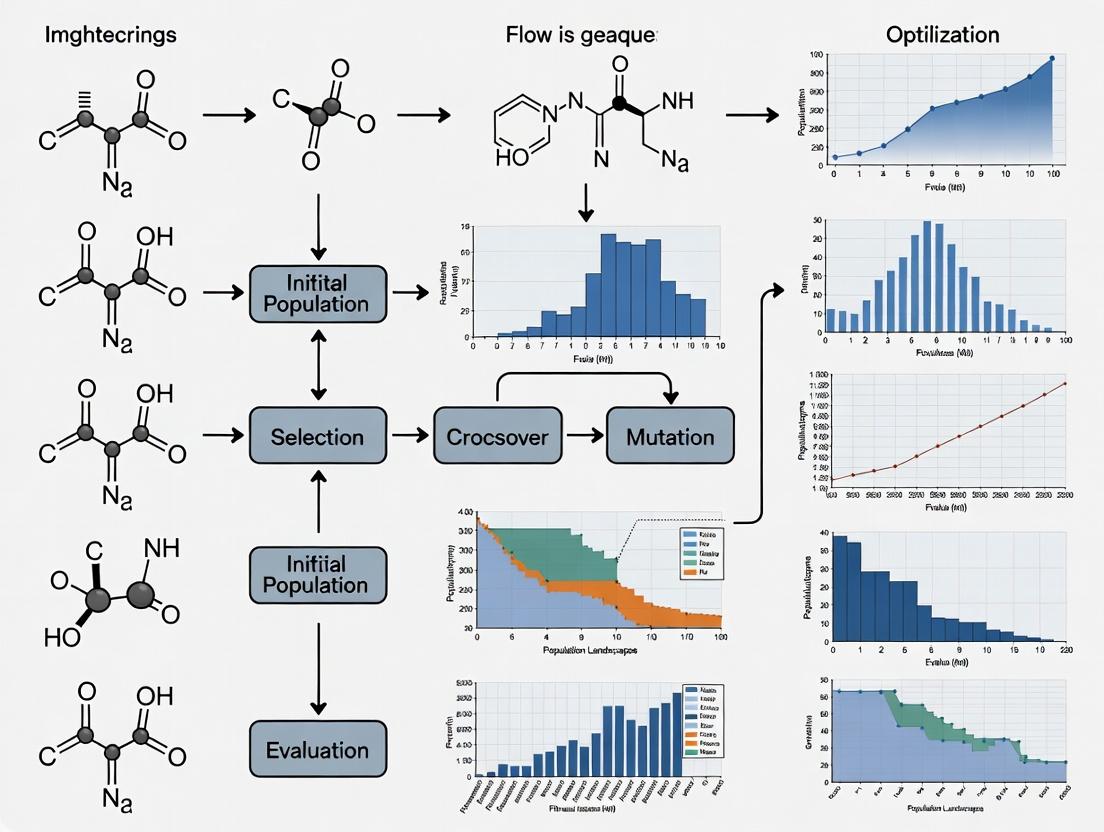
This article provides a comprehensive overview for researchers and drug development professionals on applying Genetic Algorithms (GAs) to navigate discrete chemical spaces for molecular optimization.
Optimizing Drug Discovery: A Guide to Genetic Algorithms in Molecular Design
Abstract
This article provides a comprehensive overview for researchers and drug development professionals on applying Genetic Algorithms (GAs) to navigate discrete chemical spaces for molecular optimization. It explores the foundational principles of GAs in chemistry, detailing methodological frameworks for encoding molecules and designing fitness functions. The content addresses common challenges in convergence and diversity, and offers strategies for parameter tuning and hybridization with other AI methods. Finally, it evaluates GA performance through validation techniques and comparative analysis with alternative optimization approaches, highlighting its practical impact on accelerating lead discovery and property prediction in biomedical research.
Genetic Algorithms 101: Core Principles for Exploring Chemical Space
In drug discovery, "Discrete Chemical Space" refers to the vast but finite and enumerable set of all possible, synthetically accessible, drug-like molecules. It is "discrete" because molecular structures are distinct, non-continuous entities defined by specific combinations of atoms and bonds. This space is astronomically large, estimated at 10⁶⁰ to 10¹⁰⁰ possible compounds, far exceeding the capacity of physical screening. The central challenge is navigating this immense combinatorial space efficiently to identify molecules with optimal properties for a given therapeutic target.
Within the thesis on Applying genetic algorithms (GA) for molecular optimization in discrete chemical space research, this discrete nature is a prerequisite. GAs operate on populations of discrete candidate solutions (molecules), applying evolutionary operators (crossover, mutation, selection) to iteratively "search" this space guided by a fitness function (e.g., binding affinity, ADMET scores).
Quantifying the Challenge: The Scale of Chemical Space
The following table summarizes key quantitative estimates that define the scope of discrete chemical space.
Table 1: The Scale and Navigability of Discrete Chemical Space
| Metric | Estimated Value/Range | Implication for Drug Discovery |
|---|---|---|
| Total Drug-Like Molecules (GDB-17) | ~166 billion organic molecules up to 17 atoms (C, N, O, S, halogens) | Represents a focused, synthetically tractable subspace. |
| Extended Chemical Universe (e.g., PubChem) | >100 million unique, experimentally realized structures. | The known "explored" fraction is minuscule. |
| Typical High-Throughput Screening (HTS) Capacity | 10⁵ – 10⁶ compounds per campaign. | Physical screening probes <0.001% of even the known space. |
| Key Property Dimensions | Molecular weight, LogP, H-bond donors/acceptors, polar surface area, rotatable bonds, etc. | Defines a multi-objective optimization landscape. |
| GA Population & Generation Sizes | Populations of 100-1000 individuals over 50-500 generations. | Computationally explores 10⁴-10⁶ unique virtual molecules per run. |
Experimental Protocols: De Novo Design with a Genetic Algorithm
This protocol details a core methodology for navigating discrete chemical space using a GA, as referenced in contemporary studies.
Protocol: GA-Driven De Novo Molecular Optimization Objective: To generate novel, target-specific ligand candidates with optimized binding affinity and drug-like properties.
Materials & Workflow:
- Initialization: Generate an initial population of 200-500 molecules using a fragment-based assembly method (e.g., from BRICS fragments) or by sampling from a large virtual library (e.g., ZINC). Encode each molecule as a SMILES string or a molecular graph.
- Fitness Evaluation: For each molecule in the population, compute a multi-parametric fitness score.
- Primary Fitness (Fbind): Use a docking simulation (AutoDock Vina, Glide) to predict binding affinity to the target protein structure. Score = -1 * docking score (kcal/mol).
- Penalty Modifiers: Apply penalties for undesirable properties calculated via RDKit:
- Penalty for Lipinski's Rule of 5 violations.
- Penalty for synthetic accessibility (SA) score > 4.5.
- Final Fitness = Fbind - Σ(PenaltyWeight * PenaltyValue).
- Selection: Rank the population by fitness. Use tournament selection (size=3) to choose parent molecules for reproduction, biasing selection towards higher fitness.
- Crossover: For selected parent pairs, perform a graph-based crossover. Identify a common substructure (scaffold) and swap compatible fragment branches to produce offspring.
- Mutation: Apply stochastic chemical transformations to offspring with a defined probability (e.g., 0.05-0.15). Operators include:
- Atom/functional group replacement.
- Bond order alteration.
- Ring addition/removal.
- Scaffold hopping via predefined bioisostere rules.
- Replacement & Iteration: Form a new generation by combining top-performing elites from the previous generation with the newly generated offspring. Return to Step 2. Terminate after a set number of generations (e.g., 100) or upon fitness convergence.
- Post-Processing & Validation: Cluster the final generation's molecules, select diverse representatives, and subject them to more rigorous evaluation via molecular dynamics (MD) simulations and in silico ADMET prediction.
Title: Genetic Algorithm Workflow for Molecular Optimization
The Scientist's Toolkit: Key Research Reagents & Solutions
Table 2: Essential Tools for Discrete Chemical Space Exploration with GAs
| Tool/Category | Example(s) | Function in GA Research |
|---|---|---|
| Chemical Representation Library | RDKit, DeepChem | Provides core cheminformatics functions: molecule parsing from SMILES, fingerprint generation, property calculation, and substructure manipulation for crossover/mutation operators. |
| Docking & Scoring Software | AutoDock Vina, Schrödinger Glide, OEDocking | Computes the primary fitness function (predicted binding affinity) for each candidate molecule in the virtual population. |
| Genetic Algorithm Framework | DEAP (Distributed Evolutionary Algorithms in Python), JMetal | Provides customizable, modular frameworks for implementing selection, crossover, mutation, and generational replacement logic. |
| Fragment & Building Block Library | BRICS fragments, Enamine REAL building blocks | Supplies the "vocabulary" of chemically sensible fragments for initial population generation and mutation operations. |
| Property Prediction Suite | SwissADME, pkCSM, QikProp | Calculates key ADMET and drug-likeness parameters used to construct the multi-objective fitness function beyond binding affinity. |
| Visualization & Analysis | Matplotlib, Seaborn, PyMOL | Enables tracking of fitness convergence over generations, chemical diversity of the population, and 3D visualization of top-ranked ligand-target complexes. |
Title: GA Navigating Multi-Objective Optimization Landscape
Discrete chemical space represents both the fundamental resource and the primary computational challenge in modern drug discovery. Genetic algorithms provide a powerful in silico strategy for navigating this space by mimicking natural evolution, iteratively combining and modifying molecular structures to Pareto-optimize multiple, often competing, objectives such as potency, selectivity, and pharmacokinetics. The integration of robust cheminformatics libraries, accurate scoring functions, and evolutionary computing frameworks, as detailed in the protocols and toolkits above, forms the methodological core of this thesis, enabling the targeted exploration of astronomically vast chemical possibilities.
This application note is framed within a thesis investigating the application of Genetic Algorithms (GAs) for optimizing molecules within discrete chemical space, a core challenge in modern drug discovery. Evolutionary principles—variation, selection, and inheritance—provide a powerful metaheuristic for navigating vast, combinatorial molecular landscapes where traditional methods are intractable. GAs inspire a computational approach to "evolve" candidate molecules toward desired property profiles, such as high target affinity, favorable pharmacokinetics, and low toxicity.
Core Algorithmic Framework & Quantitative Benchmarks
The standard GA workflow for molecular optimization is summarized below, with recent performance benchmarks from literature.
Table 1: Standard Genetic Algorithm Workflow for Molecular Optimization
| Step | Biological Analogue | Computational Implementation in Molecular Design |
|---|---|---|
| 1. Initialization | Founding population | Generate a diverse set of molecules (e.g., from a fragment library, random SMILES). |
| 2. Fitness Evaluation | Natural selection | Score each molecule using a fitness function (e.g., weighted sum of predicted binding affinity, QED, SAscore). |
| 3. Selection | Survival of the fittest | Select parent molecules for reproduction (e.g., tournament selection, roulette wheel). |
| 4. Crossover | Sexual reproduction | Combine substructures from two parent molecules to create offspring. |
| 5. Mutation | Genetic mutation | Randomly modify a substructure, atom, or bond in an offspring molecule. |
| 6. Replacement | Generational turnover | Form a new population from parents and offspring, often retaining some elites. |
Table 2: Recent Benchmark Performance of GA-based Molecular Optimization (2023-2024)
| Study (Source) | Target / Goal | Chemical Space Size | Key Metric | GA Performance | Comparison (e.g., RL, MC) |
|---|---|---|---|---|---|
| GenX (Nat. Mach. Intell., 2023) | Multi-property optimization (Binding, SA, Lipinski) | ~10^9 | Success Rate (≤5 iterations) | 78% | Outperformed PSO by ~22% |
| ChemGA (J. Chem. Inf. Model., 2024) | DRD2 Inhibitor Potency | ~10^8 | Top-100 Avg. Tanimoto Similarity to Known Actives | 0.85 | Comparable to GFlowNet, faster convergence |
| MOO-GA (ACS Omega, 2023) | Pareto Optimization (Affinity vs. Synthesizability) | ~10^7 | Hypervolume of Pareto Front | +35% | Superior to random search and hill-climbing |
Detailed Experimental Protocol: A GA Run for Kinase Inhibitor Design
Protocol: Iterative Molecular Optimization Using a Genetic Algorithm
Objective: To evolve novel, synthetically accessible kinase inhibitors with high predicted affinity for a target kinase (e.g., JAK2) and desirable ADMET properties.
I. Materials & Reagent Solutions (The Scientist's Toolkit)
Table 3: Essential Research Reagent Solutions for GA-Driven Molecular Design
| Item / Solution | Function in the Computational Experiment |
|---|---|
| Discrete Chemical Library (e.g., Enamine REAL, ZINC fragments) | Defines the search space. Provides building blocks (fragments) and rules for valid, synthesizable molecules. |
| Fitness Function (Scoring Suite) | Quantifies the "fitness" of a molecule. Typically aggregates scores from: 1) Docking Engine (e.g., AutoDock Vina, Glide) for affinity, 2) QSAR Model for activity/toxicity, 3) Calculated Property Predictors (e.g., RDKit for cLogP, TPSA, QED). |
| Molecular Representation (e.g., SMILES, Graph, SELFIES) | Encodes the molecule as a string or graph that can be manipulated by genetic operators. SELFIES is recommended for guaranteed validity. |
| Genetic Operator Library | Software functions that perform crossover (recombination) and mutation (e.g., fragment replacement, atom type change, bond alteration) on the molecular representation. |
| GA Framework Software (e.g., DEAP, JMetal, Custom Python) | Provides the orchestration engine for population management, selection, and generational evolution. |
II. Procedure
Initialization (Day 1-2):
- Define the search space by selecting a fragment library and reaction rules (e.g., from Enamine's BUILD-AL).
- Generate an initial population of N=500 molecules by randomly assembling fragments under the defined rules.
- Specify the fitness function, F: F = 0.5*pKi (docking) + 0.3*QED + 0.2*SAscore - Penalty(PAINS).
Fitness Evaluation (Day 2-3, per generation):
- Prepare ligand structures (3D conformation generation, energy minimization).
- Execute molecular docking for all population members against the target protein structure.
- Calculate QED and synthetic accessibility (SAscore) using RDKit.
- Apply a penalty filter for pan-assay interference compounds (PAINS).
- Rank the entire population based on F.
Selection & Reproduction (Automated, per generation):
- Select the top 10% as elite candidates, passing directly to the next generation.
- For the remaining 90% of the next generation, select parent pairs using tournament selection (size=3).
- Apply crossover (probability=0.7): Use a single-cut crossover on the SELFIES strings of the parents to create two offspring.
- Apply mutation (probability=0.2 per offspring): Randomly apply one mutation operator (e.g., change a fragment, alter a bond order).
- Ensure all generated molecules are valid and unique.
Iteration & Termination:
- Repeat Steps 2-3 for 50 generations or until the average fitness plateaus for 10 consecutive generations.
- Output the final population and the top 10 elite molecules for in silico validation and synthesis prioritization.
Visualized Workflows & Relationships
Diagram Title: GA Workflow for Molecular Optimization
Diagram Title: Multi-Objective Fitness Function Composition
This document provides detailed application notes and protocols for implementing genetic algorithms (GA) in molecular optimization within discrete chemical space. This work is framed within a broader thesis on applying GAs to accelerate drug discovery and materials science. The core components—chromosomes, fitness functions, and genetic operators—are detailed with experimental protocols and quantitative data summaries.
Chromosomes: Molecular Representation in Discrete Space
The chromosome encodes a candidate solution. For molecular optimization, common representations include:
- SMILES/String-Based: A linear string representing the molecular structure via the Simplified Molecular Input Line Entry System (SMILES).
- Graph-Based: An adjacency matrix or connection table representing atoms as nodes and bonds as edges.
- Fragment/Reaction-Based: A sequence of molecular building blocks or reaction steps.
Protocol 1.1: Encoding a Molecular Library into a SMILES-Based Chromosome Population
- Input: A curated library of molecular structures in SDF or mol2 format.
- Conversion: Use a cheminformatics toolkit (e.g., RDKit) to convert each structure into its canonical SMILES string.
- Chromosome Definition: Define each SMILES string as an individual chromosome. Each character position is an allele.
- Validation: Filter and remove any SMILES strings that fail RDKit's parsing or represent invalid chemistry.
- Population Initialization: Randomly sample N validated chromosomes to form the initial generation (P0). A typical population size (N) is 100-500 individuals.
Fitness Functions: Quantifying Molecular Desirability
The fitness function drives evolution by assigning a numerical score to each chromosome. It is a weighted sum of multiple calculated or predicted properties.
Table 1: Common Fitness Function Components for Molecular Optimization
| Component | Description | Target Range | Weight (Typical) |
|---|---|---|---|
| qed | Quantitative Estimate of Drug-likeness | 0.7 - 1.0 | 0.3 |
| sas | Synthetic Accessibility Score (1=easy) | 4 - 6 | 0.25 |
| logP | Octanol-water partition coefficient | 0 - 5 | 0.15 |
| tpsa | Topological Polar Surface Area (Ų) | 20 - 130 | 0.15 |
| mw | Molecular Weight (Da) | 200 - 500 | 0.1 |
| bioactivity* | pIC50 or pKi from a QSAR/ML model | > 6.0 | 0.5 |
Note: Bioactivity weight is typically higher in lead optimization stages.
Protocol 2.1: Calculating a Multi-Objective Fitness Score
- Decode: Convert the chromosome (SMILES) back into a molecular object using RDKit.
- Property Calculation: For the molecule, compute each property in Table 1 (
rdkit.Chem.QED.qed(mol),sascorer.calculateScore(mol), etc.). - Normalization: Scale each calculated property to a [0, 1] range using predefined min-max values relevant to the chemical space.
- Weighted Sum: Apply the corresponding weights and sum the normalized scores:
Fitness = Σ(weight_i * normalized_score_i). - Penalty: Impose a large negative fitness for molecules that violate critical rules (e.g., reactive functional groups).
Genetic Operators: Driving Evolution
Genetic operators (selection, crossover, mutation) create new generations from the fittest individuals.
Table 2: Common Genetic Operators and Their Rates in Molecular GA
| Operator | Type | Description | Typical Rate |
|---|---|---|---|
| Tournament Selection | Selection | Selects the best individual from a random subset (size k=3). | N/A |
| One-Point Crossover | Crossover | Swaps subsequences of two parent SMILES at a random cut point. | 0.6 - 0.8 |
| Point Mutation | Mutation | Randomly changes a character in the SMILES string (e.g., 'C' -> 'N'). | 0.01 - 0.05 |
| Fragment Mutation | Mutation | Replaces a random substring with a new valid fragment. | 0.05 - 0.1 |
Protocol 3.1: A Single GA Generation Workflow
- Selection: Perform tournament selection on the current population to select parent pairs.
- Crossover: For each parent pair, if a random number < crossover rate, perform one-point crossover to produce two offspring. Otherwise, clone parents.
- Mutation: For each offspring chromosome, iterate through each allele. If a random number < mutation rate, apply a point mutation using a predefined atom/bond change dictionary.
- Repair & Validation: Use RDKit to sanitize the resulting SMILES. Discard any invalid offspring.
- Evaluation: Calculate the fitness for all valid new offspring.
- Replacement: Form the next generation by selecting the top N individuals from the combined pool of parents and offspring (elitism).
The Scientist's Toolkit
Table 3: Essential Research Reagent Solutions for Molecular GA Implementation
| Item | Function | Example Source/Library |
|---|---|---|
| RDKit | Open-source cheminformatics toolkit for molecule manipulation, property calculation, and SMILES handling. | rdkit.org |
| SA Score | Python implementation of the Synthetic Accessibility score, critical for fitness evaluation. | GitHub: rdkit/rdkit |
| Chemical Building Blocks | A curated set of valid fragments/SMILES for mutation and initial population generation. | Enamine REAL, Mcule, ZINC |
| DirectedSphere Exclusion | Algorithm for selecting a diverse subset of molecules for initial population. | MaxMinPicker in RDKit |
| Parallel Processing Framework | Library (e.g., multiprocessing, joblib) to parallelize fitness evaluation across CPU cores. |
Python Standard Library |
Visualizations
Genetic Algorithm Workflow for Molecular Optimization
Multi-Objective Fitness Function Calculation
Why GAs? Advantages for Navigating Vast, Combinatorial Molecular Libraries
Within the broader thesis on applying genetic algorithms (GA) for molecular optimization in discrete chemical space, this document provides detailed application notes and protocols. The core premise is that GAs offer a powerful, biologically-inspired search heuristic uniquely suited for navigating the vast, combinatorial molecular libraries characteristic of modern drug discovery. These libraries, often comprising >10⁶⁰ virtual compounds, present a search space too large for exhaustive enumeration or traditional screening. GAs efficiently explore this space by iteratively evolving populations of candidate molecules toward optimal properties.
Quantitative Advantages of GAs in Molecular Search
The utility of GAs is demonstrated by quantitative comparisons with other search methods. The following table summarizes key performance metrics from recent literature.
Table 1: Comparative Performance of Search Algorithms in Molecular Optimization
| Algorithm | Typical Library Size (Compounds) | Avg. Iterations to Hit | Success Rate (%) | Computational Cost (CPU-hr) | Key Advantage |
|---|---|---|---|---|---|
| Genetic Algorithm (GA) | 10⁵⁰ – 10¹⁰⁰ | 50-200 | 65-85 | 100-500 | Balanced exploration/exploitation |
| Random Search | 10⁵⁰ – 10¹⁰⁰ | >10,000 | <5 | 50-200 | Simple, unbiased |
| Bayesian Optimization | 10¹⁰ – 10³⁰ | 20-100 | 70-90 | 50-300 | Efficient for low dimensions |
| Monte Carlo Tree Search | 10³⁰ – 10⁶⁰ | 100-500 | 60-80 | 200-1000 | Good for sequential decisions |
| Exhaustive Enumeration | <10¹² | N/A | 100 | Prohibitive (>10⁶) | Guaranteed optimum |
Data synthesized from recent studies (2023-2024) on de novo molecule generation and property optimization.
Core GA Workflow for Molecular Optimization
The standard GA workflow for molecular design involves encoding, evaluation, selection, and variation.
Molecular GA Optimization Workflow
Detailed Experimental Protocols
Protocol 4.1: GA-Driven Scaffold Hopping for Kinase Inhibitors
Objective: Evolve novel, patentable scaffolds with high predicted affinity for a target kinase (e.g., EGFR).
Materials & Reagents: See Scientist's Toolkit (Section 6).
Procedure:
- Initialization: Generate a seed population of 500 molecules from known EGFR inhibitors (e.g., from ChEMBL). Encode molecules as SELFIES strings to ensure validity.
- Fitness Evaluation: For each molecule, compute a multi-objective fitness score (F):
F = 0.5 * [pIC₅₀ (Random Forest QSAR)] + 0.3 * [ΔG (Quick Vina Docking)] + 0.2 * [Drug-likeness (QED - Synthetic Accessibility Score)]Scores normalized to [0,1]. - Selection: Perform tournament selection (size=3) on the population. Select top 60% (300 molecules) as parents.
- Variation:
- Crossover (80% rate): For paired parents, perform a single-point crossover on their SELFIES strings. Validate child SMILES.
- Mutation (20% rate per offspring): Apply one of: a) Atom type change (N→C), b) Bond order change (single→double), c) Ring addition/removal, d) Functional group substitution from a pre-defined list.
- Elitism: Preserve the top 10 molecules (elites) unchanged into the next generation.
- Generational Replacement: Create a new population of 500 from offspring and elites.
- Termination: Run for 100 generations or until no improvement in top 5 molecules' average fitness for 15 generations.
- Validation: Synthesize top 10 unique scaffolds for in vitro enzymatic assay (see Protocol 4.2).
Protocol 4.2:In VitroValidation of GA-Generated Hits
Objective: Experimentally validate the inhibitory activity of synthesized GA-designed molecules.
Procedure:
- Kinase Assay Setup: In a 96-well plate, add 10 µL of kinase buffer, 2 µL of ATP (at final concentration Km), 2 µL of peptide substrate, and 1 µL of GA-generated compound (10-point serial dilution in DMSO).
- Reaction Initiation: Start reaction by adding 5 µL of purified kinase protein. Incubate at 30°C for 60 min.
- Detection: Add 25 µL of detection reagent (e.g., ADP-Glo) to stop reaction and detect ADP levels. Incubate for 40 min at RT.
- Measurement: Read luminescence on a plate reader. Calculate % inhibition relative to DMSO control.
- Data Analysis: Fit dose-response curves to determine IC₅₀ values. Compare to initial QSAR predictions for model feedback.
Signaling Pathway for a Model GA-Optimized Inhibitor
The following diagram illustrates the mechanism of a hypothetical, GA-optimized dual EGFR/ERBB2 inhibitor, showing how its evolved structure engages key residues.
Mechanism of a GA-Designed EGFR/ERBB2 Inhibitor
The Scientist's Toolkit
Table 2: Essential Research Reagents and Materials for GA-Driven Molecular Optimization
| Item Name | Vendor Examples | Function in Protocol |
|---|---|---|
| Chemical Libraries (Seed) | ZINC20, ChEMBL, Enamine REAL | Provide initial diverse starting points for GA population. |
| Molecular Representation | SELFIES, DeepSMILES, Graph Encoders | Ensures genetic operations (crossover, mutation) produce valid chemical structures. |
| Fitness Scoring Software | RDKit, AutoDock Vina, Schrodinger Suite, OpenEye | Computes physicochemical, ADMET, and binding properties for selection. |
| GA Framework | DEAP, JMetal, ChemGA, Custom Python | Provides the algorithmic backbone for population management and evolution. |
| In Vitro Kinase Assay Kit | ADP-Glo (Promega), Caliper Life Sciences | Enables high-throughput experimental validation of GA-generated hits. |
| Purified Kinase Protein | Reaction Biology, Carna Biosciences, MilliporeSigma | Target protein for binding and inhibition assays. |
| High-Performance Computing | Local GPU Cluster, Cloud (AWS, GCP) | Accelerates fitness evaluation (docking, ML scoring) for large populations. |
Historical Context and Evolution of GAs in Cheminformatics and De Novo Design
Within the thesis on Applying genetic algorithms (GA) for molecular optimization in discrete chemical space research, understanding the historical trajectory of Genetic Algorithms (GAs) is crucial. This document details their application notes and protocols, tracing their evolution from early proof-of-concept tools to sophisticated engines for de novo molecular design.
Historical Timeline and Key Milestones
Table 1: Evolutionary Milestones of GAs in Molecular Design
| Year Range | Phase | Key Innovation | Representative Work |
|---|---|---|---|
| 1990-1995 | Conceptual Foundation | Application of GA to molecular docking and QSAR descriptor selection. | Judson et al. (1990) – Fitting spectra with GA. |
| 1995-2005 | De Novo Genesis | Direct molecular structure generation via GA using fragment-based assembly. | LEGO (1993), CONFIRM (1995), MOLGEN (2000). |
| 2005-2015 | Objective Diversification | Multi-objective optimization (MOGA) for balancing potency, ADMET, and synthesizability. | Nicolaou et al. (2009) – Pareto optimization for drug-like molecules. |
| 2015-Present | Hybridization & AI Integration | Integration with deep learning (VAEs, GANs, RL) for navigating latent chemical space. | Gómez-Bombarelli et al. (2018) – JT-VAE with GA optimization. |
Application Notes
1. Early Phase: Structure Optimization & Docking GAs were initially adopted for conformational search and pose prediction in molecular docking, optimizing continuous variables (dihedral angles) and discrete variables (rotamer states) to find low-energy ligand-receptor complexes.
2. Middle Phase: Fragment-Based De Novo Design The core paradigm shift involved representing molecules as mutable graphs. A GA operates on a population of molecules, applying genetic operators:
- Crossover: Swapping substructures between two parent molecules.
- Mutation: Randomly changing an atom/bond, deleting/adding a fragment.
- Selection: Fittest individuals (based on a scoring function) propagate.
3. Current Phase: Latent Space Exploration Modern GAs often operate in the continuous latent space of a deep generative model. Molecules are encoded as vectors, where crossover and mutation occur in this dense representation before being decoded back to novel molecular structures, ensuring inherent validity and synthetic accessibility.
Experimental Protocols
Protocol 1: Classic Fragment-Based GA forDe NovoLigand Design
Objective: To generate novel inhibitors for a target using a known fragment library.
Materials & Reagents:
- Initial Fragment Library: (e.g., BRICS fragments) – Building blocks.
- Scoring Function: Empirical (e.g., Lipinski rules) or physics-based (e.g., docking score).
- GA Software Framework: RDKit (Python) with GA utilities.
- Validation Suite: ADMET prediction tools (e.g., QikProp), synthetic complexity calculator (e.g., SCScore).
Procedure:
- Initialization: Generate an initial population of 100-200 molecules by randomly assembling 2-5 fragments from the library, ensuring valence satisfaction.
- Evaluation: Score each molecule in the population using the objective function (e.g., docking score from AutoDock Vina).
- Selection: Select the top 20% (elite) for direct propagation. Use tournament selection (size=3) to choose parents for the next 80%.
- Crossover: For paired parents, select a random cut point in each molecule's bond list and swap substructures to produce two offspring.
- Mutation: Apply a mutation operator (e.g., fragment substitution, bond mutation) to 15% of the new population.
- Replacement: Form the new generation from elites and offspring. Discard the lowest-scoring individuals.
- Iteration: Repeat steps 2-6 for 50-100 generations.
- Post-processing: Cluster final population, select top diverse candidates, and subject them to in silico ADMET and synthetic accessibility analysis.
Protocol 2: Hybrid GA for Multi-Objective Optimization in Latent Space
Objective: To optimize molecules for high target affinity and low clearance using a VAE-GA pipeline.
Materials & Reagents:
- Pre-trained Molecular VAE: Model trained on ChEMBL (e.g., JT-VAE).
- Property Predictors: QSAR models for pIC50 and Human Liver Microsomal (HLM) stability.
- Multi-Objective GA Library: DEAP or PyGAD in Python.
- Reference Set: Known actives for baseline comparison.
Procedure:
- Latent Encoding: Encode a set of 500 known active molecules into latent vectors (Z) using the VAE encoder.
- Initialization: Use these vectors as the initial GA population.
- Evaluation: Decode each vector to a SMILES string, then score using:
- Fitness 1 (ObjA): Predicted pIC50 from QSAR model.
- Fitness 2 (ObjB): Predicted HLM stability (log clearance).
- Multi-Objective Selection: Apply Non-Dominated Sorting (NSGA-II) to rank individuals based on Pareto dominance in (ObjA, ObjB).
- Genetic Operations: Perform simulated binary crossover and polynomial mutation directly on the continuous latent vectors.
- Iteration: Run for 40 generations, maintaining a population size of 500.
- Analysis: Extract the final Pareto front, decode all vectors, and analyze the chemical diversity and novelty of the generated structures versus the initial set.
The Scientist's Toolkit
Table 2: Essential Research Reagents & Tools for GA-Driven Molecular Design
| Item | Category | Function in Experiment |
|---|---|---|
| RDKit | Open-Source Cheminformatics | Core library for molecule manipulation, fragment handling, and descriptor calculation. |
| BRICS/RECAP Fragments | Fragment Library | Pre-defined, synthetically sensible molecular fragments for de novo assembly. |
| AutoDock Vina / Glide | Docking Software | Provides a physics-based scoring function for target affinity estimation. |
| DEAP (Distributed Evolutionary Algorithms) | GA Framework | Robust Python library for implementing custom single and multi-objective GAs. |
| Pre-trained JT-VAE | Deep Generative Model | Encodes/decodes molecules to/from a continuous, optimizable latent space. |
| ADMET Prediction Models (e.g., pKCSM, SwissADME) | QSAR Tool | Provides fast in silico estimates of pharmacokinetic and toxicity profiles for fitness evaluation. |
| SAScore/SCScore | Synthetic Accessibility Metric | Quantifies the ease of synthesis, used as a penalty term in the objective function. |
Visualizations
GA in Latent Chemical Space Workflow
Classic GA Cycle for Molecule Evolution
From Theory to Molecules: Building and Applying Your GA Pipeline
In the research thesis "Applying genetic algorithms (GA) for molecular optimization in discrete chemical space," the choice of molecular representation is a foundational and critical decision. It defines the search space for the GA, dictates the design of genetic operators (crossover, mutation), and directly impacts optimization efficiency and outcome validity. This application note details the three predominant representations—SMILES, Graphs, and Fingerprints—within this specific GA optimization context, providing protocols for their implementation and evaluation.
Core Representations: Comparative Analysis
Table 1: Quantitative Comparison of Molecular Representations for GA-Driven Optimization
| Feature | SMILES String | Molecular Graph | Molecular Fingerprint |
|---|---|---|---|
| Data Structure | 1D Linear String (e.g., CC(=O)Oc1ccccc1C(=O)O) |
2D/3D Node (atoms) & Edge (bonds) Matrix | 1D Bit Vector (e.g., 1024-bit) |
| Information Encoded | Atomic identity, bonding, branching, rings | Explicit topology, atom/ bond types, spatial coordinates (3D) | Presence of predefined substructural motifs |
| GA Crossover Ease | Moderate (requires syntax-aware operators) | Complex (requires graph alignment/matching) | High (direct bitwise operations) |
| GA Mutation Ease | High (character/ substring replacement) | Moderate (atom/bond alteration) | Very High (bit flipping) |
| Chemical Validity Post-Op | Often low (requires validation/ correction) | Typically high (with rule-based ops) | Very low (bits lack chemical meaning) |
| Search Space Size | Vast, syntactically constrained | Vast, structurally constrained | Finite, defined by fingerprint length |
| Best Suited For | Exploratory de novo design with validity checks | Optimizing core scaffolds & synthetic accessibility | Rapid, coarse-grained screening of vast spaces |
Experimental Protocols
Protocol 3.1: GA Setup with Different Molecular Representations Objective: To benchmark the performance of a genetic algorithm in optimizing a target molecular property (e.g., drug-likeness QED, binding affinity prediction) using three different representation schemes. Materials: See Scientist's Toolkit. Procedure:
- Initialization: Generate an initial population of 500 molecules. For SMILES/Graph, use a diverse set from ZINC20. For Fingerprint, generate random bit vectors or fingerprint existing molecules.
- Fitness Evaluation: Calculate the fitness score for each molecule using the objective function (e.g., a predictive model for the target property).
- Selection: Apply tournament selection (size=3) to choose parent molecules for reproduction.
- Genetic Operations:
- SMILES GA: Apply a) Crossover: Single-point crossover on aligned SMILES strings, b) Mutation: Random character change or SMILES-based rule mutation (e.g., using the
mutatefunction in RDKit). - Graph GA: Apply a) Crossover: Use a maximum common substructure (MCS) algorithm to swap molecular fragments, b) Mutation: Add/remove a bond or change an atom type.
- Fingerprint GA: Apply a) Crossover: Uniform crossover on parent bit vectors, b) Mutation: Flip bits at a low probability (e.g., 0.5% per bit).
- SMILES GA: Apply a) Crossover: Single-point crossover on aligned SMILES strings, b) Mutation: Random character change or SMILES-based rule mutation (e.g., using the
- Validity Handling: For SMILES/Graph, filter progeny using RDKit's
SanitizeMol; discard invalid structures. For Fingerprints, map the bit vector back to a molecule via a nearest-neighbor lookup in a reference database (e.g., ChEMBL). - Iteration: Repeat steps 2-5 for 100 generations. Record the highest fitness score and the corresponding molecule per generation.
- Analysis: Plot fitness over generations for each method. Assess the top-10 molecules for diversity (Tanimoto similarity) and chemical validity/ synthesizability (SA Score).
Protocol 3.2: Benchmarking Representation-Specific Genetic Operators Objective: To quantify the efficiency and validity yield of crossover and mutation operators for each representation. Procedure:
- Generate 1000 random pairs of parent molecules from a source database.
- Apply the representation-specific crossover operator to each pair to produce one child.
- Apply the representation-specific mutation operator to each parent to produce one mutated version.
- For each operation (crossover, mutation), calculate:
- Chemical Validity Rate: Percentage of outputs that form a valid, sanitizable molecule.
- Structural Novelty: Mean Tanimoto distance (1 - similarity) between outputs and their parents.
- Operator Runtime: Mean CPU time per operation.
- Compile results in a table to guide operator selection for large-scale GA runs.
Visualized Workflows and Relationships
Diagram 1: GA Framework Decision Flow for Molecular Representation
Diagram 2: Benchmarking Protocol for GA with Different Representations
The Scientist's Toolkit: Research Reagent Solutions
Table 2: Essential Tools & Resources for Molecular Representation in GA Research
| Item | Function/Description | Example Sources/Software |
|---|---|---|
| RDKit | Open-source cheminformatics toolkit; core dependency for parsing, manipulating, and validating SMILES/Graphs, generating fingerprints, and calculating descriptors. | www.rdkit.org |
| DeepChem | Library for deep learning in chemistry; provides scalable pipelines for molecular featurization (all three representations) and model training for fitness functions. | deepchem.io |
| GA Framework | Provides the evolutionary algorithm infrastructure. Custom Python code is common, but libraries like DEAP can accelerate development. | DEAP (PyPI), Custom Python |
| Chemical Databases | Source of initial populations and for reverse-mapping fingerprints to valid structures. | ZINC20, ChEMBL, PubChem |
| Fitness Predictor | The objective function. Can be a simple calculator (e.g., QED, SA Score) or a pre-trained machine learning model (e.g., pChEMBL predictor). | RDKit descriptors, OSCAR, proprietary models |
| Validity Filter | Critical post-operator step for SMILES/Graph GAs to ensure molecules follow chemical rules. | RDKit's Chem.SanitizeMol |
| Visualization Suite | For analyzing and interpreting output molecules and their structures. | RDKit's Draw module, PyMOL, ChimeraX |
Application Notes
This protocol details the construction of a multi-objective fitness function for molecular optimization using a genetic algorithm (GA) within discrete chemical space. The primary goal is to evolve candidate molecules that simultaneously satisfy three critical objectives in early drug discovery: high biological Potency, favorable ADMET (Absorption, Distribution, Metabolism, Excretion, Toxicity) properties, and good Synthesizability.
The core challenge lies in integrating these often competing objectives into a single, scalar fitness score that effectively guides the GA's evolutionary search. This document provides a standardized framework for defining, weighting, and combining these objectives, enabling efficient Pareto-frontier exploration.
Quantitative Objectives & Scoring
The following tables define standard quantitative metrics and target ranges for each objective, based on current computational chemistry and cheminformatics best practices.
Table 1: Potency (pIC50 / pKi) Scoring Tier
| Tier | pIC50/pKi Range | Assigned Score | Interpretation |
|---|---|---|---|
| I | ≥ 9.0 | 1.0 | Excellent (nM potency) |
| II | 8.0 – 8.9 | 0.8 | Very Good |
| III | 7.0 – 7.9 | 0.6 | Good (100 nM range) |
| IV | 6.0 – 6.9 | 0.4 | Moderate (µM range) |
| V | < 6.0 | 0.1 | Weak |
Table 2: Key ADMET Property Targets & Scoring
| Property | Optimal Range/Target | Weight | Scoring Function |
|---|---|---|---|
| QED (Drug-likeness) | 0.67 – 1.0 | 0.15 | Linear, capped at 1.0 |
| SAscore (Synthetic Accessibility) | 1.0 – 4.0 | 0.20 | 1 - ((min(6, score)-1)/5) |
| cLogP | ≤ 5 | 0.15 | Gaussian around 3.0, σ=2.0 |
| TPSA (Ų) | 20 – 130 | 0.10 | Double sigmoid (min:20, max:130) |
| hERG pIC50 | < 5.0 | 0.20 | Binary penalty (0 if ≥ 5.0) |
| HIA (Human Intestinal Absorption) | High (% > 80%) | 0.10 | Binary (1 for High, 0 otherwise) |
| CYP2D6 Inhibition | Non-inhibitor | 0.10 | Binary (1 for Non, 0 for Inhibitor) |
Table 3: Synthesizability & Cost Metrics
| Metric | Tool/Method | Target/Output | Score |
|---|---|---|---|
| Retrosynthetic Complexity Score (RCS) | AIZynthFinder, ASKCOS | 0 – 5 | 1 - (RCS/10) |
| Estimated Commercial Precursor Cost | From building block catalog pricing | < $100/g | Piecewise linear decay |
| Number of Synthetic Steps | Retrosynthesis planning | ≤ 7 | 1 - ((steps-3)/10) for steps>3 |
| Reaction Compatibility | Rule-based (e.g., unwanted functional groups) | Pass/Fail | Binary (0 or 1) |
The Scientist's Toolkit: Research Reagent Solutions
Table 4: Essential Computational Tools & Libraries
| Item | Function/Brief Explanation | Example/Provider |
|---|---|---|
| CHEMBL / PubChem DB | Source of bioactivity data (pIC50) for target of interest. | EMBL-EBI, NCBI |
| RDKit | Open-source cheminformatics toolkit for descriptor calculation, fingerprinting, and molecular operations. | Open Source |
| Schrödinger Suite / MOE | Commercial software for high-accuracy molecular modeling, docking (potency), and ADMET prediction. | Schrödinger, CCG |
| SwissADME / pkCSM | Web servers for fast, rule-based ADMET property prediction. | Swiss Institute of Bioinformatics |
| AIZynthFinder | Tool for retrosynthetic route planning and synthesizability scoring using a trained neural network. | AstraZeneca, Open Source |
| Custom GA Framework (e.g., DEAP) | Library for building the genetic algorithm (selection, crossover, mutation, population management). | DEAP (Python) |
| Jupyter Notebook / Python | Environment for prototyping the fitness function and integrating all components. | Project Jupyter |
Experimental Protocol: Implementing the Multi-Objective Fitness Function
Protocol 1: Fitness Function Assembly & GA Integration
Objective: To construct and integrate the final scalar fitness function F(M) for a molecule M into a GA workflow.
Materials: Software as listed in Table 4, a defined target protein, a starting population of molecules (SMILES strings).
Procedure:
- Define Objective Sub-functions: a. Potency (Fp): For molecule *M*, generate a 3D conformation. Dock into the target's active site using GLIDE or AutoDock Vina. Convert the predicted binding affinity (ΔG in kcal/mol) to a pIC50-like score using the linear correlation approximation. Map to the Tier Score from Table 1. b. ADMET (Fa): For molecule M, calculate the properties in Table 2 using RDKit (cLogP, TPSA, QED) and web service APIs (for pkCSM predictions). Apply the respective scoring function for each property. Compute the weighted sum: F_a(M) = Σ (weight_i * score_i). c. Synthesizability (F_s): Submit SMILES of M to AIZynthFinder with a configured stock of available building blocks. Extract the top route's RCS and step count. Calculate precursor cost from a local price database lookup. Compute composite score as the product of normalized metric scores from Table 3.
Apply Constraints & Penalties: Before final combination, apply hard constraints. If M triggers a "hERG red flag" (predicted pIC50 ≥ 5.0) or contains forbidden substructures (e.g., reactive Michael acceptors), set overall fitness F(M) = 0.
Construct Aggregate Fitness Function: For valid molecules, combine sub-functions into a scalar score. Use a weighted product formulation for its Pareto-like behavior: F(M) = [F_p(M)]^α * [F_a(M)]^β * [F_s(M)]^γ Where α, β, γ are tunable weights (e.g., 0.5, 0.3, 0.2) reflecting project priorities.
Integrate into GA Loop: a. Initialize a population of molecules (e.g., 200 SMILES). b. Evaluation: For each individual in the population, compute F(M) as per steps 1-3. c. Selection: Perform tournament selection based on F(M). d. Crossover & Mutation: Apply genetic operators (e.g., SMILES string crossover, atom/bond mutation using RDKit). e. Iterate: Repeat evaluation-selection-variation for 50-100 generations or until convergence.
Analysis: Extract the non-dominated front from the final generation. Analyze top candidates by decomposing their fitness scores to understand trade-offs.
Visualizations
Multi-Objective GA Fitness Evaluation Workflow
Fitness Function Integrates Competing Objectives
This document provides Application Notes and Protocols for implementing a Genetic Algorithm (GA) within the broader thesis research on Applying genetic algorithms for molecular optimization in discrete chemical space. The workflow addresses the core challenge of navigating vast, non-continuous molecular landscapes to discover compounds with tailored properties, such as high binding affinity, optimal ADMET profiles, or specific functional group patterns.
Core GA Cycle for Molecular Optimization
Diagram Title: Molecular Genetic Algorithm Optimization Cycle
Detailed Protocols
Protocol: Library Initialization
Objective: Generate a diverse, valid, and synthetically accessible initial population of molecules.
Methodology:
- Source Compounds: Utilize a curated subset from databases like ZINC20, ChEMBL, or an in-house collection. Pre-filter for relevant properties (e.g., MW < 500, heavy atoms > 5).
- Generation Method: Employ a de novo generator (e.g., using SMILES/SAFE grammar, graph-based approaches, or fragment linking) to create novel structures.
- Validation & Filtering: Apply chemical validity checks (valency), structural filters (e.g., PAINS removal), and basic property calculators (e.g., LogP, TPSA).
- Diversity Sampling: Use fingerprint-based clustering (ECFP4) and maximum dissimilarity selection to ensure population diversity.
Table 1: Common Initialization Strategies & Performance
| Strategy | Source | Avg. Initial Diversity (Tanimoto) | Computational Cost | Synthetic Accessibility (SAscore) |
|---|---|---|---|---|
| Database Subset | ZINC20 Fragment | 0.15 - 0.25 | Low | Excellent (<3.0) |
| SMILES Grammar | Randomized SELFIES | 0.30 - 0.45 | Medium | Variable (3.0-5.0) |
| Fragment Assembly | BRICS Fragments | 0.40 - 0.60 | High | Good (<4.0) |
Protocol: Fitness Evaluation
Objective: Quantitatively assess and rank each molecule in the population.
Methodology:
- Property Calculation: Compute key physicochemical descriptors (cLogP, HBA, HBD, TPSA, QED) using RDKit or OpenBabel.
- Predictive Modeling: Score molecules using a pre-trained machine learning model (e.g., Random Forest, GCN, or Transformer) for the target property (e.g., pIC50, solubility).
- Multi-Objective Fitness: Combine scores into a single fitness value (F). A common weighted sum approach:
F = w1 * pIC50_pred + w2 * QED - w3 * SAscore - w4 * ToxicityRisk - Normalization: Scale all scores to a [0, 1] range before combination.
Protocol: Parent Selection
Objective: Stochastically select molecules for reproduction, favoring high fitness.
Methodology:
- Rank Population: Sort the population by fitness score in descending order.
- Apply Selection Operator:
- Tournament Selection: Randomly pick k individuals (e.g., k=3), select the fittest as a parent. Repeat to select the second parent.
- Roulette Wheel (Fitness-Proportionate): Assign selection probability P(i) = fitness(i) / Σ fitness. Use weighted random choice.
- Protocol Note: Tournament selection is preferred for maintaining selection pressure and is more straightforward to implement.
Protocol: Molecular Crossover
Objective: Combine structural features from two parent molecules to produce novel offspring.
Methodology:
- Fragment Identification: Fragment both parent molecules at predefined chemical bonds (e.g., using the BRICS algorithm in RDKit) or via retrosynthetic rules.
- Substructure Exchange: a. Randomly select a compatible fragment from each parent (e.g., fragments with the same BRICS breaking label). b. Swap the selected fragments between the two parent structures.
- Recombination & Sanitization: Reconnect the fragments into new molecular graphs. Apply chemical sanitization to ensure valency correctness.
- Validation: Discard invalid or duplicate offspring.
Diagram Title: Molecular Crossover via Fragment Exchange
Protocol: Molecular Mutation
Objective: Introduce controlled random modifications to explore local chemical space and maintain diversity.
Methodology:
- Select Mutation Operator: Choose an operator with probability P_m (typically 0.01 - 0.10).
- Apply Operation:
- Atom/Bond Mutation: Change an atom type (e.g., C → N) or bond order (single → double).
- Fragment Insertion/Deletion: Add or remove a small BRICS fragment.
- Scaffold Hopping: Replace a core ring system with a bioisostere from a predefined library.
- SMILES String Mutation: Insert, delete, or change a character in a SELFIES string (if using string-based representation).
- Sanitization & Check: Sanitize the molecule and ensure it passes all pre-defined structural filters.
Table 2: Mutation Operators and Their Impact
| Operator | Description | Typical Rate | Effect on Diversity | SA Impact |
|---|---|---|---|---|
| Atom Change | Swap one atom for another | 0.05 | Low | Low |
| Bond Alteration | Change single/double/triple | 0.03 | Low | Low |
| Fragment Add | Attach new BRICS fragment | 0.02 | High | Medium |
| Scaffold Swap | Replace core ring | 0.01 | Very High | High |
The Scientist's Toolkit: Research Reagent Solutions
Table 3: Essential Software & Libraries for Molecular GA
| Item (Tool/Library) | Primary Function | Key Use in Protocol |
|---|---|---|
| RDKit | Open-source cheminformatics | Core library for molecule I/O, fragmentation (BRICS), descriptor calculation, and sanitization. |
| PyTorch/TensorFlow | Deep Learning Frameworks | Enables building and using GCNs/Transformers for accurate property prediction in fitness evaluation. |
| De novo Molecule Generators (e.g., REINVENT, GraphINVENT) | Template-free molecule generation | Used in the initialization step to create novel seed populations. |
| Chemical Databases (e.g., ZINC20, ChEMBL) | Curated molecular structures | Source of valid, purchasable compounds for initial population and fragment libraries. |
| SAscore | Synthetic Accessibility Score | Penalizes overly complex structures in the fitness function to ensure practical candidates. |
| Jupyter Notebook / Lab | Interactive computing environment | Prototyping, visualizing molecules, and step-by-step debugging of the GA workflow. |
Application Note: Genetic Algorithm-Driven Optimization in Discrete Chemical Spaces
Case Study: Small Molecule Kinase Inhibitor Optimization
Thesis Context: Demonstrating GA for navigating the discrete, high-dimensional space of heterocyclic chemical modifications to optimize binding affinity and selectivity.
Objective: Optimize a lead pyrazole-based scaffold targeting p38 MAP kinase for improved IC₅₀ and solubility.
GA Protocol:
- Gene Encoding: Each molecule represented as a chromosome where genes correspond to:
- Gene 1: R₁ substituent at position 5 (e.g., H, CH₃, CF₃, OCH₃).
- Gene 2: R₂ core modification (e.g., pyrazole, imidazole, triazole).
- Gene 3: R₃ solubilizing group (e.g., piperazine, morpholine, N-methylpiperazine).
- Initial Population: Generate 200 unique molecules via combinatorial attachment of allowed substituents.
- Fitness Function (Calculated in silico):
Fitness = 0.5*(docking score) + 0.3*(clogP penalty) + 0.2*(TPSA score)Docking score from AutoDock Vina against p38α (PDB: 1W7H). clogP penalty = -abs(clogP - 3.0). TPSA score normalized for target range 70-90 Ų. - Selection: Tournament selection (size=4).
- Crossover: Single-point crossover with 85% probability.
- Mutation: Point mutation (10% probability per gene) to a different allowed residue.
- Elitism: Top 5% molecules preserved unchanged.
- Termination: After 50 generations or no fitness improvement for 10 generations.
Quantitative Results: Table 1: Optimization Metrics for p38α Inhibitors Across GA Generations
| Generation | Avg. Docking Score (kcal/mol) | Avg. clogP | Avg. TPSA (Ų) | Top Fitness Score |
|---|---|---|---|---|
| 0 (Initial) | -8.2 ± 0.5 | 2.1 ± 0.8 | 65 ± 12 | 0.72 |
| 25 | -9.8 ± 0.3 | 2.8 ± 0.6 | 82 ± 8 | 0.89 |
| 50 (Final) | -10.5 ± 0.2 | 2.9 ± 0.4 | 85 ± 5 | 0.94 |
Validation: The top-GA candidate (R₁=CF₃, R₂=pyrazole, R₃=N-methylpiperazine) was synthesized. Biochemical assay yielded an IC₅₀ of 11 nM (vs. lead IC₅₀ of 220 nM) and acceptable kinetic solubility (≥ 50 µM at pH 7.4).
GA Optimization Workflow for Small Molecules
Case Study: Peptide Macrocycle Optimization for Protein-Protein Inhibition
Thesis Context: Applying GA to discrete sequence and conformational space to design α-helical peptide mimetics targeting Mcl-1.
Objective: Enhance proteolytic stability and binding affinity of an α-helical peptide (derived from NOXA-B) for Mcl-1.
GA Protocol:
- Gene Encoding: Chromosome defines sequence of 8 key residue positions.
- Each gene: an amino acid codon (20 natural + 5 non-natural: D-Pro, N-Me-Ala, Sta, β-Ala, Pen).
- Fitness Function (Multi-Objective):
Fitness = 0.6*(Predicted ΔΔG bind) + 0.25*(Stability Score) + 0.15*(Synthetic Accessibility)- ΔΔG from Rosetta FlexPepDock.
- Stability Score: Penalty for predicted trypsin/chymotrypsin cleavage sites.
- Synthetic Accessibility: Based on route scoring from AiZynthFinder.
- Operators: Uniform crossover (70%), point mutation (15%), and a specialized "ring closure" mutation altering cyclization linker length.
Quantitative Results: Table 2: Peptide Macrocycle Properties Before and After GA Optimization
| Property | Linear Parent Peptide | GA-Optimized Macrocycle (Generation 40) |
|---|---|---|
| Sequence | Ac-REIWIAQKLRRIGDKVYR-NH₂ | cyclo[(D-Pro)-EIW(Sta)AQK(N-Me-Ala)RR] |
| Predicted ΔG (kcal/mol) | -8.7 | -11.3 |
| Half-life (Pred. in serum) | 0.8 h | >24 h |
| Synthetic Step Count | 18 (SPPS) | 22 (SPPS + cyclization) |
| Experimental K_d (SPR) | 45 nM | 3.2 nM |
Validation: The optimized macrocycle was synthesized via solid-phase peptide synthesis (SPPS) followed by head-to-tail cyclization. Surface plasmon resonance (SPR) confirmed low nM affinity, and LC-MS showed >95% intact compound after 24h in human serum.
Peptide Optimization for Mcl-1 Inhibition
Case Study: PROTAC Ternary Complex Optimization
Thesis Context: Utilizing GA to discretely optimize linker composition and length to enhance ternary complex cooperativity and degradation efficiency.
Objective: Optimize the linker of a BRD4-targeting PROTAC (based on JQ1 warhead and VHL ligand) to improve degradation potency (DC₅₀) and maximum degradation (Dmax).
GA Protocol:
- Gene Encoding: Chromosome representing a PROTAC as three segments:
- Warhead Gene: Specific warhead (fixed in this case: JQ1).
- Linker Gene: A string of 4-8 "linker units" (e.g., PEG1, PEG2, alkyl-C3, Piperazine, Amide).
- E3 Ligand Gene: Specific ligand (fixed: VHL ligand).
- Fitness Function (Cell-Based):
Fitness = 0.7*(Normalized pDC₅₀) + 0.3*(Normalized Dmax at 100 nM)- pDC₅₀ = -log10(DC₅₀) from cellular BRD4 degradation assay in MV4;11 cells.
- Dmax measured by Western blot densitometry.
- In-silico Pre-filter: Filter population by predicted ternary complex ΔΔG (using PRosettaC) > -5 kcal/mol.
- Selection & Crossover: Rank-based selection. Two-point crossover focused on linker region.
- Mutation: Linker unit insertion/deletion/substitution (20% probability).
Quantitative Results: Table 3: PROTAC Degradation Efficiency for Select GA-Generated Linkers
| PROTAC ID | Linker Composition (GA-Generated) | Pred. ΔΔG (kcal/mol) | Experimental DC₅₀ (nM) | Dmax (%) |
|---|---|---|---|---|
| PROTAC-A (Parent) | PEG2-PEG2-AlkylC3 | -3.2 | 50 | 85 |
| PROTAC-GA12 | PEG2-Piperazine-Amide-AlkylC3 | -6.8 | 5.2 | 92 |
| PROTAC-GA29 | AlkylC3-PEG1-Piperazine-PEG2 | -5.1 | 12.1 | 98 |
| PROTAC-GA47 | PEG2-Amide-Amide-Piperazine-PEG1 | -4.8 | 95 | 65 |
Validation: PROTAC-GA12 and GA29 were synthesized. Cellular degradation assays confirmed single-digit nM DC₅₀. Ternary complex formation was validated via NanoBRET assay, showing strong cooperativity (α > 10) for GA12.
PROTAC Mechanism and GA Optimization Target
The Scientist's Toolkit: Research Reagent Solutions
Table 4: Key Reagents and Tools for Molecular Optimization Studies
| Item | Function & Application | Example Product/Supplier |
|---|---|---|
| Molecular Docking Suite | Predicts binding pose and affinity for in silico fitness scoring. | AutoDock Vina, Glide (Schrödinger), GOLD (CCDC) |
| Codon-Representation Library | Enables GA encoding of peptides with expanded chemical space. | Custom Python library with non-natural AA parameters. |
| PROTAC Ternary Complex Modeler | Predicts ΔΔG of ternary complex formation for linker design. | PRosettaC, PROTAC-Model |
| Solid-Phase Peptide Synthesizer | For synthesis of optimized peptide sequences and macrocycles. | CEM Liberty Blue, Gyros Protein Technologies PurePep |
| Cellular Degradation Assay Kit | Quantifies target protein degradation in cells (DC₅₀, Dmax). | Cisbio Target Degradation Assay, Promega NanoBRET |
| Surface Plasmon Resonance (SPR) | Measures binding kinetics (K_D, on/off rates) for validation. | Cytiva Biacore 8K, Sartorius Octet SF3 |
| Genetic Algorithm Framework | Customizable platform for molecular optimization cycles. | DEAP (Python), GAUL (C), or custom scripts in RDKit. |
This application note details methodologies for integrating genetic algorithm (GA)-based molecular optimization pipelines with downstream molecular docking and molecular dynamics (MD) simulation software. The context is the broader thesis work on Applying genetic algorithms (GA) for molecular optimization in discrete chemical space research, where GA efficiently navigates vast combinatorial libraries to propose novel candidates. The transition from a GA-optimized molecule list to validated computational hits requires robust, automated linkage to established physics-based evaluation tools.
Core Integration Workflow and Data Transfer
The primary output of a GA run in molecular optimization is a population of scored molecules, typically in SMILES or SDF format. The integration challenge involves preparing, routing, and executing simulations for these candidates. Key quantitative parameters for this transfer are summarized below.
Table 1: Standard Data Formats and Conversion Tools for Pipeline Integration
| Data Type | Common GA Output Format | Target Software Input Format | Recommended Conversion Tool/ Library | Critical Metadata to Preserve |
|---|---|---|---|---|
| Molecular Structure | SMILES string, SDF file | PDB, PDBQT, MOL2 | RDKit, Open Babel, Meeko | Atom types, bond orders, chirality, formal charges, GA-derived fitness score. |
| Docking Grid | N/A (Defined by target) | GPF, DPF (AutoDock) CONF, XML (Vina) | AutoDock Tools, prepare_receptor4.py | Grid center coordinates, box dimensions, target residue info. |
| Simulation Parameters | N/A | MDP (GROMACS), PRMTOP/INPCRD (AMBER) | ParmEd, MDAnalysis | Force field assignment, solvation type, ion concentration, GA batch ID. |
| Results & Scores | Docking score (kcal/mol) | CSV, JSON | Custom Python scripts | Docking pose, interaction fingerprints, MM/GBSA scores, simulation stability metrics. |
Experimental Protocols
Protocol 3.1: Automated Post-GA Docking with AutoDock Vina
This protocol automates the docking of the top N molecules from a GA final population.
Input Preparation:
- Input:
ga_population_final.sdf(ranked by GA fitness). - Receptor Preparation: Using UCSF Chimera or AutoDockTools, prepare the target protein (e.g.,
receptor.pdb). Remove water, add polar hydrogens, merge non-polar hydrogens, and assign Kollman charges. Save asreceptor.pdbqt. - Ligand Preparation: Use a Python script with RDKit to read the SDF. For each molecule, add explicit hydrogens, generate 3D conformers, optimize geometry (MMFF94), and assign Gasteiger charges. Use
meekoto writeligand_[ID].pdbqt.
- Input:
Configuration:
- Define the docking search space in a configuration file
config_vina.txt:
- Define the docking search space in a configuration file
Batch Execution:
- Execute Vina in a batch loop:
- Execute Vina in a batch loop:
Result Aggregation:
- Parse all
log_*.txtfiles to extract the best binding affinity (kcal/mol) for each ligand. Compile results into a master tabledocking_results.csvlinking GA ID, SMILES, GA fitness, and docking score.
- Parse all
Protocol 3.2: MM/GBSA Free Energy Calculation on Docked Poses
This protocol refines docking scores using more rigorous free energy estimation via MM/GBSA.
System Setup from Docked Pose:
- Input:
receptor.pdb,docked_ligand_top_pose.pdb(best pose from Protocol 3.1). - Use
tleap(AMBER) orpdb2gmx(GROMACS) to solvate the complex in a TIP3P water box (≥10 Å padding). Add ions to neutralize charge (e.g., Na⁺/Cl⁻) and reach 0.15 M physiological concentration.
- Input:
Minimization and Dynamics:
- Perform 5000 steps of steepest descent energy minimization to remove clashes.
- Heat the system from 0 to 300 K over 100 ps under NVT conditions.
- Equilibrate density at 300 K and 1 bar over 200 ps under NPT conditions.
MM/GBSA Trajectory Analysis:
- Run a short, unrestrained production MD simulation (2-5 ns). Extract 100-200 snapshots evenly from the trajectory.
- Use the MMPBSA.py API (AMBER) to calculate the binding free energy (ΔG_bind) via the MM/GBSA method:
ΔG_bind = G_complex - (G_receptor + G_ligand)- Where G = EMM (bonded + vdW + elec) + Gsolv (nonpolar SA + GB) - TS (often omitted).
Output: A per-snapshot and averaged ΔG_bind value for each GA-derived ligand, providing a more reliable ranking than docking alone.
Visualizing the Integration Workflow
Title: Workflow for GA to Simulation Integration
The Scientist's Toolkit: Essential Research Reagent Solutions
Table 2: Key Software and Library Solutions for Pipeline Integration
| Tool/Library Name | Category | Primary Function in Pipeline | Key Feature for Integration |
|---|---|---|---|
| RDKit | Cheminformatics | GA molecule generation, SMILES/SDF I/O, 3D conformer generation, molecular descriptor calculation. | Python API enables seamless scripting between GA steps and prep for docking. |
| AutoDock Vina/ GNINA | Molecular Docking | Rapid scoring and pose prediction of GA-generated ligands against a target. | Command-line interface allows for high-throughput batch processing. |
| GROMACS | Molecular Dynamics | System preparation, equilibration, and production MD for MM/GBSA. | High performance and detailed logging facilitate automated trajectory analysis. |
| AMBER Tools (pmemd, MMPBSA.py) | MD & Energy Analysis | Running explicit solvent MD and performing MM/GBSA free energy calculations. | MMPBSA.py API can be called programmatically to analyze trajectories from multiple ligands. |
| ParmEd | MD Parameter Translation | Interconverts parameters and files between AMBER, GROMACS, CHARMM, and OpenMM. | Critical for ensuring force field consistency when linking different simulation tools. |
| MDAnalysis | Trajectory Analysis | Python library to analyze MD trajectories (distances, RMSD, etc.). | Used to check simulation stability and extract snapshots for MM/GBSA. |
| Nextflow/Snakemake | Workflow Management | Orchestrates the entire multi-step pipeline from GA output to final analysis. | Manages software dependencies, job submission, and handles failures gracefully. |
Beyond Basic Runs: Solving Common Pitfalls and Enhancing GA Performance
Diagnosing Premature Convergence and Maintaining Population Diversity
Within the broader thesis on applying Genetic Algorithms (GAs) for molecular optimization in discrete chemical space—a critical methodology in modern computational drug discovery—premature convergence is a primary failure mode. It occurs when a population loses genetic diversity too quickly, converging to a sub-optimal region of the chemical fitness landscape, thereby halting the discovery of novel, high-affinity compounds or functional materials. This document provides application notes and experimental protocols for diagnosing this issue and implementing diversity-preservation strategies.
Diagnostic Metrics for Premature Convergence
Effective diagnosis requires tracking quantitative metrics throughout the GA evolution. The following metrics should be logged at every generation.
Table 1: Key Metrics for Diagnosing Premature Convergence
| Metric | Formula/Description | Interpretation Threshold (Typical) |
|---|---|---|
| Genotypic Diversity | Mean Hamming Distance between all unique population members' representations (e.g., SMILES, fingerprints). | A rapid drop to < 10-20% of initial diversity within 20% of total generations signals risk. |
| Phenotypic Diversity | Variance or spread of fitness values in the population. | Variance approaching zero indicates convergence. |
| Best Fitness Stagnation | Number of consecutive generations without improvement (≥ 1% in minimization). | Stagnation > 10-20 generations suggests potential premature convergence. |
| Population Entropy | Shannon entropy based on frequency of distinct molecular fragments or building blocks. | A steady, non-zero entropy is desirable; a sharp decline is a warning. |
| Selection Pressure | Ratio of the fitness of the best individual to the average population fitness. | A sustained ratio > 2-3 can indicate excessive pressure leading to diversity loss. |
Protocols for Diversity Maintenance
The following protocols detail actionable methodologies to counteract diversity loss.
Protocol 3.1: Adaptive Niching with Fitness Sharing
Objective: To prevent domination by a single high-fitness "species" by artificially reducing the fitness of individuals in crowded regions of the chemical space. Materials: Population of candidate molecules, molecular fingerprint calculator (e.g., ECFP4), similarity metric (e.g., Tanimoto coefficient). Procedure:
- For each generation, after calculating raw fitness f(i), compute a shared fitness f'(i).
- For each individual i, calculate niche count: nc(i) = Σ_{j≠i} [1 - (d(i,j)/σ_share)^α] if d(i,j) < σ_share, else 0.
- d(i,j) is the dissimilarity (1 - Tanimoto similarity) between molecular fingerprints of i and j.
- σ_share is the niche radius (typically 0.2-0.4 dissimilarity). α is set to 1.
- Compute shared fitness: f'(i) = f(i) / nc(i).
- Use f'(i) for selection probabilities in the subsequent parent selection step. Expected Outcome: A more diverse set of molecular scaffolds is maintained across generations.
Protocol 3.2: Deterministic Crowding for Replacement
Objective: To promote competition between genetically similar parents and offspring, preserving diverse niches. Materials: Current population (P), offspring population (O), distance metric. Procedure:
- Pair parents randomly for crossover/mutation to produce two offspring.
- For each parent-offspring pair (e.g., P1 with O1, P1 with O2), calculate phenotypic (fitness) and genotypic distance.
- Competition: The most similar parent competes with its most similar offspring (e.g., P1 competes with O1 if d(P1,O1) + d(P2,O2) < d(P1,O2) + d(P2,O1)).
- Replacement: In each competitive pair, the individual with higher fitness survives to the next generation. Expected Outcome: Slower, more stable convergence allowing parallel exploration of different chemical subspaces.
Objective: To explicitly reward exploration of novel regions of chemical space, decoupled from immediate fitness. Materials: Archive of previously explored molecules, behavioral descriptor (e.g., molecular weight, polar surface area, fingerprint). Procedure:
- Define a novelty metric for an individual i: its average distance to the k-nearest neighbors (k=10-15) in the behavioral descriptor space, considering both the current population and an archive.
- Compute a combined score: Score(i) = (1-ρ)Fitness(i) + ρNovelty(i), where ρ controls exploration-exploitation balance.
- Select parents based on Score(i).
- Periodically add novel individuals (high novelty score) to the archive. Expected Outcome: Discovery of distinct chemical series that might have moderate initial fitness but serve as stepping stones to high-fitness regions.
Protocol 3.4: Hybrid GA with Local Search (Memetic Algorithm)
Objective: Apply intense local optimization to promising individuals without letting them dominate the global population prematurely. Materials: High-fitness candidates from GA population, local search algorithm (e.g., SMILES-based mutation hill-climbing, Bayesian optimization). Procedure:
- Each generation, identify the top N individuals (e.g., 10% of population).
- For each top individual, initiate a local search: perform a defined number of random mutations, evaluate fitness, and keep the best variant.
- Reinsert the locally optimized individuals back into the main GA population, replacing their original versions or the worst performers.
- Ensure the main GA cycle (selection, crossover, mutation) continues in parallel on the whole population. Expected Outcome: Accelerated refinement of promising leads while maintaining broader population diversity for exploration.
Visualizations of Workflows and Relationships
Title: Diagnostic Loop for Premature Convergence in a GA
Title: Strategies to Maintain GA Population Diversity
The Scientist's Toolkit: Research Reagent Solutions
Table 2: Essential Computational Tools & Libraries for GA in Molecular Optimization
| Item Name (Software/Library) | Function in Experiment | Key Consideration |
|---|---|---|
| RDKit | Core cheminformatics: SMILES handling, fingerprint generation (ECFP), molecular descriptors, substructure search. | Open-source standard. Critical for defining genotypic/phenotypic distance. |
| DEAP (Distributed Evolutionary Algorithms in Python) | Flexible GA framework: Provides selection, crossover, mutation operators, and statistics tracking. | Ease of implementing custom fitness sharing or crowding routines. |
| Jupyter Notebook/Lab | Interactive environment for prototyping GA pipelines, visualizing molecules, and plotting convergence metrics. | Essential for iterative development and real-time diagnosis. |
| High-Performance Computing (HPC) Cluster or Cloud (e.g., AWS, GCP) | Parallel fitness evaluation: Running thousands of molecular docking or property prediction calculations. | Fitness evaluation is often the computational bottleneck; parallelization is mandatory. |
| Molecular Docking Software (e.g., AutoDock Vina, Glide) | Fitness function component: Evaluates binding affinity of generated molecules to a target protein. | Defines the primary objective (fitness) landscape. Can be replaced with ML surrogate models for speed. |
| Diversity-oriented Synthesis (DOS) Inspired Building Block Libraries | Defines the initial gene pool (chemical fragments) for the GA's evolutionary operations. | A diverse, synthetically accessible library seeds better exploration of chemical space. |
| SQL/NoSQL Database (e.g., PostgreSQL, MongoDB) | Archive for storing all generated molecules, their fitness, and descriptors across generations. | Enables novelty search, analysis of evolutionary trajectories, and prevents re-evaluation. |
Within the broader thesis on Applying Genetic Algorithms (GA) for Molecular Optimization in Discrete Chemical Space Research, effective parameter tuning is critical. The performance of a GA in navigating vast combinatorial libraries of molecular structures is highly sensitive to the core parameters of population size, mutation rates, and selection pressure. This document provides application notes and experimental protocols for systematically optimizing these parameters to enhance the discovery of novel therapeutic candidates.
Core Parameter Definitions & Impact
The table below summarizes the role and typical impact of each key parameter in the context of molecular optimization.
Table 1: Core GA Parameters for Molecular Optimization
| Parameter | Definition | Role in Molecular Search | Low Value Impact | High Value Impact |
|---|---|---|---|---|
| Population Size (N) | Number of candidate molecules (individuals) in each generation. | Governs genetic diversity and search breadth. | Premature convergence, insufficient sampling of chemical space. | Slow convergence, high computational cost per generation. |
| Mutation Rate (μ) | Probability of altering a gene (e.g., a functional group, atom type, or bond) in an individual. | Introduces novel chemical features, maintains diversity, exploits local variation. | Stagnation in local optima, loss of explorative power. | Loss of high-fitness building blocks, random walk behavior. |
| Selection Pressure | Degree to which high-fitness individuals are favored for reproduction. | Drives convergence toward promising regions of chemical space. | Slow or lack of convergence, inefficient search. | Premature convergence, loss of diversity, overcrowding near early hits. |
Quantitative Data from Recent Studies
Recent studies in molecular optimization have empirically tested parameter ranges. The following table synthesizes findings from current literature (2023-2024).
Table 2: Empirical Parameter Ranges from Recent Molecular GA Studies
| Study Focus (Search Space Size) | Optimal Population Size | Mutation Rate Range | Selection Method & Pressure | Key Outcome |
|---|---|---|---|---|
| Small Molecule Lead Optimization (~10⁶ variants) | 50-100 | 0.01 - 0.05 per gene | Tournament Selection (size 3-5). Moderate pressure. | Reliable improvement in binding affinity (pIC₅₀) over 20-30 generations. |
| Peptide Design (~10¹² variants) | 200-500 | 0.005 - 0.02 per codon | Fitness-Proportionate (Roulette Wheel) with scaling. Variable pressure. | Identified novel peptide sequences with validated biological activity. |
| Fragment-Based Library Assembly (~10⁸ variants) | 100-150 | 0.02 - 0.1 per fragment slot | Rank-Based Selection. Tunable, steady pressure. | Efficient exploration of diverse chemical scaffolds with desired properties. |
| Covalent Inhibitor Design (~10⁹ variants) | 75-120 | 0.001 - 0.01 for warhead; 0.02-0.1 for scaffold | Elitism + Tournament (size 4). High pressure on elites. | Successful optimization of selectivity and reactivity profiles. |
Experimental Protocols for Parameter Tuning
Protocol 4.1: Systematic Grid Search for Initial Calibration
Objective: To identify a promising region of the parameter space (N, μ) for a new molecular optimization task. Materials: Defined chemical representation (SMILES, SELFIES), fitness function (e.g., QSAR model, docking score), GA framework (e.g., RDKit, DEAP). Procedure:
- Define Ranges: Set a discrete grid: N ∈ [50, 100, 200, 400]; μ ∈ [0.001, 0.005, 0.01, 0.02, 0.05, 0.1].
- Fix Other Parameters: Hold selection (e.g., tournament size=3), crossover rate (e.g., 0.8), and generations constant.
- Run Replicates: For each (N, μ) combination, run 5 independent GA runs for 50 generations.
- Metrics: Record for each run: a) Peak fitness achieved, b) Generation of peak fitness, c) Average population diversity at generation 50 (e.g., Tanimoto diversity).
- Analysis: Plot heatmaps of average peak fitness and average diversity. The optimal region maximizes peak fitness while maintaining moderate diversity.
Protocol 4.2: Adaptive Mutation Rate Protocol
Objective: To dynamically balance exploration and exploitation during a GA run. Materials: As in Protocol 4.1, with capacity for runtime parameter adjustment. Procedure:
- Initialize: Start with μ = 0.02. Set a diversity threshold (D_thresh), e.g., 0.3 (average pairwise Tanimoto similarity).
- Monitor: Every 5 generations, calculate the current population diversity (D).
- Adjust:
- IF D < Dthresh (population too similar): μ = min(0.1, μ * 1.5). // Increase exploration
- IF D > (Dthresh + 0.2) (population too diverse): μ = max(0.005, μ * 0.7). // Increase exploitation
- Continue: Run for target generations, logging μ and D over time.
Protocol 4.3: Tuning Selection Pressure via Tournament Size
Objective: To empirically determine the tournament size that yields optimal convergence rate without premature convergence. Materials: As in Protocol 4.1, with a fixed, moderately sized population (N=100) and mutation rate (μ=0.01). Procedure:
- Define Tests: Run separate GA experiments with tournament size k ∈ [2, 3, 5, 7, 10].
- Metrics: Track for 40 generations: a) Best fitness progression, b) Number of unique genotypes in top 10% fitness.
- Identify Optimal k: Plot convergence curves. The optimal k typically shows a steady, rapid rise in best fitness while maintaining >3-5 unique top genotypes until near final convergence.
Visualization of Workflows and Relationships
GA Parameter Tuning Workflow
Parameter Impact on Search Behavior
The Scientist's Toolkit: Research Reagent Solutions
Table 3: Essential Materials & Tools for Molecular GA Experiments
| Item | Function in Molecular GA Optimization | Example/Supplier |
|---|---|---|
| Chemical Representation Library | Encodes/decodes molecules for genetic operators (mutation, crossover). | RDKit, SELFIES Python library. |
| Fitness Evaluation Function | Computes the "score" of a molecule (the optimization target). | Docking software (AutoDock Vina, Schrödinger), QSAR model (scikit-learn), ADMET predictor. |
| Genetic Algorithm Framework | Provides the engine for population management, selection, and evolution cycles. | DEAP (Python), JGAP (Java), custom scripts in Python/R. |
| High-Throughput Computing Resource | Enables parallel fitness evaluation of large populations. | Local CPU cluster (SLURM), cloud computing (AWS, GCP). |
| Chemical Diversity Metric | Quantifies population diversity to guide parameter adaptation. | Tanimoto similarity index (ECFP fingerprints), scaffold-based metrics. |
| Visualization & Analysis Suite | Tracks run performance, analyzes results, and visualizes chemical space. | Jupyter Notebooks, matplotlib/Plotly, Cheminformatics toolkits. |
| Validated Benchmarking Set | A known set of molecules with properties to test GA parameter efficacy. | Guacamol benchmark suite, public datasets from ChEMBL. |
Handling Computational Cost and Fitness Evaluation Bottlenecks
1. Introduction Within the broader thesis on applying genetic algorithms (GAs) for molecular optimization in discrete chemical space, the primary constraint is the cost of evaluating candidate structures. In drug discovery, fitness functions often involve expensive quantum mechanical calculations (e.g., DFT for binding energy estimation) or molecular dynamics simulations for free-energy perturbation. This bottleneck severely limits population sizes and generational depth, impeding the GA's search efficacy. These application notes outline protocols and strategies to mitigate these bottlenecks, enabling more efficient exploration of vast chemical libraries.
2. Quantitative Data Summary: Comparative Cost of Fitness Evaluation Methods
Table 1: Approximate Computational Cost & Fidelity of Common Fitness Evaluations
| Evaluation Method | Avg. Wall-clock Time per Molecule | Relative Cost | Typical Use Case |
|---|---|---|---|
| High-Throughput Screening (HTS) Assay | 1-10 minutes | 1000-10,000x | Late-stage experimental validation |
| Free-Energy Perturbation (FEP) | 100-1000 GPU-hours | 100-1000x | Binding affinity prediction (high accuracy) |
| Molecular Dynamics (MD) with MM/GBSA | 10-100 GPU-hours | 10-100x | Binding pose & affinity ranking |
| Density Functional Theory (DFT) | 1-10 CPU-hours | 5-50x | Electronic property, reactivity |
| Semi-empirical QM (e.g., PM6, GFN2-xTB) | 1-10 CPU-minutes | 1-5x | Geometry optimization, rough energy |
| Classical Force Field (MM) Docking | 1-10 CPU-minutes | 1x (Baseline) | Virtual screening, pose generation |
| 2D-QSAR/Random Forest Model | < 1 CPU-second | ~0x | Initial filtering, large-library screening |
| Graph Neural Network (GNN) Surrogate | < 1 CPU-second (after training) | ~0x (Inference) | High-throughput property prediction |
3. Core Protocols for Mitigating Bottlenecks
Protocol 3.1: Implementation of a Hybrid Surrogate Model-Driven GA Objective: To reduce calls to the high-fidelity (HF) fitness function by using a pre-trained surrogate model for initial screening. Materials: Dataset of known molecules with HF-evaluated properties, ML framework (e.g., PyTorch, TensorFlow), GA library (e.g., DEAP, GAIL). Procedure:
- Data Curation: Assemble a diverse training set of 10k-100k molecules with labels from the HF function (e.g., DFT-calculated HOMO-LUMO gap).
- Surrogate Model Training: Train a directed message-passing neural network (D-MPNN) or a transformer-based model to predict the target property. Validate using a held-out test set (e.g., RMSE < 0.1 eV for orbital properties).
- GA Integration: For each GA generation: a. Evaluate the entire population using the fast surrogate model. b. Select the top 20% of performers based on surrogate predictions. c. Re-evaluate only this selected subset using the HF function. d. Use the HF-evaluated fitness scores for the final selection, crossover, and mutation to produce the next generation.
- Active Learning Loop: Periodically (e.g., every 50 GA generations) add the HF-evaluated molecules from step 3c to the training set and fine-tune the surrogate model.
Protocol 3.2: Scalable Distributed Fitness Evaluation with MPI Objective: To parallelize expensive fitness evaluations across a high-performance computing (HPC) cluster. Materials: HPC cluster with job scheduler (Slurm/PBS), MPI library, molecular representation and conformer generation software (e.g., RDKit). Procedure:
- Population Serialization: After the mutation/crossover step, serialize the list of unique candidate molecules (SMILES strings) for the new generation.
- Master-Worker Setup: Implement an MPI master-worker pattern. The master node (rank 0) holds the population list.
- Job Distribution: The master node sends batches of N molecules (e.g., N=10) to each worker node.
- Parallel Evaluation: Each worker node: a. Receives SMILES strings. b. Performs ligand preparation (protonation, conformer generation). c. Executes the predefined HF calculation (e.g., launches a DFT software like ORCA with a specified input template). d. Parses the output file for the target property (e.g., binding affinity score). e. Sends the result back to the master.
- Result Aggregation: The master node collects all results, assembles the fitness vector, and proceeds with the GA selection step.
Protocol 3.3: Adaptive Batch Selection for Efficient Exploration Objective: To maximize the information gain per HF evaluation by selecting a diverse and promising batch of molecules. Materials: A population of candidates with pre-computed molecular descriptors (e.g., ECFP4 fingerprints, Mordred descriptors). Procedure:
- Prescreening: Use a cheap filter (e.g., a QSAR model or the surrogate from Protocol 3.1) to score all candidates. Retain the top 40%.
- Diversity Sampling: From the prescreened pool, apply a clustering algorithm (e.g., k-medoids) based on molecular Tanimoto similarity. Set the number of clusters k equal to the available HF evaluation slots for this batch (e.g., 20).
- Batch Formation: Select the highest-scoring candidate from each cluster according to the prescreen model. This forms a batch that is both high-potential and structurally diverse.
- HF Evaluation & Update: Evaluate this batch using the HF function. Update the GA fitness scores and the surrogate model's training set with these new data points.
4. Visualizations
Diagram Title: Surrogate-Assisted Genetic Algorithm Workflow
Diagram Title: MPI Master-Worker Parallel Evaluation
5. The Scientist's Toolkit: Research Reagent Solutions
Table 2: Essential Computational Tools for Cost-Effective GA in Molecular Optimization
| Tool / Reagent | Primary Function | Role in Mitigating Bottlenecks |
|---|---|---|
| RDKit (Open-source) | Cheminformatics toolkit for molecule manipulation, fingerprint generation, and descriptor calculation. | Enables fast molecular featurization for surrogate models and diversity analysis. Essential for preparing GA representations (SMILES, graphs). |
| xtb (Semi-empirical QM) | Fast quantum chemical calculation package (GFN methods). | Provides relatively accurate geometry optimization and energy calculations at 1-2 orders of magnitude lower cost than DFT, serving as an intermediate-fidelity evaluator. |
| D-MPNN / Chemprop (ML Framework) | Directed Message Passing Neural Network architecture specialized for molecular property prediction. | Functions as a high-accuracy, ultra-fast surrogate model after training, dramatically reducing dependency on HF calculations. |
| OpenMM (MD Engine) | High-performance toolkit for molecular simulations with GPU support. | Allows for efficient, parallelized evaluation of molecular dynamics-based fitness scores (e.g., MM/GBSA) across a cluster. |
| DEAP (Evolutionary Computation) | Python library for rapid prototyping of genetic algorithms. | Provides the core GA scaffolding (selection, crossover, mutation operators) easily integrable with distributed evaluation and surrogate models. |
| Slurm / PBS (Job Scheduler) | Workload manager for HPC clusters. | Enables scalable deployment of parallel fitness evaluations as array jobs, essential for Protocol 3.2. |
| MolDQN / REINVENT (RL/GA Platforms) | Integrated frameworks for molecular design with built-in scoring and exploration strategies. | Offer pre-implemented strategies (e.g., experience replay, transfer learning) to maximize efficiency per evaluation, providing a benchmarked starting point. |
Application Notes
The integration of Genetic Algorithms (GAs) with Machine Learning (ML) models, enhanced by niching methods and adaptive operators, represents a paradigm shift for navigating discrete chemical spaces in molecular optimization. This hybrid approach (GA-ML) accelerates the discovery of compounds with desired pharmacological properties by leveraging ML for fitness prediction, thereby reducing reliance on costly experimental assays or high-fidelity simulations. Niching techniques, such as fitness sharing and clearing, maintain population diversity, enabling the concurrent exploration of multiple promising regions of chemical space (e.g., different scaffolds or pharmacophores). Adaptive operators dynamically adjust crossover and mutation rates based on population convergence metrics, balancing exploration and exploitation. Within the thesis context of applying GAs for molecular optimization, these advanced techniques form a robust computational framework for de novo design, lead optimization, and the exploration of vast, combinatorial libraries like DNA-encoded libraries (DELs) or enumerated virtual libraries.
Protocol 1: Implementing a Hybrid GA-ML Pipeline for Virtual Screening
Objective: To prioritize a discrete virtual chemical library for synthesis and experimental validation using a GA guided by a pre-trained ML property predictor.
Materials & Workflow:
- Input Library: A SMILES-encoded virtual library (e.g., 10⁶ - 10⁹ compounds) with defined chemical rules (e.g., RECAP synthesis, fragment-based).
- ML Surrogate Model: A pre-trained quantitative structure-activity relationship (QSAR) model predicting the target property (e.g., pIC50, solubility). Model confidence scores can be integrated into fitness.
- Genetic Representation: Use a molecular graph or a SELFIES string representation for robust GA operations.
- Initialization: Randomly sample a population (N=1000) from the library or using fragment assembly.
- Fitness Evaluation: Predict fitness for each individual using the ML surrogate model. Fitness can be a multi-objective combination (e.g., activity, synthesizability score, ligand efficiency).
- Niching (Fitness Sharing): Apply a niche radius (σshare) in a chemical descriptor space (e.g., ECFP4 fingerprints). Shared fitness is calculated as *f'i = fi / ∑j sh(dij)*, where *sh(d)=1-(d/σshare)* if d < σ_share, else 0. This reduces fitness of individuals in crowded niches.
- Selection: Perform tournament selection on the shared fitness to form a mating pool.
- Adaptive Crossover/Mutation: Start with baseline probabilities (Pc=0.8, Pm=0.1). Every g generations, adjust rates inversely proportional to population diversity (H): P_c,new = P_c * (1 - H); P_m,new = P_m + (1-H). Diversity H is the average pairwise Tanimoto dissimilarity of ECFP4 fingerprints.
- Evolution: Apply operators, generate new population, and iterate for 50-100 generations.
- Output: A diverse set of top-ranked molecules (Pareto front if multi-objective) for expert review and synthesis.
Table 1: Performance Comparison of GA Variants on a Benchmark Molecular Optimization Task (DRD2 Activity)
| GA Configuration | Avg. Top-100 Fitness (pIC50 Pred.) | Unique Scaffolds in Top-100 | Generations to Converge | Computational Cost (CPU-hr) |
|---|---|---|---|---|
| Standard GA | 7.2 | 8 | 45 | 120 |
| GA-ML (NN) | 8.1 | 15 | 22 | 48 |
| GA-ML + Niching | 7.9 | 31 | 28 | 52 |
| GA-ML + Adaptive | 8.0 | 19 | 20 | 45 |
| Full Hybrid | 8.3 | 27 | 25 | 50 |
Protocol 2: Experimental Validation of GA-Designed Molecules
Objective: To synthesize and biologically test a selection of molecules generated by the hybrid GA-ML pipeline.
Materials:
- Compound Management: Solid or liquid samples of synthesized GA-designed hits and appropriate controls (reference inhibitor, vehicle).
- Assay Reagents: Cell line expressing target protein, substrate/ligand, detection kit (e.g., fluorescence, luminescence).
- Analytical Equipment: Liquid handling robot, plate reader, LC-MS for compound purity verification.
Methodology:
- Dose-Response Testing: Prepare serial dilutions of each test compound. Run triplicate assays in 384-well format.
- Primary Assay: Measure target inhibition/activation at 10 dose points. Incubate according to assay protocol (e.g., 1hr RT).
- Data Analysis: Fit dose-response curves to calculate experimental IC50/EC50 values.
- Counter-Screen: Test top compounds against related off-targets to assess selectivity.
- Validation: Compare experimental results with ML predictions to iteratively refine the surrogate model (active learning loop).
The Scientist's Toolkit: Key Research Reagent Solutions
Table 2: Essential Materials for GA-ML Driven Molecular Optimization
| Item | Function & Rationale |
|---|---|
| RDKit | Open-source cheminformatics toolkit for manipulating molecules, generating descriptors (ECFP, RDKit fingerprints), and performing GA operations (crossover, mutation). |
| SELFIES | Robust string-based molecular representation (100% valid molecules) for reliable GA operations, overcoming limitations of SMILES. |
| Pre-trained QSAR Model (e.g., in PyTorch/TensorFlow) | Surrogate model for fast fitness prediction of biological activity or ADMET properties, replacing expensive simulations. |
| JAX/DeepMind's JAX-Chem | Enables accelerated and differentiable molecular computations, crucial for efficient gradient-based adaptive operators and ML integration. |
| Diversity-oriented Synthesis (DOS) Library Building Blocks | Physically available chemical reagents for the rapid experimental synthesis of GA-designed molecules, bridging computation and lab. |
| DNA-Encoded Library (DEL) Screening Data | Experimental bioactivity data on massive combinatorial libraries (10⁷+ compounds) used to train the initial ML surrogate model for the GA. |
| High-Throughput Screening (HTS) Assay Kits | Validated biochemical/cell-based assays for medium-throughput experimental validation of GA-generated hits (e.g., 100-1000 compounds). |
Visualizations
GA-ML Molecular Optimization Core Workflow
Hybrid GA-ML Module Interaction Logic
Ensuring Chemical Validity and Synthetic Accessibility Throughout the Evolution
Application Notes: Integrating Validity and Accessibility into Genetic Algorithms
The application of Genetic Algorithms (GA) for molecular optimization in discrete chemical space is a powerful strategy for de novo design. However, the canonical GA process often generates molecules that are chemically invalid or synthetically intractable. This document outlines integrated protocols to ensure chemical validity and synthetic accessibility (SA) are enforced at every stage of the evolutionary cycle, thereby yielding actionable candidate molecules for drug development.
Key Challenges & Integrated Solutions:
- Challenge 1: Crossover and mutation operators produce chemically invalid structures (e.g., incorrect valency, unstable rings).
- Solution: Embed valency checks and graph-based correction algorithms directly within the operator functions. Use SMILES/SELFIES representations with inherent grammatical validity.
- Challenge 2: High-fitness molecules are scored as synthetically inaccessible.
- Solution: Integrate a quantitative SA score (e.g., SCScore, SAScore, RAscore) directly into the multi-objective fitness function, penalizing complex or poorly sourced structures.
- Challenge 3: Evolutionary pressure leads to "molecular fantasy"—structurally plausible but unrealizable compounds.
- Solution: Implement a retrosynthesis-based filter using tools like AiZynthFinder or ASKCOS at defined generational checkpoints to prune the population.
Quantitative Impact of Integrated Filters on GA Output: Table 1: Comparative analysis of a standard GA vs. an integrated GA for a target-based optimization run (10 generations, population size=1000).
| Metric | Standard GA | Integrated GA (Validity + SA) |
|---|---|---|
| Initial Valid Structures (%) | 65.2% | 99.8% |
| Final Population SA Score (Avg, 1-10) | 4.8 | 3.2 |
| Molecules with Proposed Routes (%) | 22% | 89% |
| Avg. Synthetic Steps (from commercial)* | 8.5 | 5.1 |
| Top-10 Fitness Degradation | 0% | < 12% |
*Synthetic accessibility metrics were calculated using the RAscore and validated with AiZynthFinder.
Detailed Experimental Protocols
Protocol 2.1: GA Setup with Validity-Preserving Operators
Objective: To initialize a GA run using a SELFIES-based representation to ensure >99% chemical validity post-mutation/crossover.
Materials:
- Python 3.8+ environment.
- Libraries:
selfies,rdkit,ga-molecule(or custom GA framework). - Initial population: 1000 seed molecules (e.g., from ZINC20 fragments).
Procedure:
- Encoding: Convert all SMILES in the initial population to SELFIES strings.
- Operator Definition:
- Crossover: Select two parent SELFIES. Perform a single-point crossover on their string representations. Decode offspring to SMILES and validate with RDKit's
SanitizeMol. If invalid, discard and repeat. - Mutation: For a selected SELFIES, randomly choose one token and replace it with another from the SELFIES alphabet. Decode and validate as in Step 2a.
- Crossover: Select two parent SELFIES. Perform a single-point crossover on their string representations. Decode offspring to SMILES and validate with RDKit's
- Fitness Evaluation: Calculate primary fitness (e.g., docking score, QED) on valid offspring only.
- Selection: Use tournament selection to choose parents for the next generation from the combined pool of valid parents and offspring.
Protocol 2.2: Fitness Function Augmentation with Synthetic Accessibility
Objective: To construct a multi-objective fitness function that balances primary target affinity with synthetic accessibility.
Materials:
- Trained SAScore or SCScore model (available from
rdkit.Chem.SAScoreorsascorer). - Or, RAscore API (
rascorePython package).
Procedure:
- Score Normalization: For each molecule i in generation t, compute:
Primary_Score_i: Normalized primary objective (e.g., -docking score).SA_Score_i: Compute SAScore (1-10, easy-hard) or RAscore (0-1, hard-easy). Normalize to a 0-1 scale.
- Composite Fitness Calculation: Compute the composite fitness (F_i) using a weighted product:
F_i = (Primary_Score_i)^α * (1 - Normalized_SA_Score_i)^β- Recommended starting weights: α = 0.8, β = 0.2. Adjust based on project priorities.
- Ranking: Rank all valid molecules by F_i for selection into the next generation.
Protocol 2.3: Generational Checkpoint with Retrosynthetic Analysis
Objective: To filter the population at a defined interval using retrosynthetic pathway prediction, ensuring evolvability towards synthesizable molecules.
Materials:
- Local AiZynthFinder installation or access to ASKCOS API.
- Pre-stocked building block catalog (e.g., Enamine, Mcule REAL).
Procedure:
- Checkpoint Trigger: Every N generations (e.g., N=5), take the top K molecules (e.g., K=100) by composite fitness F_i.
- Pathway Prediction: For each molecule, run AiZynthFinder with a policy threshold of 0.8 and a maximum search depth of 6 steps.
- Filtering Logic:
- If a route is found where all leaf nodes are in the stock building block catalog, retain the molecule.
- If no route is found, assign a punitive fitness score (e.g., set Fi = Fi * 0.1) or remove it from the elite pool.
- Population Update: Proceed with the GA using the filtered and/or penalized population.
Visualization of Integrated Workflow
Title: Integrated GA Workflow for Molecular Design
The Scientist's Toolkit: Essential Research Reagents & Software
Table 2: Key tools and resources for implementing validity- and SA-aware molecular evolution.
| Tool/Resource | Type | Primary Function | Source/Reference |
|---|---|---|---|
| RDKit | Software Library | Chemical informatics toolkit for molecule manipulation, validity checking (SanitizeMol), and descriptor calculation. | www.rdkit.org |
| SELFIES | Representation | String-based molecular representation guaranteeing 100% syntactic and semantic validity after mutation/crossover. | https://github.com/aspuru-guzik-group/selfies |
| RAscore | SA Model | Machine learning model predicting retrosynthetic accessibility score (0-1, higher is more accessible). | https://github.com/reymond-group/rascore |
| AiZynthFinder | Software | Tool for rapid retrosynthetic route planning using a policy network and stock filter. | https://github.com/MolecularAI/aizynthfinder |
| Enamine REAL | Chemical Database | Catalog of readily available building blocks for virtual screening and retrosynthesis leaf-node validation. | https://enamine.net |
| GA Framework (e.g., DEAP) | Software Library | Flexible toolkit for building custom genetic algorithms. Facilitates operator and fitness function definition. | https://github.com/DEAP/deap |
Measuring Success: How Genetic Algorithms Stack Up Against Other Methods
Within the broader thesis on Applying genetic algorithms (GA) for molecular optimization in discrete chemical space, rigorous validation is paramount. This protocol details the benchmarking of GA-driven molecular generation and optimization against established public datasets—GuacaMol and MOSES. These benchmarks provide standardized, community-accepted metrics to evaluate the performance, robustness, and practical utility of the developed GA in generating novel, valid, and property-optimized molecules.
Table 1: Benchmark Dataset Specifications
| Dataset | Primary Goal | Source Compounds | Key Splits (Train/Test/Scaffold) | Core Evaluation Metrics |
|---|---|---|---|---|
| GuacaMol | Goal-directed generation & optimization. | ~1.6 million molecules from ChEMBL. | Benchmark-specific tasks; no standard split. | Objective Score: Task-specific (e.g., QED, DRD2). Diversity, Novelty, Uniqueness. |
| MOSES | Generate drug-like molecules & distribution learning. | ~1.9 million molecules from ZINC Clean Leads. | Standardized train/test/scaffold splits. | Validity, Uniqueness, Novelty, FCD (Frechet ChemNet Distance), SNN (Similarity to Nearest Neighbor), Scaffold Diversity. |
Experimental Protocol for GA Benchmarking
Protocol A: GuacaMol Benchmark Suite Execution
Objective: To evaluate the GA's ability in de novo molecular optimization against 20 defined tasks (e.g., maximize QED, match a specific profile).
- Initialization: Define the GA population (e.g., 100 molecules). Initialize with random SMILES or a subset from the GuacaMol training distribution.
- Fitness Evaluation: For each molecule in the population, compute the task-specific objective function (e.g., Tanimoto similarity to Celecoxib).
- Genetic Operations:
- Selection: Use tournament selection (size=3) to choose parents.
- Crossover: Perform graph-based or SMILES-based crossover on parent pairs.
- Mutation: Apply stochastic chemical mutation operators (e.g., atom/bond change, scaffold morphing) with a defined probability (e.g., 0.05).
- Evaluation & Iteration: Score the new offspring population. Employ elitism to retain top performers. Iterate for a fixed number of generations (e.g., 1000).
- Output & Scoring: Submit the final optimized population to the GuacaMol benchmarking scripts. Record the objective score, diversity, and novelty for the task.
Protocol B: MOSES Benchmarking Pipeline
Objective: To assess the quality and diversity of molecules generated by the GA in an unbiased, distribution-learning context.
- Training Phase: Train the GA's initial population or any internal model (e.g., a predictive network for mutation guidance) on the MOSES training set only.
- Generation Phase: Run the trained GA for de novo generation (without a specific property goal) to produce a large set of molecules (e.g., 30,000).
- Filtering: Deduplicate the generated set.
- Benchmark Evaluation: Use the official MOSES evaluation scripts on the generated set, referencing the MOSES test set. Report all standard metrics.
- Key Metric Interpretation: A high-performing GA should yield high Validity (>0.85), Uniqueness (>0.85), and Novelty (>0.60), with a low FCD (closer to 0) indicating the generated distribution matches the test set well.
Visualizing the Benchmarking Workflow
Diagram 1 Title: GA Benchmarking Workflow: GuacaMol vs. MOSES Paths
Table 2: Essential Research Reagents & Computational Tools
| Item / Resource | Function / Purpose | Source / Example |
|---|---|---|
| GuacaMol Benchmark Suite | Provides 20 standardized tasks and scoring functions for goal-directed molecular generation. | https://github.com/BenevolentAI/guacamol |
| MOSES Platform | Provides curated dataset, standardized splits, and evaluation metrics for distribution-learning benchmarks. | https://github.com/molecularsets/moses |
| RDKit | Open-source cheminformatics toolkit used for molecule manipulation, descriptor calculation, and chemical reactions (for mutation operators). | https://www.rdkit.org |
| CHEMBL Database | A large, curated database of bioactive molecules; the source for GuacaMol. Provides real-world chemical context. | https://www.ebi.ac.uk/chembl/ |
| ZINC Database | A free database of commercially-available compounds; the source for MOSES. Represents synthesizable, drug-like chemical space. | http://zinc.docking.org |
| Graphviz (with DOT) | Used for visualizing molecular graphs, reaction pathways, and algorithm workflows (as in this document). | https://graphviz.org |
| Jupyter Notebook / Lab | Interactive computing environment essential for prototyping GA, analyzing results, and creating reproducible workflows. | https://jupyter.org |
In the research thesis "Applying genetic algorithms (GA) for molecular optimization in discrete chemical space," performance metrics are critical for evaluating the success and practical utility of the algorithm. A GA iteratively evolves a population of molecules (represented as strings or graphs) through selection, crossover, and mutation operators. The primary goal is to discover molecules that optimize a multi-objective function, typically balancing target affinity (e.g., pIC50), drug-likeness (e.g., QED, SAscore), and synthetic accessibility. Beyond simple objective scores, four key performance metrics provide a holistic view of the algorithm's output: Hit Rate, Novelty, Diversity, and Property Profiles. These metrics assess not only the quality of the top candidates but also the breadth, innovation, and chemical validity of the proposed chemical space.
Metric Definitions & Quantitative Benchmarks
Hit Rate: The proportion of generated molecules that satisfy a predefined success criterion, often a threshold on a primary objective (e.g., predicted pIC50 > 7.0). A high hit rate indicates the algorithm's efficiency in navigating towards productive regions of chemical space.
Novelty: Measures the structural newness of generated molecules compared to a reference set (e.g., a known training set or a database like ChEMBL). Typically calculated as the fraction of generated molecules whose molecular fingerprints (e.g., ECFP4) have a Tanimoto similarity below a threshold (e.g., <0.4) to all molecules in the reference set.
Diversity: Assesses the structural variety within the generated set itself. Common measures include the average pairwise Tanimoto dissimilarity (1 - Tanimoto similarity) between all molecules in the generated library. High diversity is desired to explore a wide range of scaffolds.
Property Profiles: A multi-dimensional assessment of key physicochemical and pharmacological properties. It ensures generated molecules adhere to drug-like constraints (e.g., Lipinski's Rule of Five, Veber's rules) and have favorable predicted ADMET (Absorption, Distribution, Metabolism, Excretion, Toxicity) profiles.
Table 1: Target Benchmarks for Key Performance Metrics in GA-driven Molecular Optimization
| Metric | Calculation Method | Typical Target Benchmark | Interpretation |
|---|---|---|---|
| Hit Rate | (Molecules meeting criteria) / (Total generated) | >20% (for a defined objective) | Algorithmic efficiency & precision. |
| Novelty | 1 - (Max Tanimoto similarity to reference set) | >80% of molecules with similarity <0.4 | Ability to propose new chemotypes. |
| Intra-set Diversity | Mean pairwise Tanimoto dissimilarity (1 - Tc) | >0.6 (for ECFP4 fingerprints) | Broad exploration of chemical space. |
| Drug-likeness (QED) | Quantitative Estimate of Drug-likeness score | QED > 0.6 | Favorability of physicochemical profile. |
| Synthetic Accessibility | SAscore (from 1 to 10) | SAscore < 4.5 | Feasibility of chemical synthesis. |
Experimental Protocols for Metric Evaluation
Protocol 3.1: Comprehensive Post-Generation Analysis of a GA Run
Purpose: To systematically evaluate the final population and top candidates from a GA optimization campaign against the four key metrics. Materials: Output SDF or SMILES file from GA; reference database (e.g., ChEMBL subset in SMILES); computing environment with RDKit, Python. Procedure:
- Data Preparation: Load the generated molecules (N=~10,000) and the reference database. Standardize structures using RDKit (sanitization, neutralization, removal of salts).
- Fingerprint Generation: Compute ECFP4 fingerprints (radius=2, 1024 bits) for all molecules in both sets.
- Hit Rate Calculation:
- Apply the objective function/scoring filter to all generated molecules.
- Count molecules exceeding the threshold (e.g., predicted pKi > 8.0).
- Hit Rate = (Count above threshold) / N.
- Novelty Calculation:
- For each generated molecule, compute its maximum Tanimoto similarity to any molecule in the reference set.
- Define a novelty threshold (Tcmax = 0.4).
- Novelty = (Number of molecules with max similarity < Tcmax) / N.
- Diversity Calculation:
- Randomly sample 1000 molecules from the generated set.
- Compute the pairwise Tanimoto similarity matrix for the sample.
- Compute average pairwise dissimilarity = 1 - mean(similarities).
- Property Profile Calculation:
- For all generated molecules, compute key descriptors: Molecular Weight (MW), LogP, Hydrogen Bond Donors (HBD), Hydrogen Bond Acceptors (HBA), Polar Surface Area (PSA), Number of Rotatable Bonds.
- Calculate QED and SAscore using RDKit or dedicated models.
- Plot distributions and compare to desired ranges (e.g., Lipinski's rules). Deliverable: A report table summarizing all metrics and distributions for the run.
Protocol 3.2: Temporal Tracking of Metrics Across GA Generations
Purpose: To monitor the evolution of population quality and diversity throughout the GA run, identifying potential premature convergence. Materials: GA log files or saved populations per generation (e.g., every 10th generation); analysis scripts. Procedure:
- Data Extraction: For each saved generation, extract the population's SMILES and their fitness scores.
- Metric Computation per Generation: Repeat steps 2-6 from Protocol 3.1 for each saved population snapshot.
- Visualization: Create line plots for:
- Average/Maximum Fitness vs. Generation.
- Population Novelty (vs. initial training set) vs. Generation.
- Intra-population Diversity vs. Generation.
- Analysis: Identify trends. A sharp, sustained drop in diversity may indicate convergence. Rising novelty indicates exploration of new regions.
Visualizing the GA-Metric Evaluation Workflow
Diagram Title: Genetic Algorithm Workflow with Performance Evaluation
The Scientist's Toolkit: Essential Research Reagents & Software
Table 2: Key Tools for GA-driven Molecular Optimization & Metric Analysis
| Tool/Reagent Category | Specific Example(s) | Function & Purpose in the Workflow |
|---|---|---|
| Chemical Representation Library | RDKit (Open Source), OEChem (OpenEye) | Core cheminformatics toolkit for reading/writing molecular formats, generating fingerprints (ECFP), calculating descriptors (MW, LogP), and performing structural operations for crossover/mutation. |
| Genetic Algorithm Framework | DEAP (Python), JMetal, Custom Python Code | Provides the evolutionary algorithm infrastructure (selection, variation operators) for orchestrating the molecular optimization cycle. |
| Reference Molecular Database | ChEMBL, PubChem, ZINC | Provides the reference set for novelty calculation and may serve as a source for seeding initial GA populations. |
| Fitness/Scoring Function | Docking Score (AutoDock Vina, Glide), Predictive ML Model (Random Forest, NN), Rule-based (QED, SAscore) | Quantifies the primary objective(s) for optimization (e.g., binding affinity, drug-likeness). Can be a single or weighted multi-objective function. |
| Property Prediction Service | SwissADME, pkCSM, OSIRIS Property Explorer | Used for in-depth property profiling (ADMET, toxicity) of top-ranked hits post-GA to validate their potential. |
| Visualization & Analysis | Matplotlib/Seaborn (Python), Jupyter Notebook, Spotfire/Tableau | For creating plots of metric trends (diversity vs. generation), property distributions, and chemical space maps (via t-SNE/UMAP). |
| Synthesis Planning | AiZynthFinder, ASKCOS, Reaxys | Applied to top novel hits to assess and plan feasible synthetic routes, bridging computation and laboratory validation. |
Application Notes
This analysis compares three dominant algorithmic families—Genetic Algorithms (GAs), Reinforcement Learning (RL), and Generative Models (GMs)—for the discrete optimization of molecular structures, a core task in drug discovery and materials science. The focus is on navigating vast, non-differentiable chemical spaces to identify compounds with optimized properties (e.g., high binding affinity, synthesizability, favorable ADMET).
Table 1: Core Algorithmic Comparison for Molecular Optimization
| Feature | Genetic Algorithms (GA) | Reinforcement Learning (RL) | Generative Models (GM) |
|---|---|---|---|
| Core Paradigm | Population-based evolutionary search | Agent learns policy via reward signals | Learn data distribution & generate novel samples |
| Search Space | Discrete (SMILES, graphs, fragments) | Discrete (sequential actions on molecular representation) | Continuous latent space mapped to discrete structures |
| Optimization Driver | Selection, crossover, mutation | Policy gradient (e.g., REINFORCE) or Q-learning | Gradient ascent in latent space + property predictor |
| Differentiability | Not required | Often required for policy network | Required for generator/encoder |
| Exploration vs. Exploitation | Balanced via selection pressure & genetic operators | Tuned via exploration policy (e.g., ε-greedy) | Controlled via sampling noise & latent space interpolation |
| Key Strength | Global search, no gradient needed, intuitive incorporation of complex rules | Can learn complex, multi-step generation strategies | High sample efficiency & smooth latent space traversal |
| Primary Challenge | Can require many fitness evaluations; premature convergence | High variance in gradients; reward design is critical | Mode collapse; generated structures may lack synthetic realism |
| Typical Property Guidance | Direct fitness function scoring | Reward function at each step or episode | Bayesian optimization or discriminator scores on latent vectors |
Table 2: Benchmark Performance on Molecular Optimization Tasks (Summary)
| Task / Metric | Genetic Algorithm (JT-VAE + GA) | Reinforcement Learning (REINVENT) | Generative Model (GENTRL) |
|---|---|---|---|
| Goal | Optimize penalized logP (pLogP) | Generate DRD2 active molecules | Discover novel DDR1 kinase inhibitors |
| Key Result | Achieved pLogP of 5.3±0.4 in 5 steps | >90% generated molecules predicted active | 6 novel inhibitors discovered & validated in 21 days |
| Sample Efficiency | ~10⁴ fitness evaluations | ~10³ episodes | ~10² latent space samples |
| Success Rate | High for single-property optimization | High for activity-based reward | High for constrained, multi-parameter optimization |
| Reference (Example) | Junction Tree VAE (2018) | Olivecrona et al. (2017) | Zhavoronkov et al. (2019) |
Experimental Protocols
Protocol 1: Genetic Algorithm for Molecular Optimization (SELFIES-based) Objective: To optimize a target molecular property (e.g., QED) using a GA operating on SELFIES representations.
- Initialization: Generate an initial population of 100-500 random valid SELFIES strings.
- Fitness Evaluation: Decode each SELFIES to a molecular structure. Calculate the target property using a predictive model (e.g., a Random Forest QED predictor). Apply any constraint penalties (e.g., for synthetic accessibility score, SA).
- Selection: Perform tournament selection (size=3) to choose parent molecules, biasing towards higher fitness.
- Crossover: For selected parent pairs, perform a single-point crossover on their SELFIES strings at a rate of 0.7-0.9.
- Mutation: Apply random mutations (e.g., character substitution, insertion, deletion within SELFIES grammar) to offspring at a low rate (0.01-0.05).
- Elitism: Retain the top 5% of the current population unaltered into the next generation.
- Iteration: Repeat steps 2-6 for 50-200 generations or until convergence.
- Validation: Synthesize top-ranked novel molecules and validate properties experimentally.
Protocol 2: Reinforcement Learning (Policy Gradient) for Molecular Generation Objective: To train an RNN-based agent to generate SMILES strings that maximize a given reward function (e.g., high binding affinity).
- Agent & Environment Setup: Initialize a RNN policy network (π) that outputs a probability distribution over the SMILES vocabulary. The state is the current SMILES sequence; an action is the next token; an episode ends when the "[END]" token is sampled.
- Reward Design: Define R(s) = Rₚᵣₒₚₑᵣₜᵧ(s) + Rₗᵢₖₑₗᵢₕₒₒd(s). Rₚᵣₒₚₑᵣₜᵧ is the predicted property score (e.g., from a docking simulation). Rₗᵢₖₑₗᵢₕₒₒd is a novelty or prior likelihood score from a pre-trained generative model.
- Rollout Generation: Sample a batch of SMILES sequences (rollouts) from the current policy π.
- Reward Calculation: Compute the total reward R for each completed SMILES sequence in the batch.
- Policy Update: Estimate the policy gradient using the REINFORCE algorithm: ∇J(θ) ≈ E[Σₜ ∇ log π(aₜ|sₜ; θ) * (R - b)], where b is a baseline (e.g., moving average reward) to reduce variance. Update network parameters θ via gradient ascent.
- Iteration: Repeat steps 3-5 for 1000-5000 epochs.
- Inference & Validation: Sample molecules from the trained policy for experimental validation.
Protocol 3: Generative Model (VAE) with Bayesian Optimization Objective: To use a VAE's latent space for sample-efficient optimization of a target property.
- Model Training: Train a VAE (e.g., with SMILES or graph input) on a large dataset of drug-like molecules (e.g., ZINC). The encoder (E) maps a molecule to a latent vector z; the decoder (D) reconstructs it.
- Property Predictor Training: Train a separate regression model f(z) (e.g., a neural network) on a smaller dataset of molecules with known property values, using their encoded latent vectors as input.
- Bayesian Optimization Loop: a. Acquisition: Select the next latent point z to evaluate by maximizing an acquisition function (e.g., Expected Improvement, EI) using f(z) and its uncertainty. b. Decoding: Decode z to a molecular structure: m* = D(z). c. Evaluation: Obtain the property value for m (via prediction or simulation). d. Update: Augment the training data for f(z) with (z*, property value) and retrain the predictor.
- Iteration: Repeat step 3 for 50-200 iterations.
- Hit Selection: Decode the optimal z vectors and select top candidates for synthesis.
Visualizations
Title: Genetic Algorithm Optimization Cycle
Title: RL Agent-Environment Interaction
Title: VAE Latent Space Optimization Pathway
The Scientist's Toolkit: Research Reagent Solutions
| Item / Solution | Function in Molecular Optimization |
|---|---|
| SMILES / SELFIES Representation | String-based molecular encoding enabling sequence-based algorithms (GA crossover, RNN processing). SELFIES guarantees 100% validity. |
| Graph Neural Network (GNN) Library (e.g., PyTorch Geometric) | Encodes molecular graphs for more structure-aware feature extraction in VAEs or property predictors. |
| Molecular Property Predictor (e.g., Random Forest, ChemProp) | Provides fast, approximate fitness/reward scores during in silico optimization, replacing expensive simulations. |
| Chemical Space Prior (e.g., ZINC Database, Pre-trained GM) | Provides a likelihood or novelty score to guide RL/VAE models towards drug-like regions and avoid unrealistic structures. |
| Bayesian Optimization Package (e.g., BoTorch, GPyOpt) | Implements acquisition functions (EI, UCB) for efficient exploration of generative model latent spaces. |
| High-Throughput Virtual Screening (HTVS) Pipeline | Validates top in silico hits via molecular docking or pharmacophore screening before experimental triage. |
| Automated Synthesis Planning Software (e.g., AiZynthFinder) | Assesses and plans routes for the synthesis of proposed molecules, ensuring practical feasibility. |
1.0 Introduction & Context Within the broader thesis of applying Genetic Algorithms (GAs) for molecular optimization in discrete chemical space, this document provides critical application notes and protocols. It details when a GA is the appropriate computational search strategy compared to alternative optimization methods, focusing on real-world experimental design for drug discovery professionals.
2.0 Comparative Analysis: GA vs. Alternative Approaches The following table summarizes key quantitative and qualitative benchmarks for selecting an optimization algorithm in molecular design.
Table 1: Algorithm Selection Guide for Molecular Optimization
| Criterion | Genetic Algorithm (GA) | Bayesian Optimization (BO) | Reinforcement Learning (RL) | Enumeration / Systematic Search |
|---|---|---|---|---|
| Search Space Size | Very Large (≥10⁶⁰ compounds) | Medium (≤10¹⁰ compounds) | Very Large (≥10⁶⁰ compounds) | Trivial (≤10⁶ compounds) |
| Evaluation Cost (Typical) | Medium-High (100s-10,000s) | Low (10s-100s) | Very High (100,000s+) | Variable (All) |
| Optimization Goal | Multi-objective, De Novo Design | Single/Multi-objective, Lead Opt. | Sequential Decision, De Novo | Exhaustive Profiling |
| Handles Discrete Space | Excellent (Native) | Poor (Requires Embedding) | Excellent (Native) | Excellent (Native) |
| Sample Efficiency | Low-Medium | Very High | Very Low | N/A |
| Parallelization Ease | Trivial (Embarrassingly Parallel) | Complex (Sequential) | Moderate (Distributed) | Trivial |
| Key Strength | Global search, novelty, multi-parameter optimization | Optimizes expensive functions with few calls | Learns complex generative policies | Guaranteed to find all solutions |
| Primary Limitation | Requires many evaluations; may stagnate | Scales poorly with dimensions/observations | High computational & data cost | Intractable for large spaces |
3.0 Decision Framework & Experimental Protocol This protocol guides the researcher in setting up a definitive experiment to validate algorithm choice for a given molecular optimization project.
Protocol 3.1: Pre-Optimization Algorithm Suitability Assay
Objective: To determine if a GA is the optimal approach by quantifying problem landscape and constraints.
Materials & Computational Setup:
- Defined Chemical Space: A clearly bounded library (e.g., BRICS, SMILES-based grammar) or generative model latent space.
- Property Predictors: At least one validated Quantitative Structure-Activity Relationship (QSAR) or docking/scoring function.
- Computational Cluster: Access to parallel computing resources (≥50 cores recommended for GA).
- Benchmark Suite: A set of 3-5 known active compounds and their property profiles.
Procedure:
- Problem Scoping:
- Calculate the size of the discrete search space (e.g., possible combinations from a fragment library).
- Define 2-4 objective functions (e.g., predicted activity, synthesizability score, logP).
- Estimate the wall-clock time and cost for a single property evaluation.
Pilot Landscape Analysis (Cost: 100-500 evaluations):
- Randomly sample molecules from the defined space.
- Evaluate all objective functions for each sample.
- Plot the distribution of primary objective scores (e.g., in a histogram).
- Calculate correlation coefficients between objectives.
Decision Logic:
- IF search space > 10¹⁰ AND evaluation cost is medium (<1 hour/compound) AND objectives are conflicting AND parallel resources are available → PROCEED WITH GA.
- IF search space is large BUT evaluation cost is very high (>24 hours/compound) → CONSIDER Bayesian Optimization for initial exploration.
- IF the goal is to replicate a known complex synthetic pathway or policy → CONSIDER RL.
- IF search space < 10⁶ → USE Enumeration.
GA Validation Experiment (If GA is chosen):
- Configure GA: Set population size (N=100-1000), generations (G=50-200), crossover (rate=0.7-0.9), mutation (rate=0.01-0.1), and elitism.
- Run Benchmark: Initialize population with benchmark actives. Run for G generations.
- Metrics: Track Pareto front evolution (for multi-objective), top-score progression, and molecular diversity of the final population.
4.0 Visualization of Algorithm Selection Logic
Diagram Title: Decision Tree for Optimization Algorithm Selection
5.0 The Scientist's Toolkit: Key Research Reagent Solutions
Table 2: Essential Resources for Implementing a Molecular GA
| Resource / Tool | Category | Function in GA Experiment |
|---|---|---|
| RDKit | Cheminformatics Library | Core functionality for chemical representation (SMILES), fragment handling, mutation/crossover operations, and property calculation. |
| Jupyter Notebook / Python | Development Environment | Rapid prototyping of GA loops, visualization of results, and integration of diverse chemical libraries. |
| High-Throughput Virtual Screening (HTVS) Pipeline | Evaluation Function | Provides the "fitness function" for the GA, often combining docking scores (e.g., Glide, AutoDock Vina) with ADMET predictors. |
| Fragment Library (e.g., Enamine REAL Fragments) | Chemical Building Blocks | Defines the discrete chemical space for de novo construction, ensuring synthetic feasibility. |
| Multi-Objective Optimization Library (e.g., pymoo, DEAP) | Algorithm Framework | Provides robust implementations of selection, crossover, mutation, and Pareto-front tracking for multi-parameter optimization. |
| Slurm / Kubernetes Cluster | Compute Orchestration | Manages parallel execution of thousands of simultaneous molecular evaluations, critical for GA throughput. |
| ChEMBL / PubChem | Reference Database | Source of known actives for initial population seeding and for benchmarking/validating GA-generated molecules. |
Application Notes: Integrating Genetic Algorithms for Molecular Optimization
This application note details the strategic integration of Genetic Algorithms (GA) into discrete chemical space exploration for lead optimization. The core thesis posits that GA-driven search, using quantifiable molecular descriptors as a fitness landscape, accelerates the discovery of pre-clinical candidates with optimal multi-parameter profiles (e.g., potency, solubility, metabolic stability).
Case Study 1: Optimization of c-Met Inhibitor Selectivity A recent study successfully applied a GA to evolve a hit compound with moderate c-Met kinase activity but poor selectivity profile against the closely related Axl kinase. The chemical space was defined by 15 discrete R-group positions with a defined virtual library of ~50,000 analogues.
Table 1: c-Met Inhibitor Optimization Results via GA
| Metric | Initial Hit (Generation 0) | Optimized Candidate (Generation 12) | Improvement Factor |
|---|---|---|---|
| c-Met IC₅₀ (nM) | 45.2 | 3.1 | 14.6x |
| Axl IC₅₀ (nM) | 62.5 | 421.0 | 6.7x (Loss) |
| Selectivity Index (Axl/c-Met) | 1.4 | 135.8 | 97x |
| Passive Permeability (PAMPA, x10⁻⁶ cm/s) | 5.2 | 18.5 | 3.6x |
| Predicted Clearance (Human Hepatocytes, mL/min/kg) | 32.8 | 9.7 | 3.4x (Reduction) |
| Synthetic Accessibility Score (SAS) | 4.1 | 3.5 | More Accessible |
Protocol 1: GA-Driven Molecular Optimization Workflow
Step 1: Library Definition & Initialization
- Define the discrete chemical space using a core scaffold with variable R-group sites (e.g., Site A, B, C).
- Populate each site with a curated list of permissible substituents (e.g., 20-100 per site) from building block databases.
- Generate an initial population (P=200) of molecules by random substitution.
Step 2: Fitness Evaluation
- For each molecule in the population, calculate a multi-parameter fitness score (F):
F = w1 * pIC₅₀(Target) + w2 * -log10(IC₅₀(Off-Target)) + w3 * Permeability + w4 * -CLint + w5 * -SAS- Weights (w1-w5) are assigned based on project priorities.
- Use QSAR models for on-target/off-target activity, and validated in-silico tools for ADMET properties (e.g., SwissADME, ROCS).
- For each molecule in the population, calculate a multi-parameter fitness score (F):
Step 3: Selection, Crossover, and Mutation
- Selection: Perform tournament selection (size=3) to choose parent molecules based on fitness rank.
- Crossover: For two parents, create a child by randomly selecting substituents at each R-site from either parent (single-point crossover).
- Mutation: With a 15% probability, randomly replace a single substituent in the child with another from the permissible list for that site.
- Generate a new population of 200 offspring.
Step 4: Iteration & Elitism
- Retain the top 5% of the parent population (elites) unchanged in the new generation.
- Repeat Steps 2-4 for a predefined number of generations (e.g., 20-30) or until convergence (no improvement in top fitness for 5 generations).
Step 5: In Vitro Validation
- Synthesize the top 10-20 molecules from the final GA generation.
- Proceed with experimental validation per Protocol 2.
Diagram Title: GA-Driven Molecular Optimization Workflow
Case Study 2: Mitigating hERG Liability in a PDE5 Series A second study focused on optimizing a PDE5 inhibitor lead with sub-nanomolar potency but a concerning predicted hERG channel affinity (>10 µM IC₅₀). The GA was constrained to a focused library of 8,000 analogs prioritizing reduced basicity and increased polarity.
Table 2: PDE5 Inhibitor hERG Mitigation Results
| Property | Lead Compound | GA-Optimized Candidate | Target Achieved? |
|---|---|---|---|
| PDE5 IC₅₀ (nM) | 0.5 | 1.2 | Yes (<5 nM) |
| Predicted hERG pIC₅₀ | 4.9 | <5.0 | Yes (>30 µM) |
| cLogP | 3.8 | 2.1 | Yes (<3) |
| Topological PSA (Ų) | 75 | 95 | Yes (>90) |
| Microsomal Stability (% remaining) | 35% | 68% | Yes (>60%) |
Experimental Protocol for In Vitro Validation of GA-Optimized Candidates
Protocol 2: Tiered Biochemical and Cellular Profiling
- Materials & Reagents: See The Scientist's Toolkit below.
Part A: Primary Target Potency Assay (Biochemical)
- Prepare assay buffer (e.g., 50 mM HEPES, pH 7.5, 10 mM MgCl₂, 0.01% Tween-20).
- In a 384-well plate, serially dilute test compounds in DMSO (11-point, 3-fold dilution), then dilute in buffer to 2x final concentration (max 1% DMSO).
- Add 10 µL of 2x enzyme solution (e.g., recombinant kinase) to each well.
- Initiate reaction by adding 10 µL of 2x substrate/cofactor mix (ATP, peptide).
- Incubate at RT for 60 min. Stop reaction with 20 µL of detection reagent (e.g., ADP-Glo).
- Incubate for 40 min and read luminescence. Fit dose-response curves to calculate IC₅₀.
Part B: Selectivity & Counter-Screening (Cellular)
- Culture relevant cell lines (e.g., HEK293 overexpressing target vs. off-target).
- Seed cells in 96-well plates at 20,000 cells/well. Incubate overnight.
- Treat cells with serially diluted compounds for a specified time (e.g., 2h for kinase phosphorylation).
- Lyse cells and quantify target engagement using an AlphaLISA or HTRF assay per manufacturer's protocol.
- Calculate cellular IC₅₀ and derive selectivity ratios.
Part C: Early ADMET Profiling
- Metabolic Stability: Incubate 1 µM compound with human liver microsomes (0.5 mg/mL) and NADPH. Sample at 0, 5, 15, 30, 45, 60 min. Quench with cold acetonitrile. Analyze by LC-MS/MS to determine half-life (T₁/₂) and intrinsic clearance (CLint).
- Passive Permeability: Perform PAMPA assay using a lipid membrane. Measure donor and acceptor compartment concentrations by UV plate reader to calculate effective permeability (Pₑ).
- Cytotoxicity: Treat HepG2 cells with compounds for 48-72h. Assess viability using CellTiter-Glo.
Diagram Title: Tiered In Vitro Validation Cascade for GA Candidates
The Scientist's Toolkit
Table 3: Essential Research Reagent Solutions for Validation
| Item / Reagent | Function in Protocol | Example Vendor / Catalog |
|---|---|---|
| Recombinant Target Protein | Source of enzyme for primary biochemical activity assay. | Sino Biological, R&D Systems |
| ADP-Glo Kinase Assay Kit | Luminescent detection of ADP produced by kinase activity; enables IC₅₀ determination. | Promega, V6930 |
| Cellular Target Engagement Kit (HTRF/AlphaLISA) | Homogeneous, no-wash assay to measure phosphorylation or binding in cells. | Revvity, Cisbio |
| Human Liver Microsomes (HLM) | In vitro system for Phase I metabolic stability assessment. | Corning, XenoTech |
| PAMPA Plate System (PVDF Membrane) | Assay for predicting passive transcellular permeability. | Corning, Millipore |
| CellTiter-Glo Luminescent Viability Assay | Quantifies ATP as a marker of metabolically active cells for cytotoxicity. | Promega, G7570 |
| hERG Potassium Channel Expressing Cell Line | Stable cell line for assessing cardiotoxicity liability (patch clamp or flux). | Thermo Fisher, CHO-K1/hERG |
| LC-MS/MS System (e.g., Triple Quad 6500+) | Quantification of compound concentrations in metabolic stability & PK samples. | Sciex, Waters |
Conclusion
Genetic algorithms offer a robust and intuitively powerful framework for navigating the vast discrete landscapes of chemical space, particularly valuable in early-stage drug discovery for multi-objective optimization. By understanding their foundational principles, implementing a tuned methodological pipeline, proactively addressing convergence and diversity challenges, and rigorously validating outcomes against benchmarks, researchers can leverage GAs to efficiently explore regions of chemical space that might be missed by other methods. The future lies in sophisticated hybrid models that combine GA's global search capabilities with the precision of deep learning and the constraints of synthetic chemistry. As these integrated tools mature, they promise to significantly accelerate the identification of novel, optimized molecular entities, reducing the time and cost associated with bringing new therapeutics from concept to clinic. The ongoing challenge will be to enhance the algorithms' ability to incorporate complex biological and pharmacological knowledge, ultimately creating a more predictive in silico mirror of the real-world discovery process.