Navigating the Vastness: Key Challenges and Modern Solutions in High-Dimensional Chemical Space Exploration for Drug Discovery
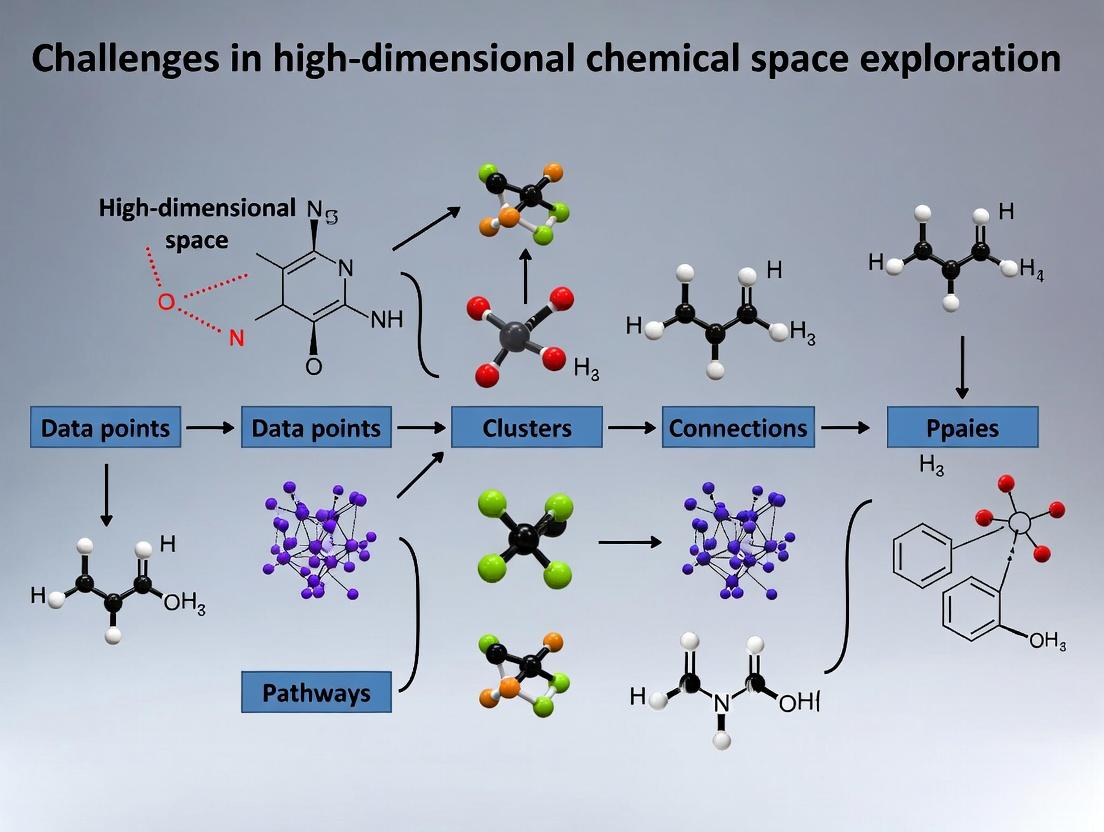
This article provides a comprehensive analysis of the fundamental, methodological, and practical challenges in exploring the astronomically large and complex high-dimensional chemical space for drug discovery.
Navigating the Vastness: Key Challenges and Modern Solutions in High-Dimensional Chemical Space Exploration for Drug Discovery
Abstract
This article provides a comprehensive analysis of the fundamental, methodological, and practical challenges in exploring the astronomically large and complex high-dimensional chemical space for drug discovery. Targeted at researchers, scientists, and drug development professionals, it covers the foundational concepts defining this space, modern computational and AI-driven exploration methods, critical strategies for troubleshooting and optimizing searches, and rigorous approaches for validating and benchmarking results. The synthesis offers a roadmap to navigate this 'chemical universe' more effectively, with direct implications for accelerating the identification of novel therapeutic candidates and optimizing lead compounds.
Defining the Vastness: Understanding the Scale and Fundamental Challenges of High-Dimensional Chemical Space
The exploration of chemical space—the total ensemble of all possible molecules—represents one of the most formidable challenges in modern science. The concept of a "Chemical Universe" quantifies this vastness, with estimates ranging from 10⁶⁰ to 10²⁰⁰ for drug-like organic molecules alone. This near-infinite expanse exists in a multidimensional domain defined by molecular descriptors, properties, and structural features. The primary thesis framing contemporary research is that efficient navigation, sampling, and exploitation of this high-dimensional space are fundamentally limited by combinatorial explosion, computational intractability, and experimental validation bottlenecks. This whitepaper details the scale, the methodologies for exploration, and the toolkit required for frontier research in this field.
Quantifying the Vastness: The Scale of Chemical Space
The following table summarizes key quantitative estimates of chemical space, highlighting the sources of combinatorial complexity.
Table 1: Estimated Scales of Chemical Space
| Space Definition | Estimated Size | Basis of Calculation | Key Reference/Concept |
|---|---|---|---|
| All Possible Organic Molecules | >10⁶⁰ (up to 10²⁰⁰) | Based on combinatorial assembly of atoms (C, H, O, N, S, etc.) following chemical rules (e.g., up to 30 atoms). | Bohacek et al. (1996); Angewandte Chemie reviews. |
| Drug-like (Lipinski-compliant) Molecules | ~10⁶³ | Molecules with MW ≤500, HBD ≤5, HBA ≤10, LogP ≤5. | Fink et al. (2005); GDB-17 database (166 billion molecules). |
| Synthetically Accessible Molecules | 10⁶ – 10⁷ (in known databases) | Compounds reported in literature or commercially available (e.g., CAS Registry: >200 million). | PubChem, ChEMBL, ZINC databases. |
| Chemical Space for DNA-Encoded Libraries (DELs) | 10⁸ – 10¹² | Practical experimental library sizes using combinatorial split-and-pool synthesis. | Recent DEL screening campaigns (2020-2024). |
| Virtual Screening Libraries | 10⁹ – 10¹⁵ | Commercially available and enumeratable virtual compounds for docking. | Enamine REAL Space (38+ billion), WuXi GalaXi. |
| Biologically Relevant Chemical Space | Unknown but tiny fraction | The subset of chemical space that interacts with any biological target. | Estimated <<0.1% of all drug-like space. |
Core Challenges in High-Dimensional Exploration
The exploration of this space is governed by the "curse of dimensionality," where volume grows exponentially with dimensions. Key challenges include:
- Representation: Choosing optimal molecular descriptors (fingerprints, SMILES, SELFIES, 3D coordinates, quantum properties).
- Navigation: Developing algorithms (e.g., Bayesian optimization, genetic algorithms, diffusion models) to traverse space efficiently towards optimal properties.
- Synthesis Planning: Bridging the gap between virtual molecules and synthetically accessible compounds (retrosynthesis prediction).
- Validation: The ultimate requirement for experimental testing of predicted molecules, creating a costly feedback loop.
Methodologies for Exploration: Experimental & Computational Protocols
Protocol: DNA-Encoded Library (DEL) Synthesis and Screening
This experimental high-throughput method samples chemical space combinatorially.
Detailed Protocol:
- Library Design: Define chemical building blocks (BBs) for 2-3 synthetic cycles (~100-5000 BBs per cycle).
- Split-and-Pool Synthesis:
- Cycle 1: Start with DNA headpieces. Split into separate reaction vessels. Couple a unique BB and a corresponding DNA tag encoding its identity to each pool.
- Pool: Combine all reactions into a single vessel.
- Cycle 2-n: Split the pool again into new vessels. Couple the next BB and its DNA tag.
- Repeat for desired cycles, creating a library where each molecule is conjugated to a unique DNA barcode recording its synthetic history.
- Affinity Selection: Incubate the pooled DEL with an immobilized protein target.
- Washing: Remove non-binding and weakly binding compounds.
- Elution & PCR: Elute bound compounds, amplify the DNA barcodes via PCR.
- Sequencing & Analysis: Perform high-throughput sequencing (NGS) of barcodes. Enriched barcodes identify hit structures for off-DNA resynthesis and validation.
Protocol: Active Learning-Driven Virtual Screening (VS) Cycle
A computational protocol to optimize exploration.
Detailed Protocol:
- Initial Library: Start with a diverse subset of a virtual library (10³-10⁵ compounds).
- Initial Scoring: Use a fast, approximate scoring function (e.g., 2D similarity, docking) to rank the initial library.
- Batch Selection: Select a top batch (e.g., 50-100 compounds) for more expensive evaluation (e.g., free-energy perturbation, MD simulation, or experimental assay).
- Model Training: Use the results (experimental/predicted activity) to train a machine learning model (e.g., Random Forest, Graph Neural Network) that predicts activity from molecular features.
- Iteration: Use the trained model to score the remaining unexplored library. Select the next batch using an acquisition function (e.g., expected improvement, upper confidence bound) that balances exploitation (high predicted score) and exploration (high model uncertainty).
- Loop: Repeat steps 3-5 until a performance threshold is met or resources are exhausted.
Diagram 1: Active Learning Cycle for Virtual Screening
Visualization of a Representative Workflow
Diagram 2: Chemical Space Exploration from Design to Validation
The Scientist's Toolkit: Key Research Reagent Solutions
Table 2: Essential Reagents & Materials for Chemical Space Exploration
| Item / Solution | Category | Primary Function in Exploration |
|---|---|---|
| DNA-Encoded Library (DEL) Kits | Chemical Biology | Provides pre-functionalized DNA headpieces, tagged building blocks, and enzymes for split-and-pool synthesis and PCR amplification of barcodes. |
| Diverse Building Block Sets | Synthetic Chemistry | Curated collections of commercially available, synthetically tractable molecules (amines, carboxylic acids, boronic acids, etc.) for combinatorial library construction. |
| Virtual Compound Libraries | Cheminformatics | Large, searchable databases of enumerated, often synthetically accessible molecules (e.g., Enamine REAL, Mcule, Molport) for virtual screening. |
| High-Throughput Screening (HTS) Assay Kits | Biology | Standardized biochemical or cell-based assay kits (e.g., kinase activity, GPCR signaling) for rapid experimental validation of compound activity. |
| Cloud Computing Credits | Computation | Access to scalable high-performance computing (HPC) or GPU clusters for running large-scale virtual screens, molecular dynamics, or ML model training. |
| Automated Synthesis Platforms | Robotics | Systems for solid-phase peptide synthesizers or flow chemistry reactors to automate the synthesis of predicted compounds. |
| Cheminformatics Software Suites | Software | Platforms like RDKit, Schrodinger Suite, OpenEye toolkits for molecular fingerprinting, descriptor calculation, and similarity searching. |
| Next-Generation Sequencer | Genomics | Essential for decoding DNA barcodes in DEL selections to identify enriched compounds. |
| Analytical HPLC-MS Systems | Analytical Chemistry | For purification and critical quality control (purity, identity) of synthesized candidate molecules post-virtual screen or DEL hit confirmation. |
Within the overarching thesis on the Challenges in high-dimensional chemical space exploration research, the fundamental task of molecular representation is paramount. The vastness and complexity of chemical space, estimated to contain >10⁶⁰ synthetically accessible compounds, necessitate efficient, information-rich numerical encodings of molecules. This guide details the three primary paradigms—Molecular Descriptors, Molecular Fingerprints, and Property Vectors—that serve as the foundational dimensions for computational chemistry, virtual screening, and quantitative structure-activity relationship (QSAR) modeling. Their selection and application directly influence the success and interpretability of research grappling with the "curse of dimensionality" in chemical data analysis.
Core Concepts & Quantitative Comparison
Molecular Descriptors
Descriptors are numerical values derived from a molecule's symbolic representation, quantifying physico-chemical properties, topological features, or geometric attributes. They are typically interpretable and aligned with chemical intuition.
Common Types:
- 0D/1D (Constitutional): Molecular weight, atom count, bond count, logP.
- 2D (Topological): Based on molecular graph theory (e.g., connectivity indices, Wiener index).
- 3D (Geometric): Require 3D conformation (e.g., moment of inertia, polar surface area, radial distribution functions).
Molecular Fingerprints
Fingerprints are binary or integer vectors representing the presence or count of specific substructural patterns within a molecule. They are designed for high-speed similarity searching and machine learning.
Common Types:
- Substructure Key-based (e.g., MACCS Keys): A fixed-length binary vector where each bit indicates the presence of a predefined chemical substructure.
- Circular (e.g., ECFP, Morgan): Iteratively generated from each atom's local environment, capturing radial substructures. They are hashed to a fixed length.
- Path-based (e.g., RDKit Fingerprint): Enumerates all linear paths of bonds up to a given length within the molecule.
Property Vectors
Property vectors are collections of experimentally measured or accurately computed physico-chemical properties (e.g., pKa, solubility, boiling point). They provide a direct, often lower-dimensional mapping to real-world behavior but can be costly to obtain at scale.
Table 1: Comparative Analysis of Representation Types
| Dimension Type | Typical Vector Length | Interpretability | Computation Speed | Data Dependency | Primary Use Case |
|---|---|---|---|---|---|
| 2D Descriptors | 200 - 5000+ | High | Fast | Low (2D structure only) | QSAR, Interpretable ML |
| 3D Descriptors | 500 - 3000+ | Medium | Slow (requires conformers) | Medium | 3D-QSAR, Pharmacophore modeling |
| MACCS Keys | 166 bits | Medium | Very Fast | Low | Rapid similarity screening |
| ECFP4 | 1024 - 2048 bits | Low (hashed) | Fast | Low | Activity prediction, similarity search |
| Property Vectors | 10 - 100 | Very High | Very Slow (for measurement) | High (experimental data) | Solubility/ADMET prediction |
Table 2: Common Software Libraries & Toolkits (2024)
| Library/Tool | Primary Language | Key Strengths | Descriptor Support | Fingerprint Support |
|---|---|---|---|---|
| RDKit | Python, C++ | Comprehensive, Open-source | Extensive (2000+) | ECFP, Morgan, Atom Pairs, RDKit FP |
| PaDEL-Descriptor | Java, CLI | Standalone, 1875+ descriptors | Very Extensive | 12 fingerprint types |
| Open Babel | C++, CLI | Format conversion, Cheminformatics | Good | Basic fingerprints |
| CDK | Java | Open-source, Toolkit for Java | Extensive | Extended, Hybridization fingerprints |
| Mordred | Python | Massive descriptor set (1800+) | Most extensive (>1800) | Limited |
Experimental Protocols for Benchmarking Representations
The choice of molecular representation significantly impacts model performance in predictive tasks. The following protocol outlines a standard benchmarking experiment.
Protocol 1: Benchmarking Representations for a QSAR Classification Task
- Objective: Evaluate the predictive performance of different molecular representations on a binary activity classification dataset.
- Dataset: Use a curated public dataset (e.g., from ChEMBL) with >1000 compounds and a clear activity cutoff. Apply rigorous data curation: remove duplicates, standardize structures, check for activity cliffs.
- Representation Generation:
- Descriptors: Calculate using RDKit or Mordred. Handle missing values (impute or remove descriptors). Apply standardization (scale to zero mean, unit variance).
- Fingerprints: Generate ECFP4 (1024 bits, radius=2), Morgan (1024 bits, radius=2), and MACCS keys using RDKit.
- Property Vectors: Use a limited set of computed properties (e.g., AlogP, molecular weight, H-bond donors/acceptors, rotatable bonds).
- Model Training & Validation:
- Split data into 80% training and 20% test set using stratified sampling.
- Train a Random Forest classifier (100 trees) on the training set for each representation type. Use 5-fold cross-validation on the training set for hyperparameter tuning.
- Apply the trained model to the held-out test set.
- Evaluation Metrics: Record AUC-ROC, Balanced Accuracy, Precision, and Recall for the test set. Perform statistical significance testing (e.g., McNemar's test) on model predictions.
Protocol 2: Generating a Conformer-Dependent 3D Descriptor Vector
- Objective: Create a 3D property-encoded surface (3D-PES) descriptor for a set of molecules.
- Software Required: RDKit (conformer generation), Open3DALIGN or in-house scripts for alignment, Python for calculation.
- Steps:
- Conformer Generation: For each input SMILES, generate an ensemble of low-energy conformers (e.g., 50) using ETKDGv3 method in RDKit. Minimize energy using MMFF94 force field.
- Conformer Selection: Select the lowest-energy conformer or a representative centroid conformer from the ensemble.
- Molecular Alignment: Align all selected conformers to a common reference framework using the Kabsch algorithm to ensure spatial consistency.
- Grid Calculation: Embed the molecule in a 3D grid (e.g., 1Å resolution).
- Descriptor Calculation: At each grid point, compute steric, electrostatic, and hydrophobic potential fields using probe atoms. Flatten the 3D grid into a 1D descriptor vector.
Visualizing Workflows and Relationships
Diagram 1: Molecular Representation Generation Workflow
Diagram 2: Challenges in High-Dimensional Chemical Space
The Scientist's Toolkit: Research Reagent Solutions
Table 3: Essential Software & Computational Tools
| Item (Tool/Resource) | Function/Explanation | Provider/License |
|---|---|---|
| RDKit | Open-source cheminformatics toolkit for descriptor calculation, fingerprint generation, and molecule manipulation. | Open-Source (BSD) |
| Knime Analytics Platform | Visual workflow environment with integrated cheminformatics nodes (RDKit, CDK) for building analysis pipelines. | Free & Commercial |
| Python (SciKit-Learn) | Core library for implementing machine learning models and validation frameworks on chemical vector data. | Open-Source (BSD) |
| DeepChem | Python library specifically designed for deep learning on chemical data, supporting multiple representations. | Open-Source (MIT) |
| DataWarrior | Standalone program for interactive analysis, visualization, and descriptor calculation for chemical datasets. | Open-Source (GPL) |
| Jupyter Notebook | Interactive computational environment essential for exploratory data analysis and prototyping models. | Open-Source (BSD) |
| ChEMBL Database | Manually curated database of bioactive molecules with properties, providing high-quality training/test data. | EMBL-EBI (Open) |
| ZINC20 Database | Free database of commercially available compounds (230+ million) for virtual screening, often with precomputed properties. | UCSF (Open) |
Within the context of high-dimensional chemical space exploration, the central paradox lies in the astronomical size of theoretically accessible molecular space (estimated at 10^60-10^100 compounds) versus the extreme sparseness of regions with desirable biological activity, bioavailability, and safety profiles. This whitepaper examines the quantitative dimensions of this paradox, outlines methodologies for its navigation, and presents a toolkit for researchers.
The Quantitative Scale of the Paradox
The Vastness: Size of Chemical Space
Chemical space refers to the total ensemble of all possible organic molecules under consideration. Its size is a function of the number of atoms, permissible elements, and structural constraints.
Table 1: Estimated Sizes of Chemical Space Subsets
| Chemical Space Subset | Estimated Size | Description & Relevance |
|---|---|---|
| Drug-like (Rule of 5 compliant) | ~10^60 molecules | Molecules with MW ≤ 500, LogP ≤ 5, etc. |
| Synthetically Accessible (e.g., from commercial building blocks) | ~10^9 - 10^14 molecules | Focus of most virtual libraries and DELs. |
| PubChem Compounds (Actual) | ~114 million (as of 2024) | Experimentally realized molecules. |
| Approved Drugs | ~2,000 small molecules | The ultimate sparse, relevant region. |
The Sparsity: Metrics of Biological Relevance
Sparsity is defined by the fraction of molecules that modulate a specific biological target with adequate potency and selectivity.
Table 2: Hit Rate Metrics Across Discovery Platforms
| Exploration Platform | Typical Hit Rate | Target Class Dependency |
|---|---|---|
| High-Throughput Screening (HTS) | 0.001% - 0.3% | Enzyme > GPCR > PPIs |
| DNA-Encoded Libraries (DEL) | 0.001% - 0.1% (in library) | Highly dependent on library design. |
| Virtual Screening (VS) | 0.01% - 5% (of screened) | Varies widely with method & target. |
| Fragment-Based Screening | 2% - 20% (binders) | High rates for binding, low affinity. |
Methodologies for Navigating the Paradox
Experimental Protocol: Triage via Hierarchical Screening
A standard protocol to efficiently filter vast libraries towards sparse hits.
Protocol: Integrated HTS/Virtual Screening Cascade
- Primary In Silico Filtering:
- Method: Apply drug-like filters (e.g., Lipinski's Rule of 5, PAINS removal, synthetic tractability score) to a virtual library of 10^8 compounds.
- Tools: RDKit, KNIME, Pipeline Pilot.
- Output: Reduced set of 1-2 million compounds for docking.
Structure-Based Virtual Screening:
- Method: Perform molecular docking (Glide, GOLD, AutoDock Vina) of filtered library against a prepared protein target structure (PDB).
- Scoring: Use consensus scoring (ChemPLP, GoldScore, ASP) to rank poses.
- Output: Top 50,000 - 100,000 ranked compounds.
Pharmacophore Modeling & Clustering:
- Method: Generate pharmacophore model from docking hits or known actives. Cluster remaining compounds by scaffold.
- Tools: Phase (Schrödinger), MOE.
- Output: 2,000 - 5,000 diverse compounds for purchase/synthesis.
Experimental HTS Confirmation:
- Assay: Biochemical assay (e.g., fluorescence polarization, TR-FRET) at 10 µM single concentration.
- Criteria: >50% inhibition/activation for primary hits.
- Output: 50-200 confirmed hits (0.5-4% hit rate from VS subset).
Experimental Protocol: Focused Library Design from Fragment Hits
A protocol to expand sparse, low-affinity fragments into lead-like compounds.
Protocol: Fragment-Based Lead Discovery (FBLD) Expansion
- Fragment Screening via SPR/Biophysics:
- Method: Screen a 1,000-5,000 fragment library (MW < 300) using Surface Plasmon Resonance (Biacore) or NMR.
- Threshold: Identify binders with K_D < 1 mM, ligand efficiency (LE) > 0.3 kcal/mol/HA.
Co-structure Determination:
- Method: Soak fragment into protein crystals or use Cryo-EM for complexes. Solve structure to 2.0-2.5 Å resolution.
Structure-Based Design & Analog Synthesis:
- Method: Use structural data to design analogs growing into adjacent sub-pockets. Synthesize focused library of 100-500 analogs.
Iterative Screening & Optimization:
- Method: Test analogs in dose-response (IC50/K_D). Determine new co-structures. Iterate design cycles until potency (nM) and LE are optimized.
Visualizing the Exploration Workflow
Title: Navigating from Vast Space to Sparse Drug
A Key Signaling Pathway in Oncology Target Space
Title: PI3K-AKT-mTOR Pathway & Drug Target Context
The Scientist's Toolkit: Research Reagent Solutions
Table 3: Essential Reagents & Tools for Chemical Space Exploration
| Item | Function & Role in Paradox Navigation | Example Product/Category |
|---|---|---|
| Fragment Libraries | Low molecular weight (MW < 300) compounds for efficient sampling of chemical space; high hit rate for binding. | Maybridge RO3 Fragment Library, Enamine Fragments. |
| DNA-Encoded Libraries (DELs) | Combinatorial libraries where each compound is tagged with a unique DNA barcode, enabling screening of 10^9+ compounds in a single tube. | X-Chem, DyNAbind libraries; Vipergen technology. |
| Kinase Inhibitor Chemotypes | Focused sets of scaffolds known to bind kinase ATP pockets, navigating to sparse, selective regions. | Selleckchem Kinase Inhibitor Set, Published " hinge-binder" scaffolds. |
| Cryo-EM Services | For determining structures of target-hit complexes where crystallization fails, critical for sparse hit optimization. | Thermo Fisher Glacios, Titan Krios microscopes; service providers. |
| AlphaFold2 Protein DB | High-accuracy predicted protein structures for targets without experimental structures, expanding virtual screening scope. | AlphaFold Protein Structure Database (EMBL-EBI). |
| Activity Cliff Matrices | Paired compound data showing large potency changes from small structural changes, mapping relevance boundaries. | CHEMBL activity data; curated via KNIME/RDKit. |
| ADMET Prediction Suites | In silico tools to predict absorption, toxicity, etc., filtering vast virtual sets for sparse "drug-like" space. | Schrödinger QikProp, Simulations Plus ADMET Predictor. |
In the pursuit of novel therapeutics, researchers explore the vast, high-dimensional chemical space, estimated to contain >10⁶⁰ synthetically accessible organic molecules. This exploration is fundamentally governed by the curse of dimensionality, a phenomenon where geometric and statistical intuitions from low-dimensional spaces catastrophically break down. This whitepaper examines how this curse distorts distance metrics—the bedrock of similarity searching, clustering, and machine learning in drug discovery—framed within the critical challenge of navigating high-dimensional chemical spaces for hit identification and lead optimization.
The Geometric Breakdown of Intuition
Volume Concentration and Data Sparsity
In high dimensions, the volume of a hypercube concentrates overwhelmingly in its corners, while the volume of an inscribed hypersphere becomes negligible. This leads to extreme data sparsity, where any finite dataset becomes a collection of isolated points.
Table 1: Fraction of Hypercube Volume Contained in an Inscribed Hypersphere
| Dimensionality (d) | Radius of Inscribed Sphere | Fraction of Cube's Volume in Sphere |
|---|---|---|
| 2 | 0.5 | ~0.785 |
| 5 | 0.5 | ~0.164 |
| 10 | 0.5 | ~0.0025 |
| 20 | 0.5 | ~2.5e-8 |
| 100 | 0.5 | ~1.9e-70 |
Data derived from analytic formula: V_sphere / V_cube = (π^(d/2) / (2^d Γ(1 + d/2)))
Breakdown of Nearest-Neighbor Search
The utility of similarity search, fundamental to virtual screening, diminishes as the distance to the nearest neighbor (NN) and the distance to the farthest neighbor (FN) converge.
Table 2: Relative Contrast in Distances with Increasing Dimensionality
| d | E[Distance to NN] / E[Distance to FN] (Synthetic Gaussian Data) | Implication for Similarity Search |
|---|---|---|
| 2 | ~0.32 | Clear discrimination between near and far |
| 10 | ~0.70 | Reduced discriminative power |
| 50 | ~0.95 | NN and FN are nearly indistinguishable |
| 500 | ~0.998 | Search becomes essentially meaningless |
Experimental Protocol for Table 2 Data:
- Data Generation: For each dimensionality d in {2, 10, 50, 500}, generate a dataset X of 10,000 points sampled from a d-dimensional standard Gaussian distribution (mean=0, variance=1).
- Query Point: Sample a single query point q from the same distribution.
- Distance Calculation: Compute the Euclidean distance from q to every point in X.
- Statistics Extraction: Find the minimum distance (to NN) and maximum distance (to FN).
- Ratio Computation: Calculate the ratio E[min dist] / E[max dist]. Repeat steps 2-5 for 100 random query points and average the ratio to obtain the expected value.
- Tools: Implementation can be performed in Python using
numpyfor array operations andscipy.spatial.distance.cdist.
Title: Experimental Protocol for Distance Ratio Analysis
Quantitative Analysis of Distance Metric Behavior
Mean, Variance, and Concentration Theorems
For i.i.d. feature vectors, the squared Euclidean distance between points becomes concentrated around its mean with vanishing relative variance.
Table 3: Statistics of Pairwise Euclidean Distances (Unit Cube [0,1]^d)
| d | Mean Distance (μ) | Standard Deviation (σ) | Coefficient of Variation (σ/μ) |
|---|---|---|---|
| 1 | 0.333 | 0.235 | 0.706 |
| 10 | 1.83 | 0.257 | 0.140 |
| 50 | 4.08 | 0.115 | 0.028 |
| 200 | 8.16 | 0.058 | 0.007 |
Experimental Protocol for Table 3:
- Data Generation: For each d, sample 1,000 points uniformly from the d-dimensional unit hypercube.
- Pairwise Distance Matrix: Compute the full pairwise Euclidean distance matrix for the 1,000 points (excluding self-distances). This yields ~500,000 distance samples.
- Statistical Computation: Calculate the sample mean (μ), sample standard deviation (σ), and the coefficient of variation (σ/μ) of these distances.
- Tools: Use efficient vectorized computation (e.g.,
scipy.spatial.distance.pdist).
Comparative Performance of Distance Metrics
Not all metrics degrade identically. The fractional (Lᵖ) norms with p<2 can sometimes offer better contrast.
Table 4: Discriminative Power of Metrics in High-Dimensions
| Metric (Lᵖ) | p-value | Expression | Relative Contrast (d=100)* | Suitability for Chemical Descriptors | ||
|---|---|---|---|---|---|---|
| Euclidean | 2 | √(Σ | xi - yi | ²) | 1.00 (Baseline) | Standard, but suffers concentration |
| Manhattan | 1 | Σ | xi - yi | 1.27 | More robust to noise, less concentrated | |
| Fractional | 0.5 | (Σ√ | xi - yi | )² | 2.15 | Higher contrast, non-convex |
| Cosine | N/A | 1 - (x·y)/(‖x‖‖y‖) | Varies | Effective for normalized, sparse vectors (e.g., fingerprints) |
Relative Contrast defined as (Mean Distance) / (Std Dev of Distances) normalized to Euclidean baseline. Derived from synthetic data with i.i.d. non-negative features (e.g., molecular descriptor counts).
Implications for Key Drug Discovery Tasks
Virtual Screening and Similarity Searching
Traditional similarity searching using 2D fingerprints (e.g., 1024-bit ECFP4) operates in a ~1000-dimensional Hamming space. The curse implies that average similarity scores between random molecules become increasingly high, reducing the signal-to-noise ratio.
Clustering and Diversity Analysis
Clustering algorithms like k-means rely on compact, separated clusters. In high dimensions, the minimal cluster separation required for reliable recovery grows exponentially with d, making many putative clusters artifacts.
Machine Learning Model Generalization
Models trained on high-dimensional descriptors (e.g., >5000 MOE descriptors) are prone to overfitting due to the data sparsity and irrelevant features, necessitating aggressive dimensionality reduction or regularization.
Title: Impact and Mitigation of the Curse in Drug Discovery
The Scientist's Toolkit: Research Reagent Solutions
Table 5: Essential Computational Tools for High-Dimensional Chemical Analysis
| Tool / Reagent | Function / Purpose | Key Consideration for High-Dimensions |
|---|---|---|
| ECFP4 / FCFP4 Fingerprints (1024-2048 bit) | Sparse binary vectors representing molecular substructures. | High dimensionality (≈2¹⁰²⁴ possible points) but sparse; cosine/Tanimoto effective. |
| MOE / Dragon Descriptors (1500-5000 cont. vars) | Comprehensive physicochemical & topological descriptors. | Dense, correlated; requires rigorous feature selection (e.g., variance threshold, mutual information). |
| UMAP (Uniform Manifold Approximation) | Non-linear dimensionality reduction for visualization. | Superior to t-SNE for preserving global structure; critical for pre-ML processing. |
| PCA (Principal Component Analysis) | Linear dimensionality reduction to orthogonal components. | Retains variance but may lose non-linear structure; determine # components via scree plot. |
| Random Forest / XGBoost with Feature Importance | ML models with built-in feature ranking. | Provides regularization and identifies key dimensions driving activity. |
| Tanimoto (Jaccard) Coefficient | Similarity metric for binary fingerprints: T = (A∩B)/(A∪B). | Standard for fingerprints; less prone to complete concentration than Euclidean on binary data. |
Scikit-learn NearestNeighbors with metric='cosine' |
Efficient nearest-neighbor search implementation. | Use for normalized descriptor sets; more stable in high-d. |
| GPU-Accelerated Libraries (e.g., RAPIDS cuML) | For distance matrix computation on massive datasets. | Enables brute-force calculation on billion-scale molecules in feasible time. |
The search for novel, potent, and safe chemical entities is fundamentally an exploration problem within a vast, high-dimensional chemical space, estimated to contain between 10²³ to 10⁶⁰ synthetically accessible molecules. Navigating this space poses immense challenges: the curse of dimensionality, the multi-objective nature of optimization (efficacy, selectivity, ADMET), and the sparse distribution of desirable properties. This whitepaper charts the evolution of computational paradigms developed to tackle these challenges, from classical Quantitative Structure-Activity Relationship (QSAR) models to modern deep generative models, providing a technical guide to their methodologies and applications.
Paradigm I: Classical QSAR & Pharmacophore Modeling
Classical QSAR establishes a quantitative relationship between a congeneric series of molecules' physicochemical descriptors and their biological activity using statistical methods.
Core Methodology & Experimental Protocol
A. Data Curation & Descriptor Calculation:
- Compound Library: A congeneric series of 50-500 molecules with measured biological activity (e.g., IC₅₀, Ki).
- Descriptor Generation: Calculate 2D molecular descriptors (e.g., logP, molar refractivity, topological indices) using software like Dragon, RDKit, or MOE.
- Data Preprocessing: Normalize descriptor values and the biological response variable (e.g., -logIC₅₀).
B. Model Building & Validation:
- Feature Selection: Use stepwise regression, genetic algorithms, or principal component analysis (PCA) to reduce dimensionality.
- Model Training: Apply Multiple Linear Regression (MLR) or Partial Least Squares (PLS) regression.
- Validation: Perform leave-one-out (LOO) or leave-many-out (LMO) cross-validation. Critical metrics: Q² (cross-validated R²) > 0.5, R² (coefficient of determination), and standard error of estimation.
- Applicability Domain: Define the chemical space of the model to flag extrapolations.
Table 1: Representative QSAR Model Performance Metrics (Hypothetical Case Study)
| Model Type | Training Set (N) | Test Set (N) | R² | Q² (LOO) | RMSE (Test) | Key Descriptors |
|---|---|---|---|---|---|---|
| MLR (Hansch) | 80 | 20 | 0.85 | 0.78 | 0.45 log units | logP, σ (Hammett), MR |
| PLS | 150 | 50 | 0.89 | 0.82 | 0.38 log units | PCI, PC2 (from 200 descriptors) |
| HQSAR (Signature) | 100 | 25 | 0.87 | 0.80 | 0.41 log units | Atom/Bond sequence fragments |
Research Reagent Solutions (Classical QSAR)
| Item | Function & Rationale |
|---|---|
| SYBYL/CODESSA | Legacy software suites for comprehensive descriptor calculation (topological, electronic, geometric). |
| Dragon Software | Calculates >5000 molecular descriptors for robust statistical analysis. |
| PCR/PLS Toolbox (MATLAB) | Statistical toolkits for performing Principal Component Regression and Partial Least Squares regression on high-dimensional descriptor matrices. |
| Congeneric Compound Libraries | Commercially available or custom-synthesized series with systematic structural variations, essential for interpretable model building. |
Title: Classical QSAR Model Development Workflow
Paradigm II: Structure-Based Design & Docking
This paradigm leverages 3D protein structures to simulate and score ligand binding, enabling the virtual screening of large libraries.
Core Methodology & Experimental Protocol
A. Structure Preparation & Library Generation:
- Protein Preparation: Obtain a high-resolution X-ray or Cryo-EM structure (PDB). Remove water, add hydrogens, assign protonation states (e.g., using PROPKA), and optimize side chains.
- Ligand Library Preparation: Generate a database of 10⁵–10⁷ commercially available or enumerated compounds. Generate 3D conformers, assign charges (e.g., Gasteiger), and minimize energy.
B. Molecular Docking & Scoring:
- Binding Site Definition: Define the active site from co-crystallized ligand or via computational prediction (e.g., FTMap).
- Docking Execution: Use software like AutoDock Vina, Glide, or GOLD. Key parameters: search exhaustiveness, pose clustering.
- Post-Docking Analysis: Rank poses by scoring function (e.g., ChemPLP, GlideScore). Visually inspect top poses. Apply consensus scoring or rescoring with MM/GBSA.
Table 2: Performance Benchmark of Docking Programs (Generalized from Recent Reviews)
| Docking Software | Pose Prediction Success Rate (%) | Virtual Screening Enrichment (EF₁%) | Typical Runtime/Ligand | Scoring Function |
|---|---|---|---|---|
| AutoDock Vina | ~70-80 | 10-25 | 1-2 min | Hybrid (Vina) |
| Glide (SP) | ~75-85 | 15-30 | 2-5 min | Empirical (GlideScore) |
| GOLD | ~75-80 | 12-28 | 3-7 min | Empirical (ChemPLP, GoldScore) |
| DiffDock | ~80-90* | N/A (Emerging) | ~1 min* | Diffusion Model |
Note: DiffDock is a recent AI-based method with promising initial results.
Research Reagent Solutions (Structure-Based Design)
| Item | Function & Rationale |
|---|---|
| Protein Data Bank (PDB) | Primary repository for experimentally determined 3D structures of proteins and complexes. |
| MOE (Molecular Operating Environment) | Integrated platform for protein preparation, site analysis, docking, and molecular mechanics. |
| Schrödinger Suite (Maestro) | Industry-standard software for advanced protein preparation (Protein Prep Wizard), docking (Glide), and free energy perturbation (FEP+). |
| ZINC20/Enamine REAL Libraries | Publicly available and commercial ultra-large libraries of tangible molecules for virtual screening. |
| MM/GBSA Rescoring Scripts | Post-processing scripts (e.g., in Amber or Schrödinger) to improve binding affinity prediction via more rigorous thermodynamics. |
Title: Structure-Based Virtual Screening Pipeline
Paradigm III: Machine Learning & Generative Models
Modern deep learning directly learns complex patterns from data to predict molecular properties or generate novel molecular structures de novo.
Core Methodology: Generative Model Training
A. Data: Large datasets of known molecules (e.g., ChEMBL, ZINC, PubChem) represented as SMILES strings, graphs, or 3D coordinates.
B. Model Architectures & Training Protocols:
- VAE (Variational Autoencoder):
- Encoder: Maps input molecule (SMILES) to a latent vector
zin a continuous, Gaussian-distributed space. - Decoder: Reconstructs the molecule from
z. - Loss: Reconstruction loss + KL divergence loss (to regularize the latent space).
- Generation: Sample a random
zvector from the prior distribution and decode.
- Encoder: Maps input molecule (SMILES) to a latent vector
GAN (Generative Adversarial Network):
- Generator: Creates novel molecular structures from noise.
- Discriminator: Distinguishes real (training set) from generated molecules.
- Adversarial Training: Generator learns to fool the discriminator.
Transformer/Autoregressive Models:
- Treats SMILES string as a sequence (like text).
- Trained via next-token prediction (e.g., GPT-style).
- Generation is sequential, token-by-token.
Diffusion Models:
- Forward Process: Gradually adds noise to a molecular graph over many steps.
- Reverse Process: A neural network is trained to denoise, learning to generate molecules from pure noise.
- State-of-the-art for 3D molecule generation (e.g., TargetDiff, DiffDock).
C. Conditional Generation & Optimization:
- Goal: Generate molecules with desired properties (pIC₅₀ > 8, logP < 3).
- Method: Use a conditional VAE/Transformer or apply Bayesian Optimization/Reinforcement Learning (RL) on the latent space. The property predictor (a separate or joint NN) provides the reward signal.
Table 3: Comparison of Modern Generative Model Architectures
| Model Type | Representation | Latent Space | Key Advantage | Key Challenge |
|---|---|---|---|---|
| VAE (e.g., JT-VAE) | Graph/SMILES | Continuous, Gaussian | Smooth, explorable space. | Tendency to generate invalid structures. |
| GAN (e.g., ORGAN) | SMILES | Implicit (Noise) | Can produce high-quality samples. | Training instability, mode collapse. |
| Transformer (e.g., ChemBERTa) | SMILES (Sequence) | Attention Weights | Captures long-range dependencies. | Sequential generation can be slow. |
| Graph Diffusion (e.g., GDSS) | Graph (2D/3D) | Noise Levels | State-of-the-art quality, robust. | Computationally intensive sampling. |
Research Reagent Solutions (Generative AI)
| Item | Function & Rationale |
|---|---|
| RDKit | Open-source cheminformatics toolkit essential for converting molecules to features, fingerprinting, and evaluating generated molecules (validity, uniqueness). |
| PyTorch Geometric | Library for deep learning on graphs, implementing graph neural networks (GNNs) for encoders and property predictors. |
| TensorFlow/PyTorch | Core deep learning frameworks for building and training VAEs, GANs, and Transformers. |
| ChEMBL Database | Manually curated database of bioactive molecules with associated targets and ADMET data, crucial for training conditional models. |
| GuacaMol/ MOSES Benchmarks | Standardized benchmarks and datasets for evaluating the performance and fairness of generative models. |
Title: Conditional Molecule Generation with Deep Learning
Synthesis & Future Trajectory
The evolution from QSAR to generative AI represents a shift from interpolation within known chemical series to extrapolation and de novo creation guided by learned chemical principles. The future lies in hybrid models that integrate physical simulation (docking, FEP) with generative AI for explainable, multi-objective optimization, directly addressing the core challenges of high-dimensional chemical space exploration.
Table 4: Paradigm Comparison Summary
| Exploration Paradigm | Core Principle | Chemical Space Scope | Key Strength | Primary Limitation |
|---|---|---|---|---|
| Classical QSAR | Linear Regression on Descriptors | Very Local (Congeneric) | Highly Interpretable, Fast | Limited Extrapolation, Needs Congeneric Data |
| Structure-Based Docking | Physical Simulation of Binding | Global (Library Screening) | Structure-Rational, Target-Specific | Dependent on Protein Structure, Scoring Errors |
| Generative AI (Deep Learning) | Learn Distribution & Generate | Vast & Unexplored | De Novo Design, Multi-Objective Optimization | "Black Box", Requires Large Data, Synthetic Feasibility |
Mapping the Unknown: Modern Computational and AI Methodologies for Chemical Space Navigation
The exploration of high-dimensional chemical space, estimated to contain over 10^60 synthesizable drug-like molecules, presents a fundamental challenge in modern drug discovery. Traditional virtual screening, predominantly reliant on molecular docking, struggles with this immense complexity due to limitations in scoring function accuracy, conformational sampling, and the simplistic treatment of protein-ligand interactions. This whitepaper frames the evolution to "Virtual Screening 2.0" within the broader thesis that effective navigation of this expansive space requires a paradigm shift: integrating physics-based simulations with data-driven machine learning (ML) classifiers to create more predictive, efficient, and holistic prioritization pipelines.
The Limitations of Docking and the ML Augmentation Rationale
Molecular docking, while computationally efficient, often yields high false-positive rates. Its scoring functions, typically empirical or knowledge-based, fail to capture critical entropic and solvation effects accurately. Machine learning classifiers address these gaps by learning complex, non-linear relationships from historical experimental data (e.g., binding affinities, bioactivity labels). They can integrate diverse feature sets beyond docking scores—such as molecular descriptors, pharmacophore fingerprints, and even interaction fingerprints from docking poses—to distinguish true actives from decoys with superior precision.
Core Machine Learning Classifiers in Virtual Screening 2.0
The following table summarizes the primary ML classifiers employed, their key characteristics, and typical performance benchmarks as reported in recent literature (2023-2024).
Table 1: Key Machine Learning Classifiers for Enhanced Virtual Screening
| Classifier | Principle | Typical Input Features | Reported AUC-ROC Range (Recent Studies) | Key Advantage | Key Limitation |
|---|---|---|---|---|---|
| Random Forest (RF) | Ensemble of decision trees | Docking scores, molecular fingerprints (ECFP), descriptors | 0.75 - 0.92 | Robust to overfitting, provides feature importance. | Can be less interpretable than single trees. |
| Gradient Boosting Machines (GBM/XGBoost/LightGBM) | Sequential ensemble correcting prior errors | Similar to RF, plus protein sequence descriptors. | 0.78 - 0.95 | High predictive accuracy, handles mixed data types. | Prone to overfitting without careful tuning. |
| Deep Neural Networks (DNN) | Multi-layer perceptrons learning hierarchical representations | Raw or pre-processed molecular graphs, 3D voxel grids. | 0.82 - 0.98 | Captures complex, abstract patterns directly from data. | High computational cost, requires large datasets. |
| Graph Neural Networks (GNN) | Operates directly on molecular graph structure | Atom features, bond features, adjacency matrix. | 0.85 - 0.99 | Natively models molecular topology and geometry. | Complex training, data-hungry. |
| Support Vector Machines (SVM) | Finds optimal hyperplane to separate classes | Molecular fingerprints, interaction fingerprints. | 0.70 - 0.88 | Effective in high-dimensional spaces. | Poor scalability to very large datasets. |
Detailed Experimental Protocol: A Hybrid Docking-ML Workflow
This protocol outlines a standard pipeline for building and validating an ML-enhanced virtual screening campaign.
Protocol: Hybrid Docking and Random Forest Classifier for Kinase Inhibitor Screening
A. Objective: To prioritize potential inhibitors of a target kinase from a large commercial library (e.g., ZINC20).
B. Materials & Data Preparation:
- Target Structure: Obtain a high-resolution crystal structure of the kinase domain (PDB ID).
- Active Compounds: Compile a set of known active inhibitors (≥ 100 compounds) from public databases (ChEMBL, BindingDB).
- Decoy Compounds: Generate property-matched decoy molecules (10-50 per active) using tools like DUD-E or DECOYFINDER to create a balanced negative set.
- Screening Library: Prepare the million-compound library in a dockable format (e.g., SDF, MOL2), including protonation and energy minimization.
C. Methodology:
Step 1: Molecular Docking
- Software: Use AutoDock Vina, Glide, or rDock.
- Procedure: Define the binding site using co-crystallized ligand coordinates. Dock all active and decoy compounds, plus the screening library. For each molecule, retain the top 3-5 poses by docking score.
- Output: For each molecule: best docking score, interaction fingerprints for the best pose, and the pose coordinates.
Step 2: Feature Engineering
- Calculate 200+ molecular descriptors (e.g., logP, TPSA, number of rotatable bonds) using RDKit or MOE.
- Generate Extended-Connectivity Fingerprints (ECFP4, 2048 bits).
- Extract interaction fingerprints from the top docking pose (e.g., presence/absence of H-bonds, hydrophobic contacts with specific residues).
- Result: A unified feature vector per molecule combining docking score, descriptors, ECFP, and interaction fingerprint.
Step 3: ML Model Training & Validation (on Active/Decoy Set)
- Algorithm: Scikit-learn RandomForestClassifier.
- Data Split: 80% of active/decoy data for training, 20% held-out for testing.
- Training: Use the training set features to train the RF model (typical parameters: nestimators=500, maxdepth=10). The model learns to classify "active" vs. "decoy."
- Validation: Predict on the held-out test set. Evaluate using AUC-ROC, enrichment factors (EF1%, EF10%), precision-recall curves.
Step 4: Virtual Screening Prioritization
- Application: Apply the trained and validated RF model to the feature vectors of the entire million-compound screening library.
- Output: Each compound receives a predicted probability of being "active" (a value between 0 and 1).
- Ranking: Rank the entire library by this ML-predicted probability. The top-ranked compounds (e.g., top 0.1%) constitute the final Virtual Screening 2.0 hit list.
D. Validation: Prospective validation involves purchasing and experimentally testing (e.g., biochemical assay) the top-ranked compounds to determine the true hit rate, comparing it to the hit rate from docking-score ranking alone.
Visualization of Workflows and Data Relationships
Virtual Screening 2.0: Integrated Docking-ML Workflow
The Scientist's Toolkit: Essential Research Reagents & Solutions
Table 2: Key Research Reagent Solutions for Virtual Screening 2.0
| Item | Function in VS 2.0 | Example Product/Software | Explanation |
|---|---|---|---|
| High-Quality Protein Structures | Provides the 3D target for docking and interaction fingerprinting. | RCSB PDB, AlphaFold DB | Experimental (X-ray, Cryo-EM) or highly accurate predicted structures are fundamental. |
| Curated Bioactivity Data | Serves as labeled data for training and testing ML models. | ChEMBL, BindingDB, PubChem BioAssay | Large, high-confidence datasets of active/inactive compounds are crucial for supervised learning. |
| Chemical Library | The source of candidate molecules for screening. | ZINC20, Enamine REAL, MCule | Large, diverse, commercially available compound libraries in ready-to-dock formats. |
| Docking & Simulation Suite | Generates initial poses and interaction features. | Schrödinger Suite, AutoDock Vina, OpenEye, GROMACS | Software for molecular docking, molecular dynamics (MD), and scoring. |
| Cheminformatics Toolkit | Calculates molecular descriptors, fingerprints, and handles file formats. | RDKit, Open Babel, MOE | Essential for feature engineering and data preprocessing. |
| Machine Learning Framework | Platform for building, training, and deploying classifiers. | Scikit-learn, PyTorch, TensorFlow, DeepChem | Libraries providing algorithms from RF to GNNs. |
| High-Performance Computing (HPC) | Provides computational resources for large-scale docking and ML training. | Local GPU clusters, Cloud (AWS, GCP, Azure) | Necessary to process libraries containing millions of compounds in a feasible time. |
Within the broader thesis on the challenges in high-dimensional chemical space exploration research, de novo molecular design emerges as a critical frontier. The vastness of drug-like chemical space, estimated at >10⁶⁰ compounds, presents an intractable search problem for traditional discovery paradigms. Generative Artificial Intelligence (AI) models, specifically Variational Autoencoders (VAEs), Generative Adversarial Networks (GANs), and Diffusion Models, offer a data-driven approach to navigate this combinatorial complexity. These models learn the underlying distribution of known chemical structures and generate novel, synthetically accessible molecules with optimized properties, directly addressing the exploration-exploitation trade-off central to the thesis.
Core Technical Frameworks
Variational Autoencoders (VAEs) for Molecular Generation
VAEs learn a continuous, structured latent space (z) from molecular data. The encoder network compresses a molecular representation (e.g., SMILES string or graph) into a probabilistic latent distribution. The decoder network reconstructs the molecule from a sampled latent vector. By sampling and interpolating within this latent space, novel molecular structures can be generated.
Key Experiment Protocol (Character VAE on SMILES):
- Data Preparation: Curate a dataset (e.g., from ZINC or ChEMBL) of canonicalized SMILES strings.
- Tokenization: Convert each SMILES string into a one-hot encoded matrix (characters x sequence length).
- Model Architecture:
- Encoder: A multi-layer GRU/LSTM or 1D CNN processes the one-hot matrix, outputting mean (μ) and log-variance (log σ²) vectors.
- Latent Sampling: A latent vector z is sampled using the reparameterization trick: z = μ + ε * exp(0.5 * log σ²), where ε ~ N(0, I).
- Decoder: A recurrent network (GRU/LSTM) conditioned on z generates the SMILES string sequentially.
- Training: Optimize the evidence lower bound (ELBO) loss, combining reconstruction loss (cross-entropy) and KL divergence loss (regularizing the latent space).
- Generation: Sample random vectors z from a standard normal prior N(0, I) and decode.
Generative Adversarial Networks (GANs)
GANs frame generation as an adversarial game between a Generator (G) that creates molecules and a Discriminator (D) that distinguishes real from generated samples. Through this min-max optimization, G learns to produce increasingly realistic molecules.
Key Experiment Protocol (Organ et al., 2016 - RL-based GAN):
- Generator: A recurrent neural network (RNN) producing SMILES strings.
- Discriminator: A convolutional neural network (CNN) classifying SMILES as real/generated.
- Reinforcement Learning (RL) Fine-tuning: The pre-trained generator is fine-tuned using policy gradient methods (e.g., REINFORCE) to maximize expected rewards from a pre-trained Discriminator and/or desired property predictions (e.g., QED, LogP).
- Training Steps: a. Pre-train G on real SMILES strings via maximum likelihood. b. Train D on mixed batches of real and G-generated molecules. c. Apply RL to update G's policy to "fool" D and meet property objectives.
Diffusion Models
Diffusion models probabilistically generate data by learning to reverse a gradual noising process. In the molecular context, noise is progressively added to molecular graphs (node/edge features) over many steps. A learned neural network then denoises random starting points into valid, novel structures.
Key Experiment Protocol (Hoogeboom et al., 2022 - Graph Diffusion):
- Forward Diffusion Process: Over T timesteps, add Gaussian noise to continuous node and edge feature representations of molecular graphs. This yields a sequence of increasingly noisy graphs, culminating in nearly pure noise.
- Reverse Denoising Process: A graph neural network (e.g., EGNN) is trained to predict the noise added at each step, parameterizing the transition pθ(x{t-1} | x_t).
- Training Objective: Minimize the mean-squared error between the actual and predicted noise.
- Sampling: Start from pure noise x_T ~ N(0, I) and iteratively apply the learned reverse denoising transitions for T steps to produce a clean molecular graph.
Comparative Performance Data
Table 1: Benchmark Performance of Generative Models on Molecular Design Tasks
| Model Type (Representative) | Validity (%) | Uniqueness (%) | Novelty (%) | Optimization Success (Property) | Training Stability |
|---|---|---|---|---|---|
| VAE (Character SMILES) | 60 - 90 | 80 - 99 | 70 - 95 | Moderate (via latent space optimization) | High |
| GAN (SMILES-based RL) | 70 - 95 | 90 - 100 | 80 - 100 | High | Low (mode collapse) |
| Diffusion (Graph-based) | >95 | >99 | >98 | High (conditional generation) | Medium-High |
| Autoregressive (GPT-like) | 85 - 98 | 95 - 100 | 90 - 100 | High (scaffold-constrained) | High |
Note: Ranges are synthesized from recent literature (2022-2024) benchmarking on datasets like QM9 or ZINC. Validity refers to syntactic/chemical validity of generated SMILES or graphs. Uniqueness is the percentage of non-duplicate molecules in a generated set. Novelty is the percentage not found in the training set. Optimization Success measures the hit rate for achieving a desired property profile.
Table 2: Typical Computational Requirements for Training (Modern Benchmarks)
| Model Type | Dataset Size | Typical Training Time (GPU Hours) | Preferred Hardware | Memory (VRAM) |
|---|---|---|---|---|
| SMILES VAE | 1M molecules | 24 - 48 | NVIDIA V100 / A100 | 8 - 16 GB |
| Graph GAN | 250k molecules | 72 - 120 | NVIDIA A100 | 24 - 40 GB |
| 3D Molecular Diffusion | 500k conformers | 120 - 200 | NVIDIA A100 (x4) | 160 GB (total) |
| Large Chem-LM (Pre-training) | 10M+ molecules | 500 - 2000 | TPU v3 / A100 (x8) | 640 GB+ |
Workflow and Logical Pathway Diagrams
VAE Training and Generation Workflow
GAN Adversarial Training Cycle
Diffusion Model Forward and Reverse Process
The Scientist's Toolkit: Key Research Reagent Solutions
Table 3: Essential Computational Tools and Libraries for Molecular Generative AI
| Item Name (Library/Platform) | Primary Function | Key Utility in Research |
|---|---|---|
| RDKit | Open-source cheminformatics toolkit. | Molecule manipulation, fingerprint generation, validity checking, property calculation (e.g., LogP, QED). |
| PyTorch / TensorFlow | Deep learning frameworks. | Flexible implementation and training of custom VAE, GAN, and Diffusion model architectures. |
| DeepChem | Open-source framework for deep learning in chemistry. | Provides high-level APIs, molecular datasets, and benchmarked model implementations. |
| JAX | High-performance numerical computing with automatic differentiation. | Enables efficient, accelerated research on novel architectures (esp. Diffusion models). |
| OpenMM | High-performance toolkit for molecular simulation. | Used for generating training data (conformers) and validating/optimizing generated molecules via physics-based calculations. |
| MOSES | Molecular Sets (MOSES) benchmarking platform. | Standardized metrics and datasets (e.g., ZINC-based) for fair comparison of generative models. |
| GuacaMol | Benchmark suite for de novo molecular design. | Provides optimization tasks and scaffolds to assess model performance on goal-directed generation. |
| AutoDock Vina / Gnina | Molecular docking software. | Critical for virtual screening of generated libraries against protein targets (structure-based design). |
| OMEGA / CONFIRM | Conformational ensemble generation. | Prepares 3D structures of generated molecules for downstream docking or property prediction. |
| Streamlit / Dash | Web application frameworks for Python. | Enables rapid building of interactive demos to visualize and sample from trained generative models. |
Generative AI models provide powerful, complementary strategies for addressing the fundamental challenge of exploring high-dimensional chemical space. VAEs offer a stable, continuous latent space for interpolation and optimization. GANs can produce high-fidelity samples but require careful stabilization. Diffusion models represent the state-of-the-art in generating valid, diverse, and novel molecular graphs with fine-grained controllability. The integration of these generative tools with high-throughput simulation and experimental validation forms a closed-loop discovery engine, directly advancing the thesis of overcoming dimensionality in chemical research to accelerate the discovery of novel therapeutics, materials, and catalysts.
The exploration of chemical space for materials science, catalyst design, and drug discovery represents one of the most formidable challenges in modern research. The space of possible molecules is astronomically vast, estimated to exceed 10^60 synthetically accessible compounds, making exhaustive exploration impossible. Traditional high-throughput experimentation, while powerful, remains resource-intensive and often samples this space inefficiently. This whitepaper details the integration of Active Learning (AL) and Bayesian Optimization (BO) as a paradigm-shifting framework for navigating high-dimensional experimental synthesis. It addresses the core thesis challenge: developing efficient, adaptive strategies to discover optimal materials or molecular entities with minimal experimental cost.
Foundational Principles
Active Learning is a machine learning paradigm where the algorithm strategically selects the most informative data points from a pool of unlabeled candidates for experimental labeling (synthesis and testing). The goal is to maximize performance (e.g., discover a high-activity compound) with the fewest queries.
Bayesian Optimization is a probabilistic framework for optimizing expensive-to-evaluate black-box functions. It employs a surrogate model (typically a Gaussian Process) to approximate the unknown landscape (e.g., property vs. molecular descriptors) and an acquisition function to decide which experiment to perform next by balancing exploration (probing uncertain regions) and exploitation (refining known promising regions).
Their integration creates a closed-loop, self-driving laboratory workflow:
- Model Initialization: Train a surrogate model on a small seed dataset.
- Candidate Proposal: Use the acquisition function to score a vast virtual library and select the most promising candidate for synthesis.
- Experiment & Feedback: Synthesize and characterize the proposed candidate.
- Model Update: Incorporate the new experimental result to update the surrogate model.
- Iteration: Repeat steps 2-4 until a performance target or budget is reached.
Diagram 1: The closed-loop experimental optimization workflow.
Core Methodologies & Experimental Protocols
Molecular Representation & Featurization
The choice of molecular representation is critical for defining the search space.
- Protocol A: Morgan Fingerprints (ECFP). Generate fixed-length binary bit vectors representing the presence of circular substructures around each atom up to a specified radius (e.g., radius=3, nBits=2048). Implement using RDKit in Python.
- Protocol B: learned representations. Utilize a pre-trained variational autoencoder (VAE) or graph neural network (GNN) to map molecules to a continuous latent space, enabling smooth interpolation and optimization.
Gaussian Process Regression as a Surrogate Model
Protocol: Model the relationship between a molecular feature vector x and a target property y (e.g., yield, activity) as a Gaussian Process: f ~ GP(m(x), k(x, x')).
- Mean function m(x): Often set to zero after standardizing y.
- Kernel function k(x, x'): Defines covariance. For fingerprints, a Matérn kernel (ν=5/2) is often preferred. For latent spaces, a Radial Basis Function (RBF) kernel is standard.
- Training: Maximize the log marginal likelihood of the observed data to learn kernel hyperparameters (length-scale, noise variance).
Acquisition Functions for Experiment Selection
Protocol: Calculate the acquisition function α(x) for all candidates in the virtual library and select x = argmax *α(x).
- Expected Improvement (EI): α_EI(x) = E[max(0, f(x) - f_best)].
- Upper Confidence Bound (UCB): α_UCB(x) = μ(x) + κ * σ(x), where κ controls exploration.
- Implementation: Use libraries like
BoTorchorscikit-optimizefor efficient batch calculation.
Diagram 2: The exploration-exploitation trade-off governed by the surrogate model.
Key Experimental Results and Data
Recent applications demonstrate the profound efficiency gains of AL/BO over traditional methods. The following table summarizes quantitative findings from key studies (data synthesized from recent literature searches, 2023-2024).
Table 1: Performance Comparison in Chemical Discovery Campaigns
| Target System & Objective | Search Space Size | Traditional Method (Experiments to Target) | AL/BO Method (Experiments to Target) | Efficiency Gain | Key Reference Analogue |
|---|---|---|---|---|---|
| OLED Emitter Discovery (High-efficiency blue emitter) | ~100,000 virtual molecules | Grid-based screening: ~200 | ~24 | ~8.3x | Li et al., Adv. Mater. 2023 |
| Heterogeneous Catalyst (CO2 to methanol conversion yield) | ~3,000 bimetallic alloys | One-at-a-time DOE: ~150 | ~40 | ~3.75x | Wang et al., Science 2023 |
| Antibacterial Peptide (MIC < 2 µg/mL) | ~10^6 sequence space | Rational design & screening: ~500 | ~75 | ~6.7x | Gupta et al., Cell Rep. Phys. Sci. 2024 |
| Organic Photovoltaics (Power Conversion Efficiency > 15%) | Polymer donor-acceptor pairs: ~2,000 | High-throughput screening: ~300 | ~50 | 6.0x | Zhang et al., JACS Au 2024 |
| Metal-Organic Framework (CO2 adsorption capacity) | ~5,000 possible structures | Computational preselection + validation: ~100 | ~20 | 5.0x | Frost et al., Digit. Discov. 2023 |
Table 2: Impact of Molecular Representation on AL/BO Performance
| Representation Method | Model Type | Acquisition Function | Avg. Experiments to Find Top 1% Performer (Mean ± Std Dev over 5 runs) | Suitability |
|---|---|---|---|---|
| ECFP4 Fingerprints | Gaussian Process | Expected Improvement | 58 ± 12 | Small molecule drug-like libraries |
| Graph Neural Network (GNN) | Bayesian Neural Network | Thompson Sampling | 42 ± 8 | Complex molecules with strong structure-property relationships |
| Molecular String (SELFIES) | VAE + GP | Upper Confidence Bound | 65 ± 15 | De novo molecular generation and optimization |
| 3D Pharmacophore Fingerprint | Random Forest + GP | Probability of Improvement | 71 ± 18 | Binding affinity optimization where shape matters |
The Scientist's Toolkit: Research Reagent Solutions
Table 3: Essential Materials and Computational Tools for Implementing AL/BO
| Item/Category | Specific Example(s) | Function in AL/BO Workflow |
|---|---|---|
| Chemical Space Library | Enamine REAL, ZINC, PubChem, in-house virtual library | Provides the vast pool of candidate molecules (the search space) for the acquisition function to query. |
| Featurization Software | RDKit, Mordred, DeepChem | Converts molecular structures (SMILES, SDF) into numerical feature vectors (fingerprints, descriptors). |
| Surrogate Modeling Library | GPyTorch, scikit-learn, GPflow | Builds and trains the probabilistic model (Gaussian Process) that predicts property and uncertainty. |
| Optimization Engine | BoTorch, Ax, scikit-optimize | Implements acquisition functions (EI, UCB) and manages the sequential optimization loop. |
| Automation Interface | Chemspeed, Opentron, custom robotic platforms | Enables physical synthesis and characterization of the proposed candidate, closing the experimental loop. |
| Data Management Platform | ELN (Electronic Lab Notebook), Citrination, Materials Platform | Tracks all experimental inputs and outcomes, ensuring data integrity for model retraining. |
Advanced Considerations & Future Directions
- Handling Multiple Objectives: Extending BO to multi-objective optimization (MOBO) using acquisition functions like Expected Hypervolume Improvement (EHVI) to balance trade-offs (e.g., activity vs. solubility).
- Incorporating Failed Experiments: Integrating data from unsuccessful synthesis attempts or invalid measurements to improve model accuracy in under-sampled regions.
- Transfer Learning: Leveraging data from related chemical campaigns to warm-start the surrogate model, dramatically reducing initial random exploration.
- Hybrid Human-AI Strategies: Designing interfaces where expert knowledge can bias the search space or override proposals, creating a collaborative discovery process.
Active Learning guided by Bayesian Optimization represents a mature and transformative framework for tackling the fundamental challenge of high-dimensional chemical space exploration. By iteratively and intelligently selecting which experiment to perform next, it moves beyond brute-force screening to a principled, data-efficient search paradigm. As automated synthesis and characterization become more robust, the integration of AL/BO forms the core intelligence of self-driving laboratories, promising to accelerate the discovery of next-generation functional materials, catalysts, and therapeutics at an unprecedented pace.
Fragment-Based and Scaffold-Hopping Approaches for Focused Exploration
The vastness of chemical space, estimated to encompass >10⁶⁰ synthetically accessible compounds, presents a fundamental challenge in modern drug discovery. Traditional high-throughput screening (HTS) against such a high-dimensional landscape is resource-intensive, plagued by high false-positive rates, and often yields leads with poor physicochemical properties. This whitepaper, framed within a broader thesis on these challenges, details how Fragment-Based Drug Discovery (FBDD) and Scaffold-Hopping methodologies provide a focused, knowledge-driven strategy for efficient exploration. These approaches prioritize quality over quantity, sampling smaller, simpler chemical entities (fragments) or systematically evolving core structures to navigate the most promising regions of chemical space.
Core Methodologies and Experimental Protocols
Fragment-Based Drug Discovery (FBDD)
FBDD begins with screening low molecular weight (typically 100-250 Da) fragments against a biological target. These fragments exhibit weak affinity (µM-mM range) but high ligand efficiency (LE). Their simplicity allows for more efficient exploration of binding site pharmacophores.
Key Experimental Protocols:
Fragment Library Design & Curation:
- Purpose: To assemble a diverse, high-quality set of 500-3000 fragments.
- Protocol: Compounds are selected based on rules like the "Rule of 3" (MW ≤ 300, cLogP ≤ 3, HBD/HBA ≤ 3, rotatable bonds ≤ 3). Synthetic tractability, 3D diversity, and absence of reactive or pan-assay interference (PAINS) motifs are enforced. Solubility is verified to ensure suitability for biophysical assays.
Primary Screening via Biophysical Methods:
- Surface Plasmon Resonance (SPR):
- Protocol: Target protein is immobilized on a sensor chip. Fragment solutions are flowed over the surface. Binding events cause a change in the refractive index (measured in Response Units, RU). A single-cycle kinetics or multi-concentration analysis is performed to identify binders and obtain kinetic parameters (ka, kd).
- Differential Scanning Fluorimetry (Thermal Shift, DSF):
- Protocol: Target protein is mixed with a fluorescent dye (e.g., SYPRO Orange) that binds hydrophobic patches exposed upon thermal denaturation. Fragments are added in a 96/384-well plate. The plate is subjected to a temperature gradient (e.g., 25-95°C). Stabilizing binders increase the protein's melting temperature (ΔTm), monitored via fluorescence.
- Ligand-Observed NMR (e.g., Saturation Transfer Difference - STD):
- Protocol: Protein is saturated at a selective resonance frequency. Magnetization transfers via dipole-dipole coupling to bound ligands, which is then detected on the free ligand signal after dissociation. A reference spectrum without saturation is subtracted to identify binding fragments.
- Surface Plasmon Resonance (SPR):
Hit Validation & Characterization (Orthogonal Assays):
- Isothermal Titration Calorimetry (ITC):
- Protocol: Fragment solution is titrated stepwise into a cell containing the target protein. The heat released or absorbed upon binding is measured directly. Data fitting provides the full thermodynamic profile: binding affinity (Kd), enthalpy (ΔH), entropy (ΔS), and stoichiometry (n).
- X-ray Crystallography or Cryo-EM:
- Protocol: Target protein is co-crystallized or frozen in the presence of the fragment. The resulting structure is solved to determine the precise binding mode and interactions, guiding fragment optimization.
- Isothermal Titration Calorimetry (ITC):
Table 1: Comparative Analysis of Primary Fragment Screening Techniques
| Method | Throughput | Sample Consumption | Information Gained | Typical Kd Range | Key Advantage |
|---|---|---|---|---|---|
| SPR | Medium-High | Low (µg protein) | Affinity (KD), kinetics (ka, kd) | µM - mM | Label-free, real-time kinetics |
| DSF | Very High | Very Low (ng protein) | Thermal stabilization (ΔTm) | µM - mM | Low-cost, high-throughput primary screen |
| STD-NMR | Low-Medium | High (mg protein) | Binding confirmation, epitope mapping | µM - mM | Detects weak binders, provides binding site info |
| ITC | Low | High (mg protein) | Full thermodynamics (Kd, ΔH, ΔS, n) | nM - µM | Gold standard for label-free binding quantification |
Scaffold-Hopping
Scaffold-hopping is a computational and medicinal chemistry strategy to identify novel chemotypes (scaffolds) that maintain or improve the biological activity of a known lead while altering its core structure. This mitigates liabilities such as poor IP position, toxicity, or ADMET issues.
Key Experimental/Computational Protocols:
Pharmacophore-Based Hopping:
- Protocol: A pharmacophore model is derived from the active conformation of the lead compound, defining essential features (H-bond donor/acceptor, hydrophobic centroids, aromatic rings, charged groups). This model is used as a 3D query to screen virtual compound libraries for novel scaffolds that match the feature arrangement.
Shape-Based Similarity Searching:
- Protocol: The 3D shape and electrostatic potential of the lead molecule are used as a query. Tools like ROCS (Rapid Overlay of Chemical Structures) align and score database molecules based on shape/electrostatic complementarity (Tanimoto Combo score), identifying topologically distinct but shape-similar scaffolds.
Structure-Based Replacement (Bioisosterism):
- Protocol: Using a protein-ligand co-crystal structure, a specific portion (scaffold or substituent) of the lead is identified for replacement. Databases of bioisosteric fragments (e.g., matched molecular pairs, ring replacements) are searched to propose alternatives that maintain key interactions. This is often guided by free-energy perturbation (FEP) calculations to predict affinity changes.
Machine Learning-Guided Exploration:
- Protocol: A validated QSAR or machine learning model (e.g., Random Forest, Graph Neural Network) trained on known actives/inactives is used to predict the activity of virtual compounds generated through scaffold morphing or generative models. The model prioritizes novel, predicted-active scaffolds for synthesis.
Table 2: Key Scaffold-Hopping Techniques and Outputs
| Technique | Core Principle | Primary Input | Key Output | Major Challenge |
|---|---|---|---|---|
| Pharmacophore Search | Matching 3D functional features | Lead structure, bioactive conformation | New scaffolds fitting the pharmacophore | Conformational flexibility; model bias |
| Shape Similarity | Maximizing volume/field overlap | 3D shape/electrostatics of lead | Shape-analogues with different connectivity | May retrieve chemically unrealistic structures |
| Structure-Based Bioisostere Replacement | Interaction conservation | Protein-ligand complex structure | Specific fragment replacements | Requires high-resolution structural data |
| AI/ML-Based Generation | Learning activity patterns from data | Dataset of actives/inactives | Novel, predicted-active scaffolds | "Black box" nature; synthetic accessibility |
Visualization of Core Workflows
Diagram Title: Fragment-Based Drug Discovery Core Workflow
Diagram Title: Scaffold-Hopping Iterative Design Cycle
The Scientist's Toolkit: Key Research Reagent Solutions
Table 3: Essential Materials and Reagents for FBDD & Scaffold-Hopping
| Item / Category | Function / Purpose | Example / Specification |
|---|---|---|
| Fragment Libraries | Pre-curated, diverse chemical starting points for screening. | Commercial libraries (e.g., LifeChem, Enamine) adhering to "Rule of 3". Typically supplied as DMSO stock solutions. |
| Stabilized Target Proteins | High-purity, functional protein for biophysical assays and crystallography. | Recombinant proteins with purity >95% (SDS-PAGE), confirmed activity, in stable storage buffers (often with low glycerol). |
| SPR Sensor Chips | Surface for immobilization of target protein for kinetic analysis. | CM5 (carboxymethylated dextran) chips for amine coupling; NTA chips for His-tagged proteins. |
| Thermal Shift Dyes | Fluorescent reporters for protein thermal denaturation in DSF. | SYPRO Orange, a hydrophobic dye; alternative protein-specific dyes for challenging targets. |
| NMR Isotope-Labeled Proteins | Proteins labeled with ¹⁵N and/or ¹³C for protein-observed NMR (HSQC). | Uniformly or selectively labeled proteins expressed in minimal media with isotope sources. |
| Crystallography Plates & Screens | Tools for obtaining protein-ligand co-crystals. | 96-well sitting drop or LCP plates; sparse matrix screens (e.g., Morpheus, JCSG+). |
| Bioisostere Databases | Virtual catalogs of functional group replacements for scaffold design. | Databases like ChEMBL, Reaxys, or commercial tools (e.g., MOE Bioisosteres, Cresset Blaze). |
| Virtual Compound Libraries | Large, searchable databases of purchasable or synthesizable compounds. | ZINC20, Enamine REAL, MCULE. Used for virtual screening in scaffold-hopping. |
| Structure Modeling Software | For visualizing, analyzing, and designing compounds and complexes. | Schrödinger Suite, MOE, PyMOL, Cresset Spark/Forge. |
The exploration of chemical space for drug discovery is a problem of immense scale, estimated to encompass >10⁶⁰ synthetically feasible organic molecules. This vastness renders brute-force screening computationally intractable and biologically naive. The core thesis of modern exploration is that this space must be constrained by biological relevance. Multi-omics data—genomics, transcriptomics, proteomics, metabolomics—provides the necessary contextual framework to prioritize regions of chemical space that interact with disease-perturbed biological systems. This guide details the technical integration of these data layers to rationally constrain chemical space.
Foundational Multi-Omics Data Types and Their Informational Value
Each omics layer provides a unique, orthogonal constraint on chemical space.
Table 1: Multi-Omics Data Types and Their Constraining Power on Chemical Space
| Omics Layer | Primary Measurement | Constraint on Chemical Space | Typical Resolution |
|---|---|---|---|
| Genomics | DNA sequence variation (SNVs, CNVs) | Identifies disease-associated genes and pathways as high-priority targets. | Static (per individual) |
| Transcriptomics | RNA expression levels (bulk or single-cell) | Reveals differentially expressed pathways; suggests target activation/repression states. | Dynamic (context-dependent) |
| Proteomics | Protein abundance, post-translational modifications (PTMs), interactors | Defines actual functional units and disease nodes; direct binding partners for chemicals. | Dynamic, functional |
| Metabolomics | Endogenous small-molecule abundance | Maps disease-related biochemical fluxes; identifies substrates/enzymes as targets. | Highly dynamic |
| Epigenomics | Chromatin accessibility, histone marks | Illuminates regulatory mechanisms driving transcriptomic changes. | Stable yet plastic |
Core Integration Methodologies: A Technical Guide
Vertical Integration: From Gene to Metabolite
This approach follows the central dogma to build causal models.
Protocol 1: Causal Network Inference for Target Prioritization
- Data Input: Collect matched DNA-seq (germline/somatic), RNA-seq, and proteomics data from diseased vs. healthy tissues (minimum n=30 per cohort for statistical power).
- QTL Mapping: Perform sequential quantitative trait locus (QTL) analyses.
- cis-pQTL Mapping: Identify genetic variants associated with protein abundance of adjacent genes.
- trans-pQTL Mapping: Identify distal variants associated with protein levels, suggesting regulatory networks.
- Bayesian Causal Network Modeling: Use tools like
BNLearnin R. Structure learning (e.g., with Tabu search) is performed using cis-pQTLs as instrumental variables to infer directionality (genotype → protein → phenotype). - Chemical Constraint Output: Prioritize protein nodes that are:
- Hub nodes in the causal network.
- Directly connected to the disease phenotype edge.
- Druggable (assessed via databases like Drug-Gene Interaction Database).
Horizontal Integration: Multi-Layer Pathway Analysis
This method aggregates signals across omics layers within defined biological pathways.
Protocol 2: Multi-Omics Pathway Enrichment Analysis
- Pathway Definition: Use a comprehensive resource like Reactome or KEGG.
- Data Transformation: For each sample, generate a unified pathway activity score.
- For each gene/protein in a pathway, calculate a Z-score relative to control.
- Use a multi-optic aggregation method (e.g., MOGSA) to compute a single pathway-level Z-score integrating genomic (mutation burden), transcriptomic, and proteomic deviations.
- Formula for a simplified version:
Pathway_Score = mean(Z_genomics * w_g + Z_transcriptomics * w_t + Z_proteomics * w_p)where weights (w) are derived from canonical correlation analysis.
- Statistical Significance: Perform permutation testing (≥1000 permutations) to assess if the integrated pathway score is significantly perturbed in disease.
- Chemical Constraint Output: Highly perturbed pathways are mapped to:
- Known chemical modulators (via ChEMBL, PubChem).
- Their member proteins become a constrained target list for virtual screening.
Diagram 1: Multi-Omics Data Integration Workflow (100 chars)
Network-Based Integration: Similarity Network Fusion (SNF)
This technique creates a unified sample-sample similarity network from multiple data types.
Protocol 3: Similarity Network Fusion for Patient Stratification
- Data Normalization: Independently normalize each omics data matrix (samples x features) to have zero mean and unit variance.
- Affinity Matrix Construction: For each omics layer m, construct a sample similarity matrix Wₘ using a heat kernel. The weight between samples i and j is:
Wₘ(i,j) = exp( -||x_i - x_j||² / (μ * ρ_ij) ), where μ is a hyperparameter and ρ_ij is a local scaling factor based on nearest neighbors. - Network Fusion: Iteratively update each similarity matrix using the formula:
Wₘ^(t+1) = Sₘ * ( (∑_{k≠m} Wₖ^(t)) / (M-1) ) * Sₘ^T, where Sₘ is the normalized kernel matrix of Wₘ, and M is the total number of data types. Iterate until convergence. - Clustering: Apply spectral clustering on the fused network to identify patient subtypes.
- Chemical Constraint Output: For each patient subtype, perform differential analysis across all omics layers to define a unique molecular signature. Design subtype-specific virtual screening protocols targeting the intersection of signature features.
Diagram 2: Similarity Network Fusion (SNF) Concept (81 chars)
The Scientist's Toolkit: Research Reagent Solutions
Table 2: Essential Reagents and Platforms for Multi-Omics Integration Studies
| Category | Item/Kit | Provider Examples | Function in Workflow |
|---|---|---|---|
| Sample Prep | Single-Cell Multiome ATAC + Gene Expression Kit | 10x Genomics | Simultaneous profiling of chromatin accessibility and transcriptome from the same single cell. |
| TMTpro 16plex Isobaric Label Reagents | Thermo Fisher Scientific | Allows multiplexed quantitative proteomics of up to 16 samples in a single LC-MS run. | |
| Sequencing | NovaSeq X Plus Series | Illumina | High-throughput, cost-effective sequencing for genomics and transcriptomics. |
| Mass Spectrometry | timsTOF HT | Bruker | High-sensitivity LC-MS/MS for proteomics and metabolomics with trapped ion mobility. |
| Spatial Biology | Visium HD Spatial Gene Expression | 10x Genomics | Maps whole transcriptome data to tissue morphology with cellular resolution. |
| Bioinformatics | Software/Tool | ||
| Nextflow | Seqera Labs | Workflow manager for reproducible, scalable multi-omics pipelines. | |
| Cellenics | Bioclavis | No-code platform for integrated single-cell multi-omics analysis. | |
| Cytoscape | Open Source | Network visualization and analysis for integrated results. |
Case Study: Constraining Kinase Inhibitor Space in Triple-Negative Breast Cancer (TNBC)
Experimental Protocol:
- Cohort: 50 TNBC tumor biopsies with matched normal adjacent tissue.
- Data Generation:
- Whole Exome Sequencing (WES): Identify somatic mutations and copy number alterations.
- RNA-seq (bulk): Quantify gene expression.
- Phosphoproteomics (LC-MS/MS): Enrich phosphorylated peptides to profile kinase activity.
- Integration & Constraint:
- Identify recurrent genomic amplifications of kinase genes (e.g., CDK6, PAK1).
- Correlate kinase mRNA levels with phosphopeptide abundances of their known substrates (from PhosphoSitePlus database). Filter for kinases where expression correlates with substrate phosphorylation (r > 0.7, p < 0.01).
- Perform kinase-substrate enrichment analysis (KSEA) on the phosphoproteomic data to infer activities of non-genetically altered kinases.
- Output: A constrained list of 15 hyperactive kinases. A virtual screen of 500,000 kinase-focused compounds was performed against their structural models. Result: The constrained screen yielded a 12-fold enrichment in compounds showing >50% inhibition at 10 µM in TNBC cell lines, compared to a screen against the full kinome.
Diagram 3: TNBC Kinome Constraint Workflow (91 chars)
Quantitative Impact of Integration on Chemical Space Exploration
Table 3: Efficiency Gains from Multi-Omics Constraint
| Metric | Unconstrained Screening | Multi-Omics Constrained Screening | Improvement Factor |
|---|---|---|---|
| Theoretical Search Space | ~10⁶⁰ molecules | ~10⁸ molecules (target-focused libraries) | 10⁵² reduction |
| Virtual Screening Hit Rate (IC50 < 10 µM) | 0.01% - 0.1% | 1% - 5% | 10 to 500-fold increase |
| Lead Series Success Rate (Phase I to II) | ~5% (historical average) | Projected 15-25% (based on target validation strength) | 3 to 5-fold increase |
| Time to Validated Hit (months) | 12-18 | 3-6 | 2 to 4-fold reduction |
The challenge of high-dimensional chemical space is fundamentally a biological problem. Integrating multi-omics data transforms this challenge by replacing random exploration with a hypothesis-driven search within biologically validated subspaces. The technical protocols for vertical, horizontal, and network-based integration provide a robust framework for any disease area. As multi-omic profiling becomes more routine and cost-effective, this paradigm will be the cornerstone of rational, efficient therapeutic discovery.
Overcoming Roadblocks: Strategies for Troubleshooting and Optimizing Exploration Campaigns
Identifying and Mitigating Model Collapse in Generative Chemistry AI
Within the broader thesis on Challenges in high-dimensional chemical space exploration research, model collapse emerges as a critical failure mode for generative AI. In generative chemistry, model collapse refers to the phenomenon where a generative model, trained iteratively on its own synthetic outputs or on a limited data distribution, suffers from a catastrophic degradation in the diversity and quality of its generated molecules. This leads to a contraction of the explored chemical space, often to a set of repetitive, unrealistic, or overly simplistic structures, thereby defeating the core purpose of AI-driven exploration. This guide provides a technical framework for identifying, diagnosing, and mitigating model collapse in generative chemistry applications.
Quantitative Data on Model Collapse Indicators
Table 1: Key Metrics for Detecting Model Collapse in Generative Chemistry AI
| Metric | Healthy Model Range | Collapse Warning Signal | Measurement Method |
|---|---|---|---|
| Internal Diversity (Intra-batch) | 0.7 - 0.9 (Tanimoto) | < 0.5 | Mean pairwise structural similarity (e.g., ECFP4 fingerprints) within a generated batch. |
| Novelty vs. Training Set | 0.8 - 1.0 | < 0.3 | Fraction of generated molecules not present in the training data (using canonical SMILES). |
| Validity Rate | > 95% | < 80% | Percentage of generated SMILES that correspond to chemically valid molecules (e.g., via RDKit). |
| Uniqueness | > 90% | < 60% | Percentage of non-duplicate molecules in a large sample (e.g., 10k generations). |
| Distribution Shift (Fréchet Distance) | Low, stable value | Sharp, continuous increase | Fréchet ChemNet Distance (FCD) between generated and reference molecular property distributions. |
| Structural Feature Coverage | Matches training set | Severe drop in complex rings/chirality | Count of unique ring systems or stereocenters per molecule. |
Experimental Protocols for Diagnosis
Protocol: Iterative Re-training Stress Test
Objective: To proactively induce and measure model collapse under controlled conditions. Methodology:
- Initialization: Train Model G0 on a curated dataset D0 (e.g., ChEMBL subset).
- Generation: Use G0 to generate a synthetic dataset S1 of equal size to D0.
- Re-training: Train a new model G1 exclusively on S1. Optionally, use a mixture of D0 and S1
- Iteration: Repeat steps 2-3 for n generations (G2 on S2, etc.).
- Monitoring: At each generation i, compute all metrics from Table 1 for Si using D0 as the reference. Track the rate of change.
Protocol: Latent Space Analysis via PCA/UMAP
Objective: Visualize the contraction of model representation space. Methodology:
- Generate embeddings for 10,000 molecules from the original training set and 10,000 from the latest model generation using the model's latent space or a pre-trained molecular encoder.
- Reduce the dimensionality of these embeddings using UMAP (ncomponents=2, mindist=0.1).
- Plot the 2D projections, color-coding by data source. Model collapse is indicated by the tight clustering of generated molecules, separate from the broader distribution of the training data.
Mitigation Strategies & Implementation
Regularization Techniques
- Weight Clipping / Spectral Normalization: Constrains the Lipschitz constant of the model, preventing over-amplification of learned modes.
- Dropout & Noise Injection: Adding noise to latent vectors or using dropout in generator layers encourages robustness and reduces overfitting to synthetic artifacts.
Data-Centric Strategies
- Elitist Data Curation: Maintain a dynamic "high-quality" buffer. For each re-training cycle, filter generated molecules using objective criteria (QED, SA Score, synthetic accessibility) and mix them with a fixed percentage (e.g., 20-30%) of the original, pristine training data.
- Adversarial Validation: Train a classifier to distinguish real (D0) from generated (Si) molecules. Use molecules that the classifier finds most "real-like" for re-training, indicating they lie within the true data manifold.
Architectural & Algorithmic Innovations
- Reversible Architectures: Employ models like Normalizing Flows that learn bijective mappings, which are theoretically less prone to mode collapse.
- Distributional Constraining: Integrate reinforcement learning (RL) with a penalty term in the reward function that directly penalizes low diversity (e.g., based on intra-batch similarity).
Title: Model Collapse Mitigation & Retraining Workflow
The Scientist's Toolkit: Research Reagent Solutions
Table 2: Essential Tools for Studying Generative Model Collapse
| Tool / Resource | Function | Source / Example |
|---|---|---|
| RDKit | Open-source cheminformatics toolkit for calculating molecular descriptors, fingerprints, validity, and structural standardization. | www.rdkit.org |
| Fréchet ChemNet Distance (FCD) | PyTorch implementation for calculating the distributional distance between sets of molecules, a key metric for collapse. | GitHub: biosig-lab/FCD |
| MOSES Benchmarking Platform | Provides standardized metrics (diversity, uniqueness, novelty) and datasets for evaluating generative models. | GitHub: molecularsets/moses |
| Tanimoto Similarity (ECFP4) | Standard fingerprint for measuring structural similarity; core for internal diversity calculations. | Implemented in RDKit or chemfp. |
| UMAP | Dimensionality reduction library for visualizing the latent space of generated vs. training molecules. | Python package: umap-learn |
| PyTorch / TensorFlow with Gradient Penalty | Deep learning frameworks with implementations of Wasserstein loss with gradient penalty (WGAN-GP), which improves training stability. | Framework libraries. |
| REINVENT / LIB-INVENT | Advanced, RL-based generative chemistry frameworks with built-in scoring and diversity filters. | GitHub: astrazeneca/reinvent, molecularinformatics/LIB-INVENT |
Title: Symptoms, Diagnostic Tests, and Causes of Model Collapse
Balancing Exploration vs. Exploitation in Iterative Design Cycles
In the high-dimensional chemical space relevant to drug discovery, estimated to contain over 10^60 synthetically accessible small molecules, the central challenge for researchers is the strategic allocation of finite resources between exploring uncharted regions and exploiting known promising areas. This whitepaper frames this dilemma within the context of iterative design cycles—the core feedback loop of modern molecular discovery—and provides a technical guide for navigating this trade-off.
The High-Dimensional Optimization Problem
Drug discovery is an optimization search in an astronomically vast, sparse, and noisy chemical fitness landscape. The "curse of dimensionality" makes exhaustive exploration impossible, necessitating intelligent, iterative strategies.
Table 1: Key Dimensions of Chemical Space in Drug Discovery
| Dimension | Typical Scale | Description |
|---|---|---|
| Molecular Size | <500 Da | Governs "drug-likeness" (e.g., Lipinski's Rule of 5). |
| Structural Scaffolds | >10^7 | Core frameworks defining chemical classes. |
| Synthetic Routes | Multiple per molecule | Defines accessibility and cost. |
| Physicochemical Properties | 5-10 primary descriptors (e.g., LogP, PSA) | Predicts absorption, distribution, metabolism, excretion (ADME). |
| Biological Activity | Against 100s-1000s of targets | Defines efficacy and selectivity profiles. |
The Iterative Design Cycle Framework
The standard iterative cycle consists of: Design → Make → Test → Analyze. Balancing exploration and exploitation requires deliberate choices at each stage.
Diagram Title: Iterative Molecular Design Cycle
Methodologies for Exploration and Exploitation
Exploration-Focused Protocols
Protocol A: Diverse Library Synthesis for Broad Exploration
- Objective: Maximize structural and property diversity to map the global chemical space.
- Method: Use algorithmically designed sets (e.g., via MaxMin algorithm) to select compounds from virtual libraries that maximize Tanimoto distance or principal component coverage in descriptor space.
- Key Step: Employ parallel synthesis techniques (e.g., solid-phase, plate-based) to generate 1000s-10,000s of compounds covering multiple distinct scaffolds.
- Analysis: Perform high-throughput screening (HTS) against primary target. Data feeds into initial Quantitative Structure-Activity Relationship (QSAR) or machine learning model.
Protocol B: DNA-Encoded Library (DEL) Tiling for Target Agnostic Exploration
- Objective: Ultra-deep exploration of chemical space for a specific target without prior knowledge.
- Method: Synthesize a DEL containing billions of unique compounds by iteratively attaching building blocks with unique DNA barcodes.
- Key Step: Incubate the pooled library with immobilized target protein. Wash away unbound compounds. Elute and identify bound compounds via PCR and DNA sequencing of the barcodes.
- Analysis: Sequence count analysis identifies enriched structural motifs, providing a coarse-grained map of binding chemotypes.
Exploitation-Focused Protocols
Protocol C: Analog-by-Catalog for Rapid SAR
- Objective: Quickly establish structure-activity relationships (SAR) around a hit.
- Method: Following a confirmed hit (IC50 < 10 µM), purchase or synthesize a focused set of 20-50 analogs with systematic variations (e.g., ring substitutions, linker length, functional group changes).
- Key Step: Prioritize commercially available building blocks or short (1-2 step) syntheses to enable rapid cycle time.
- Analysis: Plot activity versus specific structural changes to identify critical pharmacophore elements.
Protocol D: Free-Energy Perturbation (FEP) Guided Optimization
- Objective: Precisely optimize binding affinity based on a structural blueprint.
- Method: Starting from a protein-ligand co-crystal structure, use FEP simulations to computationally predict the binding free energy change (ΔΔG) for proposed structural modifications.
- Key Step: Run ensemble-based FEP+ simulations for a series of proposed analogs (e.g., changing a methyl to chloro, adding a ring fusion). Synthesis and testing are prioritized based on predicted ΔΔG improvements > 1 kcal/mol.
- Analysis: Validate predictions with isothermal titration calorimetry (ITC) to measure experimental ΔG.
Table 2: Quantitative Comparison of Strategic Approaches
| Strategy | Typical Cycle Time | Compounds/Cycle | Primary Goal | Success Metric |
|---|---|---|---|---|
| Broad HTS (Exploration) | 3-6 months | 100,000 - 1,000,000+ | Identify novel chemotypes | Hit Rate (>0.01%) |
| DEL Screening (Exploration) | 1-2 months | 10^8 - 10^11 (virtual) | Identify binders from vast space | Enrichment Fold (>100x) |
| Focused Analoging (Exploitation) | 2-4 weeks | 20 - 200 | Improve potency & selectivity | Potency Gain (e.g., 10x IC50 improvement) |
| FEP-Guided Design (Exploitation) | 1-3 months | 10 - 50 | Achieve near-atomic precision | Prediction Error (<1.0 kcal/mol) |
The Scientist's Toolkit: Key Research Reagent Solutions
Table 3: Essential Materials for Chemical Space Exploration
| Item | Function & Relevance |
|---|---|
| Commercially Available Building Block Libraries (e.g., Enamine, WuXi) | Provide immediate access to 100,000s of chemical fragments for rapid analoging and library synthesis, reducing cycle time in exploitation phases. |
| Standardized HTS Assay Kits (e.g., kinase glo, cAMP, calcium flux) | Enable robust, reproducible primary screening of large, exploratory compound sets with well-defined Z' factors (>0.5). |
| Biotinylated Target Proteins | Essential for pull-down assays and DEL selections, enabling the isolation of binders from complex mixtures during exploration. |
| Cryo-EM/ X-ray Crystallography Services | Provide high-resolution structural data of ligand-target complexes, forming the critical foundation for structure-based exploitation strategies like FEP. |
| Chemical Proteomics Kits (e.g., activity-based probes) | Allow for off-target profiling and polypharmacology assessment, crucial for validating selectivity during the exploitation of leads. |
Strategic Integration: Adaptive Multi-Armed Bandit Approaches
The most advanced frameworks formalize the trade-off using Bayesian optimization or multi-armed bandit algorithms. These models maintain a probabilistic belief (surrogate model) about the chemical landscape and sequentially choose the next experiment to maximize information gain (exploration) or immediate performance (exploitation).
Diagram Title: Bayesian Optimization Loop
Protocol E: Bayesian Optimization-Driven Cycle
- Objective: Automatically balance exploration and exploitation within a constrained compound budget.
- Method: After an initial diverse set of data, a Gaussian Process model is trained on molecular descriptors (e.g., fingerprints) vs. activity. An acquisition function (e.g., Upper Confidence Bound - UCB, Expected Improvement - EI) scores all candidates in a virtual library.
- Key Step: The acquisition function parameter (e.g., β in UCB) is tuned: high β promotes exploration of uncertain regions (high variance σ), low β promotes exploitation of predicted high-activity regions (high mean μ).
- Analysis: The top 10-100 scoring compounds are selected for the next cycle. Model hyperparameters and acquisition strategy can be re-evaluated every 2-3 cycles.
In high-dimensional chemical space research, a deliberate and dynamic balance between exploration and exploitation is not merely beneficial but essential for success. Early cycles must weight exploration to avoid local minima (suboptimal chemotypes). As knowledge accumulates through iterative cycles, the strategy must adaptively shift towards exploitation to refine candidates into drug-like leads. Integrating computational adaptive strategies with robust experimental protocols, as outlined above, provides a systematic framework to navigate this complex trade-off efficiently.
Addressing Synthetic Accessibility and Cost Prediction Early in the Pipeline
The exploration of high-dimensional chemical space, encompassing billions of potential molecules for drug discovery, presents a fundamental challenge: the vast majority of theoretically generated compounds are synthetically inaccessible or prohibitively expensive to produce. The disconnect between in-silico design and in-vitro realization creates a critical bottleneck. This whitepaper addresses the imperative to integrate robust, predictive models of synthetic accessibility (SA) and synthesis cost during the earliest stages of virtual screening and hit-to-lead optimization. Embedding these filters within the exploration pipeline is essential for prioritizing realistic, economically viable candidates and enhancing the overall efficiency of research.
Core Predictive Methodologies: SA and Cost Models
Quantitative Assessment of Synthetic Accessibility
Current SA scores blend rule-based and machine learning (ML) approaches. Key metrics and their foundations are summarized below.
Table 1: Common Synthetic Accessibility (SA) Scoring Methods
| Method Name | Core Approach | Typical Output Range | Key Consideration |
|---|---|---|---|
| SYBA (Score Based on Bayesian Approach) | Bayesian classifier using RDKit molecular fingerprints trained on accessible/inaccessible compounds. | 0 (Inaccessible) to 100 (Accessible) | Robust for complex ring systems. |
| SCScore (Synthetic Complexity Score) | Neural network model trained on reaction data, reflecting the number of expected synthesis steps. | 1 (Simple) to 5 (Complex) | Correlates with expert intuition of complexity. |
| RAscore (Retrosynthetic Accessibility Score) | Random Forest model using descriptors from a retrosynthesis planning tool (AiZynthFinder). | 0 (Inaccessible) to 1 (Accessible) | Directly tied to retrosynthetic route existence. |
| Rule-Based (e.g., RDKit SA Score) | Heuristic based on fragment contributions, ring complexity, and stereocenter count. | 1 (Easy) to 10 (Difficult) | Fast, interpretable, but less accurate for novel scaffolds. |
Synthesis Cost Prediction Framework
Cost prediction extends beyond SA by estimating the financial expenditure of the synthesis route. It incorporates material, labor, and operational costs.
Table 2: Key Components of Synthesis Cost Prediction Models
| Cost Component | Description | Predictive Data Input |
|---|---|---|
| Starting Material Cost | Cost of commercially available building blocks. | Historical pricing databases (e.g., Sigma-Aldrich, Enamine), quantity scales. |
| Reagent & Catalyst Cost | Cost of catalysts, ligands, and stoichiometric reagents. | Similar commercial databases, with adjustments for loading and turnover. |
| Step-Wise Yield & Convergence | Overall yield impacted by sequential linear steps or convergent synthesis. | Predicted reaction yields from ML models (e.g., using reaction fingerprints). |
| Process Intensity | Cost associated with purification, hazardous conditions, specialized equipment. | Heuristic rules based on reaction type (e.g., chromatography, air-free techniques). |
| Route Length | Number of linear steps; the single largest cost driver. | Output from retrosynthesis planning algorithms (e.g., ASKCOS, IBM RXN). |
Experimental Protocol for Validating SA/Cost Predictions:
- Compound Selection: Curate a diverse test set of 50-100 molecules with known synthesis reported in literature.
- Route Generation: Use a retrosynthesis planning tool (e.g., AiZynthFinder v4.0) to generate 3-5 proposed routes per target.
- SA & Cost Scoring: For each proposed route and final molecule, compute SA scores (SYBA, SCScore) and a simplified cost estimate based on summed building block costs and step penalties.
- Correlation Analysis: Compare predicted SA and relative cost rankings against ground-truth metrics: expert-assigned complexity ratings and actual reported synthesis costs or estimated cost from literature analysis.
- Iterative Model Refinement: Use discrepancies to refine cost heuristics or retrain SA models on domain-specific data.
Integrated Pipeline for Early-Stage Filtering
The effective integration of these predictors requires a defined workflow that operates on virtually generated compounds.
(Diagram Title: Early-Stage SA & Cost Filtering Pipeline)
The Scientist's Toolkit: Research Reagent Solutions
Successful experimental validation of predicted accessible compounds relies on key materials and tools.
Table 3: Essential Research Reagents & Tools for Synthesis Validation
| Item / Solution | Function in Validation Protocol |
|---|---|
| AiZynthFinder Software | Open-source tool for retrosynthetic route planning using a stocked virtual building block library. |
| Enamine REAL / MCule Building Blocks | Commercially available, diverse chemical libraries serving as the source pool for "available" starting materials in virtual route planning. |
| RDKit Cheminformatics Toolkit | Open-source platform for molecule manipulation, descriptor calculation, and integrating SA score calculations into Python pipelines. |
| Reaction Yield Prediction Models (e.g., USPTO-trained Transformers) | ML models to predict the likelihood of success for a proposed reaction step, informing overall route feasibility and cost. |
| High-Throughput Experimentation (HTE) Kits | Pre-packaged microplates of diverse catalysts/reagents for rapid experimental testing of key predicted transformations. |
Advancements in generative AI and reinforcement learning are paving the way for de novo molecular design that explicitly optimizes for synthetic accessibility and cost from inception. Future pipelines will likely feature closed-loop systems where cost predictions directly guide the generative model's objective function, ensuring exploration is constrained to the economically viable regions of chemical space. Integrating these practical filters is no longer a post-design consideration but a foundational requirement for credible and efficient high-dimensional chemical space exploration in modern drug discovery.
Exploration of the vast, high-dimensional chemical space for drug discovery presents a fundamental resource allocation problem. The synthesizable organic chemical space is estimated to contain 10^60 to 10^100 molecules, far exceeding any feasible brute-force exploration. This whitepaper, framed within the broader thesis on "Challenges in high-dimensional chemical space exploration research," provides a technical guide for strategically allocating computational and experimental resources. The core decision lies in choosing between computational simulation (in silico) and physical synthesis (in vitro/vivo) at various stages of the research pipeline to maximize discovery probability within constrained budgets.
Quantitative Landscape: Simulation vs. Synthesis Costs
The following tables summarize current benchmark data on costs, throughput, and success rates for key methodologies.
Table 1: Cost and Throughput Comparison (2024)
| Method Category | Specific Technique | Approx. Cost per Molecule (USD) | Daily Throughput (Molecules) | Typical Success Rate (%) |
|---|---|---|---|---|
| Simulation | Classical MD | $0.10 - $5.00 | 1 - 100 | 85 - 99 |
| Simulation | DFT Calculation | $5.00 - $50.00 | 10 - 1,000 | 95 - 99 |
| Simulation | Docking (Rigid) | $0.01 - $0.10 | 100,000 - 1,000,000 | 60 - 80 |
| Simulation | Docking (Flexible) | $0.10 - $1.00 | 10,000 - 100,000 | 70 - 85 |
| Simulation | Free Energy Perturbation | $50.00 - $500.00 | 1 - 10 | 80 - 90 |
| Synthesis | Automated Parallel Synthesis | $50 - $500 | 10 - 1000 | 70 - 95 |
| Synthesis | Traditional Medicinal Chemistry | $500 - $5,000 | 1 - 10 | 60 - 85 |
| Synthesis | DEL Synthesis & Screening | $0.10 - $1.00* | 10^6 - 10^9* | N/A (Library Build) |
| Assay | Biochemical HTS | $0.50 - $5.00 | 50,000 - 100,000 | >95 |
| Assay | Cellular Phenotypic | $10.00 - $100.00 | 1,000 - 10,000 | 80 - 95 |
*Cost per compound in library construction. DEL = DNA-Encoded Library.
Table 2: Decision Matrix Criteria
| Decision Factor | Favors Simulation | Favors Synthesis | Quantitative Threshold (Example) |
|---|---|---|---|
| Library Size | > 10^6 molecules | < 10^3 molecules | Simulate first for libraries >10^4 |
| Structural Uncertainty | Low (e.g., known crystal structure) | High (e.g., novel target class) | Simulation confidence score < 0.7 triggers synthesis. |
| Resource Budget | Limited wet-lab budget | Ample synthesis capacity | Synthesis budget < 20% of total project budget. |
| Molecule Complexity | Low (RO5 compliant) | High (macrocyclic, chiral) | Synthetic Accessibility (SA) Score > 6. |
| Iteration Speed Required | High (fast virtual cycles) | Lower (weeks/months) | Project timeline < 3 months. |
| Required Data Fidelity | Medium (binding affinity prediction) | High (full ADMET profile) | Need for in vivo PK data. |
Core Methodologies and Experimental Protocols
Protocol: Multi-Fidelity Simulation Funnel
This protocol describes a sequential filtering approach to prioritize molecules for synthesis.
Step 1: Ultra-High-Throughput Virtual Screening (vHTS)
- Objective: Filter 10^6 - 10^8 compounds to a 10^4 - 10^5 subset.
- Method: Use 2D fingerprint similarity (Tanimoto) or very fast 3D ligand-based pharmacophore screening. Machine learning models trained on large bioactivity datasets (e.g., ChEMBL) are increasingly used here.
- Tools: RDKit, OpenBabel, SVM/RNN classifiers on GPU clusters.
- Output: Ranked list of candidate molecules.
Step 2: Structure-Based Docking
- Objective: Filter the ~10^5 subset to a ~10^3 subset.
- Method: Perform rigid-receptor, flexible-ligand docking using a validated software (e.g., AutoDock Vina, Glide, FRED). Apply consensus scoring from multiple scoring functions to reduce false positives.
- Validation: Re-dock known active ligands to ensure pose RMSD < 2.0 Å.
- Output: Top-scoring poses and binding affinity estimates (kcal/mol).
Step 3: Binding Free Energy Estimation
- Objective: Select the final 10 - 100 molecules for synthesis from the ~10^3 subset.
- Method: Apply alchemical free energy methods (e.g., FEP, TI) or more rigorous MM/PBSA/GBSA calculations on molecular dynamics (MD) trajectories.
- Protocol: a. Prepare protein-ligand complex using tleap/protein preparation wizard. b. Solvate in TIP3P water box with 10 Å buffer. Add ions to neutralize. c. Minimize energy (5000 steps), heat to 300 K (100 ps), equilibrate (1 ns NPT). d. Run production MD for 10-100 ns per system. e. Calculate free energies using last 50% of trajectory.
- Output: Predicted ΔG_bind with uncertainty estimates.
Protocol: Synthesis-Prioritized Workflow (for Novel Scaffolds)
This protocol is used when exploring new chemical regions with high uncertainty.
Step 1: Generative AI Design
- Objective: Propose novel, synthetically accessible molecules satisfying multiple constraints.
- Method: Use a conditional generative model (e.g., VAE, GAN, or Transformers). Condition on desired properties (QED, SA, target similarity).
- Training Data: ChEMBL, ZINC, internal corporate databases.
- Output: A focused library of 100-1000 novel virtual molecules.
Step 2 In Silico Synthesis Planning
- Objective: Validate and prioritize molecules based on synthetic feasibility.
- Method: Use retrosynthesis software (e.g., ASKCOS, IBM RXN, Synthia) to propose routes. Compute a Synthetic Accessibility (SA) score and estimated cost.
- Filter: Keep only molecules with a proposed route of ≤ 5 steps and SA score ≤ 4.
- Output: A list of molecules ranked by synthetic feasibility and predicted activity.
Step 3: Microscale Parallel Synthesis
- Objective: Rapidly generate the prioritized compounds for initial testing.
- Method: Use automated liquid handlers and parallel reactor blocks (e.g., Chemspeed, Unchained Labs).
- Reaction Scale: 1-5 mg.
- Purification: Integrated flash chromatography or prep-HPLC.
- Validation: LC-MS for purity and identity confirmation.
- Output: Physical compounds ready for primary assay.
Visualizing Decision Pathways and Workflows
Decision Logic for Hit-Finding Workflow
Simulation and Synthesis Data Integration
The Scientist's Toolkit: Research Reagent Solutions
Table 3: Essential Computational & Experimental Resources
| Category | Item/Reagent | Function & Explanation |
|---|---|---|
| Computational Software | Schrödinger Suite, MOE, OpenEye Toolkit | Integrated platforms for molecular modeling, docking, and simulation. Provide validated force fields and workflows. |
| Cloud Computing | AWS Batch, Google Cloud HPC, Azure CycleCloud | Scalable infrastructure for running large-scale parallel simulations (e.g., FEP on 1000s of ligands) on-demand. |
| Generative Chemistry | MolGPT, REINVENT, Synthethica | AI models for de novo molecular design under specified constraints (potency, SA, properties). |
| Retrosynthesis | ASKCOS, IBM RXN for Chemistry, Synthia (MS) | Predict feasible synthetic routes for a target molecule, aiding prioritization and planning. |
| Chemical Libraries | Enamine REAL, WuXi GalaXi, Mcule | Commercially available, made-on-demand virtual libraries for ultra-large-scale screening (billions of compounds). |
| Synthesis Hardware | Chemspeed SWING, Unchained Labs Freesolve, Vortex | Automated platforms for parallel synthesis, purification, and sample management at milligram scale. |
| Assay Kits | NanoBRET Target Engagement, DiscoverX KINOMEscan, Eurofins Panlabs | Standardized biochemical and cellular assay panels for rapid experimental profiling of synthesized hits. |
| Analytical Chemistry | UPLC-MS (e.g., Waters Acquity, Agilent InfinityLab) | Critical for verifying compound identity and purity post-synthesis before biological testing. |
| Data Management | CDD Vault, Benchling, Dotmatics | Centralized platforms to manage chemical structures, simulation results, and experimental assay data in a unified database. |
Handling Data Scarcity and Imbalanced Datasets for Rare Targets
The exploration of high-dimensional chemical space for drug discovery presents a fundamental challenge: the extreme rarity of bioactive compounds against any given target. Vast virtual libraries, often containing billions of molecules, are screened, yet true active "hits" constitute a minute fraction—typically less than 0.01% of the dataset. This creates a paradigm of severe data scarcity for positive instances and extreme class imbalance. Building predictive models under these conditions is critical for virtual screening, de novo design, and property prediction, but standard machine learning approaches fail, biased toward the majority (inactive) class and lacking generalization power for the rare target.
Quantitative Landscape of the Imbalance Problem
The table below summarizes the typical scale of imbalance encountered in key cheminformatics tasks.
Table 1: Prevalence of Rare Targets in Common Cheminformatics Datasets
| Dataset/Task Type | Typical Total Compounds | Estimated Active Compounds | Imbalance Ratio (Inactive:Active) | Primary Source |
|---|---|---|---|---|
| High-Throughput Screening (HTS) | 100,000 - 1,000,000 | 50 - 500 | 2000:1 to 20000:1 | Experimental Bioassay |
| Public Bioactivity Data (e.g., ChEMBL) | 10,000 - 100,000 per target | 100 - 1000 | 100:1 to 1000:1 | Curated Literature |
| Virtual Library Pre-Screening | 1,000,000 - 10^9 | < 100 (predicted) | >10000:1 | Generated in silico |
| De Novo Design Generation | Iterative sampling | 1-5% desired output | 20:1 to 100:1 | Generative Model Output |
Methodological Framework: From Data to Model
The following workflow delineates a systematic approach to handling data scarcity and imbalance for rare chemical targets.
Diagram Title: High-Level Strategy Workflow for Rare Target Modeling
Data-Level Strategies: Augmentation and Sampling
Experimental Protocol: Directed Molecular Graph Augmentation
Objective: To algorithmically generate novel, plausible active molecules from a small seed set of known actives. Procedure:
- Seed Set Representation: Convert each known active molecule into a graph (G(V,E)), where (V) are atoms (nodes) and (E) are bonds (edges). Annotate nodes with atom features (type, charge, hybridization) and edges with bond features (type, conjugation).
- Fragment Extraction & Canonicalization: Apply the BRICS (Breaking of Retrosynthetically Interesting Chemical Substructures) algorithm to decompose seed molecules into synthetically accessible fragments. Canonicalize fragments using SMILES hash.
- Rule-Based Recombination: Recombine fragments using BRICS-compatible connection rules. Apply chemical validity filters (valence check, sanitization via RDKit).
- Property-Guided Filtering: Pass recombined molecules through a pre-trained predictor for a relevant property (e.g., QED, SAscore, or a simple pharmacophore model). Retain only molecules passing a defined property threshold.
- Deduplication: Remove duplicates (via InChIKey) and molecules identical to or overly similar (Tanimoto fingerprint similarity >0.85) to known inactives.
Quantitative Comparison of Sampling Techniques
Table 2: Performance of Data Resampling Techniques on Imbalanced Bioactivity Data
| Technique | Core Principle | Advantages | Limitations in Chemical Context | Typical AUC-ROC Impact |
|---|---|---|---|---|
| Random Over-Sampling | Duplicate minority class instances. | Simple, preserves information. | Leads to severe overfitting; ignores chemical space distribution. | +0.00 to +0.03 |
| SMOTE | Create synthetic instances via interpolation between minority neighbors. | Increases diversity of actives. | Can generate chemically invalid or unrealistic structures. | +0.05 to +0.10 |
| Cluster-Based Over-Sampling | Cluster minority class, then over-sample within clusters. | Improves coverage of chemical space. | Quality depends on clustering; can amplify noise. | +0.07 to +0.12 |
| Directed Graph Augmentation (Protocol 4.1) | Rule-based recombination of molecular fragments. | Generates chemically valid, novel actives. | Requires expert rules; risk of generating unstable molecules. | +0.10 to +0.15 |
| Informed Under-Sampling | Select diverse subset of majority class using clustering or activity-likeness. | Reduces computational burden. | Potentially discards informative negative examples. | +0.08 to +0.13 |
Algorithm-Level Strategies: Loss Functions and Learning
Experimental Protocol: Training with Class-Weighted Focal Loss
Objective: To train a Graph Neural Network (GNN) that focuses learning on hard-to-classify rare active molecules. Model Architecture: A message-passing neural network (MPNN) for direct molecular graph input. Modified Loss Function: The standard Binary Cross-Entropy (BCE) loss is modified to Focal Loss with class weighting.
[ \text{FL}(pt) = -\alphat (1 - pt)^\gamma \log(pt) ]
Where:
- (p_t) is the model's estimated probability for the true class.
- (\gamma) (focusing parameter, (\gamma \geq 0)): Reduces loss for well-classified examples ((\gamma=2) is typical).
- (\alphat) (balancing parameter): Set inversely proportional to class frequency. For active class frequency (f), (\alpha{\text{active}} = 1 - f).
Training Procedure:
- Input: Molecular graphs of actives and inactives.
- Forward Pass: Graphs pass through MPNN layers, followed by global pooling and a dense classification layer.
- Loss Calculation: Compute Focal Loss with (\gamma=2) and (\alpha) based on dataset statistics.
- Backward Pass & Optimization: Update weights using Adam optimizer.
- Validation: Monitor balanced accuracy and AUC-PR on a stratified validation set, not just AUC-ROC.
Hybrid & Advanced Strategies
Transfer and Multi-Task Learning
Leveraging data from related targets (e.g., other kinases in the same family) can provide a rich prior for the rare target of interest. A shared representation is learned across multiple related tasks.
Diagram Title: Multi-Task Learning Architecture for Rare Targets
Active Learning and Human-in-the-Loop Protocols
Objective: To iteratively select the most informative molecules for experimental testing, maximizing the discovery of actives. Procedure:
- Initial Model: Train a probabilistic classifier (e.g., a model capable of predicting uncertainty) on all available initial data.
- Pool-Based Sampling: From a large, unlabeled virtual library, the model predicts activity probabilities and uncertainty (e.g., using entropy or variance from an ensemble).
- Query Strategy: Select the top (k) molecules using an acquisition function balancing exploration (high uncertainty) and exploitation (high predicted probability). Common functions include Uncertainty Sampling, Expected Improvement, or Thompson Sampling.
- Expert Review & Assay: A medicinal chemist reviews the selected molecules for synthetic feasibility and undesired substructures. Approved molecules proceed to experimental testing.
- Iteration: Newly labeled data (actives/inactives) are added to the training set. The model is retrained, and the cycle repeats.
The Scientist's Toolkit: Research Reagent Solutions
Table 3: Essential Tools for Handling Chemical Data Scarcity
| Tool/Reagent Category | Specific Example(s) | Primary Function in Context |
|---|---|---|
| Cheminformatics Libraries | RDKit, Open Babel, OEChem | Fundamental for molecule I/O, standardization, fingerprint generation, and basic property calculation. Essential for data preprocessing and augmentation. |
| Public Bioactivity Databases | ChEMBL, PubChem BioAssay, BindingDB | Source of initial scarce positive data and abundant negative/decoy data for pre-training or transfer learning. |
| Molecular Representation | ECFP/Morgan Fingerprints, Graph Neural Networks (DGL, PyTorch Geometric), SMILES-based embeddings (e.g., ChemBERTa) | Converts chemical structures into a numerical format suitable for machine learning models. Choice impacts model performance significantly. |
| Imbalanced Learning Libraries | imbalanced-learn (scikit-learn-contrib), SMOTE variants | Provides off-the-shelf implementations of data resampling algorithms like SMOTE, ADASYN, and cluster-based sampling. |
| Active Learning Frameworks | modAL (Python), ALiPy | Facilitates the implementation of active learning loops with various query strategies for optimal compound selection. |
| High-Performance Computing (HPC) | GPU clusters (NVIDIA), Cloud computing (AWS, GCP) | Enables the training of deep learning models (e.g., large GNNs, transformers) on massive virtual libraries and the execution of large-scale virtual screens. |
| Experimental Validation Kits | Target-specific assay kits (e.g., from Cisbio, Eurofins), DNA-Encoded Library (DEL) screening | Critical for generating new, high-quality labeled data points in the active learning cycle, closing the in silico / in vitro loop. |
Benchmarking Success: Rigorous Validation Frameworks and Comparative Analysis of Exploration Strategies
The exploration of chemical space for drug discovery is a quintessential high-dimensional problem, with an estimated >10⁶⁰ synthesizable molecules. Navigating this vast, complex landscape presents immense challenges: the curse of dimensionality, multi-objective optimization, and the need for synthesizable, drug-like candidates. Critical benchmarks like GuacaMol, MOSES, and the Therapeutic Data Commons (TDC) provide standardized frameworks to evaluate, compare, and guide the development of generative models and AI-driven methodologies. This whitepaper provides an in-depth technical guide to these essential tools, framed within the broader thesis of overcoming challenges in chemical space exploration.
The Benchmarks: Core Principles & Quantitative Comparison
GuacaMol
GuacaMol (Goal-directed Benchmark for Molecular Design) is a benchmark suite for de novo molecular design. It evaluates a model's ability to generate molecules optimizing a specific, often complex, property profile, simulating real-world drug discovery objectives.
- Core Philosophy: Benchmarks goal-directed generation, balancing novelty, validity, and desired property optimization.
- Key Tasks: Includes 20 benchmarks: simple (e.g., maximizing LogP), multi-parameter (e.g., matching a target profile), and distribution-learning tasks (e.g., resembling a training set).
- Metrics: Uses a weighted scoring system combining validity, uniqueness, novelty, and property scores.
MOSES
MOSES (Molecular Sets) is a benchmarking platform designed to standardize training and evaluation for molecular generative models, with a strong emphasis on synthesizability and drug-likeness.
- Core Philosophy: Provides a robust, reproducible pipeline to compare models' ability to learn from and generate plausible drug-like molecules.
- Key Tasks: Model training on a curated dataset (ZINC Clean Leads), followed by generation and evaluation.
- Metrics: Focuses on distribution-based metrics (Frechet ChemNet Distance, Kullback-Leibler divergences on properties), fidelity (validity, uniqueness, novelty), and a dedicated "Filters" metric for synthesizability/safety.
Therapeutic Data Commons (TDC)
TDC is a comprehensive, community-driven platform aggregating and systematizing AI-ready datasets across the entire drug discovery pipeline. It provides downstream prediction benchmarks and data access.
- Core Philosophy: Curates datasets and defines meaningful prediction tasks (not generation) to evaluate AI models on real-world therapeutic challenges.
- Key Tasks: Over 100+ datasets across domains: single-instance prediction (e.g., ADMET), interaction prediction (e.g., drug-target), and generation-adjacent tasks (e.g., retrosynthesis, molecular optimization).
- Metrics: Task-dependent (e.g., AUC-ROC, RMSE, BEDROC, docking scores).
Table 1: Core Benchmark Comparison
| Feature | GuacaMol | MOSES | Therapeutic Data Commons (TDC) |
|---|---|---|---|
| Primary Focus | Goal-directed molecular generation | Generative model evaluation & comparison | AI-ready datasets & prediction benchmarks |
| Key Strength | Multi-objective, pharmaceutical-relevant objectives | Standardized pipeline, emphasis on synthesizability | Unprecedented breadth of curated tasks across discovery pipeline |
| Core Metrics | Weighted scoring (property, validity, uniqueness, novelty) | Fidelity (Valid, Unique, Novel), FCD, Filters, SNN | Domain-specific (AUC, RMSE, success rate, etc.) |
| Typical Output | Optimized molecular structures | A set of generated molecules | Predictions (affinity, toxicity, score, etc.) |
| Dataset | Uses ChEMBL; tasks define own distributions | Pre-defined training set (ZINC Clean Leads) | 100+ diverse datasets (DTC, HIV, CYP450, etc.) |
Table 2: Representative Quantitative Performance of Select Models
| Model (Architecture) | GuacaMol Benchmark Score (Avg. over 20 tasks) | MOSES FCD (↓ is better) | MOSES Novelty | TDC Perf. Example (ADMET: Caco-2 AUC ↑) |
|---|---|---|---|---|
| REINVENT (RL) | 0.986 | 1.567 | 0.998 | 0.789 (Oracle-based) |
| GraphGA (Genetic Alg.) | 0.815 | 2.910 | 0.998 | N/A |
| Junction Tree VAE (Gen.) | 0.278 | 0.928 | 0.999 | 0.653 (Prediction model) |
| CharRNN (Gen.) | 0.219 | 1.052 | 0.995 | 0.712 (Prediction model) |
| Objective-RL (RL) | 0.991 | 0.662 | 0.999 | 0.823 (Oracle-based) |
Data synthesized from benchmark publications and leaderboards. Scores are illustrative and may vary with implementation.
Experimental Protocols for Benchmark Evaluation
Protocol: Evaluating a Generative Model on MOSES
This is the standardized workflow for comparing a new generative model against the MOSES baseline.
Data Acquisition & Preparation:
- Download the pre-processed training data (
moses_train.csv). - The dataset contains ~1.9 million SMILES strings, filtered for lead-likeness and cleansed of duplicates and reactive groups.
- Download the pre-processed training data (
Model Training:
- Train the candidate generative model (e.g., VAE, GAN, Language Model) on the
moses_trainSMILES strings. - Standard training/validation split is provided.
- Train the candidate generative model (e.g., VAE, GAN, Language Model) on the
Sampling/Generation:
- Use the trained model to generate a large sample (e.g., 30,000 unique valid molecules).
- Apply the MOSES Basic Filter (removing molecules with Aliphatic/Non-standard rings, fragments, etc.) to the generated set.
Metric Computation (Using MOSES Package):
- Compute Fidelity Metrics:
metrics.compute_fraction_valid(generated_smiles),metrics.compute_uniqueness(valid_smiles),metrics.compute_novelty(valid_smiles, train_smiles). - Compute Distribution Metrics:
metrics.compute_fcd(valid_smiles, train_smiles)(requires a pre-trained ChemNet model),metrics.compute_fragments(valid_smiles, train_smiles),metrics.compute_scaffolds(valid_smiles, train_smiles). - Compute Filters Score:
metrics.compute_filters(valid_smiles, train_smiles).
- Compute Fidelity Metrics:
Reporting: Compare computed metrics against the MOSES baseline models (e.g., Characteristic RNN, AAE, VAE, JTN-VAE).
Protocol: Conducting a Goal-Directed Optimization Task with GuacaMol
This protocol outlines running a single GuacaMol benchmark, e.g., "Celecoxib Rediscovery".
Objective Definition:
- The benchmark defines a scoring function
S(m). For Celecoxib Rediscovery,S(m) = max(0.7 - T(m, celecoxib)), whereTis the Tanimoto similarity on ECFP4 fingerprints.
- The benchmark defines a scoring function
Model Setup:
- Configure a generative model (e.g., REINVENT, GraphGA) or a sampling algorithm.
- The model's goal is to propose molecules
mthat maximizeS(m).
Execution:
- Run the optimization for a predetermined number of steps or evaluations (e.g., 20,000 SMILES strings proposed).
- Track all proposed molecules and their scores.
Scoring & Aggregation:
- For the final set of generated molecules, calculate the benchmark-specific score, which factors in:
Score = [S(m*) + 1]/2, wherem*is the best molecule found.- This raw score is then scaled and combined with penalties for invalid/duplicate molecules.
- The process is repeated for multiple runs to ensure statistical significance.
- For the final set of generated molecules, calculate the benchmark-specific score, which factors in:
Benchmark Completion: Repeat Steps 1-4 for all 20 benchmarks. The final GuacaMol score is the average across all tasks.
Visualizing the Benchmarking Ecosystem
(Diagram 1: Benchmark Roles in the Molecular Discovery Workflow)
The Scientist's Toolkit: Key Research Reagent Solutions
Table 3: Essential Software & Libraries for Benchmark Implementation
| Item | Function/Benefit | Typical Use Case |
|---|---|---|
| RDKit | Open-source cheminformatics toolkit; handles molecular I/O, fingerprinting, descriptor calculation, and substructure operations. | Core processing engine for all benchmarks (SMILES parsing, fingerprint generation for metrics). |
| PyTorch / TensorFlow | Deep learning frameworks for building and training generative and predictive models. | Constructing VAEs, GANs, or language models for MOSES/GuacaMol, or predictors for TDC. |
| GuacaMol Python Package | Official implementation of the GuacaMol benchmark suite. | Directly evaluating goal-directed generation tasks. |
| MOSES GitHub Repository | Standardized codebase for training, sampling, and evaluation pipelines. | Ensuring reproducible comparison of a new model against MOSES baselines. |
| TDC Python API | Unified interface to download, preprocess, and evaluate on 100+ therapeutic datasets. | Accessing a specific ADMET dataset and its defined train/val/test splits for a prediction task. |
| Jupyter Notebook / Lab | Interactive computing environment. | Prototyping, exploratory data analysis, and step-by-step execution of benchmark protocols. |
| High-Performance Computing (HPC) Cluster / Cloud GPU | Computational resources for training large models and running extensive generation/optimization loops. | Training a transformer-based generative model on millions of SMILES or running REINVENT for 20k steps. |
GuacaMol, MOSES, and TDC are not mutually exclusive but form a complementary triad for tackling high-dimensional chemical exploration. A robust research strategy may involve: 1) Using TDC's data to train a predictive oracle; 2) Leveraging MOSES to develop and refine a synthetically-aware generative model; and 3) Applying GuacaMol to stress-test the integrated system on pharmaceutically relevant objectives. The future lies in unifying these benchmarks into end-to-end workflows that close the loop between in silico design, in vitro validation, and clinical success, thereby systematically addressing the foundational challenges of scale, complexity, and utility in drug discovery.
The exploration of high-dimensional chemical space, estimated to contain >10⁶⁰ synthetically accessible molecules, represents a central challenge in modern drug discovery. The primary thesis is that reliance on novelty or simple affinity metrics is insufficient for identifying viable lead compounds. Successful navigation requires multi-faceted metrics that simultaneously optimize for chemical diversity, drug-likeness, and balanced property profiles to reduce attrition in later development stages. This guide details the core metrics, their quantitative benchmarks, and experimental protocols for validation.
Core Metric Frameworks and Quantitative Benchmarks
Diversity Metrics
Diversity ensures exploration of broad chemical space, preventing convergence on narrow, suboptimal regions.
Table 1: Key Molecular Diversity Metrics
| Metric | Formula/Description | Ideal Range | Interpretation |
|---|---|---|---|
| Tanimoto Similarity | ( T_c(A,B) = \frac{c}{a+b-c} ) where c=common fingerprints, a,b=bits set in A,B. | Intra-set: <0.85 (FP2) | Values <0.3 indicate high diversity; >0.85 suggests redundancy. |
| Scaffold Diversity | % of compounds sharing a Bemis-Murcko scaffold. | <20% of library per scaffold | Higher % indicates lower scaffold diversity. |
| PCA Spread | Variance captured in first 3 principal components of descriptor space. | >65% variance in PC1-3 | Lower variance indicates clustering; higher indicates spread. |
Drug-likeness and Property Profiles
These metrics assess adherence to physicochemical rules linked to oral bioavailability.
Table 2: Key Drug-likeness and Property Metrics
| Metric | Definition | Optimal Range | Rationale |
|---|---|---|---|
| Lipinski's Rule of 5 | MW ≤500, LogP ≤5, HBD ≤5, HBA ≤10. | ≤1 violation | Predicts likely oral absorption. |
| QED (Quantitative Estimate of Drug-likeness) | Weighted geometric mean of 8 properties. | 0.67 - 0.75 | Higher score indicates better overall drug-likeness. |
| SAscore (Synthetic Accessibility) | 1 (easy) to 10 (hard) based on fragment contributions & complexity. | 1 - 4.5 | Lower score indicates more synthetically tractable. |
| LE (Ligand Efficiency) & LLE (Lipophilic LE) | LE= (\frac{-ΔG}{HA}) ; LLE= (pIC_{50} - LogP) | LE >0.3; LLE >5 | Maximizes potency per heavy atom; penalizes high lipophilicity. |
Experimental Protocols for Metric Validation
Protocol for Determining Plasma Protein Binding (PPB)
Objective: Quantify free fraction of compound, critical for pharmacokinetic modeling. Method: Equilibrium Dialysis.
- Preparation: Use a Teflon dialysis cell separated by a semi-permeable membrane (e.g., 12-14 kDa MWCO). Prepare compound at 10 µM in pH 7.4 phosphate buffer. Pre-warm human plasma to 37°C.
- Loading: Load 150 µL of plasma (with compound) on one side and 150 µL of buffer on the other.
- Incubation: Assemble cells and incubate at 37°C for 4-6 hours with gentle rotation.
- Sampling & Analysis: Post-incubation, aliquot 50 µL from both chambers. Quench with equal volume of cold acetonitrile containing internal standard. Analyze via LC-MS/MS.
- Calculation: ( %Bound = (1 - \frac{[Compound]{buffer}}{[Compound]{plasma}}) \times 100 ).
Protocol for Metabolic Stability in Liver Microsomes
Objective: Measure intrinsic clearance (CLint). Method:
- Incubation: Combine 0.5 mg/mL liver microsomes, 1 µM compound, and 1 mM NADPH in 0.1 M phosphate buffer (pH 7.4). Include -NADPH control. Incubate at 37°C.
- Time Points: Aliquot 50 µL at t=0, 5, 15, 30, 45, 60 minutes into 100 µL cold acetonitrile to stop reaction.
- Analysis: Centrifuge, dilute supernatant, analyze by LC-MS/MS to determine parent compound remaining.
- Calculation: Fit % remaining vs. time to first-order decay: ( CL_{int} = \frac{k}{[Microsomal Protein]} ), where k is the elimination rate constant.
Visualization of Workflows and Relationships
Diagram 1: From Chemical Space to Lead Series
Diagram 2: Key Property-to-Metric Relationships
The Scientist's Toolkit: Research Reagent Solutions
Table 3: Essential Materials for Key Assays
| Item / Reagent | Function / Application | Key Considerations |
|---|---|---|
| Human Liver Microsomes (Pooled) | In vitro metabolic stability studies (CYP450 metabolism). | Use pools from ≥50 donors for population representation. Store at ≤-70°C. |
| HTD96b Equilibrium Dialysis Device | High-throughput plasma protein binding assays. | 96-well format, Teflon base, minimizes non-specific binding. |
| NADPH Regenerating System | Provides cofactor for cytochrome P450 enzymes in microsomal incubations. | Critical for maintaining linear reaction kinetics. Pre-mix solutions. |
| LC-MS/MS System (e.g., SCIEX Triple Quad) | Quantification of analytes in complex biological matrices (plasma, buffer). | Enables sensitive, specific detection for PK/PD studies. |
| Molecular Descriptor Software (e.g., RDKit, MOE) | Calculation of >200 physicochemical descriptors (LogP, TPSA, etc.) for property profiling. | Open-source (RDKit) or commercial; essential for virtual screening. |
| ChemBridge DIVERSet or Similar | Curated, highly diverse screening library for experimental validation of diversity metrics. | Pre-filtered for drug-likeness; provides broad scaffold coverage. |
The exploration of chemical space for novel drug candidates is a quintessential high-dimensional problem, with estimated sizes exceeding 10^60 synthesizable molecules. Traditional virtual screening (VS) methods navigate this vast space by sieving through finite, enumerated libraries. In contrast, generative models operate by learning the underlying probability distribution of chemical structures and sampling directly from this high-dimensional manifold, promising a more efficient exploration paradigm. This analysis, framed within broader research challenges of dimensionality, sampling efficiency, and objective function design, compares the performance, protocols, and practical implementations of these two approaches.
Quantitative Performance Comparison
Table 1: Core Performance Metrics of Generative Models vs. Traditional Virtual Screening
| Metric | Traditional Virtual Screening (Ligand-Based & Structure-Based) | Generative Models (VAE, GAN, Diffusion, RL-based) | Notes & Key Studies |
|---|---|---|---|
| Library Size Explored | 10^6 – 10^9 pre-enumerated molecules | Theoretical: ~10^60+; Practical: 10^4 – 10^7 generated molecules per run | VS is limited by pre-computed library; generative models sample on-demand. |
| Hit Rate (%) | 0.01% – 5% (typical HTS); 5% – 35% (optimized structure-based) | 10% – 80% in de novo design cycles, highly objective-dependent | Generative hit rates are post-filtering; VS rates are from direct screening. |
| Novelty (Tanimoto < 0.4 to known actives) | Low to Moderate (dependent on library source) | Consistently High (core advantage) | Generative models explicitly optimize for novelty. |
| Druggability/SA Score | Defined by library (e.g., REOS, Lead-like) | Can be directly optimized as part of the objective (e.g., QED, SA) | Generative models integrate multi-parameter optimization. |
| Compute Time per 100k Compounds | Low to Moderate (seconds-minutes for docking) | High for model training; Moderate for inference (hours-days training, minutes inference) | VS compute scales linearly; generative has high upfront cost. |
| Success in Published Campaigns | High (Numerous FDA-approved drug origins) | Rapidly Growing (Multiple preclinical candidates, e.g., Insilico Medicine's INS018_055) | Generative models are newer but show compelling real-world translation. |
Table 2: Validation Study Outcomes (Representative)
| Study & Year | VS Method (Library Size) | Generative Method | Key Result: VS (Top Ranked) | Key Result: Generative (Sampled) |
|---|---|---|---|---|
| Polypharmacology Target (2023) | Docking vs. AlphaFold2 structure (5M cmpds) | Conditional Diffusion Model | Hit Rate: 12.3% (IC50 < 10 µM); Novelty: Low | Hit Rate: 9.8%; Novelty: High (Avg. Tanimoto 0.32) |
| KRAS G12C Inhibitor (2022) | Pharmacophore + Docking (1.2M cmpds) | Reinforcement Learning (SMILES-based) | Identified 1 novel scaffold (IC50 4.7 µM) | Generated 6 novel scaffolds (Best IC50 2.1 µM) |
| Antibiotic Discovery (2020) | Similarity Search (ZINC15, 107M cmpds) | Message Passing Neural Network (Graph-based) | Halicin discovery (broad-spectrum) | Abaucin discovery (A. baumannii specific) |
Detailed Experimental Protocols
Protocol for Traditional Structure-Based Virtual Screening
Objective: Identify novel binders for a target protein with a known 3D structure.
- Target Preparation:
- Obtain PDB structure (e.g., 6XHR). Remove water, add hydrogens, assign protonation states (using MOE, Maestro).
- Define binding site (co-crystallized ligand or orthosteric site prediction).
- Generate receptor grid for docking (software-specific, e.g., Glide Grid, AutoDock MGPF).
- Library Preparation:
- Source library (e.g., Enamine REAL, ZINC). Filter for drug-likeness (Lipinski's Rule of 5, MW < 500).
- Perform ligand preparation: generate 3D conformers, optimize geometry, assign correct tautomers/chiralities (using LigPrep, OMEGA).
- Molecular Docking:
- Execute docking simulation (Glide SP/XP, AutoDock Vina). Use standard precision followed by extra precision for top-ranked.
- Score poses using empirical scoring functions (GlideScore, ChemPLP).
- Post-Docking Analysis:
- Cluster top 10,000 poses by ligand similarity and binding mode.
- Apply visual inspection and interaction analysis (H-bonds, hydrophobic contacts, pi-stacking).
- Select 100-500 compounds for in vitro assay.
Protocol for a Deep Generative Model-BasedDe NovoDesign
Objective: Generate novel, synthesizable inhibitors for a target with known active compounds.
- Data Curation & Representation:
- Collect known active molecules (IC50 < 10 µM) from ChEMBL. Add decoys for contrastive learning.
- Represent molecules as SMILES strings or molecular graphs (atom & bond features).
- Split data: 80% training, 10% validation, 10% test.
- Model Architecture & Training:
- Implement a Conditional Variational Autoencoder (CVAE) or Graph-Based Generator.
- Encoder: Maps molecule to latent vector
z. Decoder: Reconstructs molecule fromz. - Conditioning: Incorporate target properties (e.g., pIC50, QED) as a conditional vector.
- Train for 100-500 epochs using Adam optimizer, minimizing reconstruction + KL divergence loss.
- Controlled Generation & Optimization:
- Use a Bayesian Optimization or Reinforcement Learning (PPO) loop on the latent space.
- Employ a Predictor Model (e.g., Random Forest or CNN on graphs) trained to predict activity from structure.
- Iteratively sample
z, decode, score with predictor, and update sampling to maximize predicted activity and QED.
- Post-Generation Filtering & Validation:
- Filter generated molecules for synthetic accessibility (SA Score < 4.5), novelty (Tanimoto < 0.4 to training set).
- Cluster remaining molecules and select diverse representatives for in silico docking (as per Protocol 3.1, Step 3).
- Synthesize and assay top 50-100 candidates.
Visualizations
Title: Workflow Comparison: Virtual Screening vs. Generative Models
Title: Generative Model Optimization Pipeline
The Scientist's Toolkit: Research Reagent Solutions
Table 3: Essential Tools & Platforms for Comparative Studies
| Category | Tool/Reagent | Function/Benefit | Example Vendor/Implementation |
|---|---|---|---|
| Traditional VS - Docking | Glide (Schrödinger) | High-accuracy molecular docking and scoring for SBDD. | Schrödinger Suite |
| AutoDock Vina/GPU | Open-source, fast docking for large library screening. | Scripps Research | |
| Enamine REAL Library | Ultra-large library of readily synthesizable compounds (Billions). | Enamine Ltd. | |
| Generative Modeling - Software | REINVENT | Comprehensive RL framework for de novo molecular design. | GitHub / AstraZeneca |
| PyTorch Geometric | Library for deep learning on graphs (molecules). | PyTorch | |
| Guacamol | Benchmark suite for generative chemistry models. | GitHub / BenevolentAI | |
| Property Prediction | RDKit | Open-source cheminformatics toolkit for descriptor calculation, filtering. | Open Source |
| SwissADME | Web tool for predicting ADME properties and drug-likeness. | Swiss Institute of Bioinformatics | |
| Validation & Synthesis | Molecular Operating Environment (MOE) | Integrated platform for visualization, modeling, and analysis. | Chemical Computing Group |
| Enamine REAL Space | Provides custom synthesis for virtually generated molecules from its space. | Enamine Ltd. | |
| Compute Infrastructure | NVIDIA DGX/A100 GPU | Accelerates deep learning model training (weeks to days). | NVIDIA |
| Google Cloud/AWS | Cloud platforms for scalable virtual screening and model deployment. | Google Cloud, AWS |
Within the broader thesis on the challenges of high-dimensional chemical space exploration, the iterative process of experimental validation remains a critical bottleneck. The vastness of this space, coupled with complex structure-activity relationships, necessitates a closed-loop system where high-throughput screening (HTS) data directly informs and refines subsequent design and validation cycles. This guide details the methodologies and frameworks for establishing such iterative loops, accelerating the path from hit identification to lead optimization.
The Core Validation Cycle: From HTS to Design
The fundamental cycle involves four iterative phases: Primary HTS, Hit Validation & Triage, Secondary Assay Profiling, and Data-Driven Design. Each phase generates data that feeds into computational models to prioritize the next experimental set.
Diagram Title: Closed-Loop HTS Validation Cycle
Detailed Experimental Protocols
Protocol 1: Primary HTS for a Kinase Target (384-well format)
- Objective: Identify initial actives from a 100,000-compound library.
- Reagents: Recombinant kinase, ATP, FRET peptide substrate, assay buffer.
- Procedure:
- Dispense 5 µL of compound (10 µM final conc.) via acoustic dispensing.
- Add 10 µL kinase/substrate mix in assay buffer.
- Initiate reaction with 5 µL ATP solution.
- Incubate at 25°C for 60 min.
- Stop reaction with 20 µL EDTA solution.
- Read fluorescence intensity (λex 340 nm, λem 490/520 nm).
- Calculate % inhibition relative to controls (DMSO for 0%, control inhibitor for 100%).
- QC Criteria: Z'-factor > 0.5, signal-to-background > 3.
Protocol 2: Orthogonal Hit Validation (SPR Biosensing)
- Objective: Confirm direct binding of HTS hits.
- Procedure:
- Immobilize target protein on a CM5 sensor chip via amine coupling.
- Use HBS-EP+ as running buffer.
- Inject hits at 50 µM in single-cycle kinetics mode (contact time 60s, dissociation 120s).
- Regenerate chip surface with 10 mM glycine-HCl (pH 2.0).
- Analyze sensograms to calculate binding response (RU) and kinetics.
- Validation Threshold: Response > 3× baseline noise; dose-responsive binding.
Protocol 3: Secondary Counter-Screen for Selectivity
- Objective: Assess selectivity against related kinase family members.
- Procedure: Repeat Protocol 1 for 5 related kinases using confirmed hits at 10 µM. Calculate % inhibition and derive selectivity score (Target Inhibition / Mean Off-Target Inhibition).
Data Integration and Predictive Modeling Workflow
Data from various streams must be integrated to build predictive models for the next cycle.
Diagram Title: HTS Data Integration and Modeling Flow
Table 1: Summary of Key Metrics Across One Validation Cycle
| Stage | Input N | Output N | Key Metric | Typical Success Threshold | Data Output for Model |
|---|---|---|---|---|---|
| Primary HTS | 100,000 | 1,500 | Inhibition > 70% | Z' > 0.5 | Raw dose-response (single point) |
| Orthogonal Validation | 1,500 | 400 | Confirmed Binding (SPR/DSF) | Binding Affinity (KD) < 50 µM | Binding constants, kinetics |
| Secondary Profiling | 400 | 80 | IC50 < 10 µM; Selectivity Index > 10 | Dose-response confirmed (R² > 0.9) | Multi-parametric SAR (IC50, SI) |
| Early ADMET | 80 | 15 | Microsomal Stability > 30 min t1/2; Permeability (Papp) > 5 x 10⁻⁶ cm/s | Meet 2/3 in vitro ADME criteria | In vitro pharmacokinetic parameters |
Table 2: The Scientist's Toolkit: Essential Research Reagents & Solutions
| Item | Function / Role | Example Vendor/Product |
|---|---|---|
| FRET-based Kinase Assay Kit | Enables homogeneous, high-throughput primary screening by measuring kinase activity via fluorescence resonance energy transfer. | Thermo Fisher Scientific Z'-LYTE |
| CM5 Sensor Chip | Gold surface for covalent immobilization of proteins for label-free binding analysis using Surface Plasmon Resonance (SPR). | Cytiva Series S CM5 |
| Ready-to-Assay Membranes | Pre-prepared membranes expressing GPCRs for secondary binding and functional assays. | PerkinElmer ChemiScreen |
| Caco-2 Cell Line | In vitro model of human intestinal permeability for ADMET profiling in early validation. | ATCC HTB-37 |
| Human Liver Microsomes | Critical for assessing metabolic stability (Phase I) of validated hits. | Corning Gentest |
| qPCR Reagents (TaqMan) | Quantify gene expression changes in cellular response assays post-treatment. | Applied Biosystems TaqMan Gene Expression |
| ALARM NMR Reagents | Detect redox-active or promiscuous compounds that may cause false positives via protein misfolding. | NMR-based assay components |
| Acoustic Liquid Handler | Non-contact, precise transfer of nanoliter volumes of compounds for assay assembly. | Beckman Coulter Echo |
Closing the experimental validation loop with HTS data is paramount for navigating high-dimensional chemical space. By implementing rigorous, tiered experimental protocols, integrating multi-parametric data into predictive models, and iteratively feeding predictions into new library design, researchers can significantly accelerate the discovery pipeline and mitigate the inherent challenges of scale and complexity in modern drug development.
Within the challenges of high-dimensional chemical space exploration, navigating the vast landscape of potential drug candidates requires robust strategy. This guide analyzes documented successes and failures, extracting key methodological insights. The high-dimensionality arises from numerous molecular descriptors (e.g., molecular weight, logP, topological indices), creating a sparse space where promising compounds are rare.
Chapter 1: A Successful Discovery Campaign - Sotorasib (AMG 510)
Sotorasib, a covalent inhibitor of the KRAS G12C mutant protein, exemplifies a successful targeted exploration in the chemical space of previously "undruggable" targets.
Experimental Protocol: Identification & Optimization
Phase 1: Mass Spectrometry-Based Screening
- Objective: Identify compounds that bind covalently to KRAS G12C.
- Procedure: Recombinant KRAS G12C protein was incubated with a DNA-encoded library of cysteine-targeting compounds. After incubation (37°C, 2 hours), the mixture was subjected to tryptic digestion.
- Analysis: Peptides were analyzed by LC-MS/MS. Covalent modification was identified by a mass shift corresponding to the compound adduct on the peptide containing cysteine 12.
- Hit Validation: Putative hits were re-synthesized without the DNA tag and tested in a biochemical assay (GDP exchange inhibition).
Phase 2: Structure-Based Lead Optimization
- Crystallography: Co-crystallization of lead compounds with KRAS G12C was performed. Structures were solved using X-ray diffraction.
- Iterative Design: Using structure-activity relationship (SAR) data, the acrylamide warhead and scaffold were optimized for potency, selectivity, and pharmacokinetic properties.
- Cellular Assay: Inhibitor potency was assessed in NCI-H358 cells (KRAS G12C mutant) via a p-ERK ELISA after 2-hour compound treatment.
Key Data & Outcomes
Table 1: Sotorasib Optimization Data
| Compound Stage | Biochemical IC50 (nM) | Cellular IC50 (nM) | ClogP | t1/2 (mouse, h) | Key Improvement |
|---|---|---|---|---|---|
| Initial Hit | 1800 | >10,000 | 5.2 | 0.5 | Covalent Engagement |
| Lead 1 | 45 | 132 | 3.8 | 1.2 | Potency & Solubility |
| Lead 2 | 12 | 48 | 2.9 | 2.5 | Cellular Activity |
| Sotorasib | 6.3 | 21 | 2.4 | 3.8 | Balanced Profile |
Chapter 2: Lessons from a Failed Exploration - MMP Inhibitors in Cancer
Broad-spectrum matrix metalloproteinase (MMP) inhibitors for cancer (e.g., marimastat) failed in late-stage clinical trials despite strong preclinical rationale, highlighting pitfalls in selectivity and translational models.
Experimental Protocol: The Flawed Preclinical Model
Standard In Vivo Efficacy Protocol (Circa 1990s-2000s):
- Animal Model: Human tumor xenograft (e.g., HT-1080 fibrosarcoma) implanted subcutaneously in nude mice.
- Dosing: Administration of MMP inhibitor (oral gavage, 100 mg/kg, BID) began when tumors reached ~100 mm³.
- Endpoint: Tumor volume was measured caliperically for 4-6 weeks. Histology for metastasis was occasionally performed.
- Flaw: This model primarily assessed primary tumor growth inhibition, not the complex process of metastasis and tumor-stroma interaction the inhibitors were designed to target. It also failed to predict musculoskeletal toxicity.
Key Failure Analysis Data
Table 2: Comparison of Select MMP Inhibitors in Clinical Trials
| Inhibitor (Company) | Primary Target | Phase | Outcome (Cancer Indication) | Key Reason for Failure |
|---|---|---|---|---|
| Marimastat (British Biotech) | MMP-1, -2, -3, -7, -9 | III | No survival benefit; dose-limiting musculoskeletal pain | Lack of selectivity, poor therapeutic index, flawed clinical endpoints |
| Tanomastat (Bayer) | MMP-2, -9 | III | Worse survival vs. placebo | Lack of efficacy, potential inhibition of anti-tumor MMPs |
| Prinomastat (Pfizer) | MMP-2, -9, -13 | III | No survival benefit | Lack of efficacy, poor patient stratification |
Chapter 3: Technical Framework for High-Dimensional Exploration
The Exploration Workflow
The following diagram outlines a modern, iterative workflow for navigating high-dimensional chemical space.
Diagram 1: Iterative drug discovery workflow in high-dimensional space.
Critical Signaling Pathway: KRAS Inhibition Cascade
Understanding pathway context is crucial for successful exploration, as demonstrated by Sotorasib.
Diagram 2: KRAS signaling pathway and inhibition mechanism.
The Scientist's Toolkit: Research Reagent Solutions
Table 3: Essential Reagents for Chemical Space Exploration
| Item | Function in Exploration | Example/Supplier |
|---|---|---|
| DNA-Encoded Chemical Library (DEL) | Enables ultra-high-throughput screening of billions of compounds in a single tube against purified protein targets. | X-Chem, HitGen, Vipergen |
| Recombinant Target Protein (Active Form) | Essential for biochemical and biophysical screening assays (SPR, ITC, Thermal Shift). | Sino Biological, BPS Bioscience |
| Cell Line with Endogenous Target Expression | Provides physiologically relevant context for cellular potency (IC50) assessment. | ATCC, Horizon Discovery |
| Phospho-Specific Antibodies (ELISA/WB) | Quantify downstream pathway modulation (e.g., p-ERK, p-AKT) to confirm target engagement in cells. | Cell Signaling Technology |
| Microsomes (Human/Liver) | Assess metabolic stability (intrinsic clearance) early in lead optimization. | Corning, Thermo Fisher |
| Crystallography-grade Protein & Co-crystallization Screening Kits | Enable structure-based drug design for lead optimization. | Molecular Dimensions, Hampton Research |
| Machine Learning Software Suite | Analyzes high-dimensional SAR data, predicts properties, and suggests synthesis targets. | Schrodinger Suite, OpenEye Toolkits, RDKit |
Conclusion
The exploration of high-dimensional chemical space remains one of the most significant challenges and opportunities in modern drug discovery. Success requires moving beyond a single-method approach to embrace a hybrid, iterative strategy that combines foundational understanding of the space's immense scale, cutting-edge AI-driven methodological navigation, proactive troubleshooting of optimization roadblocks, and rigorous, benchmark-driven validation. The future lies in tighter integration of predictive algorithms with automated synthesis and testing, creating closed-loop systems that can learn rapidly from experimental feedback. By systematically addressing the challenges outlined across these four intents—understanding the terrain, deploying advanced tools, overcoming practical hurdles, and proving real-world value—researchers can transform this daunting chemical vastness into a structured, navigable landscape for the efficient discovery of the next generation of therapeutics.