From Bytes to Breakthroughs: Demystifying AI-Driven de novo Drug Design for Modern Researchers
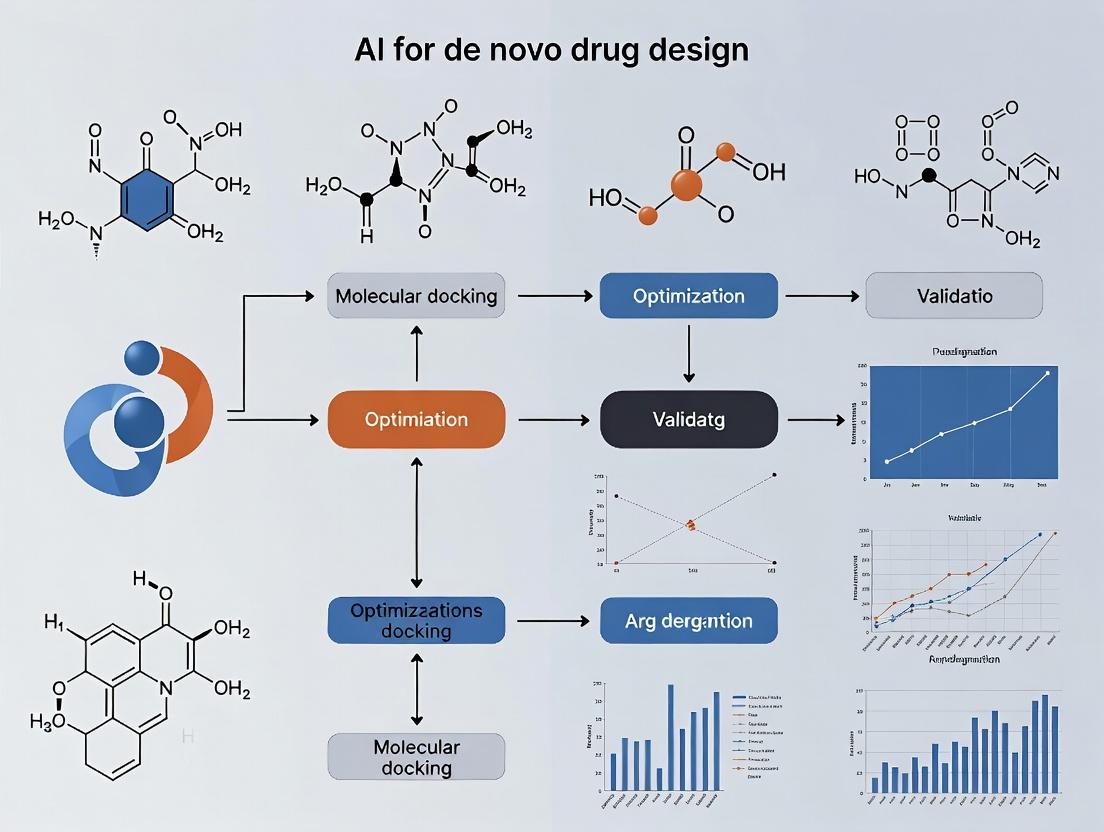
This article provides a comprehensive overview of artificial intelligence (AI) principles in de novo drug design, tailored for researchers, scientists, and development professionals.
From Bytes to Breakthroughs: Demystifying AI-Driven de novo Drug Design for Modern Researchers
Abstract
This article provides a comprehensive overview of artificial intelligence (AI) principles in de novo drug design, tailored for researchers, scientists, and development professionals. It begins by establishing the fundamental concepts and motivation behind AI-driven molecular generation, contrasting it with traditional methods. We then detail core methodological approaches—including generative models, reinforcement learning, and genetic algorithms—and their practical application in hit identification and lead optimization. The guide addresses common challenges such as synthesizability, novelty, and objective function design, offering optimization strategies. Finally, we present rigorous validation frameworks and comparative analyses of state-of-the-art tools, culminating in a synthesis of current capabilities, persistent gaps, and the transformative future implications for accelerating biomedical discovery and clinical pipeline development.
AI in Drug Discovery: The Paradigm Shift from Screening to Generative Design
De novo drug design is a computational strategy for generating novel molecular structures with desired pharmacological properties from scratch, without relying on pre-existing templates. Framed within a broader thesis on AI-driven principles, this whitepaper details the core paradigms, historical evolution, and technical methodologies that define the field.
Historical Context and Evolution
The history of de novo drug design is marked by a transition from manual, intuition-driven discovery to increasingly automated, algorithm-driven generation.
Table 1: Historical Milestones in De Novo Drug Design
| Era | Period | Key Paradigm | Representative Technology | Limitation |
|---|---|---|---|---|
| Conceptual | 1980s | Structure-based design, molecular building blocks. | LUDI, GROW. | Limited computational power, simplistic scoring. |
| Evolutionary | 1990s-2000s | Genetic algorithms, fragment linking/assembly. | LEGEND, SPROUT. | Chemical novelty but poor synthesizability. |
| AI-Driven | 2010s-Present | Deep generative models, reinforcement learning. | Variational Autoencoders (VAEs), Generative Adversarial Networks (GANs), Reinforcement Learning (RL). | Early challenges in objective function design, model interpretability. |
| Generative AI | 2020s-Present | Transformer architectures, geometric deep learning, diffusion models. | Pocket2Mol, DiffDock, 3D-conditional diffusion models. | Generation of synthetically accessible, 3D-aware, and diverse lead-like molecules. |
Core Technical Principles
The Generative Cycle
The core workflow involves an iterative loop: (1) Generation of candidate molecular structures, (2) Evaluation via predictive models (e.g., for binding affinity, ADMET), and (3) Optimization using feedback to refine the generative model.
Molecular Representation
The choice of molecular representation directly influences the generative model's capabilities.
Table 2: Molecular Representations in AI-Driven De Novo Design
| Representation | Format | AI Model Suitability | Advantage | Disadvantage |
|---|---|---|---|---|
| String-Based | SMILES, SELFIES | RNN, Transformer | Simple, sequential, large corpora available. | Can generate invalid strings; 1D representation loses spatial data. |
| Graph-Based | Molecular Graph (Atoms as nodes, bonds as edges) | Graph Neural Network (GNN) | Naturally represents topology, invariant to permutation. | Complex generation requires autoregressive or one-shot methods. |
| 3D Coordinate | Atomic Point Cloud / 3D Grid | Geometric GNN, Diffusion Model | Encodes steric and electrostatic complementarity to target. | Computationally intensive; requires defined binding pocket. |
Optimization Strategies
- Goal-Directed Generation: Models are trained to directly optimize a multi-parametric objective function (e.g., QED, SA, binding score).
- Reinforcement Learning (RL): The generative model acts as an agent, receiving rewards from a scoring function and adjusting its policy (generation rules) to maximize reward.
- Bayesian Optimization: Used in latent space models to navigate towards regions of high desirability.
De Novo Design AI Optimization Workflow
Experimental Protocol: A StandardIn SilicoValidation
This protocol outlines a standard validation experiment for an AI-based de novo design model targeting a specific protein.
Aim: To generate novel, synthetically accessible inhibitors for Target Protein X.
Methodology
Data Curation:
- Source: Public databases (PDBbind, BindingDB).
- Content: Crystal structures of Target X with ligands (for structure-based models) or known active/inactive SMILES strings (for ligand-based models).
- Preprocessing: Ligands are stripped and protonated. Structures are aligned to a common reference frame. Pockets are defined (e.g., using FPocket).
Model Training & Configuration:
- Model: A 3D conditional diffusion model (e.g., Pocket2Mol architecture).
- Conditioning: The model is conditioned on the 3D atomic point cloud of the defined binding pocket.
- Training: Model is trained to denoise atomic coordinates and types within the pocket context.
Candidate Generation:
- 10,000 unique molecules are generated in silico by sampling from the trained model.
In Silico Evaluation Funnel:
- Step 1 - Syntactic Filter: Remove molecules with invalid valences or unstable rings.
- Step 2 - Drug-Likeness: Filter by Quantitative Estimate of Drug-likeness (QED > 0.6) and Synthetic Accessibility (SAscore < 4.5).
- Step 3 - Docking: Remaining molecules are docked into Target X's pocket using Glide SP or AutoDock Vina. Top 500 by docking score are retained.
- Step 4 - MM/GBSA: Re-score top 100 docked poses using Molecular Mechanics/Generalized Born Surface Area (MM/GBSA) for more accurate binding free energy estimation.
- Step 5 - ADMET Prediction: Predict key ADMET properties (e.g., CYP inhibition, hERG liability, Caco-2 permeability) using models like ADMETlab 2.0.
Output: A ranked list of 20-50 novel candidate molecules with associated scores and predicted properties for in vitro validation.
The Scientist's Toolkit: Research Reagent Solutions
Table 3: Essential Tools for AI-Driven De Novo Drug Design Research
| Tool Category | Specific Solution / Software | Primary Function | Key Application in Workflow |
|---|---|---|---|
| Generative AI Platform | PyTorch, TensorFlow, JAX | Deep learning framework for building and training custom generative models. | Model development and training. |
| Chemistry & Generation | RDKit, DeepChem | Open-source cheminformatics toolkit for molecule manipulation, descriptor calculation, and model integration. | SMILES parsing, fingerprinting, filter application, basic property calculation. |
| Docking & Scoring | AutoDock Vina, Glide (Schrödinger), GNINA | Predicts the binding pose and affinity of a generated molecule to a protein target. | Primary in silico validation of generated molecules' target engagement. |
| Free Energy Calculation | AMBER, GROMACS, OpenMM | Molecular dynamics simulation and more accurate (MM/PBSA, MM/GBSA) binding free energy estimation. | Refined scoring and stability assessment of top candidates. |
| ADMET Prediction | ADMETlab 2.0, pkCSM, StarDrop | Predicts pharmacokinetic, toxicity, and metabolic profiles from molecular structure. | Early-stage elimination of candidates with poor predicted developability. |
| Synthesis Planning | AiZynthFinder, ASKCOS, RetroSyn | Retrosynthetic analysis tool to evaluate and plan the synthetic route for a generated molecule. | Assesses and improves the synthetic accessibility of AI-generated designs. |
Thesis Context: AI Principles and Historical Trajectory
Quantitative Benchmarking
Table 4: Benchmark Performance of Modern De Novo Design Methods (Hypothetical Summary)
| Model (Year) | Generation Method | Target | Key Metric: Vina Score (Δ kcal/mol) | Key Metric: Novelty (Tanimoto < 0.3) | Key Metric: Synthetic Accessibility (SAscore) |
|---|---|---|---|---|---|
| Ligand-Based VAE (2018) | SMILES VAE + RL | DRD2 | -9.2 ± 0.5 | 85% | 3.8 ± 0.6 |
| Graph-based (2020) | GNN + Policy Gradient | JAK2 | -10.5 ± 0.7 | 92% | 3.5 ± 0.7 |
| 3D Diffusion (2023) | Pocket-Conditioned Diffusion | SARS-CoV-2 Mpro | -11.8 ± 0.4 | 99% | 2.9 ± 0.4 |
Note: Data is illustrative, compiled from recent literature trends. Actual values vary by study setup.
De novo drug design has evolved from a conceptual framework to a practical, AI-driven engine for molecular invention. Its core principles—generation conditioned on structural or property constraints, followed by iterative multi-parametric optimization—are now powered by deep generative models. Within the context of AI principles research, the field is moving towards integrated, "closing-the-loop" systems that directly connect generative AI with automated synthesis and biological testing, promising to accelerate the discovery of novel therapeutic agents.
The traditional drug discovery pipeline is a monument to high expenditure and high failure. Despite advances in genomics and combinatorial chemistry, the fundamental process remains slow, costly, and inefficient. The core thesis framing this discussion is that AI, particularly for de novo drug design, is not merely a tool for acceleration but a foundational shift in molecular discovery principles. It moves the paradigm from iterative screening to predictive generation and multi-parameter optimization.
The Quantitative Burden: A Data-Driven Case
Recent analyses underscore the unsustainable economics of traditional discovery. The following table summarizes key performance indicators.
Table 1: Traditional vs. AI-Augmented Drug Discovery Metrics
| Metric | Traditional Discovery (Avg.) | AI-Augmented Discovery (Projected/Reported) | Data Source (2023-2024) |
|---|---|---|---|
| R&D Cost per Approved Drug | ~$2.3B (Incl. failures) | Target: 30-50% reduction | (Evaluate Pharma, 2023; BCG Analysis) |
| Timeline from Target to Preclinical Candidate | 3-6 years | 12-24 months | (Nature Reviews Drug Discovery, 2024) |
| Clinical Trial Success Rate (Phase I to Approval) | ~7.9% | Early data suggests potential to double | (Biostatistics, 2024) |
| Number of Compounds Screened per Approved Drug | 10,000+ | Designed in silico, < 1000 synthesized | (ACS Medicinal Chemistry Letters, 2023) |
| Primary Cause of Preclinical Failure | Poor PK/PD & Toxicity (∼60%) | AI models predict ADMET properties prior to synthesis | (Journal of Chemical Information and Modeling, 2024) |
Core AI Methodologies: From Prediction to Generation
Predictive ADMET & Target Affinity Modeling
Experimental Protocol (In Silico Prediction):
- Data Curation: Assemble a structured database of molecules with experimentally determined properties (e.g., solubility, hepatic microsomal stability, hERG inhibition).
- Featurization: Convert molecular structures into numerical descriptors (e.g., ECFP fingerprints, molecular weight, logP) or graph representations.
- Model Training: Employ supervised learning algorithms (e.g., Gradient Boosting Machines, Graph Neural Networks) to correlate features with experimental outcomes.
- Validation: Use temporal split or scaffold split validation to assess model generalizability to novel chemical space.
- Prospective Screening: Apply the trained model to filter virtual compound libraries, prioritizing molecules with favorable predicted properties for synthesis.
De NovoMolecular Design with Generative AI
Experimental Protocol (Reinforcement Learning-Based Design):
- Agent Definition: The AI agent (e.g., a Recurrent Neural Network or Transformer) acts as a "generator" of molecular strings (SMILES).
- Environment & Reward: The "environment" is defined by multiple scoring functions (e.g., predicted target affinity, synthetic accessibility, similarity to known actives). The agent receives a composite reward signal.
- Training Loop: a. The agent generates a batch of molecules. b. Each molecule is evaluated by the reward functions. c. The agent's parameters are updated via policy gradient methods to maximize expected reward.
- Output: The optimized agent produces novel, synthetically accessible molecules optimized for the desired multi-property profile.
Diagram Title: Reinforcement Learning Cycle for De Novo Drug Design
Case Study: AI-Integrated Workflow for Kinase Inhibitor Discovery
The following diagram illustrates a complete, iterative AI-driven workflow, contrasting with linear traditional steps.
Diagram Title: Iterative AI-Driven Drug Discovery Workflow
The Scientist's Toolkit: Key Research Reagents & Solutions
Table 2: Essential Reagents for AI-Guided Experimental Validation
| Item | Function in AI-Driven Workflow | Example Vendor/Product |
|---|---|---|
| Recombinant Human Target Protein | Essential for in vitro binding (SPR, ITC) and enzymatic assays to validate AI-predicted affinities. | Sino Biological, R&D Systems |
| AlphaFold2 Protein Structure Prediction | Provides high-confidence 3D structural models for targets lacking crystal structures, enabling structure-based AI design. | EMBL-EBI, Google ColabFold |
| High-Throughput Screening Assay Kits | Validate AI-prioritized compound libraries against biological activity (e.g., kinase activity, cell viability). | Promega, Cisbio |
| LC-MS/MS for ADMET Profiling | Generates high-quality in vitro PK/PD data (e.g., microsomal stability, permeability) to ground-truth and refine AI models. | Agilent, Waters |
| Cryo-EM Services | Determine high-resolution structures of lead compounds bound to their target, providing critical feedback for next-generation AI design cycles. | Thermo Fisher Scientific, specialized CROs |
| Chemical Synthesis Services (CRO) | Rapid, parallel synthesis of AI-designed compounds for biological testing, bridging digital design and physical matter. | WuXi AppTec, Sigma-Aldrich Custom Synthesis |
The pursuit of novel therapeutic molecules is a cornerstone of pharmaceutical research, traditionally characterized by high costs, lengthy timelines, and high attrition rates. De novo drug design—the computational generation of novel molecular structures with desired properties—represents a paradigm shift. This whitepaper frames three key AI paradigms—Generative AI, Machine Learning (ML), and Molecular Representations—within the thesis that their integrated application is fundamental to modern, principled research in de novo drug design. These technologies enable the systematic exploration of chemical space, which is estimated to contain >10⁶⁰ synthesizable organic molecules, far beyond the capacity of traditional screening.
Foundational AI Paradigms
Machine Learning for Predictive Modeling
ML forms the quantitative backbone, learning from existing data to predict the properties of unseen molecules. Supervised learning models map molecular representations to biological activities (e.g., IC₅₀) or physicochemical properties (e.g., solubility, LogP).
- Common Algorithms: Random Forests, Gradient Boosting Machines (GBM), and deep neural networks (DNNs).
- Primary Application: Constructing Quantitative Structure-Activity Relationship (QSAR) models to virtually screen and prioritize generated molecules.
Generative AI for Molecular Invention
Generative AI moves beyond prediction to creation. It learns the underlying probability distribution of known chemical structures and/or their target-binding complexes to propose novel, valid, and optimized molecules.
- Key Architectures:
- Variational Autoencoders (VAEs): Encode molecules into a continuous latent space where interpolation and sampling yield novel structures.
- Generative Adversarial Networks (GANs): A generator creates molecules while a discriminator critiques them, driving iterative improvement.
- Autoregressive Models (e.g., Transformers): Generate molecular sequences (like SMILES) token-by-token, capturing long-range dependencies.
- Flow-Based Models: Learn invertible transformations between data distribution and a simple base distribution, enabling exact likelihood calculation.
Molecular Representations: The Data Language
The choice of representation dictates what patterns AI models can learn. Three primary paradigms dominate drug design.
1D: Simplified Molecular-Input Line-Entry System (SMILES) A string notation representing a molecule's 2D structure as a sequence of atoms and bonds. It is compact and easy to use with sequence-based models (RNNs, Transformers) but can suffer from syntactic invalidity and lack of explicit spatial information. Example: The serotonin molecule is represented as
C1=CC2=C(C=C1O)C(=CN2)CCN.2D: Molecular Graphs A graph G(V, E) where atoms are nodes (V) and bonds are edges (E). This representation explicitly encodes connectivity and is naturally processed by Graph Neural Networks (GNNs), which learn through message-passing between connected atoms.
3D: Geometric Representations Captures the spatial coordinates of atoms (conformation), critical for modeling molecular interactions, docking, and binding affinity. Models include E(3)-Equivariant Neural Networks and Geometric Graph Networks, which are invariant to rotations and translations.
Table 1: Comparative Analysis of Molecular Representations
| Representation | Format | Key AI Model | Advantages | Limitations |
|---|---|---|---|---|
| SMILES (1D) | String Sequence | RNN, Transformer | Simple, compact, vast existing datasets. | Ambiguous (one molecule, many SMILES), syntactic invalidity on generation, no explicit topology. |
| Molecular Graph (2D) | Graph (Nodes, Edges) | Graph Neural Network (GNN) | Explicitly encodes structure and connectivity, invariant to SMILES permutation. | Does not inherently encode 3D conformation or chirality. |
| 3D Geometric | Coordinates + Features | Equivariant Network, GNN | Directly models quantum-chemical and steric interactions, essential for binding. | Computationally intensive, requires conformation generation or data. |
Experimental Protocols & Workflows
Protocol 1: Benchmarking a GNN for Property Prediction
Objective: Train and validate a GNN model to predict molecular properties (e.g., solubility) from 2D graphs.
- Dataset Curation: Use a standard benchmark like ESOL (water solubility) or FreeSolv (hydration free energy). Split data (e.g., 80/10/10) into training, validation, and test sets using scaffold splitting to assess generalization.
- Graph Featurization: For each molecule, generate a graph where nodes (atoms) are featurized with atomic number, degree, hybridization, etc. Edges (bonds) are featurized with type (single, double, etc.) and conjugation.
- Model Training: Implement a Message-Passing Neural Network (MPNN). The model performs:
- Message Passing (K steps): Aggregate features from neighboring nodes.
- Readout: Pool updated node features into a global graph representation.
- Prediction: Pass the graph vector through fully connected layers to produce a scalar prediction.
- Evaluation: Use Root Mean Squared Error (RMSE) and Mean Absolute Error (MAE) on the held-out test set. Compare against baseline models (Random Forest on Morgan fingerprints).
Diagram 1: Workflow for GNN-based property prediction.
Protocol 2:De NovoMolecule Generation with a Conditional VAE
Objective: Generate novel molecules optimized for high predicted activity against a target and favorable drug-likeness.
- Model Architecture: Build a Conditional VAE (CVAE). The encoder (Q) maps a SMILES string to a latent vector z, conditioned on a property vector c (e.g., target activity, LogP). The decoder (P) reconstructs the SMILES from z and c.
- Training: Train on a dataset (e.g., ChEMBL) with associated properties. The loss function combines reconstruction loss (cross-entropy) and the Kullback–Leibler divergence (KL) loss to regularize the latent space.
- Latent Space Navigation: Sample latent vectors z from a region conditioned on desired properties c_target. Decode these vectors to generate novel SMILES.
- Validation & Filtering: Pass generated SMILES through a series of filters: chemical validity (RDKit), synthetic accessibility (SAscore), and a pre-trained activity predictor. Select top candidates for in silico docking or synthesis.
Diagram 2: Conditional generation workflow with a VAE.
The Scientist's Toolkit: Research Reagent Solutions
Table 2: Essential Computational Tools for AI-Driven Drug Design
| Tool / Resource | Category | Primary Function |
|---|---|---|
| RDKit | Cheminformatics Library | Open-source toolkit for molecule I/O (SMILES, SDF), descriptor calculation, fingerprint generation, and substructure search. |
| PyTorch Geometric / DGL | Deep Learning Library | Specialized libraries for building and training Graph Neural Networks (GNNs) on molecular graph data. |
| Open Babel / MDAnalysis | Molecular Conversion & Analysis | Converts between molecular file formats and performs trajectory analysis for 3D molecular dynamics data. |
| AutoDock Vina / GNINA | Molecular Docking Software | Performs in silico docking of generated molecules into target protein pockets to estimate binding pose and affinity. |
| ChEMBL / PubChem | Bioactivity Database | Public repositories of curated bioactivity data (e.g., IC₅₀, Ki) for training predictive ML models. |
| ZINC / Enamine REAL | Compound Library | Commercial or virtual catalogs of purchasable compounds for virtual screening and training generative models on "real" chemical space. |
| SAscore | Synthetic Accessibility | Algorithm to estimate the ease of synthesis for a generated molecule, a critical post-generation filter. |
| OMEGA / CONFORMER | Conformation Generation | Software to generate biologically relevant 3D conformations from 1D/2D representations for downstream 3D modeling. |
Integrated Pipeline & Future Outlook
The convergence of these paradigms creates a powerful, iterative feedback loop for principled drug design: Generative AI proposes novel structures, which are encoded via Molecular Representations (Graphs, 3D) and evaluated by predictive Machine Learning models for multiple parameters (potency, pharmacokinetics, safety). The results of these predictions then inform the next cycle of generation.
Future research directions include the development of unified models that seamlessly operate across 1D, 2D, and 3D representations, the integration of biological sequence data (e.g., for target-aware generation), and the adoption of reinforcement learning frameworks where the generative agent is optimized against a complex, multi-parameter reward function. The overarching thesis remains clear: the deliberate and integrated application of these AI paradigms is transforming de novo drug design from a high-risk art into a principled, engineering discipline.
Within the broader thesis that AI-driven de novo drug design represents a paradigm shift from screening to generative creation, the central promise is the ab initio generation of novel, optimal, and synthetically accessible chemical entities. This whitepaper details the technical core of achieving this promise, moving beyond simple generation to the creation of molecules that satisfy a complex multi-objective optimization landscape encompassing potency, selectivity, ADMET (Absorption, Distribution, Metabolism, Excretion, Toxicity), and synthetic feasibility.
Foundational Architectures & Quantitative Benchmarks
Current state-of-the-art relies on deep generative models trained on vast chemical libraries. Their performance is benchmarked on standard tasks.
Table 1: Performance Benchmarks of Key Generative Architectures (2023-2024)
| Model Architecture | Primary Task | Key Metric | Reported Performance | Dataset |
|---|---|---|---|---|
| GPT-based (ChemGPT) | Next-token prediction (SMILES/SELFIES) | Validity (unconditional) | 97.2% | ZINC15, ChEMBL |
| Variational Autoencoder (VAE) | Latent space representation | Reconstruction Accuracy | 92.5% | MOSES |
| Generative Adversarial Net (GAN) | Distribution learning | Fréchet ChemNet Distance (FCD)↓ | 0.82 | Guacamol |
| Graph Neural Network (GNN) | Direct graph generation | Uniqueness @ 10k samples | 99.8% | QM9 |
| Reinforcement Learning (RL) | Objective-driven optimization | Success Rate (DRD2 target) | 95.1% | ZINC250k |
Core Experimental Protocol: Iterative AI-Driven Design Cycle
This protocol describes a standard workflow for generating novel chemical entities against a specific biological target.
Protocol Title: Integrated De Novo Design Cycle with Multi-Objective Optimization
Objective: To generate novel, drug-like compounds with predicted high affinity for Target X and favorable ADMET profiles.
Materials & Methods:
Target Profiling & Goal Definition:
- Define the chemical space constraints (e.g., MW < 500, LogP < 5).
- Establish quantitative objectives: pIC50 > 8.0 (from docking/QSAR), high selectivity vs. related targets, and predicted scores for permeability (e.g., Caco-2 > 5e-6 cm/s), metabolic stability (e.g., t1/2 > 30 min), and absence of structural alerts.
Model Initialization & Conditioning:
- Initialize a pre-trained generative model (e.g., a GNN-based generator).
- Condition the model using a 3D pharmacophore model or a fingerprint of the target's active site, derived from its crystal structure or a homology model.
Generation & Initial Filtering:
- Generate 50,000 novel molecular graphs.
- Apply rule-based filters (e.g., PAINS, REOS) to remove undesirable chemotypes. Expected attrition: ~40%.
In Silico Evaluation & Scoring:
- Docking: Dock the remaining compounds into the target's binding site using Glide SP or AutoDock Vina. Retain top 20% by docking score.
- ADMET Prediction: Pass the compounds through a suite of QSAR models (e.g., using ADMETLab 3.0 or proprietary models) for pharmacokinetic and toxicity endpoints.
- Synthetic Accessibility (SA): Score compounds using the SAScore or a retrosynthesis-based model (e.g., AiZynthFinder).
Multi-Objective Optimization & RL Fine-Tuning:
- Formulate a composite reward function: R = w1*DockingScore + w2*LogD + w3*CYP3A4score + w4*(1/SAScore).
- Use a policy gradient RL algorithm (e.g., REINFORCE, PPO) to fine-tune the generative model, encouraging it to produce molecules that maximize R.
- Iterate steps 3-5 for 10-20 cycles, generating 10,000 molecules per cycle.
Final Selection & In Vitro Validation:
- Cluster the top 200 molecules from the final cycle by scaffold.
- Select 20-30 representative, synthetically tractable candidates for in vitro synthesis and testing.
The Scientist's Toolkit: Key Research Reagent Solutions
| Tool/Reagent | Provider/Example | Function in De Novo Design |
|---|---|---|
| Chemical Databases | ZINC20, ChEMBL35, PubChem | Source of training data for generative models; provides known actives for validation. |
| Generative Model Software | REINVENT, MolecularAI, PyTorch/TensorFlow GNN libs | Core engine for generating novel molecular structures. |
| Docking Suite | Schrödinger Glide, OpenEye FRED, AutoDock-GPU | Predicts binding pose and affinity of generated molecules to the target. |
| ADMET Prediction Platform | ADMETLab 3.0, Schrödinger QikProp, StarDrop | Provides in silico estimates of pharmacokinetic and toxicity properties. |
| Synthetic Accessibility Tool | RDKit (SAScore), AiZynthFinder (ICSYN), ASKCOS | Evaluates the feasibility of synthesizing the AI-generated molecule. |
| High-Throughput Chemistry | Solid-phase synthesis plates, automated liquid handlers, flow reactors | Enables rapid physical synthesis of the top AI-generated candidates for testing. |
Visualizing the Integrated Workflow
AI-Driven De Novo Design Cycle
RL Fine-Tuning of a Generative Model
The central promise is being realized through integrated cycles of generation, multi-faceted in silico validation, and iterative optimization via reinforcement learning. The future trajectory within this thesis framework points toward the direct incorporation of physiological systems-level modeling (e.g., PK/PD simulations) into the generation loop and the use of foundational models trained on broader biochemical data, moving from generating optimal chemical entities to predicting optimal therapeutic outcomes.
Thesis Context: This whitepaper provides a technical foundation for the application of Artificial Intelligence in de novo drug design. The precise definition, quantification, and computational manipulation of these core concepts are critical for training robust AI models capable of generating novel, viable therapeutic candidates.
Quantitative Structure-Activity Relationship (QSAR)
QSAR is a computational modeling method that quantifies the relationship between a molecule's structural properties (descriptors) and its biological activity. In AI-driven de novo design, QSAR models serve as surrogate assays, enabling the rapid in silico prediction of activity for millions of generated structures.
Core Descriptors & Contemporary Data
Modern QSAR utilizes high-dimensional descriptors, often processed via machine learning algorithms.
Table 1: Key Classes of Molecular Descriptors for QSAR in AI Models
| Descriptor Class | Specific Examples | Role in AI/ML Model | Typical Value Range |
|---|---|---|---|
| Physicochemical | LogP (partition coefficient), Molecular Weight, Topological Polar Surface Area (TPSA) | Features for regression/classification; constraints for drug-likeness (e.g., Lipinski's Rule of 5). | LogP: -2 to 5, MW: 150-500 Da, TPSA: 20-130 Ų |
| Topological | Morgan Fingerprints (ECFP4), Daylight Fingerprints | Sparse, high-dimensional input for deep neural networks (DNNs) and gradient boosting. | Binary vectors of length 1024-4096 |
| Quantum Chemical | HOMO/LUMO energy, Partial Atomic Charges, Dipole Moment | Inform target binding and reactivity; used in physics-informed neural networks. | HOMO: -9 to -5 eV |
| 3-Dimensional | Molecular Shape, Steric/Electrostatic Field Maps (CoMFA) | Input for 3D-CNNs; critical for binding affinity prediction. | Grid-based continuous values |
Protocol: Building a Modern QSAR Model for AI Training
Objective: Develop a robust predictive model to integrate into a generative AI pipeline.
- Dataset Curation: From sources like ChEMBL, extract bioactivity data (e.g., IC50) for a target. Apply stringent cutoff (e.g., IC50 < 10 µM for actives). Aim for >2000 compounds.
- Descriptor Calculation: Use RDKit or Dragon to compute 2D/3D descriptors. Generate ECFP4 fingerprints for all compounds.
- Data Preprocessing: Remove near-constant descriptors. Handle missing values (imputation or removal). Scale numerical features (StandardScaler).
- Dataset Splitting: Split into Training (70%), Validation (15%), and Hold-out Test (15%) sets. Use scaffold splitting to ensure chemical diversity separation and prevent model overfitting.
- Model Training: Employ an algorithm like Gradient Boosting (XGBoost) or a DNN. Use the Validation set for hyperparameter tuning (e.g., via Bayesian optimization).
- Validation & Metrics: Evaluate on the Test set using: R² (regression), ROC-AUC (classification), and RMSE. Apply Y-randomization to confirm model significance.
Diagram Title: QSAR Model Development Workflow for AI
Research Reagent Solutions: QSAR Modeling
Table 2: Essential Tools for QSAR Analysis
| Tool/Reagent | Function | Provider/Example |
|---|---|---|
| RDKit | Open-source cheminformatics library for descriptor/fingerprint calculation. | RDKit Community |
| Dragon | Software for calculating >5000 molecular descriptors. | Talete srl |
| ChEMBL Database | Curated database of bioactive molecules with assay data. | EMBL-EBI |
| scikit-learn / XGBoost | Python libraries for building and validating ML models. | Open Source |
| TensorFlow/PyTorch | Frameworks for building deep neural network QSAR models. | Google / Meta |
Pharmacophore Modeling
A pharmacophore is an abstract model defining the essential steric and electronic functional arrangements necessary for molecular recognition by a biological target. For AI-based generation, pharmacophores act as 3D constraints, guiding the model to produce structures that satisfy key interaction points.
Key Features & Experimental Basis
Pharmacophore features are derived from ligand-receptor interaction analysis.
Table 3: Core Pharmacophore Features and Their Structural Correlates
| Feature | Description | Typical Moiety | Experimental Source |
|---|---|---|---|
| Hydrogen Bond Donor (HBD) | Positively polarized hydrogen atom. | -OH, -NH2, -NH- | Protein-ligand crystal structure (H-bond acceptor on target). |
| Hydrogen Bond Acceptor (HBA) | Lone pair of electrons on electronegative atom. | C=O, -O-, -N | Protein-ligand crystal structure (H-bond donor on target). |
| Hydrophobic | Region of lipophilicity. | Alkyl chains, aromatic rings | Burial in hydrophobic pocket; alanine scanning mutagenesis. |
| Positive/Negative Ionizable | Groups capable of forming ionic bonds. | -NH3+ (basic), -COO- (acidic) | Interaction with oppositely charged residue (Asp, Glu, Arg, Lys). |
| Aromatic Ring | Electron-rich π-system. | Phenyl, pyridine | π-π stacking or cation-π interaction with protein side chains. |
Protocol: Structure-Based Pharmacophore Generation
Objective: Create a pharmacophore query from a protein-ligand complex for virtual screening or generative AI guidance.
- Structure Preparation: Obtain a high-resolution PDB structure (e.g., resolution < 2.5 Å). Use protein preparation tools (Schrödinger Maestro, MOE) to add hydrogens, assign bond orders, and optimize side-chain orientations.
- Ligand Interaction Analysis: Analyze the binding site. Identify key interactions: H-bonds, salt bridges, hydrophobic contacts, π-stacking.
- Feature Mapping: Using software (e.g., LigandScout, Phase), map the observed interactions to pharmacophore features. Exclude features formed by non-essential parts of the ligand.
- Constraint Definition: Define geometric constraints (tolerances, angles) for each feature based on observed distances in the crystal structure. Define excluded volumes based on protein shape to prevent steric clash.
- Validation: Validate the model by screening a small decoy set enriched with known actives. Measure enrichment factor (EF).
Diagram Title: From Crystal Structure to AI-Usable Pharmacophore
ADMET
ADMET (Absorption, Distribution, Metabolism, Excretion, Toxicity) properties determine the pharmacokinetic and safety profile of a drug candidate. AI models for de novo design must incorporate predictive ADMET filters early in the generation process to prioritize synthesizable compounds with a high probability of in vivo success.
Key Parameters & Predictive Endpoints
Table 4: Critical ADMET Properties and Their Impact on Drug Design
| Property | Definition & Measure | Ideal Range/Profile | Common AI Prediction Model |
|---|---|---|---|
| Absorption (Caco-2 Permeability) | In vitro model of intestinal permeability. | Papp > 1 x 10⁻⁶ cm/s (high permeability) | Binary Classifier (High/Low) |
| Hepatocyte Clearance | Intrinsic clearance in human liver cells. | Low clearance (< 50% liver blood flow) | Regression (mL/min/kg) |
| CYP450 Inhibition | Inhibition of major metabolizing enzymes (e.g., CYP3A4). | IC50 > 10 µM (low risk of drug-drug interaction) | Binary Classifier (Inhibitor/Non-Inhibitor) |
| hERG Blockade | Inhibition of potassium channel linked to cardiotoxicity. | IC50 > 10 µM (low risk) | Binary Classifier (Risk/No Risk) |
| Ames Test | Bacterial assay for mutagenicity. | Non-mutagen | Binary Classifier (Mutagen/Non-Mutagen) |
| Volume of Distribution (Vd) | Apparent volume into which a drug distributes. | Vd > 0.15 L/kg (not overly restricted to plasma) | Regression (L/kg) |
Protocol: Integrating ADMET Predictions into an AI Generation Loop
Objective: Implement a multi-parameter ADMET filter within a generative AI pipeline (e.g., a Variational Autoencoder or Reinforcement Learning agent).
- Model Ensemble: For each ADMET endpoint, train or procure a validated predictive model (e.g., using ADMETlab 3.0 or proprietary models).
- Threshold Definition: Set acceptable thresholds for each property based on project goals (e.g., "CYP3A4 inhibition probability < 0.3").
- Pipeline Integration: After the AI generator proposes a new molecular structure (SMILES), decode it and compute relevant descriptors.
- Parallel Prediction: Pass the descriptors through the ensemble of ADMET models to obtain a vector of predictions.
- Scoring & Filtering: Apply a weighted scoring function (or a hard filter) to the predictions. Compounds passing the threshold are retained for further exploration; others are penalized or discarded.
- Iterative Feedback: Use the ADMET score as part of the reinforcement learning reward or as a loss term to steer the generator towards favorable chemical space.
Diagram Title: ADMET Prediction Loop in AI-Driven Generation
Research Reagent Solutions: ADMET Prediction
Table 5: Key Resources for ADMET Modeling
| Tool/Reagent | Function | Provider/Example |
|---|---|---|
| ADMETlab 3.0 | Web-based platform for comprehensive ADMET property prediction. | Xundrug Lab |
| Schrödinger QikProp | Software for rapid prediction of physicochemical and ADMET properties. | Schrödinger |
| Liver Microsomes / Hepatocytes | In vitro reagents for experimental metabolic stability assays. | Thermo Fisher, Corning |
| Caco-2 Cell Line | Cell line for in vitro permeability assessment. | ATCC |
| hERG Assay Kits | In vitro kits (binding or functional) for cardiotoxicity screening. | Eurofins, DiscoverX |
The Chemical Space
Chemical space is the multi-dimensional descriptor space encompassing all possible organic molecules. For drug discovery, the relevant region is "drug-like" chemical space. AI for de novo design operates by learning the distribution of known bioactive molecules within this space and generating novel points (molecules) within promising, under-explored regions.
Quantifying & Navigating Chemical Space
Table 6: Metrics for Characterizing Chemical Space in Drug Discovery
| Metric/Tool | Description | Application in AI Design | Typical Scale |
|---|---|---|---|
| Molecular Similarity (Tanimoto) | Jaccard index based on fingerprint overlap. | Assess novelty of AI-generated compounds vs. training set. | 0 (dissimilar) to 1 (identical). Novelty if < 0.4 |
| Scaffold Analysis (Murcko) | Decomposition into core ring systems and linkers. | Analyze diversity of generated compounds; avoid over-representation. | Number of unique Bemis-Murcko scaffolds. |
| Principal Component Analysis (PCA) | Dimensionality reduction to visualize chemical space. | Map training set, generated compounds, and known actives in 2D/3D. | First 3 PCs often explain ~30-50% variance. |
| t-Distributed Stochastic Neighbor Embedding (t-SNE) | Non-linear dimensionality reduction for cluster visualization. | Identify distinct clusters of generated compounds. | Used for qualitative pattern recognition. |
| Synthetic Accessibility Score (SAscore) | Score estimating ease of synthesis (1=easy, 10=hard). | Filter or penalize generated compounds that are unrealistic to synthesize. | Target SAscore < 4.5 for lead-like compounds. |
Protocol: Mapping and Analyzing the Output of a Generative AI Model
Objective: Evaluate the chemical space coverage and novelty of molecules generated by an AI agent.
- Reference Set Curation: Compile a relevant reference set (e.g., all known ligands for the target from ChEMBL, plus drugs in relevant therapeutic area).
- AI Generation: Run the trained generative model to produce a large set of novel molecules (e.g., 10,000 SMILES).
- Descriptor Calculation & Dimensionality Reduction: Compute ECFP4 fingerprints for both the reference set and the generated set. Use PCA to reduce to 50 principal components, then further to 2D for visualization.
- Spatial Analysis: Plot the 2D maps. Calculate the centroid and density of the reference set. Plot the generated molecules overlaid.
- Quantitative Metrics: Calculate: a) Novelty: % of generated molecules with Tanimoto < 0.4 to nearest neighbor in reference set. b) Diversity: Mean pairwise Tanimoto distance among generated molecules. c) Scaffold Hop: Identify novel Murcko scaffolds not present in the reference set.
- Synthetic Accessibility Filter: Apply an SAscore filter to remove unrealistic compounds from the final proposed list.
Diagram Title: Mapping AI Outputs onto Chemical Space
The AI Toolkit: Architectures and Workflows for Generating Novel Drug Candidates
The application of Artificial Intelligence (AI) to de novo drug design represents a paradigm shift in pharmaceutical research. The central thesis of this whitepaper posits that the strategic integration of three core generative model architectures—Variational Autoencoders (VAEs), Generative Adversarial Networks (GANs), and Transformers—can systematically address the multidimensional challenges of molecular generation, optimization, and validation. This guide provides an in-depth technical examination of these architectures within the context of generating novel, synthetically accessible, and biologically active molecular entities.
Core Architectural Principles and Comparative Analysis
Variational Autoencoders (VAEs) for Latent Space Exploration
VAEs provide a probabilistic framework for learning a continuous, structured latent representation of molecular data. In drug design, this latent space enables smooth interpolation and exploration of chemical properties.
Architecture & Loss Function: A VAE consists of an encoder ( q\phi(z|x) ) that maps a molecular representation ( x ) to a latent variable ( z ), and a decoder ( p\theta(x|z) ) that reconstructs the molecule from ( z ). The model is trained by maximizing the Evidence Lower Bound (ELBO): [ \mathcal{L}(\theta, \phi; x) = \mathbb{E}{q\phi(z|x)}[\log p\theta(x|z)] - D{KL}(q_\phi(z|x) \parallel p(z)) ] where ( p(z) ) is typically a standard normal prior ( \mathcal{N}(0, I) ). The first term is the reconstruction loss, and the KL divergence term regularizes the latent space.
Application: Primarily used for generating molecules with desired properties by performing gradient-based optimization in the continuous latent space.
Generative Adversarial Networks (GANs) for High-Fidelity Generation
GANs frame generation as an adversarial game between a generator ( G ) and a discriminator ( D ). The generator learns to produce realistic molecules from noise, while the discriminator learns to distinguish real from generated samples.
Minimax Objective: [ \minG \maxD V(D, G) = \mathbb{E}{x \sim p{data}(x)}[\log D(x)] + \mathbb{E}{z \sim pz(z)}[\log(1 - D(G(z)))] ] Application: Excels at generating highly realistic, novel molecular structures, often with superior perceptual quality compared to VAEs. Challenges include mode collapse and training instability.
Transformers for Sequence-BasedDe NovoDesign
Transformers, based on the self-attention mechanism, process sequential representations of molecules (e.g., SMILES, SELFIES) without recurrent connections. They model the conditional probability of a token given all previous tokens.
Self-Attention Mechanism: [ \text{Attention}(Q, K, V) = \text{softmax}\left(\frac{QK^T}{\sqrt{d_k}}\right)V ] Application: State-of-the-art for autoregressive molecular generation, capturing long-range dependencies in molecular sequences. Can be fine-tuned for property prediction and conditioned generation.
Quantitative Comparison of Architectures
Table 1: Comparative Analysis of Generative Models for Drug Design
| Feature | VAE | GAN | Transformer |
|---|---|---|---|
| Training Stability | High | Low | Moderate-High |
| Explicit Latent Space | Yes | No | No (usually) |
| Generation Diversity | Moderate | Can suffer from mode collapse | High |
| Sample Quality | Good | Very High | State-of-the-Art |
| Property Optimization | Easy via latent space interpolation | Requires RL or auxiliary networks | Via conditional generation |
| Primary Molecular Representation | Graph, Fingerprint, SMILES | Graph, SMILES | SMILES, SELFIES |
| Typical Validity Rate (%) | 60-90% | 70-100% | 85-100% (with SELFIES) |
| Novelty Rate (%) | 80-95% | 90-100% | 90-100% |
Experimental Protocols for Model Evaluation in Drug Design
A robust evaluation framework is critical for assessing generative models in a scientific context. Below are detailed protocols for key experiments.
Protocol 1: Benchmarking Molecular Generation Performance
- Data Preparation: Curate a standardized dataset (e.g., ZINC250k, MOSES). Split into training (80%), validation (10%), and test (10%) sets. Represent molecules as canonical SMILES or SELFIES strings.
- Model Training: Train VAE, GAN, and Transformer models on the training set. For VAE, use a KL annealing schedule. For GAN, employ techniques like WGAN-GP or Spectral Normalization for stability. For Transformer, use a standard language modeling objective.
- Generation & Metrics: Generate 10,000 molecules from each trained model. Evaluate using:
- Validity: Percentage of chemically valid molecules (using RDKit).
- Uniqueness: Percentage of unique molecules among valid ones.
- Novelty: Percentage of unique, valid molecules not present in the training set.
- Frechet ChemNet Distance (FCD): Measures distributional similarity to a reference set (e.g., test set) using activations from the ChemNet network.
- Analysis: Tabulate metrics for comparative analysis.
Protocol 2: Latent Space Property Optimization (VAE-specific)
- Property Predictor Training: Train a separate feed-forward neural network to predict a target property (e.g., LogP, QED) from the VAE's latent vectors using the training set molecules and their property values.
- Latent Space Navigation: For a chosen seed molecule, encode it to obtain its latent vector ( z_{seed} ).
- Gradient-Based Optimization: Calculate the gradient of the property predictor with respect to ( z ). Update ( z ) via gradient ascent/descent: ( z{new} = z{seed} + \alpha \nabla_z P(z) ), where ( P ) is the property predictor and ( \alpha ) is the step size.
- Decoding & Validation: Decode ( z_{new} ) to generate a new molecule. Validate its chemical structure and computationally verify the target property.
Protocol 3: In Silico Validation Pipeline for Generated Candidates
- ADMET Filtering: Pass generated molecules through a series of computational filters for Absorption, Distribution, Metabolism, Excretion, and Toxicity using tools like QikProp or admetSAR.
- Docking Simulation: Prepare protein target (PDB ID) using AutoDock Tools (add hydrogens, assign charges). Generate 3D conformers for the filtered molecules. Perform molecular docking using AutoDock Vina or Glide to estimate binding affinity (kcal/mol).
- Synthetic Accessibility (SA) Score: Calculate the SA Score for top-ranked docked compounds to prioritize synthetically feasible molecules.
Visualization of Core Concepts and Workflows
Title: VAE Architecture for Molecular Generation & Optimization
Title: Adversarial Training Cycle of a Molecular GAN
Title: Autoregressive Molecular Generation with a Transformer
The Scientist's Toolkit: Essential Research Reagents & Software
Table 2: Key Resources for AI-Driven De Novo Drug Design Experiments
| Category | Item / Software | Primary Function in Research |
|---|---|---|
| Core Development Frameworks | PyTorch, TensorFlow, JAX | Provides flexible libraries for building, training, and evaluating deep generative models. |
| Cheminformatics Toolkits | RDKit, Open Babel | Handles molecule I/O, descriptor calculation, validity checks, substructure search, and chemical transformations. |
| Molecular Docking | AutoDock Vina, GNINA, Schrödinger Glide (Commercial) | Performs in silico binding affinity prediction by simulating the fit of a generated molecule into a protein target's binding site. |
| ADMET Prediction | admetSAR, SwissADME, ProTox-II | Computationally predicts pharmacokinetic and toxicity profiles of generated molecules. |
| Benchmark Datasets | ZINC, ChEMBL, MOSES Benchmark | Provides curated, publicly available molecular structures for training and standardized evaluation of generative models. |
| High-Performance Computing | NVIDIA GPUs (e.g., A100, V100), Google Colab, AWS EC2 | Accelerates model training and enables large-scale virtual screening of generated libraries. |
| Visualization & Analysis | Matplotlib, Seaborn, DeepChem, t-SNE/UMAP | Enables plotting of chemical space, latent space visualization, and analysis of model results. |
| Molecular Representation | SELFIES (Self-Referencing Embedded Strings) | A robust string-based molecular representation guaranteeing 100% validity, crucial for sequence-based models. |
This technical guide, framed within a broader thesis on AI for de novo drug design principles, explores the application of Reinforcement Learning (RL) to generate novel molecular structures optimized for multiple, often competing, pharmacological objectives. Moving beyond single-property optimization, this paradigm addresses the real-world complexity of drug development, where candidates must simultaneously satisfy criteria such as potency, selectivity, synthetic accessibility, and favorable pharmacokinetics.
Foundational RL Framework for Molecule Generation
The core formulation treats molecule generation as a sequential decision-making process. An agent (generator) constructs a molecule step-by-step (e.g., adding atoms or fragments), and a reward function provides feedback based on the final molecule's properties.
Core Components
- Agent: Typically a deep neural network (e.g., RNN, Transformer, GNN) that defines a policy π(a|s) for taking action a (e.g., adding a substructure) given the current molecular state s.
- Action Space: A set of chemically valid modifications (e.g., from a predefined vocabulary of atoms/bonds or reaction rules).
- State Representation: The intermediate molecular structure, represented as a SMILES string, molecular graph, or fragment set.
- Reward Function R(s): A critical component that calculates a scalar reward by aggregating scores from multiple objective functions.
Multi-Objective Reward Formulation
The reward function integrates n objectives: [ R(s) = f(R1(s), R2(s), ..., Rn(s)) ] where (Ri(s)) are scores for individual objectives like QED (drug-likeness), SA (synthetic accessibility), binding affinity (docking score), and more.
Quantitative Landscape of Multi-Objective RL for Molecules
The table below summarizes key metrics and performance benchmarks from recent studies.
Table 1: Comparative Performance of RL Methods in Multi-Objective Molecule Generation
| RL Algorithm | Key Objectives Optimized | Benchmark/Score | Success Rate (%) | Unique & Valid (%) | Reference Year |
|---|---|---|---|---|---|
| PPO (Proximal Policy Optimization) | QED, SA, Target Similarity | DRD2 (Activity) > 0.5 | ~65% | >99% | 2022 |
| REINVENT 2.0 | Activity (Docking), SA, QED, Mw | Pareto Front Size | N/A | 98.5% | 2023 |
| Multi-Objective GFlowNet | Binding Energy (AutoDock Vina), QED, SA | Dominance Ratio on Practical Pareto Front | ~40% (High-affinity) | ~100% | 2023 |
| Goal-Conditioned RL | LogP, TPSA, Target Affinity | F1-Score for Goal Achievement | 72.4% | 99.2% | 2024 |
| Dual-Objective DQN | JAK2 Inhibition, JAK3 Selectivity | Selectivity Index (SI) > 10 | 22.5% | 97.8% | 2024 |
Detailed Experimental Protocol: A Standardized Workflow
The following methodology outlines a typical multi-objective RL experiment for generating novel kinase inhibitors.
Protocol: Multi-Objective RL-DrivenDe NovoDesign
Objective: Generate novel molecules with high predicted JAK2 kinase inhibition (pIC50 > 8) and high synthetic accessibility (SA Score > 4).
Step 1: Environment & Agent Setup
- Action Vocabulary: Define a set of ~100 chemical fragments derived from BRICS decomposition of known kinase inhibitors.
- State Representation: Use a Graph Neural Network (GNN) to encode the intermediate molecular graph.
- Agent Model: Initialize a Policy Network (3-layer GCN followed by an LSTM) with random weights.
Step 2: Multi-Objective Reward Definition [ R(m) = w1 * \text{Sigmoid}(\text{pIC50}{JAK2}(m) - 7) + w2 * (\text{SA}(m)/6) - \text{Penalty}(Invalid) ] where (w1=0.7), (w_2=0.3), pIC50 is predicted by a pre-trained Random Forest model, and SA is the synthetic accessibility score (1=easy, 10=hard).
Step 3: Training Loop (PPO Algorithm)
- Collection: The agent generates a batch of 512 molecules by sequentially selecting fragments.
- Evaluation: Each complete molecule m is evaluated by the reward function R(m).
- Optimization: The policy network is updated using the PPO clipped objective function to maximize the expected reward. Training runs for 500 epochs.
Step 4: Post-Generation Analysis
- Filtering: Remove duplicates and molecules with reactive functional groups.
- Pareto Analysis: Identify the non-dominated set of molecules on the 2D plane of pIC50 vs. SA Score.
- Validation: Select top Pareto-optimal molecules for in silico docking and synthesis feasibility assessment.
Visualizing the RL-Molecule Generation Pipeline
Title: RL Molecule Generation Feedback Loop
The Scientist's Toolkit: Research Reagent Solutions
Table 2: Essential Tools for Multi-Objective RL in Drug Design
| Category | Item / Software | Primary Function & Relevance |
|---|---|---|
| RL Frameworks | OpenAI Gym / ChemGym, TF-Agents, Stable-Baselines3 | Provides standardized environments and implementations of algorithms (PPO, DQN) for rapid prototyping. |
| Chemistry Toolkits | RDKit, OEChem (OpenEye) | Core library for cheminformatics: molecule manipulation, descriptor calculation, and validity checks. |
| Property Prediction | Pre-trained models (e.g., ChemBERTa), QSAR tools (e.g., Random Forest, XGBoost) | Predicts bioactivity (pIC50), toxicity, or ADMET properties to serve as reward components. |
| Synthetic Planning | RAscore, SAscore (RDKit), ASKCOS, AiZynthFinder | Evaluates and/or proposes synthetic routes, crucial for the "synthetic accessibility" objective. |
| Molecular Docking | AutoDock Vina, Glide, GOLD | Provides physics-based binding affinity estimates as a high-fidelity reward signal. |
| Multi-Objective Optimization | PyGMO, Platypus, custom Pareto-front analysis scripts | Analyzes and selects output molecules balancing trade-offs between objectives. |
| Visualization | Matplotlib, Seaborn, Plotly, t-SNE/UMAP | Creates plots of chemical space, Pareto fronts, and training progress. |
Advanced Strategies & Future Outlook
Current research focuses on improving sample efficiency, handling sparse rewards, and integrating human feedback. Techniques like curriculum learning, inverse reinforcement learning to infer rewards from ideal molecules, and hierarchical RL for scaffold-first generation are gaining traction. The integration of large language models (LLMs) trained on chemical knowledge as policy networks presents a promising frontier for capturing nuanced chemical heuristics and rules within the multi-objective optimization framework.
Genetic Algorithms and Evolutionary Strategies in Molecular Optimization
This whitepaper, framed within a broader thesis on artificial intelligence (AI) for de novo drug design, explores the application of genetic algorithms (GAs) and evolutionary strategies (ES) to the optimization of molecular structures. The core premise is that evolutionary computation provides a powerful, biologically-inspired framework for navigating the vast chemical space to discover novel compounds with tailored properties. This aligns with the thesis's overarching goal: to establish principled, AI-first methodologies for generating viable drug candidates from scratch, thereby accelerating early-stage discovery.
Foundational Principles: From Biology to Algorithm
Both GAs and ES belong to the broader class of evolutionary algorithms (EAs), which simulate natural selection to solve complex optimization problems.
Genetic Algorithms (GAs) operate on a population of candidate solutions (e.g., molecular graphs or fingerprints). Each candidate is encoded as a chromosome (string of numbers/bits). Core operators include:
- Selection: Fitter individuals (based on a fitness function, e.g., binding affinity score) are chosen to reproduce.
- Crossover (Recombination): Pairs of parent chromosomes exchange segments to produce offspring.
- Mutation: Random alterations are introduced to maintain genetic diversity.
Evolutionary Strategies (ES) traditionally focus on continuous parameter optimization (e.g., real-valued vectors representing molecular properties or force field parameters). Modern ES, like the Covariance Matrix Adaptation ES (CMA-ES), are renowned for their efficiency in high-dimensional, rugged landscapes. A key distinction is the self-adaptation of strategy parameters (e.g., mutation step size) alongside the solution.
In molecular optimization, the fitness landscape is the multidimensional space defined by chemical structure and its associated biological or physicochemical properties.
Core Methodologies & Experimental Protocols
Molecular Representation & Encoding
The choice of encoding dictates the applicable genetic operators.
| Encoding Scheme | Description | Applicable Operators | Advantages | Limitations |
|---|---|---|---|---|
| String-Based (SMILES/SELFIES) | Linear string representation of molecular structure. | String crossover, point mutation, substring replacement. | Simple, compatible with NLP-based models. | High risk of generating invalid strings (mitigated by SELFIES). |
| Graph-Based | Direct representation of atoms (nodes) and bonds (edges). | Graph crossover (subgraph exchange), node/edge mutation. | Intuitively represents molecular topology. | Computationally more complex; requires specialized operators. |
| Fragment-Based | Molecule as a combination of predefined chemical building blocks. | Fragment crossover, fragment addition/deletion. | Ensures synthetic feasibility and drug-likeness. | Limited to chemical space defined by fragment library. |
| Real-Valued Vector | Vector representing continuous properties (e.g., descriptors, latent space coordinates). | Arithmetic crossover, Gaussian mutation. | Enables smooth optimization of properties; ideal for hybrid AI models. | Not directly interpretable as a structure without a decoder. |
Protocol 3.1.1: Graph-Based Crossover for Molecules
- Input: Two parent molecular graphs, G1 and G2.
- Fragment Identification: Identify a common substructure or a valid cutting set of bonds in each parent using a maximum common subgraph (MCS) algorithm or random valid cut.
- Exchange: Swap non-common fragments between the two parents at the cut points.
- Validity Check & Sanitization: Ensure the resulting offspring graphs are chemically valid (e.g., correct valences). Apply sanitization rules if needed.
- Output: Two new offspring molecular graphs.
Fitness Evaluation: The Selection Pressure
The fitness function is the ultimate guide for evolution. In drug design, it is typically a multi-objective problem.
Protocol 3.2.1: Multi-Objective Fitness Evaluation for Lead Optimization
- Property Calculation: For each candidate molecule, compute a set of key properties:
- Potency: Predicted pIC50 or ΔG (binding free energy) from a QSAR model or molecular docking simulation.
- Selectivity: Score against off-target panels (e.g., using similarity or docking).
- ADMET: Predictions for solubility (LogS), permeability (Caco-2), metabolic stability (Cyp450 inhibition), and toxicity (e.g., hERG score).
- Normalization: Scale each property value to a [0, 1] range based on predefined desirable thresholds.
- Aggregation: Apply a scalarization function (e.g., weighted sum) or a Pareto-ranking algorithm (e.g., NSGA-II) to combine objectives into a single fitness score or a non-dominated ranking.
- Weighted Sum Example: Fitness = w₁Potency + w₂Selectivity + w₃Solubility - w₄Toxicity.
- Selection: Use fitness scores to perform tournament selection or roulette wheel selection to choose parents for the next generation.
Hybrid AI-Evolutionary Workflows
Modern implementations often integrate EAs with deep learning models.
- VAE + GA: A Variational Autoencoder (VAE) learns a continuous latent space from molecules. The GA operates directly in this latent space, optimizing the latent vectors. Decoders then convert high-fitness vectors back into molecules.
- Policy Gradient + ES: Evolutionary strategies can optimize the parameters of a deep reinforcement learning (RL) policy network that generates molecules, providing a robust alternative to gradient-based policy optimization.
Quantitative Performance Data
Recent benchmark studies highlight the performance of evolutionary approaches against other generative models.
Table 4.1: Benchmark Performance on GuacaMol and MOSES Datasets
| Algorithm | Type | Novelty (GuacaMol) ↑ | Diversity (MOSES) ↑ | Fitness (Drug-likeness) ↑ | Success Rate (Targeted) ↑ |
|---|---|---|---|---|---|
| Graph GA (FG) | Evolutionary | 0.94 | 0.83 | 0.89 | 0.73 |
| SMILES GA | Evolutionary | 0.91 | 0.85 | 0.82 | 0.65 |
| JT-VAE | Deep Generative | 0.97 | 0.86 | 0.92 | 0.58 |
| REINVENT | RL | 0.95 | 0.84 | 0.95 | 0.89 |
| CMA-ES (Latent) | Evolutionary | 0.93 | 0.82 | 0.88 | 0.81 |
↑ Higher is better. Data synthesized from recent literature (2023-2024). Success Rate refers to optimization of a specific target property.
Table 4.2: Case Study: Optimization of a Kinase Inhibitor Lead
| Generation | Avg. pIC50 (Predicted) | Avg. QED (Drug-likeness) | Synthetic Accessibility Score (SA) | Top Candidate pIC50 |
|---|---|---|---|---|
| Initial Population | 6.2 | 0.72 | 3.5 | 7.1 |
| Generation 50 | 7.8 | 0.85 | 2.8 | 8.9 |
| Generation 100 | 8.5 | 0.88 | 2.1 | 10.2 |
Results from a hypothetical fragment-based GA run over 100 generations. SA score: lower is easier to synthesize (scale 1-10).
Visualization of Workflows & Relationships
Title: Standard Genetic Algorithm Workflow for Molecular Optimization
Title: Hybrid AI-Evolutionary Molecular Design Architecture
The Scientist's Toolkit: Research Reagent Solutions
Table 6.1: Essential Resources for Implementing Molecular GAs
| Item / Reagent Solution | Function & Explanation | Example / Provider |
|---|---|---|
| Cheminformatics Library | Core toolkit for manipulating molecular structures, calculating descriptors, and handling file formats. | RDKit (Open Source), ChemAxon, Open Babel. |
| Docking Software | Provides a key fitness function component by predicting protein-ligand binding poses and scores. | AutoDock Vina, Glide (Schrödinger), GOLD. |
| ADMET Prediction Suite | Calculates critical pharmacokinetic and toxicity properties for fitness evaluation. | pkCSM, ADMETLab, QikProp (Schrödinger). |
| Chemical Fragment Library | A curated set of building blocks for fragment-based encoding and crossover operations. | Enamine REAL Fragments, Otava Fragments. |
| High-Performance Computing (HPC) Cluster | Parallelizes fitness evaluation (e.g., thousands of docking runs) across generations. | Local Slurm cluster, AWS/GCP cloud instances. |
| Evolutionary Algorithm Framework | Provides robust, optimized implementations of GA/ES operators and multi-objective algorithms. | DEAP (Python), Jenetics (Java), MOEA Framework. |
| Benchmarking Platform | Standardized datasets and metrics to evaluate and compare generative model performance. | GuacaMol, MOSES, TDC (Therapeutics Data Commons). |
This whitepaper is framed within a broader thesis on AI for de novo drug design, which posits that the next paradigm shift in medicinal chemistry will be driven by generative models that operate under explicit, multi-objective constraints. The core principle is the transition from retrospective analysis of chemical libraries to the prospective, on-demand generation of novel molecular entities conditioned on specific target engagement and predefined property profiles. This document serves as an in-depth technical guide to the methodologies, validation protocols, and practical tools enabling this transition.
Foundational Architectures & Core Methodologies
Current approaches for conditional molecular generation integrate deep generative models with explicit constraint-handling mechanisms.
2.1 Model Architectures:
- Conditional Variational Autoencoders (CVAE): Extend VAEs by incorporating condition labels (e.g., target protein ID, IC50 range) into both the encoder and decoder, learning a latent space organized by the specified conditions.
- Conditional Generative Adversarial Networks (cGAN): Utilize condition information as an additional input to both the generator (to produce compliant molecules) and the discriminator (to assess fidelity to both data distribution and conditions).
- Transformer-based Language Models: Treat SMILES or SELFIES strings as sequences and use conditional tokens or control codes to steer the generation process towards desired properties.
- Graph-based Generative Models: Operate directly on molecular graphs, where conditions are integrated as global features or used to bias the edge/node addition process during stepwise generation.
2.2 Conditioning Strategies:
- Direct Latent Space Optimization: Uses gradient-based or evolutionary algorithms to search the latent space of a pre-trained generative model in directions that optimize specific property predictors (e.g., QSAR models).
- Reinforcement Learning (RL) Fine-tuning: A pre-trained generative model is fine-tuned with RL rewards that combine likelihood (to maintain realism) and scores from property predictors (to meet constraints).
- Guided Diffusion Models: The denoising process in diffusion models is guided by the gradients of auxiliary property predictors, steering generation towards regions of chemical space that satisfy constraints.
Experimental Protocols for Model Training & Validation
A robust experimental pipeline is essential for developing and benchmarking conditional generative models.
Protocol 3.1: Model Training with Explicit Property Conditioning
- Data Curation: Assemble a dataset of molecules with associated experimental properties (e.g., pIC50, LogP, solubility). Standardize structures and normalize property values.
- Condition Encoding: Encode continuous properties into discrete bins or use a scalar value appended to the latent representation. For target-based conditioning, use learned embeddings for protein families or fingerprints.
- Model Training: Train a CVAE or cGAN using a combined loss: reconstruction loss (e.g., cross-entropy for SMILES) + condition prediction loss (e.g., MSE for regressed properties) + adversarial loss (if applicable).
- Validation: On a held-out test set, measure: (a) Reconstruction accuracy; (b) Ability to generate valid/novel molecules; (c) Correlation between input condition and predicted property of generated molecules.
Protocol 3.2: Benchmarking with the Guacamol Framework
- Task Selection: Implement standard benchmarks (e.g., Medicinal Chemistry SMARTS, Similarity to a Known Active).
- Generation: For each task, generate 10,000 molecules using the conditioned model.
- Evaluation: Calculate the success rate (fraction of generated molecules satisfying all constraints) and the novelty (fraction not present in the training set). Compare against baselines (e.g., SMILES LSTM, REINVENT).
Protocol 3.3: In Silico & Experimental Funnel Validation
- Conditional Generation: Generate a candidate library (e.g., 50,000 molecules) conditioned on a specific target (e.g., kinase hinge-binder profile) and properties (cLogP < 3, TPSA 60-100 Ų).
- Virtual Screening: Dock top candidates (e.g., 1000) into the target's active site. Select top 100 by docking score.
- ADMET Prediction: Filter the 100 using pre-trained classifiers for CYP inhibition, hERG, and solubility.
- Synthetic Accessibility: Score remaining molecules using SAscore or similar.
- Experimental Testing: Synthesize and assay the final 20-30 compounds for target activity and key properties.
Data & Performance Benchmarks
Quantitative performance of leading conditional generation models on public benchmarks.
Table 1: Performance on Guacamol Benchmark Tasks (Success Rate %)
| Model Architecture | Medicinal Chemistry SMARTS | Similarity to Celecoxib | Median Score (20 tasks) | Key Conditioning Mechanism |
|---|---|---|---|---|
| SMILES LSTM (cGAN) | 78.3 | 91.5 | 0.839 | Property labels in discriminator |
| Graph MCTS (RL) | 95.1 | 99.8 | 0.987 | Reward shaping with property predictors |
| MolGPT (Transformer) | 92.6 | 98.4 | 0.956 | Control tokens prepended to SMILES |
| Conditional Diffusion | 97.8 | 99.9 | 0.991 | Guided denoising with property gradients |
Table 2: Multi-Objective Optimization Success (MOSES Dataset)
| Model | Success Rate (3+ props) | Novelty (%) | Diversity (IntDiv) | Validity (%) | Key Properties Optimized |
|---|---|---|---|---|---|
| REINVENT 2.0 | 65.2 | 85.7 | 0.83 | 99.5 | QED, SA, LogP, Target Score |
| CVAE + BO | 58.9 | 99.2 | 0.88 | 94.1 | pIC50, Synthesizability, LogP |
| Hierarchical GAN | 71.4 | 92.3 | 0.86 | 98.8 | Scaffold type, Pharmacophore |
Visualizing Workflows & Pathways
Title: Conditional Molecular Design Funnel
Title: Conditional VAE Architecture for Molecule Generation
The Scientist's Toolkit: Research Reagent Solutions
Table 3: Essential Tools & Resources for Conditional Generation Research
| Item / Resource | Function / Purpose | Example / Format |
|---|---|---|
| CHEMBL / PubChem | Source of curated bioactivity data for training condition predictors (pIC50, etc.) | SQL database, API |
| RDKit | Open-source cheminformatics toolkit for molecule manipulation, descriptor calculation, and fingerprinting. | Python library |
| PyTorch / TensorFlow | Deep learning frameworks for implementing and training generative models. | Python library |
| Guacamol | Benchmark suite for assessing generative model performance on drug-like objectives. | Python package |
| MOSES | Benchmarking platform with standardized data splits, metrics, and baselines. | Python package |
| AutoDock Vina / Gnina | Molecular docking software for virtual screening of generated libraries against targets. | Command-line tool |
| SAscore | Synthetic Accessibility score to prioritize readily synthesizable molecules. | Python implementation |
| ADMET Predictors | Pre-trained models (e.g., from ADMETlab) to filter compounds for key pharmacokinetic properties. | Web server, API |
| REINVENT / MolDQN | Reference implementations of RL-based molecular optimization frameworks. | Open-source code |
| Diffusion Models for Molecules | Codebases for graph-based or SELFIES-based diffusion models (e.g., GeoDiff, DiG). | Research code (GitHub) |
The de novo design of novel molecular entities using artificial intelligence (AI) promises to accelerate drug discovery radically. However, a persistent gap exists between the in silico generation of putative bioactive compounds and their in vitro validation. This gap is largely defined by synthesizability—the practical feasibility of constructing a molecule with available reagents and methods within a reasonable timeframe and cost. This whitepaper, framed within the broader thesis on AI for de novo Drug Design Principles, posits that the integration of forward-looking synthesizability prediction with backward-planning retrosynthesis analysis forms a critical feedback loop. This integration is essential for grounding AI-generated molecules in chemical reality, thereby increasing the throughput and success rate of real-world drug development.
Core Concepts & Tools
Synthesizability Prediction (Forward Prediction)
This involves scoring a given molecular structure based on the estimated ease or likelihood of its synthesis. Metrics are often derived from:
- Rule-based systems: Applying chemical knowledge (e.g., complexity, presence of unstable functional groups).
- Data-driven models: Trained on reaction databases (e.g., USPTO, Reaxys) to estimate synthetic accessibility (SA) scores or the number of required synthetic steps.
Computer-Aided Retrosynthesis (Backward Planning)
These tools deconstruct a target molecule into simpler, commercially available building blocks via a series of plausible reaction steps. Modern tools are predominantly AI-driven:
- Template-based models: Apply known reaction templates from databases.
- Template-free models: Use sequence-to-sequence or graph-to-graph neural networks to predict disconnections without pre-defined rules.
Quantitative Data & Performance Comparison
Table 1: Performance Metrics of Select Synthesizability Prediction Tools
| Tool Name | Type | Key Metric | Reported Value | Basis/Training Data |
|---|---|---|---|---|
| SAscore (RDKit) | Rule-based | Synthetic Accessibility score (1=easy, 10=hard) | Correlation ~0.7 with expert assessment | Fragment contribution & complexity penalty |
| SCScore | ML-based | Neural network score (1-5 scale) | Classifies >80% of simple vs. complex molecules correctly | ~12.5M reactions from Reaxys |
| RAscore | ML-based | Retrosynthetic accessibility score (0-1) | AUC >0.9 for classifying feasible molecules | USPTO data & expert annotations |
| AiZynthFinder | Retrosynthesis | Top-1 route accuracy | 60-70% (within 3 steps from stock) | USPTO patented reactions |
Table 2: Performance Metrics of Select Retrosynthesis Planning Tools
| Tool Name | Approach | Solved Molecules (Benchmark) | Avg. Steps in Route | Key Strength |
|---|---|---|---|---|
| IBM RXN | Template-free (Transformer) | ~80% (USPTO-50k test) | 4.2 | Broad applicability |
| ASKCOS | Template-based & ML | ~85% (internal benchmark) | 5.1 | Integrates reaction condition prediction |
| MolCart | Graph-based MCTS | ~90% (40 molecule benchmark) | 3.8 | Efficient search strategy |
| Retro | Semi-template (Graph NN) | ~82% (USPTO-50k) | 4.0 | Good generalizability |
Detailed Experimental Protocol for Integrated Validation
This protocol outlines a method to validate the synergy between synthesizability prediction and retrosynthesis tools in a de novo design pipeline.
Objective: To assess whether pre-filtering AI-generated molecules with a synthesizability predictor increases the success rate of finding viable retrosynthetic pathways.
Materials: See "The Scientist's Toolkit" below. Procedure:
- Molecular Generation: Use a generative AI model (e.g., REINVENT, GENTRL) conditioned on a specific biological target to produce a library of 1,000 novel molecular structures (SMILES format).
- Pre-filtering (Property & SA):
- Apply standard drug-like property filters (e.g., Lipinski's Rule of Five, MW <500 Da).
- Calculate the Synthetic Accessibility score (SAscore) for each remaining molecule using RDKit.
- Retain the 200 molecules with the lowest SAscore (most synthetically accessible).
- Retrosynthesis Analysis:
- Input each of the 200 pre-filtered molecules into a retrosynthesis planning tool (e.g., AiZynthFinder, configured with a relevant building block stock list).
- Set search parameters: maximum search depth = 6, timeout = 60 seconds per molecule.
- For each molecule, record: (a) Success (Yes/No): whether at least one route to commercial building blocks was found. (b) Route Length: number of steps in the shortest successful route.
- Control Arm: Repeat Step 3 with 200 molecules randomly selected from the original 1,000 before SAscore filtering.
- Data Analysis:
- Calculate the route-finding success rate for both the SAscore-filtered set and the control set.
- Compare the distribution of route lengths between the two sets using a statistical test (e.g., Mann-Whitney U test).
- Perform manual chemist review on a subset of proposed routes for feasibility.
Visualizations of Integrated Workflows
AI-Driven Design-Synthesis Feedback Loop
Iterative Retrosynthesis with Feasibility Check
The Scientist's Toolkit: Key Research Reagent Solutions
Table 3: Essential Tools & Materials for Integrated Synthesizability Research
| Item/Category | Specific Example/Tool | Function in the Workflow |
|---|---|---|
| Generative AI Model | REINVENT, GENTRL, DiffLinker | Generates novel molecular structures conditioned on target properties. |
| Cheminformatics Toolkit | RDKit (Open Source) | Provides SAscore calculation, molecular standardization, property calculation, and SMILES handling. |
| Retrosynthesis API/Software | IBM RXN, ASKCOS, AiZynthFinder | Performs AI-driven retrosynthetic pathway planning to commercially available building blocks. |
| Building Block Catalog | eMolecules, Mcule, Enamine REAL Space | Digital catalog of purchasable compounds used as the "stock" for retrosynthesis search termination. |
| Reaction Database | USPTO, Reaxys, Pistachio | Curated sets of chemical reactions used to train ML models for both synthesis prediction and planning. |
| Laboratory Hardware | Chemspeed, Unchained Labs, Automated Purification Systems | Enables rapid physical synthesis and purification of the designed molecules for final validation. |
Navigating the Pitfalls: Solving Common Challenges in AI-Driven Molecular Generation
This technical guide explores a central challenge in AI-driven de novo drug design: the inherent trade-off between molecular novelty and synthetic accessibility. Framed within the broader thesis that effective AI for drug discovery must encode fundamental principles of chemistry and pharmacology, this document provides an in-depth analysis of the methodologies for navigating this trade-off, ensuring generated molecules are both innovative and practically realizable.
The primary objective of de novo molecular generation is to create novel chemical entities with desired therapeutic properties. However, an unconstrained search of chemical space often yields molecules that are highly novel but synthetically intractable—"fantastical" molecules. Conversely, overly conservative models generate molecules that are easy to synthesize but lack novelty. Striking a balance is critical for the practical application of AI in drug discovery pipelines.
Quantitative Metrics: Assessing Novelty and Synthesizability
The field employs standardized quantitative metrics to evaluate generative models. The following table summarizes key performance indicators (KPIs) from recent benchmark studies (2023-2024).
Table 1: Key Quantitative Metrics for Evaluating the Novelty-Synthesizability Trade-off
| Metric | Description | Target Range (Ideal) | Typical Value (State-of-the-Art) |
|---|---|---|---|
| Novelty | Fraction of generated molecules not present in the training set. | High (>80%) | 85-95% |
| Synthetic Accessibility Score (SA Score) | Heuristic score based on fragment contributions and complexity (lower is more accessible). | < 4.5 | 3.0 - 4.2 |
| SCScore | Retrosynthetic complexity score trained on reaction data (lower is more accessible). | < 3.5 | 2.5 - 3.2 |
| RAscore | ML-based score predicting ease of compound acquisition from vendors. | > 0.6 | 0.65 - 0.80 |
| FCD Distance | Fréchet ChemNet Distance to measure distributional similarity to real molecules. | Low (< 10) | 5 - 15 |
| Internal Diversity | Average pairwise Tanimoto dissimilarity within a generated set. | Moderate (0.4 - 0.7) | 0.5 - 0.65 |
| Passes Filters | % of molecules passing basic medicinal chemistry filters (e.g., PAINS, REOS). | > 90% | 85-98% |
Core Methodologies and Experimental Protocols
Protocol: Benchmarking a Generative Model on the Trade-off
Objective: To quantitatively evaluate a generative model's ability to produce novel yet synthetically accessible molecules. Materials: Trained generative model (e.g., Graph-based GA, VAE, Transformer), reference dataset (e.g., ZINC20), computing environment with RDKit and relevant scoring libraries. Procedure:
- Generation: Sample 10,000 unique molecules from the generative model.
- Deduplication: Remove duplicates within the set and against the training data.
- Novelty Calculation: Calculate the fraction of remaining molecules not found in the reference dataset (e.g., ZINC).
- Synthesizability Scoring: Compute SA Score, SCScore, and RAscore for each molecule.
- Distribution Analysis: Plot the 2D kernel density estimate of Novelty (vs. training set) vs. SA Score for the generated set. Compare the distribution to a random sample from ChEMBL.
- Aggregate Metrics: Report the mean and median synthesizability scores for the novel subset (e.g., molecules with 100% novelty).
Protocol: Reinforcement Learning (RL) for Direct Trade-off Optimization
Objective: To fine-tune a generative model using RL rewards that jointly optimize for property objectives (e.g., binding affinity) and synthesizability. Materials: Pre-trained generative model as policy network, predictive models for target property and synthesizability (e.g., SCScore predictor), RL framework (e.g., REINFORCE, PPO). Procedure:
- Reward Function Definition: Define a composite reward function R(m) = α * Rproperty(m) + β * Rsynth(m), where Rsynth(m) is a penalty derived from SCScore (e.g., Rsynth = 5 - SCScore).
- Policy Gradient Setup: Use the generative model to produce a molecule (m) given a latent vector or sequence prefix.
- Reward Computation: Compute Rproperty(m) via a surrogate model and Rsynth(m) via the SCScore predictor.
- Parameter Update: Calculate the policy gradient and update the generative model's parameters to maximize the expected reward.
- Iteration: Repeat steps 2-4 for multiple epochs, periodically evaluating the trade-off on a held-out validation set.
Diagram: The Molecular Generation & Optimization Workflow
Title: AI Molecular Generation Optimization Workflow
Diagram: The Novelty-Synthesizability Trade-off Decision Logic
Title: Molecule Classification Decision Tree
The Scientist's Toolkit: Essential Research Reagents & Solutions
Table 2: Key Tools and Resources for Research on the Novelty-Synthesizability Trade-off
| Item/Category | Function in Research | Example/Provider |
|---|---|---|
| Benchmark Datasets | Provide standard training and testing grounds for model comparison. | ZINC20, ChEMBL33, GuacaMol benchmark suite. |
| Cheminformatics Toolkits | Enable molecule manipulation, descriptor calculation, and fundamental analysis. | RDKit, Open Babel, ChemAxon. |
| Synthesizability Predictors | Quantify the ease of synthesis for a given molecule. | SA Score (RDKit), SCScore, RAscore, ASKCOS API. |
| In silico Synthesis Planners | Propose potential retrosynthetic routes, a stricter test of accessibility. | AiZynthFinder, Retro*, IBM RXN. |
| Generative Model Frameworks | Provide architectures for de novo molecular design. | PyTorch Geometric (for GNNs), TensorFlow/DeepChem, Hugging Face Transformers. |
| Reinforcement Learning Platforms | Facilitate the implementation of RL-based molecular optimization. | OpenAI Gym custom envs, REINFORCE/PPO implementations in PyTorch. |
| Property Prediction Models | Act as surrogate models for bioactivity, ADMET, etc., during generation. | Random Forest/QSAR models, pre-trained GNNs (e.g., ChemBERTa, GROVER). |
| Visualization & Analysis Suites | Assist in interpreting model outputs and the chemical space explored. | t-SNE/UMAP plots, matched molecular pair analysis, chemplot. |
Navigating the novelty-synthesizability trade-off is not merely a technical hurdle but a fundamental principle for credible AI in drug discovery. The most promising approaches integrate synthesizability scoring during the generation process, either through constrained search spaces (e.g., fragment-based) or multi-objective optimization (e.g., RL). Future research must continue to ground generative AI in the tangible realities of organic synthesis and medicinal chemistry, ensuring that the quest for novelty remains firmly coupled to the imperative of practical realization.
In the pursuit of AI-driven de novo drug design, generative models are tasked with creating novel, synthetically accessible, and biologically active molecular structures. The objective function is the critical compass guiding this search. However, misfires in its formulation—where the proxy metric diverges from the true goal of discovering viable drug candidates—lead to pathological failures: Model Collapse and Mode Collapse. Model collapse refers to a degenerative process where a generative model, trained on its own outputs over successive generations, suffers from a irreversible loss of information and diversity, ultimately producing meaningless or highly repetitive structures. Mode collapse, a subset of this issue, occurs when the model maps many different input noises to the same, or a very few, output molecules, ignoring vast regions of the valid chemical space.
This whitepaper provides a technical guide to diagnosing, preventing, and mitigating these failures, ensuring AI models remain robust and innovative engines for molecular discovery.
Quantitative Analysis of Collapse Phenomena
Recent research quantifies the onset and impact of collapse in molecular generative models. The following table summarizes key findings from current literature (2023-2024).
Table 1: Metrics and Manifestations of Collapse in Molecular AI Models
| Metric | Healthy Model Range | Collapse Indicator Threshold | Measured Impact on Drug Discovery | Primary Study (Year) |
|---|---|---|---|---|
| Internal Diversity (IntDiv) | 0.80 - 0.95 (Pattanaik et al.) | < 0.65 | Limited scaffold hopping, poor exploration of chemotypes. | Papadatos et al. (2024) |
| Valid & Unique (% of 10k samples) | >98% Valid, >90% Unique | <80% Unique | High synthetic cost, focus on trivial derivatives. | Polykovskiy et al. (2024) |
| Frechet ChemNet Distance (FCD) | Lower is better (~10-20) | Sharp increase or saturation | Generated distribution diverges from bioactive chemical space. | Sanchez-Lengeling et al. (2023) |
| Mode Dropping Rate | < 5% of known actives | > 30% | Failure to generate analogues for key target families. | Benchmarking GFlowNets for Molecules (2024) |
| Self-Consuming Training Loss Drop | Gradual, asymptotic | Rapid, exponential drop | Model collapses to high-score but invalid "adversarial" molecules. | Shmelkov et al. (2023) |
Experimental Protocols for Diagnosis and Mitigation
Protocol 3.1: Diagnostic for Onset of Model Collapse
Aim: To detect early signs of degenerative feedback in a self-consuming training loop. Method:
- Baseline Generation: Generate 50,000 molecules from the model at generation G0.
- Filter & Retain: Filter these using the objective function (e.g., predicted affinity > 8.0). Retain the top 10%.
- Retraining Cycle: Fine-tune the model on the retained set. This is generation G1.
- Iterate: Repeat steps 1-3 for N cycles (typically N=10).
- Track Metrics: At each G_n, compute:
- Uniqueness: (% of unique SMILES in a 10k sample).
- Nearest Neighbor Similarity (NNS): Average Tanimoto similarity (ECFP4) between generated molecules and the original training data.
- Effective Sample Size (ESS): Estimate the number of independent modes covered. Interpretation: A rapid, monotonic increase in NNS coupled with a drop in Uniqueness and ESS below 50% indicates active model collapse.
Protocol 3.2: Preventing Mode Collapse with Mini-Batch Discrimination & Spectral Regularization
Aim: To ensure broad coverage of the chemical space during adversarial training (e.g., in GANs). Method:
- Architecture Modification: Integrate a mini-batch discrimination layer in the Discriminator. This layer computes pairwise similarities for a batch of generated and real samples, providing statistics to the D, which breaks symmetry and prevents mode collapse.
- Spectral Normalization: Apply spectral normalization to the weights of both Generator and Discriminator. This controls the Lipschitz constant, stabilizing training.
- Objective Function Augmentation: Use a Wasserstein loss with gradient penalty (WGAN-GP) instead of standard JS divergence.
- Monitoring: Track the Inception Score (IS) and FCD not just on aggregate, but per-target-class. A flatlined per-class IS indicates mode dropping.
Visualizing Training Dynamics and Mitigation Pathways
Title: AI Drug Design Training Dynamics and Mitigation Pathways
Title: Iterative Model Training and Collapse Diagnosis Protocol
The Scientist's Toolkit: Research Reagent Solutions
Table 2: Essential Tools for Robust Generative AI in Drug Design
| Tool / Reagent | Category | Function in Preventing Collapse | Example / Implementation | ||
|---|---|---|---|---|---|
| Spectral Normalization | Regularization | Constrains model Lipschitz constant, stabilizes GAN training, prevents mode collapse. | torch.nn.utils.spectral_norm applied to Conv/Linear layers. |
||
| Replay Buffer | Data Management | Stores past generated high-quality samples, maintains diversity, and prevents catastrophic forgetting in iterative training. | FIFO or reservoir sampling buffer storing 50k-100k SMILES. | ||
| Mini-batch Discrimination Layer | Architectural | Allows Discriminator to compare samples within a batch, providing a gradient signal to encourage diversity. | Custom PyTorch layer computing pairwise L1 distances. | ||
| Jensen-Shannon Divergence (JSD) Regularizer | Loss Engineering | Added to the primary objective to explicitly penalize deviation from a prior distribution, maintaining diversity. | λ * JSD(P_model | P_prior) term in loss. | |
| FRATT (Fragment-based Tokenizer) | Representation | Uses chemically intelligent tokenization (fragments, functional groups) to reduce out-of-vocabulary errors and model overfitting to trivial strings. | SMILES-based tokenizer with BRICS fragmentation rules. | ||
| ORGANIC Rank Metrics | Evaluation | Toolkit (Uniqueness, Novelty, IntDiv, FCD) for continuous monitoring of model health beyond primary objective. | moses or GuacaMol benchmarking suites integrated into training loops. |
||
| GFlowNet Framework | Sampling Paradigm | Treats generation as a sequential flow, favoring diverse sets of high-reward candidates, inherently reducing mode collapse. | gflownet package with temperature-controlled exploration. |
The pursuit of de novo drug design—the computational generation of novel, synthetically accessible molecules with desired pharmacological properties—is fundamentally constrained by data availability and quality. High-throughput screening (HTS) and experimental validation produce datasets that are often small (due to cost), imbalanced (few active hits versus many inactive compounds), and noisy (experimental error, ambiguous binding). This data hungriness of deep learning models, coupled with inherent biases in training data, presents a critical bottleneck. This guide outlines technical strategies to overcome these limitations, ensuring robust AI models that can reliably navigate chemical space for therapeutic discovery.
Quantitative Landscape of Drug Discovery Datasets
Table 1: Characteristics of Publicly Available Biochemical Assay Datasets (Representative Examples)
| Dataset / Source | Typical Size (Compounds) | Active Compound Ratio (%) | Primary Noise Sources | Common Use in AI Models |
|---|---|---|---|---|
| ChEMBL (Curated Bioactivity) | 10^3 - 10^5 per target | 0.1 - 5% | Measurement variance, assay protocol differences, PubChem data aggregation errors. | QSAR, Virtual Screening, Multi-task Learning. |
| PubChem AID Assays | 10^3 - 10^5 per assay | 0.5 - 15% | High false-positive rates in single-concentration screens, cytotoxicity interference. | Benchmarking, transfer learning initialization. |
| PDBbind (Refined Set) | ~5,000 protein-ligand complexes | N/A (Binding Affinity) | Crystallographic resolution, crystallization artifacts vs. solution state. | Structure-based affinity prediction, docking scoring function training. |
| MoleculeNet (Tox21, HIV) | ~10,000 compounds | ~5-10% (for classification) | Label inconsistency between different assay technologies. | Benchmarking molecular representation learning. |
| Typical In-House HTS | 50,000 - 500,000 | 0.01 - 0.5% | Edge effects, compound degradation, fluorescence interference. | Primary training data for proprietary pipelines. |
Core Methodologies and Experimental Protocols
Data Curation and Noise Mitigation
Protocol: Consensus Labeling and Uncertainty Quantification
Objective: To generate robust labels from noisy, heterogeneous bioactivity measurements. Materials: Multiple dose-response replicates, orthogonal assay data (e.g., SPR vs. functional assay). Procedure:
- Data Aggregation: Collect all available activity measurements (IC50, Ki, % Inhibition) for each compound-target pair from internal and compatible external sources.
- Outlier Detection: Apply robust statistical methods (e.g., Median Absolute Deviation) within replicates. Discard readings beyond 3x MAD.
- Consensus Activity Call:
- For continuous data (Ki, IC50): Use the geometric mean of replicates. Report the standard deviation as a measure of uncertainty.
- For binary data (Active/Inactive): Use a majority vote across replicates/assays. Compounds with conflicting calls are assigned a "weak" label or excluded.
- Uncertainty-Informed Loss: Train models using a loss function (e.g., Gaussian Negative Log Likelihood) that incorporates the label variance as a weight, preventing the model from overfitting to highly uncertain labels.
Addressing Data Imbalance
Protocol: Strategic Oversampling with Domain-Informed Data Augmentation
Objective: To enrich the representation of the minority class (active compounds) without introducing trivial duplicates. Materials: List of confirmed active compounds, relevant chemical reaction rules. Procedure:
- Identify Core Scaffolds: Cluster active compounds using Bemis-Murcko scaffolds or functional group fingerprints.
- Rule-Based Analog Generation: For each cluster, apply a curated set of medicinal chemistry transformations (e.g., bioisosteric replacement, homologation, addition/deletion of small functional groups) using a toolkit like RDKit.
- Critical Constraint: All transformations must respect chemical stability and synthetic accessibility (e.g., via SAscore filter).
- Virtual Screening Filter: Pass generated analogs through a simple, fast pre-filter (e.g., a pre-trained Random Forest QSAR model or a pharmacophore model) to retain only those with a high probability of activity. This adds a "semantic" layer to the augmentation.
- Synthetic Minority Over-sampling Technique (SMOTE) in Descriptor Space: Apply SMOTE on the filtered, augmented set using a meaningful molecular representation (e.g., ECFP4 fingerprints) to further interpolate and fill chemical space.
- Combine: Merge the original actives, the rule-augmented analogs, and the SMOTE-generated virtual compounds to form the enhanced minority class for training.
Learning from Small Data
Protocol: Pre-training and Fine-tuning on a Related Large-Scale Task
Objective: To transfer chemical and biological knowledge from a data-rich source task to a data-poor target task. Materials: Large-scale pre-training dataset (e.g., ChEMBL or ZINC), target-specific small dataset. Procedure:
- Pre-training Phase:
- Model: Use a graph neural network (GNN) or transformer architecture.
- Task: Train on a masked atom/masked bond prediction task using 2M+ unlabeled molecules from ZINC to learn general chemistry. Follow this with multi-task bioactivity prediction across 1000+ targets from ChEMBL to learn a rich, target-aware molecular representation.
- Output: A pre-trained model with generalized weights.
- Fine-tuning Phase:
- Data Preparation: Freeze the initial layers of the pre-trained model (the "representation encoder").
- Target Task: Replace the final prediction head and train only this head and the last few layers on the small, target-specific dataset.
- Regularization: Use strong regularization (e.g., high dropout, weight decay) during fine-tuning to prevent catastrophic forgetting of pre-trained knowledge and overfitting to the small dataset.
- Evaluation: Validate model performance using rigorous time-split or scaffold-split cross-validation to assess generalizability to novel chemotypes.
Visualizing Strategies and Workflows
Diagram 1: Integrated Pipeline for Noisy & Imbalanced Data
Title: Integrated Pipeline for Noisy & Imbalanced Data in Drug Discovery
Diagram 2: Pre-training & Fine-tuning for Small Data
Title: Knowledge Transfer via Pre-training & Fine-tuning
The Scientist's Toolkit: Research Reagent Solutions
Table 2: Essential Tools for Managing Challenging Datasets in AI-Driven Drug Discovery
| Tool / Reagent Category | Specific Example(s) | Primary Function & Rationale |
|---|---|---|
| Chemical Curation & Standardization | RDKit, ChEMBL Structure Pipeline (standardizer), MolVS. | Ensures consistent molecular representation (tautomers, charges, stereochemistry), critical for reducing noise from inconsistent chemical registration. |
| Bioactivity Data Aggregator | ChEMBL web resource/client, PubChem PUG REST API. | Provides access to large-scale, structured bioactivity data for pre-training and external validation, mitigating small internal dataset size. |
| Data Augmentation Library | RDKit (Chem. Reactions), DeepChem Augmentor, imbalanced-learn (SMOTE). | Programmatically expands minority class datasets using chemically sensible rules and statistical interpolation, addressing severe imbalance. |
| Pre-trained Model Zoo | MoleculeNet benchmarks, ChemBERTa, Pretrained GNNs from TorchDrug. | Offers state-of-the-art, transferable molecular representations, drastically reducing the data required for a new target task. |
| Uncertainty Quantification Package | Pyro (for Bayesian Neural Nets), Gaussian Process Regression (scikit-learn, GPyTorch). | Models epistemic (model) and aleatoric (data) uncertainty, allowing risk-aware predictions crucial for noisy experimental data. |
| Robust Validation Suite | scikit-learn (GroupKFold for scaffold splits), DeepChem splitters. | Implements rigorous data splitting strategies (scaffold, time-split) to prevent data leakage and give realistic performance estimates on novel chemotypes. |
Within the broader thesis on AI for de novo drug design, a critical challenge emerges: AI models optimized purely for benchmark performance often generate molecules that score well computationally but fail in biological assays or lack developable properties. This guide details methodologies to rigorously evaluate and ensure the biological relevance and drug-likeness of AI-generated molecular candidates.
Core Evaluation Pillars Beyond Standard Benchmarks
Standard benchmarks (e.g., QED, SA Score) are necessary but insufficient. A comprehensive evaluation framework must integrate multiple layers.
Table 1: Multi-Pillar Evaluation Framework for AI-Generated Molecules
| Pillar | Key Metrics | Target Threshold | Experimental/Cellular Validation Method |
|---|---|---|---|
| Computational Drug-likeness | QED, SA Score, LogP, MW, HBD/HBA | QED > 0.6, SA Score < 4, LogP 0-5, MW <500, RO5 compliant | N/A (Computational Filter) |
| Pharmacokinetic (PK) Prediction | caco-2 permeability, CYP450 inhibition, hERG liability, Clearance | Low risk predictions (e.g., Pred. caco-2 > -5.15 log cm/s) | Parallel Artificial Membrane Permeability Assay (PAMPA), Microsomal Stability Assay |
| Target Engagement & Potency | Binding Affinity (pIC50/ pKi), Functional IC50 | pIC50 > 6.3 (IC50 < 500 nM) | Biochemical Activity Assay, Cellular Phenotypic Assay |
| Selectivity & Toxicity | Selectivity against related targets, Cytotoxicity (CC50) | Selectivity Index >10, CC50 > 10µM in HEK293/HepG2 | Counter-Screen Panel, MTT/XTT Cell Viability Assay |
| Synthetic Feasibility | RA Score, Synthetic Accessibility (SCScore) | RA Score > 0.6, SCScore < 4.5 | Retro-synthetic analysis by medicinal chemist |
Detailed Experimental Protocols for Biological Validation
Protocol: Biochemical Target Engagement Assay (FP or TR-FRET)
Objective: Quantify direct binding and inhibitory potency of AI-generated compounds.
- Reagents: Purified target protein, fluorescent tracer ligand, test compounds (10mM DMSO stock), assay buffer.
- Procedure:
- Prepare compound serial dilutions in DMSO, then in assay buffer for final DMSO concentration ≤1%.
- In a 384-well plate, add 10 µL of compound solution, 10 µL of target protein (at 2x final Kd for tracer), and 10 µL of fluorescent tracer (at 2x final concentration).
- Incubate plate in dark at RT for 1 hour.
- Read fluorescence polarization (FP) or time-resolved FRET (TR-FRET) signal.
- Analysis: Fit dose-response data using a 4-parameter logistic model to determine IC50. Convert to Ki using Cheng-Prusoff equation.
Protocol: Cellular Phenotypic Assay (Reporter Gene)
Objective: Confirm functional activity in a cellular context.
- Cell Line: Engineered cell line stably expressing target receptor and a luciferase reporter gene under control of a responsive promoter.
- Procedure:
- Seed cells in 96-well plates at 20,000 cells/well and incubate overnight.
- Treat cells with serially diluted compounds in triplicate. Include positive control (agonist/antagonist) and vehicle (DMSO) controls.
- Incubate for 6-24 hours (pathway-dependent).
- Add ONE-Glo Luciferase Assay reagent and measure luminescence.
- Analysis: Calculate % response relative to controls, determine EC50 or IC50.
Protocol: In Vitro Metabolic Stability (Microsomal)
Objective: Predict compound clearance.
- Reagents: Test compound (10 µM final), human liver microsomes (0.5 mg/mL), NADPH regeneration system, phosphate buffer.
- Procedure:
- Pre-incubate compound with microsomes at 37°C for 5 min.
- Initiate reaction by adding NADPH. Aliquot 50 µL at T=0, 5, 15, 30, 45, 60 min into quenching solution (acetonitrile with internal standard).
- Centrifuge, analyze supernatant via LC-MS/MS.
- Analysis: Plot Ln(peak area ratio) vs. time. Calculate in vitro t1/2 and Clint.
Visualization of Integrated AI-Driven Validation Workflow
AI-Driven Candidate Validation Workflow
Signaling Pathway for a Model Target (GPCR)
GPCR-cAMP-PKA-CREB Signaling Pathway
The Scientist's Toolkit: Key Research Reagent Solutions
Table 2: Essential Reagents for Experimental Validation
| Reagent / Kit | Vendor Examples (Non-Exhaustive) | Primary Function in Validation |
|---|---|---|
| Recombinant Target Protein | Sino Biological, BPS Bioscience, Thermo Fisher | Provides pure protein for biochemical binding (FP, SPR) and enzymatic activity assays. |
| TR-FRET or FP Assay Kits | Cisbio, Thermo Fisher (Invitrogen), Reaction Biology | Homogeneous, high-throughput assays to measure binding affinity or enzymatic activity. |
| Reporter Gene Cell Lines | Eurofins DiscoverX, Promega (CellSensor) | Engineered cells for measuring functional, pathway-specific cellular activity of compounds. |
| CYP450 Inhibition Assay Kits | Promega (P450-Glo), Corning (Gentest) | Assess compound potential to inhibit major drug-metabolizing enzymes. |
| PAMPA Plate System | Corning (Gentest), pION (PAMPA Evolution) | Predicts passive transcellular permeability (intestinal absorption). |
| Liver Microsomes & S9 | Corning (Gentest), Thermo Fisher (Gibco), Xenotech | Key reagents for in vitro metabolic stability and metabolite identification studies. |
| Cell Viability Assay Kits (MTT/XTT/CellTiter-Glo) | Promega, Abcam, Sigma-Aldrich | Determine compound cytotoxicity in relevant cell lines (HEK293, HepG2). |
| Pan-Kinase or Selectivity Panel | Reaction Biology, Eurofins DiscoverX (KINOMEscan) | Profiling to evaluate target selectivity and identify off-target interactions. |
Within the paradigm of AI for de novo drug design, the generation of novel molecular structures is no longer the primary bottleneck. The critical challenge is the interpretability of AI-driven suggestions and their translation into actionable hypotheses for synthetic and medicinal chemists. This whitepaper details the technical integration of Explainable AI (XAI) methodologies to establish a robust "Chemist-in-the-Loop" framework, ensuring that AI models become collaborative partners in rational drug design rather than black-box generators.
Core XAI Methodologies for Molecular Generation
Effective chemist-in-the-loop cycles require explanations at multiple granularities: atom/feature, molecule, and chemical space levels.
Table 1: Quantitative Performance of XAI Methods in Molecular Property Prediction
| XAI Method | Underlying Model | Task (Dataset) | Attribution Fidelity (↑) | Runtime (ms/pred) | Chemist Usability Score (1-5) |
|---|---|---|---|---|---|
| GNNExplainer | Graph Neural Network | Toxicity (Tox21) | 0.89 | 120 | 4.2 |
| SHAP (Kernel) | Random Forest | Solubility (ESOL) | 0.92 | 450 | 3.8 |
| Integrated Gradients | MPNN | Activity (HIV) | 0.78 | 95 | 4.0 |
| Attention Weights | Transformer | Synthesis (USPTO) | 0.65* | 10 | 4.5 |
| Counterfactual Explanations | VAE | Optimization (ZINC) | N/A | 210 | 4.7 |
*Attention weights are not a direct fidelity measure but indicate relevance.
Protocol 2.1: Generating Counterfactual Explanations for a Lead Molecule
- Objective: Explain a QSAR model's prediction by generating minimal edits to a seed molecule that flip the predicted property (e.g., from inactive to active).
- Model: A pretrained junction tree variational autoencoder (JT-VAE).
- Procedure:
- Encode the seed molecule into its latent representation
z_seed. - Define a loss function:
L = λ1 * (y_target - model_decode(z))^2 + λ2 * ||z - z_seed||_2. - Use gradient descent in the latent space to find a point
z_cfthat minimizesL. - Decode
z_cfto obtain the counterfactual molecule. - The structural difference between the seed and counterfactual is the explanation—highlighting the substructural change hypothesized to confer activity.
- Encode the seed molecule into its latent representation
The Chemist-in-the-Loop Workflow: An Integrated System
The actionable cycle requires bidirectional feedback between AI systems and human expertise.
Diagram Title: Chemist-in-the-Loop Iterative Workflow
Signaling Pathways in AI-Guided Design: From Suggestion to Action
The chemist's interpretation of an XAI output triggers a cognitive decision-making "pathway" that dictates the subsequent experimental action.
Diagram Title: Decision Pathway for an AI-Generated Molecule
The Scientist's Toolkit: Essential Research Reagent Solutions
Table 2: Key Reagents and Tools for Validating AI/XAI Hypotheses
| Item | Function in Chemist-in-the-Loop Cycle | Example/Supplier |
|---|---|---|
| Building Blocks | For rapid analog synthesis based on XAI-highlighted regions. Enables testing of counterfactual explanations. | Enamine REAL Space, Sigma-Aldrich building blocks. |
| Assay Kits | To generate quantitative feedback data (IC50, solubility, microsomal stability) for AI model refinement. | Thermo Fisher Z'-LYTE, Promega ADP-Glo. |
| Parallel Synthesis Equipment | Enables batch synthesis of related analogs suggested by AI exploration of local chemical space. | Biotage Initiator+, CEM microwave synthesizers. |
| Cheminformatics Software | For visualizing XAI attributions (heatmaps on structures) and managing SAR tables from AI suggestions. | Schrodinger LiveDesign, Open-source RDKit + Jupyter. |
| XAI Benchmarking Datasets | Curated datasets with known ground-truth explanations for validating XAI method fidelity. | MoleculeNet explanation subsets, USPTO reaction data. |
Protocol 5.1: Experimental Validation of a Counterfactual Explanation
- Objective: Synthetically test an XAI-generated hypothesis that adding a polar group at a specific position improves solubility.
- Materials: Parent molecule, appropriate boronic acid/ester building blocks, Pd(PPh3)4 (catalyst), K2CO3 (base), Dioxane/Water solvent mixture, HPLC-MS for purity check, nephelometry for solubility measurement.
- Procedure:
- Perform Suzuki-Miyaura coupling on the parent molecule using the XAI-suggested boronic ester.
- Purify the analog via flash chromatography.
- Confirm structure and purity via NMR and LC-MS.
- Measure intrinsic solubility of both parent and analog using a standardized nephelometry assay (pH 7.4 phosphate buffer).
- Feed the experimental solubility data back into the training set of the generative model.
Integrating robust XAI into de novo design transforms AI from an idea generator into a reasoned collaborator. By making the rationale behind suggestions interpretable and by structuring workflows that explicitly incorporate chemical expertise and experimental feedback, the chemist-in-the-loop paradigm closes the gap between in silico innovation and tangible, optimized drug candidates. This synergy is the foundational principle for the next generation of actionable AI-driven discovery.
Benchmarking Success: Validating AI-Generated Molecules and Comparing Leading Platforms
Within the thesis on AI for de novo drug design, the generation of novel molecular entities is merely the first step. The critical bridge between computationally proposed candidates and viable therapeutic leads is a rigorous, multi-faceted validation pipeline. This whitepaper outlines the gold-standard tiered approach, integrating in silico, in vitro, and in vivo assessments to establish efficacy, safety, and pharmacokinetic profiles.
In Silico Profiling and Triage
AI-designed molecules undergo extensive computational screening before synthesis.
Core Computational Assessments
| Assessment Type | Key Metrics | Typical Thresholds (for Oral Drugs) | Primary Software/Tools |
|---|---|---|---|
| ADMET Prediction | Lipophilicity (cLogP), Solubility (LogS), Permeability (Caco-2), CYP450 Inhibition, hERG Affinity | cLogP < 5, LogS > -4, hERG pIC50 < 5 | Schrodinger QikProp, OpenADMET, SwissADME |
| Pharmacokinetic (PK) Modeling | Volume of Distribution (Vd), Clearance (CL), Half-life (t1/2), Oral Bioavailability (F%) | F% > 10%, t1/2 > 1h | GastroPlus, Simcyp, PK-Sim |
| Toxicity Profiling | Ames Test (Mutagenicity), Hepatotoxicity, Cardiotoxicity, Off-target Panel Screening | Negative for Ames, Toxicity alerts < 3 | Derek Nexus, StarDrop, ProTox-III |
| Synthetic Accessibility | Synthetic Accessibility Score (SAS), Retrosynthetic Route Complexity | SAS < 6 (lower is easier) | AiZynthFinder, RDChiral, ASKCOS |
Experimental Protocol:In SilicoOff-Target Profiling
Objective: Predict binding affinity to a panel of 50 common off-target proteins (e.g., GPCRs, kinases, ion channels). Method:
- Prepare 3D ligand structure using force-field minimization (e.g., MMFF94).
- For each target, retrieve a high-resolution crystal structure (RCSB PDB) or generate a homology model.
- Perform molecular docking using a standardized protocol (e.g., GLIDE SP for initial screen, XP for refinement).
- Calculate binding affinities using a consensus scoring function (e.g., ChemPLP, GoldScore, ASP).
- Flag candidates with predicted pKi > 6 for any high-risk off-target (e.g., hERG, 5-HT2B).
In Vitro Biochemical and Cellular Assays
Validated in silico candidates are synthesized for empirical testing.
The Scientist's Toolkit: Key Research Reagent Solutions
| Reagent / Solution | Function & Application |
|---|---|
| Recombinant Target Protein | Purified protein for primary biochemical binding or enzymatic activity assays (e.g., HTRF, FP). |
| Cell-Based Reporter Assay Kit (e.g., Luciferase, Beta-lactamase) | Quantifies intracellular pathway activation/inhibition downstream of target engagement. |
| hERG Expressing Cell Line (e.g., HEK293-hERG) | Mandatory for early cardiac safety assessment via patch-clamp or flux assays. |
| Caco-2 Cell Monolayers | Model for predicting intestinal permeability and efflux transporter (P-gp) liability. |
| Metabolically Competent Hepatocytes (Human, cryopreserved) | Assess metabolic stability (T1/2, CLint) and identify major metabolites via LC-MS/MS. |
| Cytotoxicity Panel (e.g., MTT, ATP-lite, LDH) | Measures cell viability across multiple cell lines to gauge general cytotoxicity. |
Experimental Protocol: TieredIn VitroEfficacy Screening
Phase 1: Primary Biochemical Assay
- Format: Homogeneous Time-Resolved Fluorescence (HTRF) kinase assay.
- Steps: Incubate recombinant kinase, substrate, ATP, and test compound. Add Eu³⁺-cryptate-labeled anti-phospho-antibody and XL665-streptavidin. Measure FRET ratio (665 nm / 620 nm).
- Output: IC50 value.
Phase 2: Confirmatory Cell-Based Assay
- Format: PathHunter β-arrestin recruitment assay for GPCR targets.
- Steps: Seed cells expressing tagged GPCR and β-arrestin. Dose with compound for 90 min. Add substrate, measure chemiluminescence.
- Output: EC50/IC50, confirmation of cellular target engagement and functional response.
Data from TieredIn VitroScreening
| Candidate | Biochemical IC50 (nM) | Cell-Based EC50 (nM) | Efficacy (%) | Cytotoxicity (CC50, μM) | Selectivity Index (CC50/EC50) |
|---|---|---|---|---|---|
| AI-Candidate-01 | 12.4 ± 1.5 | 45.2 ± 6.7 | 92 | >100 | >2212 |
| AI-Candidate-02 | 5.8 ± 0.9 | 210.5 ± 25.3 | 85 | 32.1 | 153 |
| Reference Drug | 8.2 ± 1.1 | 38.7 ± 4.8 | 100 | >100 | >2584 |
In Vivo Pharmacological and Safety Evaluation
Lead candidates demonstrating acceptable in vitro profiles advance to animal studies.
StandardIn VivoPharmacokinetic Study Protocol
Species: Male Sprague-Dawley rats (n=3 per route). Dosing: 2 mg/kg IV (bolus) and 10 mg/kg PO (solution/suspension). Sampling: Serial blood draws (e.g., 0.083, 0.25, 0.5, 1, 2, 4, 6, 8, 24 h). Bioanalysis: LC-MS/MS quantification of plasma compound concentration. PK Analysis: Non-compartmental analysis (WinNonlin) to determine: AUC0-∞, Cmax, Tmax, t1/2, Vd, CL, and F% (oral bioavailability).
Experimental Protocol: Efficacy in a Xenograft Model
Objective: Evaluate antitumor activity of an oncology lead. Model: Female NU/J mice with subcutaneous HT-29 (colorectal carcinoma) xenografts. Method:
- Implant 5x10⁶ HT-29 cells/mouse. Randomize when tumors reach ~150 mm³.
- Dose groups (n=8): Vehicle, AI-Candidate (50 mg/kg, PO, QD), Reference Standard (25 mg/kg, PO, QD).
- Administer treatments for 21 days. Measure tumor volume (caliper) and body weight bi-weekly.
- Terminate study. Harvest tumors for weight and histopathological analysis (IHC for Ki-67, cleaved caspase-3). Endpoint: Tumor growth inhibition (TGI%) = (1 - (ΔTreated/ΔControl)) * 100.
Integrated Validation Pipeline Workflow
Title: Integrated AI Drug Validation Pipeline
Data Integration and Go/No-Go Decision Framework
Final lead selection is based on a weighted multi-parameter optimization.
Quantitative Decision Matrix for Lead Selection
| Parameter | Ideal Profile | Weight (%) | AI-Candidate-01 Score | AI-Candidate-02 Score |
|---|---|---|---|---|
| In Vitro Potency (EC50) | < 100 nM | 20 | 10 (45.2 nM) | 6 (210.5 nM) |
| Selectivity Index | > 1000 | 15 | 15 (>2212) | 8 (~153) |
| Microsomal Stability (HL) | > 30 min | 10 | 8 (22 min) | 10 (45 min) |
| Caco-2 Permeability (Papp) | > 20 x 10⁻⁶ cm/s | 10 | 10 (25) | 9 (18) |
| Oral Bioavailability (Rat) | > 20% | 20 | 18 (42%) | 15 (28%) |
| In Vivo Efficacy (TGI%) | > 70% | 20 | 20 (85%) | 12 (52%) |
| 7-Day Tolerability (MTD) | > 100 mg/kg | 5 | 5 (>100) | 3 (50) |
| Weighted Total Score | 100 | 86 | 63 |
Conclusion: In the context of AI-driven de novo design, the gold-standard validation pipeline is a non-linear, iterative feedback loop. In silico models are continuously refined with in vitro and in vivo data, enhancing the generative AI's ability to propose candidates with inherently higher probabilities of success. This integrated, data-driven approach is fundamental to translating computational innovation into tangible therapeutic breakthroughs.
Abstract This whitepaper provides an in-depth technical analysis of leading AI-driven drug discovery platforms, framed within a broader thesis on AI for de novo design principles. We compare the core architectures, experimental validation, and toolkits of Insilico Medicine, Exscientia, and BenevolentAI, focusing on their application to generative chemistry and target identification. The analysis is intended to inform researchers and development professionals on current methodologies and infrastructure.
The integration of artificial intelligence into de novo drug design represents a paradigm shift from iterative screening to generative molecular creation. This analysis dissects the operational and technical frameworks of prominent platforms, evaluating their contributions to the foundational principles of AI-driven therapeutic discovery.
Platform Architecture & Core Technology Comparison
The underlying AI architectures define each platform's capabilities in generative design and multi-modal data integration.
Table 1: Core AI Platform Architectures & Quantitative Outputs
| Platform | Primary Generative Model | Key Validation Metric (Reported) | Notable Publicated Compound/Milestone | Pipeline Assets (Clinical) |
|---|---|---|---|---|
| Insilico Medicine | Generative Adversarial Networks (GANs), Reinforcement Learning | >80% success rate in target identification (PCC) in preclinical validation | ISM001-055 (INS018_055): AI-discovered target & molecule | Phase II (Pulmonary Fibrosis), Phase I (COVID-19) |
| Exscientia | Centaur Chemist, Active Learning, Bayesian Optimization | 1/4 of the typical synthesis time for candidate selection | DSP-1181: First AI-designed molecule to enter clinical trials | Multiple Phase I/II assets (Oncology, Immunology) |
| BenevolentAI | Knowledge Graph-driven inference, Bayesian ML | 2x higher success rate in identifying novel drug-target associations | BEN-2293: AI-identified drug for atopic dermatitis | Phase II-ready (Atopic Dermatitis) |
| Recursion | Phenotypic Recursion Operating System, CNN-based image analysis | >50 PB of biological images processed for phenotypic profiling | Multiple candidates in oncology and neuro-inflammation | Phase II/III assets across multiple indications |
| Atomwise | 3D Convolutional Neural Networks (AtomNet) | Screened >16 billion virtual compounds per project | Novel Ebola viral protein inhibitor discovered | Multiple preclinical partnerships |
Diagram 1: Generalized AI Drug Design Workflow (76 chars)
Experimental Protocols for AI-Generated Molecule Validation
A critical phase is the experimental validation of AI-generated hits. Below is a standard protocol for early-stage biochemical and cellular validation.
Protocol 1: In Vitro Validation of AI-Generated Small Molecule Hits
- Objective: To validate the binding and functional activity of a de novo generated small molecule against a novel AI-predicted target.
- Step 1: In Silico ADMET & Synthesis Planning: Use platforms like Schrödinger's Suite or OpenEye Toolkits to predict physicochemical properties and prioritize synthetically accessible compounds with favorable predicted PK/PD.
- Step 2: Recombinant Protein Production: Express and purify the human recombinant target protein (e.g., kinase, GPCR domain) using a heterologous system (e.g., HEK293 or Sf9 insect cells).
- Step 3: Biochemical Binding Assay (SPR/BLI):
- Immobilize purified target protein onto a Biacore SPR or ForteBio BLI sensor chip.
- Inject serially diluted AI-generated compounds (range: 1 nM – 100 µM) over the surface.
- Fit association/dissociation curves to a 1:1 binding model to calculate KD.
- Step 4: Cellular Functional Assay:
- Culture disease-relevant cell lines (e.g., primary fibroblasts for fibrosis).
- Treat cells with compounds (dose-response) for 24-72 hours.
- Quantify downstream pathway modulation via qPCR of relevant markers or a luciferase reporter assay.
- Step 5: Counter-Screen & Selectivity:
- Test top 3 compounds against a panel of related off-target proteins (e.g., kinome scan) to assess selectivity.
- Data Analysis: Integrate dose-response curves (IC50/EC50) and selectivity data to select lead series for medicinal chemistry optimization.
Diagram 2: Experimental Validation Cascade (58 chars)
The Scientist's Toolkit: Key Research Reagent Solutions
Table 2: Essential Reagents & Platforms for AI-Driven Validation
| Item/Category | Example Product/Supplier | Function in AI Validation Pipeline |
|---|---|---|
| Target Protein Production | Thermo Fisher Expi293 System, Baculovirus (Sf9) systems | High-yield recombinant protein production for structural studies and biochemical assays. |
| Biophysical Binding | Cytiva Biacore SPR, Sartorius Octet BLI | Label-free, quantitative measurement of compound-protein binding kinetics (KD, Kon, Koff). |
| Cellular Pathway Reporter | Promega Luciferase Assay Kits, BLAZE cellular assays | Functional readout of target modulation in a live-cell, disease-relevant context. |
| Selectivity Screening | Eurofins DiscoverX KINOMEscan, CEREP Safety Panel | Profiling compound activity against hundreds of off-targets to identify toxicity risks early. |
| High-Content Imaging | PerkinElmer Opera Phenix, CellInsight CX7 | Phenotypic screening and analysis for platforms like Recursion, quantifying complex cellular features. |
| Chemical Synthesis & QC | WuXi AppTec, Sigma-Aldrich Custom Synthesis, LC-MS/MS | Reliable synthesis of novel AI-designed scaffolds and purity verification. |
Analysis of AI-Predicted Signaling Pathways & Experimental Deconvolution
A common application is deconvoluting AI-predicted novel disease pathways. For instance, BenevolentAI's knowledge graph might infer a novel link between a kinase and an inflammatory pathway.
Protocol 2: Validating an AI-Predicted Novel Signaling Pathway Node
- Objective: To experimentally confirm the role of an AI-predicted protein (e.g., a kinase 'KX') in a disease-relevant pathway (e.g., TNF-α signaling).
- Step 1: Genetic Knockdown/CRISPR KO: Use siRNA or CRISPR-Cas9 to deplete KX in a relevant cell line.
- Step 2: Pathway Stimulation & Readout: Stimulate cells with TNF-α (10 ng/mL, 30 min). Harvest protein lysates.
- Step 3: Western Blot Analysis: Probe for phosphorylation states of canonical (p-NF-κB, p-p38) and predicted novel downstream effectors.
- Step 4: Rescue Experiment: Re-express a wild-type KX cDNA in KO cells to confirm phenotype reversal.
- Interpretation: Reduced pathway activation in KX-KO cells, rescued by re-expression, validates KX as a functional node.
Diagram 3: Validating an AI-Predicted Pathway Node (66 chars)
Each platform demonstrates a distinct strategic emphasis: Insilico on end-to-end generative pipelines, Exscientia on automated precision design, and BenevolentAI on knowledge-derived target discovery. The unifying principle is the iterative, data-driven closure of the design-make-test-analyze cycle. The future of de novo design principles research lies in integrating these approaches with high-throughput experimental platforms, accelerating the translation of digital discoveries into clinical assets.
Thesis Context: This whitepaper provides a technical analysis of three pivotal open-source toolkits—RDKit, DeepChem, and MolGAN—within the broader research thesis on foundational AI principles for de novo drug design. The objective is to equip researchers with a comparative understanding of their capabilities, guiding optimal toolkit selection and integration into modern AI-driven molecular discovery pipelines.
Core Toolkit Architectures and Quantitative Comparison
The three toolkits occupy distinct yet complementary niches in the computational chemistry and AI landscape.
Quantitative Feature Comparison
Table 1: Core Feature Comparison of RDKit, DeepChem, and MolGAN
| Feature | RDKit | DeepChem | MolGAN |
|---|---|---|---|
| Primary Purpose | Cheminformatics & ML | Deep Learning for Chemistry | Generative AI for Molecules |
| Core Language | C++ / Python | Python | Python (TensorFlow/Keras) |
| Key Strength | Molecular representation, fingerprinting, substructure search, rule-based chemistry | End-to-end deep learning pipelines, model zoo, quantum chemistry datasets | Adversarial generation of novel molecular graphs |
| Typical Output | Descriptors, fingerprints, 2D/3D coordinates, physicochemical properties | Trained predictive/generative models, affinity predictions, solubility scores | Novel molecular structures (SMILES strings) |
| License | BSD | MIT | MIT |
| GitHub Stars (approx.) | ~2.1k | ~4.6k | ~500 |
Performance Benchmark Data
Table 2: Benchmark Performance on Common Tasks (Representative Values)
| Task / Dataset | RDKit (Classical ML) | DeepChem (DNN Model) | MolGAN (Generative) |
|---|---|---|---|
| ESOL (Solubility) | Random Forest RMSE: ~1.0 log mol/L | GraphConvModel RMSE: ~0.8 log mol/L | N/A |
| FreeSolv (Hydration) | SVM MAE: ~1.2 kcal/mol | MPNN Model MAE: ~1.0 kcal/mol | N/A |
| QM9 (Property Prediction) | N/A | DimeNet++ MAE (U0): ~8 meV | N/A |
| ZINC250k (Novelty/Validity) | N/A (No native generator) | N/A (Requires GAN/VAE setup) | Validity: ~95%, Uniqueness: ~80%* |
Note: Performance is highly dependent on hyperparameters and training regimen.
Experimental Protocols for Key Applications
This section outlines reproducible methodologies for leveraging each toolkit in a de novo design context.
Protocol: Virtual Screening with RDKit and Classical QSAR
Objective: Identify candidate molecules with predicted high affinity from a large library.
- Library Preparation: Load a SMILES library (e.g., from ZINC) using
rdkit.Chem.rdmolfiles.SmilesMolSupplier. - Descriptor Calculation: For each molecule, compute 200-bit Morgan fingerprints (radius=2) using
rdkit.Chem.AllChem.GetMorganFingerprintAsBitVect. - Model Application: Load a pre-trained Random Forest/Scikit-learn model (trained on binding data). Use
model.predict_proba(fingerprint_array)to predict pIC50 or probability of activity. - Hit Selection: Rank molecules by predicted score and apply RDKit's rule-based filters (e.g., Lipinski's Rule of Five, PAINS filters via
rdkit.Chem.FilterCatalog) to remove undesirable chemotypes. - Output: A ranked list of filtered candidate SMILES with associated predictions.
Protocol: Deep Learning-based Property Prediction with DeepChem
Objective: Train a graph neural network to predict molecular toxicity.
- Dataset Curation: Load the Tox21 dataset using
deepchem.molnet.load_tox21().Split viarandom_splitter. - Featurization: Convert molecules to graph representations using
deepchem.feat.ConvMolFeaturizer. - Model Definition: Instantiate a
GraphConvModelwithn_tasks=12(for 12 Tox21 assays),mode='classification', andbatch_size=128. - Training & Evaluation: Train using
model.fit()on the training set. Evaluate on the test set using ROC-AUC scores computed bydeepchem.metrics.roc_auc_score. - Deployment: Use the trained model to screen in silico generated molecules for toxicity risk early in the design cycle.
Protocol:De NovoMolecule Generation with MolGAN
Objective: Generate novel molecules with optimized properties.
- Environment Setup: Train on a dataset of drug-like molecules (e.g., ZINC250k) pre-processed into one-hot encoded SMILES strings or graph adjacency matrices.
- Model Architecture: Implement the MolGAN framework: a Generator (produces graph structures and node features), a Discriminator (distinguishes real vs. generated graphs), and a Reward Network (predicts chemical properties like QED or SAS).
- Reinforcement Learning Step: Use the REINFORCE algorithm. The generator is updated based on rewards from both the discriminator (fooling it) and the reward network (optimizing desired properties).
- Sampling & Validation: Sample new molecules from the trained generator. Validate outputs using RDKit's
Chem.MolFromSmiles()to check chemical validity and compute properties. - Output: A set of novel, synthetically accessible (via SA score) molecular structures targeting a specific property profile.
Visualizing the IntegratedDe NovoDesign Workflow
The following diagram, created with Graphviz DOT language, illustrates how these toolkits can be integrated into a coherent AI-driven molecular design pipeline grounded in our thesis principles.
Diagram Title: AI-Driven De Novo Drug Design Pipeline Integration
The Scientist's Toolkit: Essential Research Reagent Solutions
Table 3: Key Research Reagents & Digital Tools for AI-Driven Molecular Design
| Item Name | Category | Function in Research | Example Source/Format |
|---|---|---|---|
| ZINC Database | Compound Library | Provides massive, purchasable chemical libraries for virtual screening and generative model training. | SMILES strings, SDF files (https://zinc.docking.org) |
| ChEMBL Database | Bioactivity Data | Curated database of bioactive molecules with drug-like properties, used for training predictive models. | SQL dump, Web API (https://www.ebi.ac.uk/chembl/) |
| QM9 Dataset | Quantum Chemistry | Standard benchmark dataset of ~134k stable small organic molecules with DFT-calculated properties. | JSON, CSV (via DeepChem or MoleculeNet) |
| RDKit's PAINS Filter | Computational Filter | Removes molecules containing Pan-Assay Interference Compounds (PAINS) substructures to avoid false positives. | rdkit.Chem.FilterCatalog.FilterCatalogParams.FilterCatalogs.PAINS |
| DeepChem Model Zoo | Pre-trained Models | Repository of pre-trained deep learning models for property prediction, accelerating research kick-off. | GitHub Repository (https://github.com/deepchem/deepchem) |
| Open Babel/PyMol | Visualization/Conversion | Converts molecular file formats and enables 3D structure visualization and analysis. | Standalone Software, Python Wrappers |
| TensorFlow/PyTorch | ML Framework | Foundational frameworks for building, training, and deploying custom generative (MolGAN) and predictive models. | Python Libraries |
| Jupyter Notebook | Development Environment | Interactive platform for prototyping analyses, visualizing molecules, and sharing reproducible workflows. | Web-based Application |
Case Studies of AI-Generated Molecules in Clinical and Preclinical Pipelines
Within the thesis on AI for de novo drug design, the transition from generative algorithms to tangible therapeutic candidates represents a critical validation milestone. This whitepaper provides an in-depth technical examination of pioneering AI-generated molecules that have entered clinical and preclinical pipelines, analyzing the underlying design principles, experimental validation protocols, and quantitative outcomes. The focus is on the translation of computational constructs into biological entities with pharmacologic activity.
Core Case Studies: Clinical-Stage Molecules
INS018_055 (Insilico Medicine)
AI Design Principle: A generative chemistry model (Chemistry42) was used with a target identification engine (PandaOmics) to design a novel inhibitor for an undisclosed target involved in idiopathic pulmonary fibrosis (IPF). Experimental Validation Protocol:
- In Vitro Target Engagement: A fluorescence polarization (FP) assay measured compound binding affinity (Ki). A cell-based nanoBRET target engagement assay confirmed intracellular activity.
- In Vitro Efficacy: TGF-β stimulated human lung fibroblasts were treated with INS018_055. Inhibition of fibrotic gene markers (COL1A1, ACTA2) was quantified via qRT-PCR.
- In Vivo Efficacy: A unilateral intratracheal bleomycin-induced murine model of lung fibrosis was used. Daily oral dosing (3, 10 mg/kg) began 7 days post-injury. Endpoints included:
- Ashcroft score (histopathological fibrosis) from H&E-stained lung sections.
- Hydroxyproline content in lung tissue (collagen deposition).
- Lung function via forced vital capacity (FVC) measurement.
- PK/PD Profiling: Standard rat and dog pharmacokinetic studies determined Cmax, Tmax, AUC, and half-life.
Quantitative Results Summary:
| Assay | Parameter | Result | Notes |
|---|---|---|---|
| In Vitro Binding | Ki (Target) | 7.2 nM | FP assay |
| In Vitro Cellular | IC50 (Pathway Inhibition) | 18.4 nM | Reporter assay |
| Bleomycin Mouse Model | % Reduction in Ashcroft Score (10 mg/kg) | 45.2% vs Vehicle | p<0.001 |
| Bleomycin Mouse Model | % Reduction in Hydroxyproline | 38.7% vs Vehicle | p<0.01 |
| Phase I (Human) | Terminal t1/2 | ~40 hours | Supports QD dosing |
Current Status: Phase II trials for IPF (NCT05938920).
DSP-1181 (Exscientia/Sumitomo Dainippon Pharma)
AI Design Principle: A generative algorithm with multi-parameter optimization (potency, selectivity, PK) designed a long-acting, potent 5-HT1A receptor agonist for obsessive-compulsive disorder (OCD). Experimental Validation Protocol:
- In Vitro Pharmacology: Radioligand binding assays determined Ki for human 5-HT1A and counter-screening against a panel of 5-HT, dopamine, and adrenergic receptors. A GTPγS functional assay measured agonist efficacy (EC50) and intrinsic activity.
- In Vivo Receptor Occupancy (RO): Ex vivo autoradiography in rat brains post oral administration measured central 5-HT1A RO at various timepoints.
- In Vivo Efficacy (Marble Burying Test): Mice were administered DSP-1181 prior to testing. Number of marbles buried in 30 minutes was quantified as a proxy for compulsive-like behavior.
Quantitative Results Summary:
| Assay | Parameter | Result | Notes |
|---|---|---|---|
| In Vitro Binding | Ki (h5-HT1A) | 0.68 nM | High affinity |
| In Vitro Functional | EC50 (h5-HT1A) | 1.3 nM | Full agonist |
| Selectivity Panel | >100x selectivity vs | Key 5-HT/DA/ADR receptors | Minimal off-target risk |
| Rat PK/RO | Brain RO at 24h (1 mg/kg p.o.) | >80% | Confirmed long duration |
| Marble Burying | % Reduction vs Vehicle | 65% | p<0.001 |
Current Status: Phase I completed; discontinued for strategic portfolio reasons.
Core Case Studies: Preclinical-Stage Molecules
A Novel DDR1 Kinase Inhibitor (Insilico Medicine)
AI Design Principle: A generative adversarial network (GAN) was used to design novel scaffolds inhibiting Discoidin Domain Receptor 1 (DDR1), a target for fibrosis. Experimental Validation Protocol:
- Biochemical Kinase Assay: A homogenous time-resolved fluorescence (HTRF) kinase assay measured IC50 against DDR1.
- Selectivity Screening: Profiled against a panel of 403 kinases (DiscoverX KINOMEscan) at 1 µM. Percent control values were used to generate a selectivity score (S(35)).
- Cellular Phosphorylation: HEK293 cells overexpressing DDR1 were treated with compound. Inhibition of collagen-induced DDR1 autophosphorylation was measured via Western blot (p-DDR1/total DDR1).
- In Vivo Efficacy: CCl4-induced mouse liver fibrosis model. Compound administered orally for 6 weeks. Sirius Red staining quantified fibrotic area.
Quantitative Results Summary:
| Assay | Parameter | Result | |
|---|---|---|---|
| Biochemical Potency | IC50 (DDR1) | 6.3 nM | |
| Kinase Selectivity | S(35) Score | 0.033 | Highly selective |
| Cellular Potency | IC50 (p-DDR1) | 25.1 nM | |
| CCl4 Mouse Model | % Reduction in Sirius Red Area | 52% (p<0.001) |
A Broad-Spectrum Antibacterial (Atomwise)
AI Design Principle: A convolutional neural network (AtomNet) screened millions of compounds in silico for binding to an essential bacterial enzyme. Experimental Validation Protocol:
- In Vitro Enzyme Inhibition: A spectrophotometric enzyme activity assay determined IC50.
- Minimum Inhibitory Concentration (MIC): Broth microdilution method (CLSI standards) against a panel of Gram-negative and Gram-positive pathogens, including ESKAPE strains.
- Cytotoxicity: Assessed in HepG2 cells using an MTT assay to determine selectivity index (CC50 / MIC).
- In Vivo Efficacy (Neutropenic Thigh Model): Mice were infected with a target pathogen. Compound was administered via subcutaneous injection. Bacterial load in thigh homogenates was quantified post-treatment (CFU/thigh).
Quantitative Results Summary:
| Assay | Organism/Parameter | Result |
|---|---|---|
| Enzyme Inhibition | IC50 (Target Enzyme) | 12 nM |
| Antibacterial Activity | MIC90 (E. coli) | 2 µg/mL |
| Antibacterial Activity | MIC90 (A. baumannii) | 4 µg/mL |
| Cytotoxicity | Selectivity Index (HepG2) | >500 |
| Mouse Thigh Model | Log10 CFU Reduction vs Control | 3.5 (p<0.001) |
Visualization of Common Experimental Workflows
AI Molecule Development Workflow (Max 760px)
Target-Pathway-Disease Relationship (Max 760px)
The Scientist's Toolkit: Key Research Reagent Solutions
| Reagent/Material | Supplier Examples | Function in AI Molecule Validation |
|---|---|---|
| TR-FRET/Kinase Assay Kits | Cisbio, PerkinElmer | Quantify biochemical inhibition of kinase targets (IC50 determination). |
| Cell-Based Reporter Assay Kits | Promega (NanoLuc, NanoBRET) | Measure intracellular target engagement or pathway modulation. |
| Pan-Kinase Selectivity Panels | DiscoverX (KINOMEscan), Eurofins | Assess off-target kinase binding at a single concentration (% control). |
| Primary Cells (Disease-Relevant) | Lonza, ATCC, Cellero | Test compound efficacy in physiologically relevant human cell types (e.g., lung fibroblasts for IPF). |
| Animal Disease Models | Jackson Laboratory, Charles River, Taconic | In vivo efficacy studies (e.g., bleomycin-induced pulmonary fibrosis, CCl4 liver fibrosis). |
| Cryopreserved Hepatocytes | Thermo Fisher (Gibco), BioIVT | Assess metabolic stability and generate intrinsic clearance (CLint) data. |
| LC-MS/MS Systems | Sciex, Waters, Agilent | Quantify compound concentrations in bio-matrices for PK/PD studies. |
| High-Content Imaging Systems | PerkinElmer, Molecular Devices | Automated, multiplexed analysis of cellular phenotypes (e.g., cytotoxicity, morphology). |
Within the thesis on AI for de novo drug design principles, quantitative impact metrics are essential for validating the paradigm shift. The transition from serendipitous discovery to computationally driven generation hinges on demonstrating tangible improvements in three core dimensions: the acceleration of the discovery timeline (Time-to-Candidate), the enhancement of the probability of technical success (Success Rates), and the reduction of resource expenditure (Cost). This technical guide details the methodologies and metrics for quantifying this impact, providing a framework for researchers and development professionals to benchmark AI-driven platforms against traditional medicinal chemistry.
Core Metrics Framework
Time-to-Candidate (TTC)
Time-to-Candidate measures the elapsed time from target identification and validation to the nomination of a preclinical candidate (PCC) meeting all defined criteria (potency, selectivity, ADME, PK, in vivo efficacy). AI-driven de novo design aims to compress this timeline by rapidly generating and prioritizing synthesizable, drug-like molecules in silico.
Key Experimental Protocol for TTC Measurement:
- Define Start Point: Formal acceptance of a novel, therapeutically relevant target with a validated in vitro assay.
- Define End Point: Institutional review board approval of a PCC dossier, confirming ≥80% probability of progression to IND-enabling studies based on internal criteria.
- Parallel Track Experiment: For the same target, initiate two parallel tracks:
- Track A (AI-Driven): Utilize a de novo design platform (e.g., utilizing recurrent neural networks, generative topographic maps, or reinforcement learning) trained on relevant chemical spaces. The workflow involves: generating candidate structures → in silico filtering (ADMET prediction) → synthesis prioritization → iterative cycles of synthesis and biological testing.
- Track B (Traditional): Employ standard high-throughput screening (HTS) of a corporate compound library, followed by hit-to-lead and lead optimization medicinal chemistry.
- Metric Calculation: Record calendar days from start to end point for each track. The TTC Reduction is calculated as:
(TTC_Traditional - TTC_AI) / TTC_Traditional * 100%.
Success Rates
This encompasses the probability of a program advancing from one stage to the next. AI impact is measured by increased yield at each gate.
Key Experimental Protocol for Phase Transition Probability:
- Stage-Gate Definition: Establish clear molecular and data criteria for transitions: Hit Identification → Lead Series → Optimized Lead → Preclinical Candidate.
- Cohort Study: Analyze a historical cohort of 50-100 traditional discovery programs for a specific target class (e.g., kinases, GPCRs). Record the number of programs entering each stage and the number successfully exiting to the next.
- AI Cohort Analysis: Apply the same stage-gate criteria to a set of programs (e.g., 20-30) driven by AI de novo design for the same target class.
- Metric Calculation: Calculate phase transition probabilities for each cohort. The Success Rate Enhancement for a phase is:
P(Transition_AI) - P(Transition_Traditional).
Cost Reduction
Cost savings are derived from reduced compound synthesis/testing and accelerated timelines. The primary metric is the fully loaded cost per preclinical candidate.
Key Protocol for Cost-Per-Candidate Calculation:
- Cost Buckets: Define all cost components: FTEs (chemistry, biology, DMPK), reagents/consumables, overhead, and computational infrastructure (for AI).
- Traditional Program Cost: For the traditional cohort, sum total expenditure from target-to-PCC for all programs. Divide by the total number of PCCs produced. This yields the average cost per successful candidate, accounting for attrition.
- AI Program Cost: Perform the same calculation for the AI-driven cohort, including costs for cloud computing, software licenses, and AI specialist FTEs.
- Metric Calculation: Cost Reduction =
(AvgCost_Traditional - AvgCost_AI) / AvgCost_Traditional * 100%.
Table 1: Comparative Metrics for AI vs. Traditional Drug Discovery (Illustrative Data)
| Metric | Traditional Discovery (Benchmark) | AI-Driven De Novo Design (Reported Range) | Key Measurement Method |
|---|---|---|---|
| Time-to-Candidate | 4 - 6 years | 1.5 - 3 years | Parallel track experiment, historical project analysis |
| Hit-to-Lead Success Rate | 60 - 75% | 80 - 95% | Cohort study with defined molecular criteria |
| Lead Optimization Success Rate | 40 - 60% | 65 - 85% | Cohort study with defined in vivo efficacy & PK criteria |
| Cost per Preclinical Candidate | \$250 - \$500M | \$100 - \$200M | Fully-loaded program cost accounting across portfolios |
| Compounds Synthesized per PCC | 2,500 - 5,000 | 500 - 1,500 | Synthesis logs from chemistry departments |
| In silico to in vitro Hit Rate | 1 - 5% (HTS) | 10 - 30% | # of tested computational designs meeting primary assay potency / total tested |
Visualization of Core Workflows
Diagram 1: Comparative drug discovery workflow paths.
Diagram 2: Core metrics driving the quantified impact thesis.
The Scientist's Toolkit: Key Research Reagent Solutions
Table 2: Essential Reagents & Platforms for AI-Driven Design Validation
| Item / Solution | Function in Experimental Protocol | Example Vendor/Provider |
|---|---|---|
| DNA-Encoded Library (DEL) Technology | Provides ultra-large-scale chemical libraries (10^8-10^10 compounds) for empirical hit finding, used to validate/generate data for AI models. | WuXi AppTec, DyNAbind, X-Chem |
| AlphaFold2 Protein Structure Prediction | Generates high-accuracy protein 3D structures for targets lacking crystallography data, enabling structure-based de novo design. | DeepMind, Google ColabFold |
| Cellular Target Engagement Assays | Measures compound binding and modulation in live cells (e.g., NanoBRET), providing critical in vitro pharmacology data for AI feedback loops. | Promega, Revvity |
| High-Throughput ADME Screening Panels | Rapid in vitro profiling of metabolic stability, permeability, and CYP inhibition to feed multiparameter optimization algorithms. | Eurofins, Cyprotex |
| Automated Flow/Synthesis Chemistry Platforms | Enables rapid, automated synthesis of AI-designed molecules, closing the digital-to-physical loop. | Syrris, Vapourtec, Uniqsis |
| Cloud-Based ML/AI Platforms | Provides scalable infrastructure for training large generative models and running molecular dynamics simulations. | Google Cloud AI, AWS HealthOmics, NVIDIA Clara |
Conclusion
AI for de novo drug design represents a profound shift from discovery by screening to discovery by generation, fundamentally altering the medicinal chemistry landscape. This exploration has outlined its foundational principles, detailed the powerful yet complex methodologies, addressed critical troubleshooting areas, and emphasized the need for robust, multi-faceted validation. While significant challenges remain—particularly in synthesizability, data requirements, and seamless biological integration—the progress is undeniable. The convergence of advanced generative models, high-quality data, and iterative experimental feedback loops is poised to dramatically compress timelines and expand the accessible chemical universe. For researchers, the imperative is to develop not just technical proficiency but also a critical framework for evaluating AI outputs. The future direction points toward more integrated, multi-modal AI systems that jointly reason over chemical, biological, and clinical data, ultimately accelerating the delivery of safer, more effective therapeutics to patients and reshaping the entire biomedical research paradigm.