Engineers of the Frost: Designing Ice-Binding Proteins from Scratch
In the frozen realms of nature, a secret weapon allows life to thrive against the cold. Scientists have now learned to design this weapon from scratch, opening new frontiers in medicine and beyond.
Image Credit: Unsplash
Introduction
Imagine a world where transplant organs can be stored for years without damage, where ice cream never forms gritty ice crystals, and where crops can withstand sudden frosts. This is the future promised by the science of ice-binding proteins (IBPs), remarkable molecules that allow life to flourish in frozen environments. Now, through cutting-edge computational design, scientists are not just studying these proteins—they're building entirely new versions from the ground up.
For decades, researchers have marveled at how organisms like Arctic fish, insects, and plants survive temperatures that should turn their cells to ice shards. Their secret? IBPs that act as molecular bodyguards, controlling how ice forms and grows.
Recently, a team of scientists has made a breakthrough: they've successfully designed synthetic IBPs by constraining the twist of protein helices. This de novo (from scratch) approach validates long-held theories about how these proteins work and opens exciting possibilities for designing custom proteins tailored to specific applications in cryopreservation, medicine, and food science 3 .
Antifreeze Protection
Prevents deadly ice crystals from growing inside cells and tissues through thermal hysteresis.
Ice Recrystallization Inhibition
Stops small ice crystals from merging into larger, destructive ones during temperature fluctuations.
The Frozen Frontier: Life in the Cold
What Are Ice-Binding Proteins?
Ice-binding proteins are a diverse class of molecules produced by cold-adapted organisms (psychrophiles) to survive in freezing environments. More than 80% of Earth's surface is exposed to temperatures below 5°C during the year, creating a massive evolutionary pressure for life to adapt to the cold 1 .

Ice crystals formed in nature (Unsplash)
Nature's Frostbite Fighters
In nature, IBPs come in astonishing variety. Antarctic fish circulate them in their blood at millimolar concentrations, preventing freezing in icy waters. The Arctic bacterium Marinomonas primoryensis uses a massive, train-like IBP to anchor itself to ice, maintaining access to oxygen and nutrients 1 .
80% of Earth's surface experiences temperatures below 5°C annually 1
Natural IBP Sources
Antarctic Fish
Prevent freezing in icy waters
Arctic Bacteria
Anchor to ice for oxygen access
Plants
Improve yeast survival in frozen dough
The Design Revolution: From Observation to Creation
The Winter Flounder Hypothesis
The journey to designing IBPs from scratch began with careful observation of nature's designs. Researchers were particularly intrigued by the winter flounder antifreeze protein, a model α-helical protein that uses an unusual structural feature: an undertwisted helix 3 .
The hypothesis was elegant yet revolutionary: this undertwisting perfectly aligns threonine residues along one side of the helix, creating an ideal ice-binding surface. The spacing of these threonine residues matches the pattern of water molecules in the ice crystal lattice, allowing for tight binding.
The Rise of De Novo Protein Design
Traditional protein engineering modifies existing natural proteins. De novo design is far more ambitious—it creates entirely new proteins with sequences not found in nature, based purely on physical principles of protein folding 7 .
The field has been revolutionized by powerful new algorithms like RFdiffusion—a generative artificial intelligence system that can create protein backbones from simple molecular specifications 2 . Think of it as a "protein imagination engine" that can dream up new molecular structures tailored to specific functions.
Key Advances Enabling De Novo Protein Design
| Advance | Description | Impact |
|---|---|---|
| RFdiffusion | Generative AI that creates protein structures from noise | Enables design of diverse protein backbones from simple specifications 2 |
| ProteinMPNN | Sequence design algorithm | Generates amino acid sequences that will fold into desired structures 2 |
| AlphaFold2 | Structure prediction network | Validates whether designed proteins will fold correctly 2 7 |
| Crick Parameterization | Mathematical framework for helical bundles | Allows systematic sampling of helical protein structures 7 |
Evolution of Protein Design Tools
Early 2000s
First attempts at computational protein design with limited success
2010s
Improved algorithms for protein structure prediction
2020
AlphaFold2 revolutionizes protein structure prediction
2022-2023
RFdiffusion and ProteinMPNN enable de novo protein design
The Blueprint: Designing with Twist Constraints
The Experimental Approach
To test their hypothesis about helix twist, the research team designed a series of straight three-helix bundle proteins. Each bundle contained:
- An ice-binding helix projecting threonine residues
- Two supporting helices constraining the twist of the ice-binding helix 3
This elegant arrangement allowed them to systematically control and test the effect of helix undertwisting on ice-binding activity, isolating this variable from other factors.
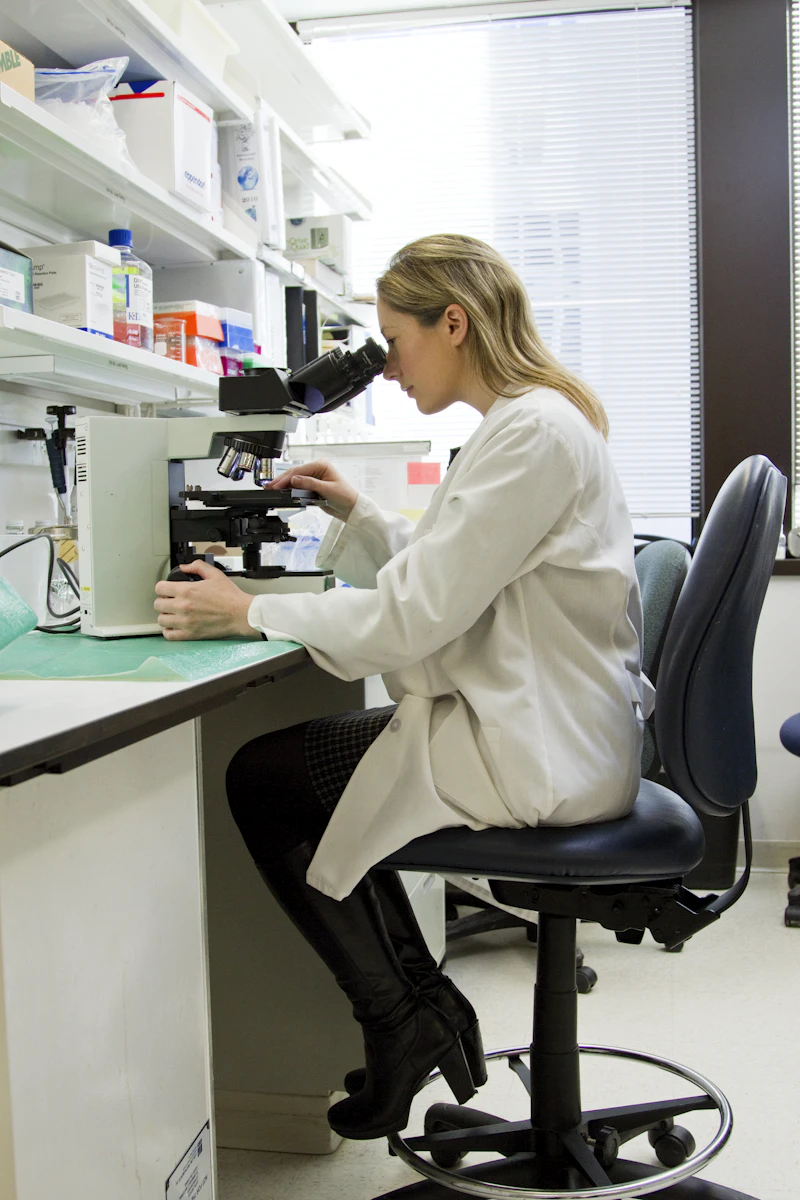
Laboratory research setting (Unsplash)
Step-by-Step Methodology
The researchers followed a meticulous design process:
Computational Design
Using protein design software, they created three-helix bundle blueprints with varying degrees of twist in the ice-binding helix.
Sequence Optimization
They generated amino acid sequences that would fold into these structures using algorithms that consider atomic-level interactions.
Experimental Characterization
The designed proteins were synthesized and tested for ice recrystallization inhibition and structural validation.
Key Research Reagents and Their Functions
| Research Reagent/Tool | Function in the Experiment |
|---|---|
| Computational Design Software | Generated 3D models of twist-constrained helical bundles |
| ProteinMPNN | Designed amino acid sequences fitting the target structures |
| AlphaFold2/RoseTTAFold | Validated that designed sequences would fold correctly |
| Ice Recrystallization Assay | Quantified IRI activity of designed proteins |
| Fluorescence-Based Ice Plane Affinity (FIPA) | Visualized which ice crystal planes the proteins bound to |
A Breakthrough Validated: When Design Meets Reality
The Twist-Activity Relationship
The results were striking and clear: ice-recrystallization inhibition by the designed proteins increased with the degree of designed undertwisting 3 . This direct correlation provided compelling validation of their initial hypothesis—the geometry of the ice-binding helix, particularly its twist, is indeed a critical factor determining IRI activity.
The most undertwisted designs showed significant IRI activity, despite having completely novel sequences unrelated to natural IBPs. This demonstrated that the researchers had successfully identified and implemented the key structural principles underlying ice-binding function.
Beyond Natural Design
These synthetic IBPs represent more than just copies of nature's work. They offer several advantages:
Precise Control
Scientists can fine-tune activity by adjusting helix parameters
Novel Functions
Designs can target specific ice crystal planes or temperature ranges
Stability
Synthetic proteins can be engineered for enhanced stability
Specificity
Activities can be tailored for particular applications 3
Comparison of Natural and De Novo Designed IBPs
| Characteristic | Natural IBPs | De Novo Designed IBPs |
|---|---|---|
| Sequence | Evolved from natural selection | Designed computationally |
| Diversity | Limited by evolutionary history | Limited only by imagination and physics |
| Optimization | For organism survival | For specific human applications |
| Structure | Various folds (α-helices, β-solenoids) | Initially focused on helical bundles |
| Reliability | Well-adapted but variable | Predictable based on design parameters |
The Future on Ice: Applications and Implications
Transforming Cryopreservation
One of the most promising applications lies in cryopreservation—the freezing of cells, tissues, and potentially entire organs for transplantation. Current methods rely on cryoprotectants like dimethyl sulfoxide (DMSO), which can be toxic to cells and tissues at high concentrations 5 .
Designed IBPs used at thousandths of the concentration of traditional antifreezes could revolutionize this field by:
- Improving viability of frozen blood products
- Enabling long-term storage of stem cells
- Potentially allowing organ banking for transplants 5
Cryopreservation research (Unsplash)
Climate Research
Understanding cloud formation and precipitation processes 1
Potential Impact Areas
- Medicine: Creating new treatments for frostbite and hypothermia
- Materials Science: Developing anti-icing surfaces for aircraft and infrastructure
- Biotechnology: Improving stability of frozen biological samples
- Food Industry: Enhancing quality of frozen products
Conclusion: A New Era of Molecular Design
The successful de novo design of ice-binding proteins from twist-constrained helices represents far more than a laboratory curiosity—it signals a new era in our ability to harness nature's principles while moving beyond its limitations. By understanding and applying the geometric secret of helix twist, scientists have opened the door to designing a new generation of cryoprotectants tailored to specific needs.
As one researcher noted, this approach "opens up avenues for the computational design of IBPs" with activities customized for everything from cell cryopreservation to food storage 3 . The frozen world that once limited life has now become a canvas for human ingenuity, and the designs we create may ultimately help us preserve and protect life itself.
For further reading on ice-binding proteins and their applications, refer to the research articles cited in this piece, available through the PubMed and Nature Publishing Group databases.