Advanced Troubleshooting Guide for Heterologous Expression Systems: From Foundational Principles to Cutting-Edge Solutions
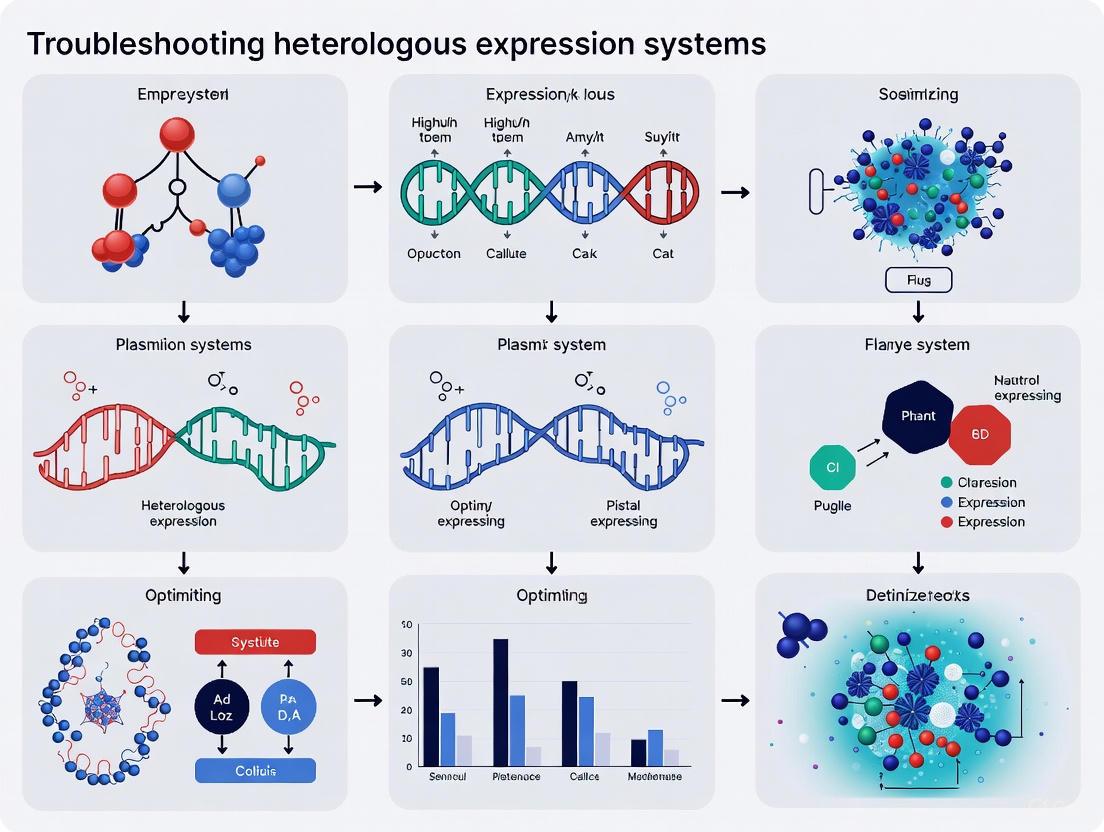
This comprehensive guide addresses the critical challenges researchers face in heterologous protein expression, a cornerstone technique in biotechnology and drug development.
Advanced Troubleshooting Guide for Heterologous Expression Systems: From Foundational Principles to Cutting-Edge Solutions
Abstract
This comprehensive guide addresses the critical challenges researchers face in heterologous protein expression, a cornerstone technique in biotechnology and drug development. Covering foundational principles to advanced optimization, it systematically explores host system selection (E. coli, yeast), vector design, and codon optimization strategies. The article provides practical methodologies for expressing complex proteins including membrane proteins and toxic proteins, alongside proven troubleshooting protocols for low yields, solubility issues, and proteolysis. Through comparative analysis of expression platforms and validation techniques, it equips scientists with integrated strategies to overcome expression barriers and maximize success in producing recombinant proteins for research and therapeutic applications.
Understanding Heterologous Expression: Core Principles and Common Roadblocks
Core Concepts and FAQs
What is heterologous expression?
Heterologous expression is the process of introducing and expressing a gene or DNA sequence from one species into a different host organism. This host organism, known as the heterologous host, then uses its own cellular machinery to produce the recombinant protein. The production of a protein encoded by recombinant DNA in a heterologous host is a cornerstone of modern biotechnology [1].
What are the main applications of heterologous expression?
This technology is fundamental to various scientific and industrial endeavors. It is used for the large-scale production of therapeutic proteins and enzymes, functional analysis of genes and proteins, structural biology studies requiring high protein yields, and the development of biopharmaceuticals, including some vaccines, as evidenced by its role in certain COVID-19 vaccine production [1].
How do I choose the right expression system?
Selecting an optimal expression system depends on multiple criteria, including the origin and intrinsic characteristics of your target protein, the required post-translational modifications, the intended application, and practical considerations like cost and laboratory expertise [2] [1]. The table below summarizes the common systems:
Table 1: Comparison of Heterologous Expression Systems
| Expression System | Typical Yield | Key Advantages | Key Limitations | Ideal For |
|---|---|---|---|---|
| Bacterial (e.g., E. coli) | High (mg to g/L) | Simple, fast, low-cost, high yield [2] | Lack of complex PTMs, protein misfolding & inclusion bodies [2] | Non-glycosylated proteins, prokaryotic proteins, research requiring high yield quickly [2] |
| Yeast (e.g., P. pastoris) | High | Eukaryotic PTMs, scalable, cost-effective [2] | Glycosylation patterns differ from mammals | Secreted proteins, scalable production of eukaryotic proteins [2] [3] |
| Insect Cells (Baculovirus) | Up to 500 mg/L [2] | Better PTMs than yeast, more native-like protein folding, handles large proteins | Culture can be challenging, slower than bacterial systems [2] | Complex eukaryotic proteins, membrane proteins, viral proteins |
| Mammalian Cells (e.g., HEK293, CHO) | Variable | Most native PTMs and protein folding, produces functional proteins [2] | High cost, slow growth, technically demanding [2] | Therapeutic proteins, complex proteins requiring authentic PTMs [2] |
| Cell-Free | Low to moderate | Rapid, bypasses cell viability, good for toxic proteins [2] [4] | Not sustainable for large-scale production [2] | High-throughput screening, labeling for structural studies, toxic proteins [4] |
Troubleshooting Common Experimental Issues
Problem 1: No or Low Protein Expression
This is a common issue where the target protein is not detected or is produced at very low levels after induction.
Potential Causes and Solutions:
- Verify Your Construct: The first step is always to check your plasmid by sequencing the entire expression cassette. A single point mutation or a frameshift can introduce a premature stop codon, preventing expression [5] [6].
- Check Promoter and Ribosome Binding Site (RBS): Secondary structures in the mRNA around the 5' untranslated region (UTR) or the beginning of the coding sequence can prevent efficient translation by the ribosome. Trying a different promoter or altering the RBS to more closely match the ideal sequence (e.g., AGGAGGT in E. coli) can help [5] [4].
- Assay Sensitivity: Do not rely solely on SDS-PAGE with Coomassie staining, as it is relatively insensitive. Use a more sensitive method like western blot (if you have an antibody) or an activity assay to confirm whether low-level expression is occurring [5].
- Codon Usage: Check if your gene of interest is rich in codons that are rare for your expression host. This can cause the ribosome to stall, resulting in truncated or non-functional proteins. Solutions include using a host strain engineered to supply rare tRNAs (e.g., Rosetta for E. coli) or having the gene synthesized with optimized codon usage [5] [6] [3].
Problem 2: Protein is Expressed but Insoluble (Inclusion Bodies)
You detect a strong band for your protein, but it's located in the pellet fraction after centrifugation, indicating the formation of inclusion bodies—aggregates of misfolded protein.
Potential Causes and Solutions:
- Slow Down Expression: Rapid expression can overwhelm the cell's folding machinery. Lowering the induction temperature (e.g., to 20-30°C) or reducing the concentration of the inducer (e.g., IPTG) can slow down translation, giving the protein more time to fold correctly [5] [3].
- Use Fusion Tags: Fusing your protein to a highly soluble partner like Maltose Binding Protein (MBP) or Thioredoxin (Trx) can greatly enhance solubility. Test both N-terminal and C-terminal fusions [5] [4].
- Co-express Chaperones: Co-expressing molecular chaperones (e.g., GroEL/GroES, DnaK/DnaJ) can assist in the proper folding of the target protein within the cell. Kits with chaperone plasmids are commercially available for this purpose [5] [3].
- Screen for Solubility: Always check for solubility by lysing the cells and centrifuging. The supernatant contains the soluble fraction, while the pellet contains the insoluble fraction. Re-suspend the pellet in buffer to the same volume as the supernatant to compare them via SDS-PAGE [5].
Problem 3: High Basal (Leaky) Expression or Protein Toxicity
The target protein is expressed even without induction, which can be toxic to the host cells, leading to poor cell growth, plasmid instability, or loss of the recombinant gene.
Potential Causes and Solutions:
- Tighten Promoter Control:
- For lac/T7-lac promoter systems, ensure your system has sufficient LacI repressor. Use host strains that carry the lacIq gene, which increases repressor production ten-fold, providing tighter control [4].
- For the common T7 system (e.g., in BL21(DE3) strains), basal expression comes from low-level activity of T7 RNA polymerase. Switch to a host that co-expresses T7 lysozyme (e.g., pLysS or lysY strains), which is a natural inhibitor of T7 RNA polymerase [4] [6].
- Use Tunable Expression Systems: For highly toxic proteins, use tightly regulated and tunable systems like the Lemo21(DE3) strain, where expression of the inhibitory T7 lysozyme is controlled by the rhamnose promoter. Titrating rhamnose concentration allows you to fine-tune the expression level of your toxic protein just below the host's toxicity threshold [4].
- Consider Cell-Free Expression: If the protein is extremely toxic to living cells, a cell-free protein synthesis system can be a viable alternative [4].
Problem 4: Protein Degradation
The full-length protein is degraded by host cell proteases, resulting in multiple smaller bands or a complete loss of the protein band on a western blot.
Potential Causes and Solutions:
- Use Protease-Deficient Strains: Use expression strains that lack key proteases like OmpT and Lon to minimize degradation during cell lysis and processing [4] [3].
- Add Protease Inhibitors: Always include a cocktail of protease inhibitors in your lysis buffer [3].
- Adjust Growth Conditions: Shorten the induction time or lower the induction temperature to reduce protease activity.
- Engineer the Protein: If the protein contains readily recognized degradation signals, consider removing these sequences through protein engineering to enhance stability [3].
Problem 5: Lack of Biological Activity
The protein is expressed and soluble but is not functionally active, which is often due to improper folding or missing post-translational modifications.
Potential Causes and Solutions:
- Promote Disulfide Bond Formation: If your protein requires disulfide bonds for stability or activity, the reducing cytoplasm of standard E. coli strains is not suitable. Use strains like Origami or SHuffle, which have mutations that promote disulfide bond formation in the cytoplasm. SHuffle strains also express the disulfide bond isomerase DsbC in the cytoplasm to help correct misfolded bonds [5] [4].
- Switch Expression Systems: If your protein requires specific eukaryotic PTMs (e.g., complex glycosylation, gamma-carboxylation), a prokaryotic system like E. coli will not be sufficient. You must switch to a eukaryotic host such as yeast, insect, or mammalian cells [5] [2] [3].
- Test Fusion Tags: Sometimes, a fusion tag can interfere with the protein's active site or oligomerization. Test the protein's activity with the tag removed (using a protease cleavage site) or try a different tag configuration (e.g., switch from N-terminal to C-terminal) [5].
Essential Experimental Workflows
Standard Workflow for Testing Heterologous Expression in E. coli
This workflow provides a foundational methodology for establishing a protein expression experiment.
Decision Workflow for Troubleshooting Expression Problems
This logic diagram guides the troubleshooting process based on initial experimental observations.
The Scientist's Toolkit: Key Research Reagent Solutions
This table details essential materials and reagents used to address common challenges in heterologous expression.
Table 2: Essential Reagents for Heterologous Expression
| Reagent / Tool | Function / Purpose | Example Products / Strains |
|---|---|---|
| Specialized E. coli Strains | Engineered hosts to solve specific problems like codon bias, disulfide bond formation, or toxicity. | Rosetta: Supplies rare tRNAs for rare codons [5].Origami/SHuffle: Promotes cytoplasmic disulfide bond formation [5] [4].BL21(DE3) pLysS/T7 Express lysY: Provides T7 lysozyme for tight control of basal expression [4]. |
| Fusion Tags | Polypeptides fused to the target protein to aid in solubility, detection, and purification. | His-tag: Simplifies purification via immobilized metal affinity chromatography (IMAC) [7].MBP/GST-tag: Enhances solubility; also used for purification (amylose/glutathione resin) [5] [4].SUMO-tag: Enhances solubility and allows for highly specific cleavage [7]. |
| Chaperone Plasmid Kits | Co-expression plasmids for molecular chaperones that assist in the correct folding of the target protein inside the cell, reducing inclusion body formation. | Takara's Chaperone Plasmid Set [5]. |
| Protease Inhibitor Cocktails | Chemical mixtures added to lysis buffers to inhibit endogenous proteases released during cell disruption, preventing protein degradation. | Commercial cocktails (e.g., from Roche, Thermo Fisher) containing inhibitors for serine, cysteine, metallo, and aspartic proteases. |
| Tunable Induction Systems | Systems that allow precise control over the level of protein expression, crucial for expressing toxic proteins. | Lemo21(DE3) strain: Expression level is tuned with L-rhamnose concentration [4].Arabinose-inducible (pBAD) systems: Tightly regulated by arabinose [3]. |
Frequently Asked Questions (FAQs)
Q1: What are the common causes of low recombinant protein expression in CHO cells and how can they be addressed? Low expression can stem from several factors related to vectors, promoters, and the host organism itself. A key issue is the use of suboptimal regulatory elements in the expression vector. Research has demonstrated that incorporating a Kozak sequence (GCCGCCRCC) upstream of the start codon can enhance translation initiation, while adding a Leader peptide sequence can improve protein folding and trafficking [8]. Combining these two elements has been shown to increase the expression of model proteins like eGFP by over 2-fold and secreted alkaline phosphatase (SEAP) by 1.55-fold compared to baseline vectors [8]. Furthermore, the site of transgene integration within the host genome is critical. Integration into transcriptionally inactive heterochromatin regions leads to silencing or low expression [9]. Strategies to overcome this include using Site-Specific Integration (SSI) systems like CRISPR-Cas9 to target "hotspot" genomic loci such as the Hprt1 gene, or employing chromatin opening elements like Scaffold/Matrix Attachment Regions (S/MARs) in the vector design to promote a more active chromatin state and stable expression [9] [10].
Q2: How can I reduce clonal heterogeneity and ensure stable protein production in recombinant CHO cell lines? Clonal heterogeneity, where different cell clones show vast differences in productivity and growth, is primarily caused by Random Transgene Integration (RTI) [9]. When a transgene integrates randomly, its expression is highly influenced by the local genomic environment. To address this, consider moving away from traditional RTI methods. Semi-Targeted Integration (STI) systems, such as the Sleeping Beauty or PiggyBac transposases, can improve the proportion of high-expressing clones and yield better productivity stability [9]. The most effective strategy is Site-Specific Integration (SSI) using CRISPR-based tools to insert the transgene into a predefined, transcriptionally active genomic "landing pad" [9]. This ensures that every selected clone has the transgene in the same favorable genetic context, drastically reducing heterogeneity. Additionally, for any chosen method, implementing a rigorous single-cell cloning and expansion protocol, followed by a Long-Term Culture (LTC) study to monitor for phenotypic drift over 55+ days, is crucial to identify the most stable production clones [9].
Q3: What strategies can improve CRISPR-Cas9 editing efficiency in difficult-to-transfect host cells like iPSCs or primary lymphocytes? Editing efficiency in sensitive primary cells like lymphocytes or finicky iPSCs can be enhanced by optimizing the delivery and nuclear localization of the CRISPR machinery. A proven strategy is using Hairpin Internal Nuclear Localization Signals (hiNLS) engineered directly into the backbone of the Cas9 protein [11]. This design increases the density of NLS sequences without hindering protein production, leading to more efficient import of the Cas9 ribonucleoprotein (RNP) complex into the nucleus. This approach has successfully enhanced gene knockout efficiency in primary human T cells compared to standard terminally-fused NLS constructs [11]. For iPSCs, which have notoriously low rates of Homology-Directed Repair (HDR), enriching for successfully transfected cells is key. This can be achieved by adding antibiotic selection or using Fluorescence-Activated Cell Sorting (FACS) to sort for cells that have taken up the editing components [12] [13].
Q4: How can I minimize off-target effects in CRISPR-based genome editing experiments? Minimizing off-target activity is critical for clean experimental results and therapeutic safety. The first line of defense is careful guide RNA (gRNA) design. Use established online tools to design highly specific gRNAs and scan for potential off-target sites in your specific genome [14]. Beyond design, employ high-fidelity Cas9 variants (e.g., HiFi Cas9) that have been engineered to drastically reduce off-target cleavage while maintaining robust on-target activity [14]. Finally, the choice of delivery method matters. Using pre-assembled Cas9 Ribonucleoprotein (RNP) complexes for editing, rather than plasmid DNA, limits the time the nuclease is active in the cell, thereby reducing the window for off-target cutting [11]. Always include proper controls, such as cells treated with a non-targeting gRNA, to accurately account for background noise and off-target effects in your analysis [14].
Troubleshooting Guides
Table 1: Troubleshooting Low Recombinant Protein Expression
| Problem Area | Potential Cause | Recommended Solution | Experimental Protocol to Test |
|---|---|---|---|
| Vector | Weak or unsuitable promoter | Use a strong, constitutive promoter (e.g., CMV) and validate its activity in your specific host cell type. | Clone your Gene of Interest (GOI) into a vector with a validated strong promoter. Transfert and measure mRNA (qPCR) and protein levels (ELISA/Western Blot) after 48h against a positive control. |
| Lack of enhancer elements | Incorporate regulatory elements like a Kozak sequence (GCCGCCRCC) and/or a Leader sequence upstream of the GOI [8]. | Construct vectors with the GOI alone, GOI+Kozak, and GOI+Kozak+Leader. Transfert in parallel and compare expression via flow cytometry (for fluorescent reporters) or specific activity assays over 72h [8]. | |
| Transgene Integration | Integration into silent heterochromatin | Employ Site-Specific Integration (SSI) into a known active locus (e.g., Hprt1) or use Bacterial Artificial Chromosomes (BACs) to include full regulatory loci [9] [10]. | Use CRISPR-Cas9 to target the GOI to a defined hotspot. Compare protein titer and clonal stability from SSI-derived clones versus those from Random Integration (RTI) over at least 15 passages. |
| Low copy number or gene silencing | Use a transposase-based Semi-Targeted Integration (STI) system (e.g., PiggyBac) to achieve higher, more stable copy numbers [9]. | Cotransfect the GOI plasmid with the transposase plasmid. Select pools and single clones. Use digital PCR to assess copy number and compare expression stability to RTI pools in a long-term culture study. | |
| Host Cell | Low transfection efficiency | Optimize delivery method. For CHO cells, test lipofection, electroporation, or different viral vectors [14] [10]. | Transfert cells with a GFP reporter plasmid using different methods/parameters. Analyze GFP positivity by flow cytometry at 24-48h to determine the most efficient protocol for your cell line. |
| Cellular stress / apoptosis | Engineer the host cell line to be more robust, e.g., by knocking out pro-apoptotic genes like Apaf1 to extend culture longevity and productivity [8]. | Use CRISPR-Cas9 to generate an Apaf1 knockout CHO cell line. Culture the KO and WT cells in production mode and compare viability (via Trypan Blue exclusion) and product titer at days 7, 10, and 14. |
Table 2: Quantitative Impact of Vector Optimization on Protein Expression
| Recombinant Protein | Regulatory Element Added | Expression Fold Change vs. Control | Key Experimental Finding |
|---|---|---|---|
| eGFP [8] | Kozak sequence | 1.26x | Increased translation initiation, measured by Mean Fluorescence Intensity (MFI) via flow cytometry. |
| eGFP [8] | Kozak + Leader sequence | 2.2x | Synergistic effect on translation and proper folding, measured by MFI. |
| SEAP (Transient) [8] | Kozak sequence | 1.37x | Elevated levels of secreted enzyme in culture supernatant, detected by enzymatic activity assay. |
| SEAP (Stable) [8] | Kozak + Leader sequence | 1.55x | Sustained higher yield in selected stable cell pools, confirming long-term benefit of element combination. |
Experimental Protocols
Protocol 1: Testing Regulatory Elements for Vector Optimization
This protocol outlines the steps to empirically test the effect of Kozak and Leader sequences on the expression of your gene of interest (GOI) in a mammalian cell system [8].
Workflow Diagram: Testing Regulatory Elements
Key Research Reagent Solutions:
- Expression Vectors: Start with a standard mammalian expression vector (e.g., pcDNA3.1, pCMV-based).
- Cell Line: CHO-S or CHO-K1 cells are standard for recombinant protein production [10].
- Transfection Reagent: Use a high-efficiency reagent optimized for your cell line (e.g., Lipofectamine 3000) [12].
- Selection Antibiotic: e.g., Blasticidin, Puromycin, or G418, depending on the resistance marker in your vector.
- Analysis Kits: e.g., Alkaline phosphatase kit for SEAP, or specific ELISA kits for your GOI.
Methodology:
- Vector Construction: Clone your GOI into three variants of the backbone vector: (A) the basic vector with no added elements, (B) vector with a strong Kozak sequence (GCCGCCACC) added directly upstream of the start codon, and (C) vector with both the Kozak and a suitable Leader sequence [8]. Verify all constructs by sequencing.
- Cell Transfection: Culture CHO cells in an appropriate medium (e.g., DMEM/F12). Transfect the cells in parallel with the three constructed vectors using an optimized protocol. Include a mock transfection as a negative control.
- Transient Expression Analysis: 48 hours post-transfection, harvest the cell culture supernatant (for secreted proteins) or the cells themselves (for intracellular proteins). Quantify expression using a method suitable for your protein (e.g., fluorescence measurement for eGFP, enzymatic activity assay for SEAP, or ELISA) [8].
- Stable Cell Pool Generation: After transfection, passage the cells into a medium containing the appropriate selection antibiotic. Maintain the culture for 1-2 weeks, replenishing the selection medium every 2-3 days, to select for a stable pool of integrants.
- Stable Expression Analysis: Once a stable pool is established, assay the protein expression from the pools under standard production conditions. Compare the yield from the three different pools (A, B, and C) to determine the effect of the regulatory elements on long-term, stable production [8].
Protocol 2: Enhancing CRISPR Editing Efficiency with hiNLS Cas9
This protocol describes the use of novel Hairpin Internal Nuclear Localization Signal (hiNLS) Cas9 constructs to achieve higher editing rates in primary human cells, a common challenge in therapeutic development [11].
Workflow Diagram: hiNLS CRISPR Workflow
Key Research Reagent Solutions:
- CRISPR Nuclease: Use commercially available or research-provided hiNLS-Cas9 protein [11].
- Synthetic gRNA: Chemically synthesized crRNA and tracrRNA, or a single-guide RNA (sgRNA), designed for your specific genomic target.
- Delivery System: Electroporator system (e.g., Neon, Amaxa) for efficient RNP delivery into primary cells [11].
- Genotyping Detection Kit: T7 Endonuclease I assay kit or materials for Next-Generation Sequencing (NGS) library prep and analysis.
Methodology:
- RNP Complex Assembly: Complex the purified hiNLS-Cas9 protein with the synthesized target gRNA at a predetermined molar ratio in a suitable buffer. Incubate for 10-20 minutes at room temperature to form the active RNP complex.
- Cell Preparation and Delivery: Harvest and wash the primary cells (e.g., T cells). Resuspend the cells in the appropriate electroporation buffer. Mix the cell suspension with the pre-assembled RNP complex and electroporate using optimized parameters for your cell type [11].
- Post-Transfection Culture: Immediately after electroporation, transfer the cells to pre-warmed culture medium. Allow the cells to recover and the editing to occur for 48-72 hours.
- Editing Efficiency Analysis: Harvest the genomic DNA from the edited cells. Amplify the target genomic region by PCR. Quantify the editing efficiency using the T7 Endonuclease I (T7E1) assay, which cleaves heteroduplex DNA formed by edited and wild-type sequences, or through Next-Generation Sequencing (NGS) for a more precise and quantitative measurement [14] [12]. Compare the efficiency achieved with hiNLS-Cas9 to that of standard NLS-Cas9 constructs.
The Scientist's Toolkit
Table 3: Essential Reagents for Heterologous Expression and Genome Engineering
| Reagent / Solution | Function / Application | Example(s) |
|---|---|---|
| Kozak Sequence | A nucleotide sequence (GCCGCCRCC) that enhances the initiation of translation in eukaryotic cells by ensuring accurate ribosome binding [8]. | GCCGCCACC |
| Leader Sequence | A peptide sequence that directs the nascent protein to the secretory pathway, aiding in proper folding and post-translational modification, and is often cleaved from the mature protein [8]. | Native secretion signal peptides (e.g., from IL-2) |
| Site-Specific Integration (SSI) Systems | Enables precise insertion of a transgene into a predefined, transcriptionally active genomic locus, reducing clonal heterogeneity [9]. | CRISPR-Cas9, Cre-loxP, Bxb1 integrase |
| Semi-Targeted Integration (STI) Systems | Transposase-based systems that facilitate higher integration efficiency into transcriptionally active regions compared to random integration, without requiring a predefined site [9]. | PiggyBac, Sleeping Beauty transposases |
| High-Fidelity Cas9 | Engineered Cas9 variants with reduced off-target cleavage activity, crucial for applications requiring high specificity, such as therapeutic development [14]. | HiFi Cas9, eSpCas9 |
| Hairpin Internal NLS (hiNLS) | Engineered nuclear localization signals placed within a protein's structure to increase nuclear import density and efficiency, boosting editing rates in primary cells [11]. | hiNLS-Cas9 constructs |
| Ribonucleoprotein (RNP) Complex | A pre-assembled complex of Cas9 protein and guide RNA, delivered directly into cells. Offers high efficiency, rapid action, and reduced off-target effects compared to plasmid DNA delivery [11]. | Cas9 protein + sgRNA complexed in vitro |
| Chromatin Opening Elements | DNA elements (e.g., S/MARs) included in vectors to help maintain an open, transcriptionally active chromatin state at the integration site, promoting stable transgene expression [10]. | Scaffold/Matrix Attachment Regions (S/MARs) |
Troubleshooting Guides
Insoluble Aggregate Formation
Q: My target protein is expressed but forms insoluble aggregates (inclusion bodies). What strategies can I use to improve solubility?
A: Insoluble aggregation often occurs when proteins misfold or hydrophobic residues are exposed. A multi-pronged approach is needed to address this.
- Modify Expression Conditions: Slowing down the expression rate allows the cellular folding machinery to keep up. You can achieve this by:
- Utilize Fusion Tags: Fusing your protein to a highly soluble partner can dramatically improve its solubility. A common and effective tag is Maltose-Binding Protein (MBP) [5] [15] [16]. Test both N- and C-terminal fusions, as the optimal configuration can be protein-specific. A case study showed that adding an MBP tag led to a strong increase in protein yield for a viral coat protein with known solubility issues, whereas expression without the tag was barely detectable [16].
- Employ Chaperone Co-expression: Co-express molecular chaperones, such as GroEL/S, DnaK/DnaJ, or ClpB, to assist with proper protein folding inside the cell. Kits are available that provide plasmids for co-expressing specific chaperone sets [5] [15].
- Address Disulfide Bonds: If your protein requires disulfide bonds for stability, use engineered E. coli strains like SHuffle or Origami. These strains have a more oxidizing cytoplasm that facilitates the formation of correct disulfide bonds [5] [15].
- Analyze the Mechanism: Understand that aggregates are typically stabilized by non-covalent forces. Hydrophobic interactions are the main driving force, while hydrogen bonding and van der Waals forces also contribute to structural stability. In some cases, disulfide bonds can also play a role in aggregation [17].
Table: Strategies to Combat Insoluble Aggregates
| Strategy | Method Example | Key Mechanism |
|---|---|---|
| Process Modulation | Lower temperature (15-20°C), reduce inducer concentration [5] [15] | Slows synthesis rate for proper folding |
| Genetic Fusion | MBP, Thioredoxin, or SUMO solubility tags [5] [16] | Enhances solubility of passenger protein |
| Chaperone Co-expression | Plasmids for GroEL/S, DnaK/DnaJ complexes [5] [15] | Increases cellular folding capacity |
| Specialized Strains | SHuffle (disulfide bonds), Rosetta (rare codons) [5] [15] | Corrects specific folding deficiencies |
Proteolysis and Protein Degradation
Q: I see multiple lower molecular weight bands on my Western blot, suggesting proteolysis. How can I minimize degradation of my recombinant protein?
A: Proteolysis indicates that host cell proteases are cleaving your target protein.
- Select a Protease-Deficient Strain: Always use expression strains that lack key proteases. Look for strains with mutations in genes like ompT (outer membrane protease) and lon (cytoplasmic protease) [15]. Common E.coli strains like BL21(DE3) are often deficient in these proteases.
- Work at Low Temperatures: Perform cell lysis and all subsequent purification steps on ice or at 4°C. Always include a broad-spectrum protease inhibitor cocktail in your lysis buffer [15].
- Consider the Protein's Destination: For proteins that naturally form disulfide bonds, targeting them to the oxidative environment of the periplasm can be beneficial. Use expression vectors that include a signal sequence (e.g., pelB, DsbA) for periplasmic secretion [15].
- Shorten Experiment Time: If degradation persists, try to shorten the time between induction and harvest, as the stress of recombinant protein production can upregulate protease activity.
Low Protein Yields
Q: I am getting very low yields of my target protein. What are the primary factors I should investigate?
A: Low yields can stem from problems at the transcriptional, translational, or post-translational level.
- Verify Your DNA Construct: The first step is always to sequence the entire expression cassette to ensure there are no accidental mutations, stray stop codons, or errors in the ribosomal binding site (RBS) [5].
- Check for Rare Codons: Analyze the codon usage of your gene. If it contains codons that are rare in your expression host (e.g., E. coli), the translation will stall. This can be resolved by using strains like Rosetta that carry extra copies of rare tRNA genes, or by having the gene synthesized using host-optimized codons [5] [15].
- Troubleshoot Low Basal Expression: For toxic proteins, even low levels of "leaky" expression before induction can inhibit cell growth and plasmid stability.
- In IPTG-inducible T7 systems (e.g., BL21(DE3)), use strains that co-express T7 Lysozyme (e.g., pLysS strains or T7 Express lysY), which is a natural inhibitor of T7 RNA polymerase [15].
- Ensure sufficient levels of the Lac repressor by using strains with the lacIq allele, which produces more repressor protein [15].
- Optimize Culture Conditions: The culture medium and growth conditions are critical cost drivers and significantly impact yield [18]. Optimization involves:
- Medium Composition: Use a well-defined medium and experiment with carbon sources and key nutrients. Statistical design of experiments (DoE) can efficiently identify optimal concentrations [18].
- Process Parameters: Carefully control and optimize pH, dissolved oxygen levels, and feeding strategies in bioreactors [18].
Table: Culture Condition Optimization for Improved Yield
| Parameter | Potential Impact | Optimization Approach |
|---|---|---|
| Medium Composition | Accounts for up to 80% of production cost; affects nutrient availability and physicochemical environment [18] | High-throughput screening, Statistical Design of Experiments (DoE), AI/ML-driven modeling [18] |
| pH | Influences protein stability, fragmentation, and charge variants [18] | Controlled feedback loops in bioreactors |
| Dissolved Oxygen | Critical for cell health and proper protein folding; low oxygen can lead to aggregation [18] | Cascade control of air/O2/N2 gas mixing |
| Temperature | Affects growth rate, expression rate, and folding efficiency [5] [15] | Test a range (e.g., 15°C, 25°C, 37°C) |
Frequently Asked Questions (FAQs)
Q: When should I consider switching to a different expression system? A: Consider switching if you have exhaustively tried the strategies above in E. coli without success. This is particularly true for complex proteins that require post-translational modifications (e.g., specific glycosylation patterns), are highly disulfide-bonded, or are toxic to bacterial cells. Alternative systems include:
- Insect Cells (Sf9, Sf21): Use the baculovirus expression system (BEVS) for producing more complex eukaryotic proteins [19].
- Mammalian Cells: The preferred choice for therapeutic proteins requiring human-like glycosylation [18].
- Cell-Free Systems: Useful for toxic proteins or for rapid screening. Platforms like ALiCE can produce proteins within 24 hours and are excellent for testing different tags and constructs [16].
Q: What is the quickest way to test if a solubility tag will help my protein? A: The fastest approach is to use a cell-free protein expression system. These systems, such as ALiCE, allow you to test multiple constructs (e.g., with and without an MBP tag) in parallel within a single day, bypassing the time-consuming steps of bacterial transformation and culture growth [16].
Q: Are there emerging technologies that can help with these challenges? A: Yes, the field is rapidly advancing. Key trends include:
- AI-Driven Protein Engineering: AI and machine learning are now used to accurately model protein structures, optimize stability, and reduce immunogenicity [20].
- Advanced Modeling for Culture Optimization: Artificial Intelligence and Machine Learning (AI/ML) are being integrated to model the complex relationships between medium components and protein yield, accelerating optimization [18].
- Novel Delivery Systems: Research into nanocarriers and cell-penetrating peptides aims to improve the delivery of protein drugs, which can influence the design criteria for expression [20].
Experimental Workflow: A Systematic Approach to Troubleshooting
The following diagram outlines a logical workflow for diagnosing and addressing common heterologous expression challenges.
The Scientist's Toolkit: Key Research Reagent Solutions
Table: Essential Reagents for Troubleshooting Heterologous Expression
| Reagent / Material | Function in Troubleshooting | Example Use Cases |
|---|---|---|
| Specialized E. coli Strains | Provides a tailored cellular environment for expression. | SHuffle: For disulfide-bonded proteins [5] [15]. Rosetta 2: Supplies tRNAs for rare codons [5] [15]. BL21(DE3) pLysS: For tight control of basal expression [15]. |
| Solubility Enhancement Tags | Improves solubility and folding of the target protein. | MBP (Maltose-Binding Protein): A highly effective, large solubility tag [5] [16]. SUMO: Also acts as a chaperone and can be cleaved with high specificity. |
| Chaperone Plasmid Sets | Co-expression of folding assistants to improve yield of soluble protein. | Takara's Chaperone Plasmid Set: Allows for co-expression of GroEL/S, DnaK/DnaJ, etc., to test which complex aids your protein [5]. |
| Cell-Free Protein Synthesis Kit | Rapidly test constructs without live cells; useful for toxic proteins. | PURExpress Kit (NEB): Recombinant system for in vitro expression [15]. ALiCE (LenioBio): Eukaryotic-based system for rapid screening of tags and constructs [16]. |
| Protease Inhibitor Cocktails | Prevents proteolytic degradation during cell lysis and purification. | Added to lysis buffer when using non-protease-deficient strains or when degradation is suspected [15]. |
System Comparison and Selection Guide
Selecting the appropriate protein expression system is a critical first step in experimental design. The table below summarizes the core characteristics of E. coli and yeast systems to guide this decision.
| Feature | E. coli (Prokaryotic) | Yeast (Eukaryotic) |
|---|---|---|
| Growth Rate | Very fast (doubling time ~20-30 min) [21] [22] | Moderate (doubling time ~90 min - 2 hours) [21] [22] |
| Cost & Complexity | Low cost; simple growth medium [23] [21] [24] | Low cost; simple to medium complexity [21] [25] |
| Post-Translational Modifications | None or minimal (e.g., no glycosylation) [21] [24] [22] | Capable of many (e.g., glycosylation, disulfide bond formation) [21] [24] [25] |
| Typical Protein Localization | Primarily intracellular (can form inclusion bodies) [21] [24] | Can be secreted into the medium or intracellular [21] [25] |
| Common Yields | High [23] [21] | Low to High [21] |
| Glycosylation Pattern | Not applicable | High-mannose type; can differ from mammalian patterns (may be hyperglycosylation in S. cerevisiae) [21] |
| Genetic Manipulation | Easy; very mature and standardized tools [23] [24] | Easy to medium complexity [21] [25] |
| Ideal For | Simple proteins not requiring eukaryotic PTMs; rapid, low-cost production [24] [22] | Proteins requiring eukaryotic-like folding and PTMs; secreted production [24] [25] |
Troubleshooting FAQs and Guides
Frequently Asked Questions
Q1: I see no protein expression in my E. coli culture after induction. What should I check?
- Verify your construct: Sequence the expression cassette to ensure there are no unintended stop codons or frame shifts [26] [5].
- Check for protein toxicity: If your gene of interest is toxic to the host, use tighter regulation systems like BL21(DE3)pLysS or BL21-AI strains, and consider adding glucose to the medium to repress basal expression [26].
- Confirm antibiotic selection: If using ampicillin, it can degrade during culture. Substitute with the more stable carbenicillin to maintain plasmid selection pressure [26].
- Assess solubility: Your protein may be expressed but insoluble. Centrifuge the lysate and analyze both the supernatant (soluble fraction) and the resuspended pellet (insoluble fraction) by SDS-PAGE [5].
Q2: My target protein is expressed in E. coli but forms inclusion bodies. How can I improve solubility?
- Lower induction temperature: Reduce the temperature to 30°C, 25°C, or even 18°C during induction. Lower temperatures slow down protein synthesis, allowing more time for proper folding [26].
- Reduce inducer concentration: Use a lower amount of IPTG (e.g., 0.1 - 1 mM) to moderate the expression rate [26] [5].
- Co-express chaperones: Co-express molecular chaperones (e.g., using commercial chaperone plasmid sets) to assist with protein folding [5].
- Use fusion tags: Fuse your protein to highly soluble partners like Maltose Binding Protein (MBP) or thioredoxin to enhance solubility [5].
Q3: I am getting low transformation efficiency in my Pichia pastoris system. What could be wrong?
- Use log-phase cells: Ensure cells are harvested during log-phase growth (OD600 generally below 1.0) for making competent cells [27].
- Check reagent pH and freshness: The pH of transformation solutions should be at 8.0. Prepare the PEG solution fresh each time [27].
- Increase DNA amount and incubation time: Use more linearized DNA and consider extending the incubation time during the transformation process to up to 3 hours [27].
Q4: My protein yield in yeast is low, even though the gene is integrated. What are potential causes?
- Check codon usage: The heterologous gene may contain codons that are rare in your yeast host. Consider using codon-optimized gene synthesis or specialized host strains [26] [5].
- Proteolytic degradation: Proteases in the culture medium may be degrading your secreted protein. Use protease-deficient host strains and add compatible protease inhibitors to the culture medium [26] [21].
- Optimize secretion: If secreting the protein, test different secretion signal sequences (e.g., the α-mating factor pre-sequence) to find the most efficient one for your target protein [21].
Experimental Troubleshooting Workflow
The following diagram outlines a logical, step-by-step approach to diagnosing and resolving common issues in heterologous protein expression.
Essential Reagents and Tools
The table below catalogs key reagents and materials frequently used to address common problems in E. coli and yeast expression systems.
| Reagent / Tool | Function | Example Use Case |
|---|---|---|
| BL21(DE3) pLysS/E Strains [26] | Tighter regulation of T7 RNA polymerase; reduces basal expression. | Expressing proteins toxic to E. coli. |
| BL21-AI Strain [26] | Expression is induced by arabinose, offering very tight control. | An alternative for expressing toxic proteins in E. coli. |
| Chaperone Plasmid Sets [5] | Overexpress specific molecular chaperones (e.g., GroEL/GroES). | Improving folding and solubility of complex proteins in E. coli. |
| SHuffle / Origami Strains [5] | Promote disulfide bond formation in the cytoplasm. | Expressing proteins that require correct disulfide bonding in E. coli. |
| Rosetta Strain [5] | Supplies tRNAs for codons rarely used in E. coli. | Expressing genes with codons not optimal for E. coli. |
| Protease-deficient Yeast Strains [21] | Reduce proteolytic degradation of the target protein. | Increasing yield of secreted proteins in yeast systems. |
| PichiaPink System [21] | A suite of strains and vectors for optimized expression in P. pastoris. | High-yield secretion of recombinant proteins with options to combat toxicity. |
| Various Secretion Signals [21] | Leader sequences to direct protein secretion (e.g., α-mating factor). | Finding the most efficient signal to secrete a target protein from yeast. |
Detailed Experimental Protocols
Protocol 1: Testing for Solubility and Small-Scale Expression Optimization in E. coli
This protocol is essential when initial expression attempts fail or when a protein is suspected to be insoluble [5].
- Transformation and Growth: Transform your expression plasmid into an appropriate E. coli host strain (e.g., BL21(DE3)). Plate on selective media and incubate overnight at 37°C.
- Inoculate Cultures: Inoculate 2-5 mL of autoinduction media or LB with antibiotic with a single fresh colony. Grow at the appropriate temperature (e.g., 37°C) with shaking until the OD600 reaches ~0.5.
- Induce Expression: Add IPTG to a final concentration (e.g., 0.1 mM, 0.5 mM, 1.0 mM). For temperature testing, split the culture into smaller aliquots and induce at different temperatures (e.g., 37°C, 25°C, 18°C). Continue shaking for 3-4 hours or overnight for lower temperatures.
- Harvest and Lysis: Pellet 1 mL of each culture by centrifugation. Resuspend the cell pellets in 100 µL of lysis buffer (e.g., with lysozyme) and incubate on ice for 15-30 minutes. Lyse cells by sonication or freeze-thaw cycles.
- Fractionation: Centrifuge the lysate at high speed (e.g., >12,000 x g) for 10-15 minutes at 4°C.
- Analysis: Carefully transfer the supernatant (soluble fraction) to a new tube. Resuspend the pellet (insoluble fraction) in 100 µL of SDS-PAGE loading buffer. Analyze equal proportions of the total, soluble, and insoluble fractions by SDS-PAGE to determine expression level and solubility.
Protocol 2: Diagnostic Colony PCR for Yeast Transformants
This protocol confirms the successful integration of an expression cassette into the yeast genome [27].
- Pick Colonies: Using a sterile pipette tip, pick a small portion of a putative yeast transformant colony.
- Prepare Template: Resuspend the cells in 20 µL of a lysis solution (e.g., 20 mM NaOH, 0.1% SDS) and incubate at 95-100°C for 10-15 minutes to lyse the cells and release genomic DNA. Centrifuge briefly to pellet cell debris.
- Set Up PCR: Use 1-2 µL of the supernatant as a template in a standard PCR reaction. The primers should be designed to flank the intended integration site or to amplify a product spanning the junction between the host genome and the integrated cassette.
- Run PCR: Perform PCR using a standard thermocycling program suitable for your primer pair and expected product size.
- Analyze: Run the PCR products on an agarose gel. A band of the expected size confirms correct integration, while no band suggests a failed transformation or incorrect integration.
Frequently Asked Questions (FAQs)
FAQ 1: What are the first steps to take when my recombinant protein is not expressing at all? The initial troubleshooting should focus on verifying your vector, host strain, and growth conditions.
- Vector: Ensure your gene of interest is in-frame after cloning by sequencing the plasmid. Check the sequence for long stretches of rare codons, which can cause truncation, and consider using a host strain engineered to express rare tRNAs. Also, avoid high GC content at the 5' end of the gene, as this can affect mRNA stability [28].
- Host Strain: Confirm that your chosen host strain is appropriate for your expression system (e.g., a T7 RNA polymerase-expressing strain for a T7 promoter-based vector) [29] [28].
- Growth Conditions: Perform an expression time course, taking samples every hour after induction. Test different induction temperatures (e.g., 30°C vs. 37°C) and inducer concentrations, as IPTG can be toxic at high levels [28].
FAQ 2: How can I prevent "leaky" basal expression of a toxic protein? High basal (uninduced) expression can inhibit cell growth or cause plasmid loss.
- For T7-based systems (e.g., in BL21(DE3)), use hosts that co-express T7 Lysozyme (e.g., pLysS/LysY strains), which inhibits T7 RNA polymerase [29] [28].
- Use host strains with enhanced repressor production, such as those carrying the lacIq gene, for tighter control of lac-derived promoters [29].
- Consider strains with lower basal T7 RNA polymerase production, such as T7 Express strains, which use a wild-type lac promoter instead of lacUV5 [29].
FAQ 3: My protein is expressed but is insoluble. What strategies can I use to improve solubility? If your protein forms inclusion bodies, several approaches can promote soluble expression.
- Lower Induction Temperature: Induce protein expression at a lower temperature, typically between 15–20°C [29].
- Use a Solubility Tag: Fuse your protein to a solubility tag like Maltose-Binding Protein (MBP) using systems like the pMAL Protein Fusion and Purification System. These tags can enhance solubility and allow for purification [29].
- Co-express Chaperones: Co-express molecular chaperones such as GroEL, DnaK, or ClpB to assist with proper folding in vivo [29].
FAQ 4: What specific solutions are available for expressing membrane proteins? Membrane proteins require specialized hosts and strategies for proper integration and folding.
- Tunable Expression Systems: Use systems like the Lemo21(DE3) strain, which allows for precise control of expression levels by titrating the concentration of L-rhamnose. This helps to avoid saturation of the membrane insertion machinery [29] [30].
- Specialized Strains: Employ strains engineered for disulfide bond formation, such as SHuffle strains, if your membrane protein requires correct cysteine pairing [29].
FAQ 5: How can I achieve proper disulfide bond formation in the cytoplasm? The E. coli cytoplasm is a reducing environment, which inhibits disulfide bond formation.
- Use engineered strains like SHuffle strains, which have a mutated thioredoxin reductase pathway that allows for disulfide bond formation in the cytoplasm. These strains also express the disulfide bond isomerase DsbC in the cytoplasm to correct mis-oxidized proteins [29].
Troubleshooting Guide
The table below summarizes common problems, their potential causes, and recommended solutions.
| Problem Category | Specific Symptom | Possible Cause | Recommended Solution |
|---|---|---|---|
| Low or No Expression | No protein band on SDS-PAGE | Gene sequence errors, rare codons, or mRNA instability | Sequence plasmid; use rare tRNA strains (e.g., Rosetta); check GC content [28] |
| Incorrect host strain for vector system | Use T7-compatible strains (e.g., BL21(DE3)) for T7 promoters [29] | ||
| Suboptimal growth/induction conditions | Perform a time course; test temperatures (16°C-30°C) and IPTG concentrations [31] [28] | ||
| Toxic Protein Expression | Poor cell growth, plasmid instability | Leaky basal expression before induction | Use strains with tighter repression (lacIq, pLysS/LysY, T7 Express) [29] [28] |
| Overwhelming expression upon induction | Use a tunable system (e.g., Lemo21(DE3)) [29] or switch to a cell-free system [29] [32] | ||
| Solubility & Folding Issues | Protein in inclusion bodies | Aggregation due to rapid expression | Reduce induction temperature (15-20°C); use solubility tags (e.g., MBP) [29] |
| Lack of proper folding assistance | Co-express chaperones (GroEL, DnaK) [29] | ||
| Incorrect disulfide bonds | Reducing environment of cytoplasm | Use SHuffle strains for cytoplasmic disulfide bond formation [29] | |
| Membrane Protein Challenges | Low yield, misfolded protein | Saturation of membrane insertion machinery | Use tunable expression (Lemo21(DE3)) to control expression rate [29] |
Detailed Experimental Protocols
Protocol 1: High-Throughput Screening for Soluble Expression
This protocol is adapted for a 96-well plate format to rapidly screen multiple constructs or conditions [31].
Key Materials:
- Expression Vector: e.g., pMCSG53 (with cleavable N-terminal 6xHis-tag) [31].
- Competent E. coli: High-throughput competent cells (e.g., BL21(DE3) or derivatives) [31].
- Media: Luria-Bertani (LB) broth with appropriate antibiotics.
- Inducer: Isopropyl β-D-1-thiogalactopyranoside (IPTG).
- Lysis Buffer: e.g., Tris-based buffer with lysozyme and/or detergents.
- Equipment: 96-well deep-well plates, microplate shaker/incubator, centrifuge with plate rotor.
Methodology:
- Transformation: Transform commercially synthesized, codon-optimized plasmid clones into high-efficiency competent E. coli directly in a 96-well plate format [31].
- Expression Culture: Inoculate 1-2 mL of LB medium in a deep-well plate with single colonies. Grow at 37°C with shaking until mid-log phase (OD600 ~0.6-0.8).
- Induction: Induce protein expression by adding IPTG to a final concentration of 200 µM. Incubate with shaking at 25°C overnight (~16-20 hours) [31].
- Harvesting and Lysis: Centrifuge plates to pellet cells. Resuspend pellets in a suitable lysis buffer (e.g., containing lysozyme). Perform freeze-thaw cycles or use chemical lysis to disrupt cells.
- Solubility Analysis: Centrifuge the lysates to separate soluble (supernatant) and insoluble (pellet) fractions. Analyze both fractions by SDS-PAGE or use a method compatible with His-tag detection to assess the amount of soluble target protein.
Protocol 2: Tunable Expression for Toxic and Membrane Proteins
This protocol uses the Lemo21(DE3) strain to fine-tune expression levels by varying L-rhamnose concentration [29].
Key Materials:
- Host Strain: Lemo21(DE3) competent cells.
- Inducers: IPTG and L-Rhamnose.
- Media: LB or defined medium.
Methodology:
- Transformation: Transform your expression plasmid into the Lemo21(DE3) strain.
- Setting up Expression Trials: Inoculate multiple cultures and grow them to mid-log phase.
- Titration of Expression: To each culture, add a different concentration of L-rhamnose, ranging from 0 µM to 2000 µM. Then, induce with a fixed concentration of IPTG [29].
- Analysis: Incubate the cultures post-induction for the desired time. Monitor cell growth (OD600) and analyze protein expression and solubility (via SDS-PAGE) for each condition. The optimal L-rhamnose concentration is the one that maximizes soluble yield while maintaining healthy cell growth.
Experimental Workflow and Pathways
The following diagram illustrates a systematic troubleshooting workflow for heterologous protein expression.
Systematic Troubleshooting Workflow for Heterologous Protein Expression
The Scientist's Toolkit: Research Reagent Solutions
This table details key reagents and their functions for troubleshooting heterologous expression.
| Reagent / Material | Function / Application | Examples / Notes |
|---|---|---|
| Specialized E. coli Strains | Engineered hosts to overcome specific hurdles. | BL21(DE3) pLysS/LysY: For toxic proteins, reduces basal T7 expression [29] [28]. SHuffle: For disulfide bond formation in the cytoplasm [29]. Lemo21(DE3): For tunable expression of toxic/membrane proteins [29]. Rosetta: Supplies rare tRNAs for genes with non-optimal codon usage [28]. |
| Expression Vectors with Tags | Vectors designed to enhance solubility and simplify purification. | pMAL Vectors: Fuse protein to Maltose-Binding Protein (MBP) to improve solubility [29]. pMCSG53: Vector with a cleavable N-terminal 6xHis-tag for purification [31]. |
| Inducers & Inhibitors | Chemicals to control expression and prevent degradation. | IPTG: Inducer for lac/T7-lac systems [33]. L-Rhamnose: Used for tunable induction in systems like Lemo21(DE3) [29]. Protease Inhibitor Cocktail: Added during cell lysis to prevent protein degradation [29] [33]. |
| Culture Media | Nutrient sources for cell growth and protein production. | LB (Lysogeny Broth): Standard rich medium [33] [31]. Terrific Broth (TB): High-density growth for increased yield [33]. Defined/Minimal Media (e.g., M9): For isotope labeling or metabolic studies [33]. |
| Lysis & Purification Reagents | For cell disruption and protein isolation. | Lysis Buffers: Typically Tris- or phosphate-based, with lysozyme (for bacteria) and detergents [33]. IMAC Resins: For purifying His-tagged proteins (e.g., Ni-NTA) [33]. Amylose Resin: For purifying MBP-fusion proteins [29]. |
Strategic Implementation: Host Selection, Vector Design, and Expression Optimization
FAQs: Selecting and Troubleshooting Your Expression System
Q1: What are the four key questions to ask when selecting a gene expression system?
A systematic approach is recommended, starting with four key questions about your protein of interest [34]:
- What is the biological source of the protein? Prokaryotic proteins often express well in E. coli, whereas eukaryotic proteins typically require eukaryotic hosts.
- Is the protein secreted or intracellular in its native source? This influences the choice of secretion signals and cellular compartment for expression (e.g., targeting the periplasm in E. coli).
- What is the protein's size and structural complexity? Large, multi-domain proteins or those with complex quaternary structures often require the sophisticated folding machinery of insect or mammalian cells [34] [35].
- Does the protein require post-translational modifications (PTMs) for functionality? If yes, the type of PTM (e.g., glycosylation, disulfide bonds) will dictate the host. E. coli cannot perform complex glycosylation, while yeast, insect, and mammalian cells offer varying capabilities [34] [36].
Q2: My protein is toxic to the host cells. What strategies can I use?
Protein toxicity can stunt cell growth and drastically reduce yields [3]. Several proven solutions exist:
- Use Tightly Controlled Inducible Systems: Systems such as the lac operon, T7 lac, or arabinose-inducible (pBAD) promoters allow you to grow the cells to a robust density before inducing expression [3] [37]. For the T7 system in E. coli, using strains that express T7 lysozyme (e.g., pLysS or lysY strains) can effectively inhibit basal expression before induction [37].
- Employ Tunable Expression Systems: For fine-grained control, systems like the rhamnose-inducible PrhaBAD promoter allow you to titrate expression levels by varying the inducer concentration, keeping the toxic protein just below the host's tolerance threshold [37].
- Switch to Low-Copy Number Plasmids: These plasmids reduce the gene dosage, slowing down protein production and mitigating toxicity [3].
- Consider a Cell-Free System: For highly toxic proteins, cell-free expression systems completely bypass cell viability issues [37].
Q3: My protein is expressed but forms inclusion bodies. How can I improve solubility?
The formation of insoluble inclusion bodies is a common challenge, especially in E. coli [3]. You can address this by:
- Lowering the Expression Temperature: Reducing the temperature (e.g., to 20–30°C) upon induction slows down translation, giving the protein more time to fold correctly [3] [37].
- Using Fusion Tags: Tags like Maltose-Binding Protein (MBP) or Glutathione-S-Transferase (GST) can enhance solubility and prevent misfolding [3] [37].
- Co-expressing Molecular Chaperones: Co-expression of chaperone systems like GroEL/GroES or DnaK/DnaJ can assist in proper protein folding [3].
- Using Specialized Strains: Strains like SHuffle are engineered for disulfide bond formation in the cytoplasm and can aid in the folding of complex proteins [37].
Q4: I am not getting any protein expression. What could be wrong?
- Codon Mismatch: The gene may contain rare codons for your host organism, causing translational stalling. Solution: Perform codon optimization of the gene sequence to match the tRNA pool of your host [3] [38].
- Poor Transcriptional Initiation: Weak promoters or inefficient ribosomal binding sites (RBS) can limit expression. Solution: Use strong, well-characterized promoters (e.g., T7, AOX1 for P. pastoris) and ensure optimal Kozak (eukaryotes) or Shine-Dalgarno (prokaryotes) sequences [8] [38].
- mRNA Secondary Structure: Stable structures in the 5' UTR can prevent ribosome binding. Solution: Re-engineer the sequence to avoid such structures [37].
- Protein Degradation: Your protein may be degraded by host proteases. Solution: Use protease-deficient host strains (e.g., BL21(DE3) for E. coli) and add protease inhibitors during lysis and purification [3] [37].
Troubleshooting Guides
Guide to Common Protein Expression Challenges
The table below summarizes frequent problems, their likely causes, and proven solutions.
| Challenge | Root Cause | Proven Solutions |
|---|---|---|
| Low or No Yield [3] [37] | Codon bias; mRNA secondary structure; weak promoter; protein degradation. | Codon optimization; optimize 5' UTR/RBS; use stronger promoter; use protease-deficient strains and inhibitors. |
| Inclusion Body Formation [3] [37] | Misfolding in high-expression prokaryotic systems; reducing cytoplasm. | Lower expression temperature (15-30°C); use fusion tags (MBP, GST); co-express chaperones; use engineered strains (e.g., SHuffle). |
| Host Cell Toxicity [3] [37] | Protein function inhibits host growth. | Use tightly controlled inducible systems (e.g., pLysS, rhamnose-inducible); use low-copy plasmids; induce at high cell density; switch to cell-free systems. |
| Incorrect PTMs / Lack of Activity [34] [36] | Prokaryotic host cannot perform essential eukaryotic modifications (e.g., glycosylation). | Switch to eukaryotic host: yeast, insect, or mammalian cells based on PTM complexity required. |
| Protein Degradation [3] | Recognition by host proteases; inherent instability. | Use protease-deficient strains; add protease inhibitors; engineer protein to remove degradation signals. |
Quantitative Comparison of Major Expression Systems
Selecting the right host is critical. The following table provides a comparative overview of the most common systems to guide your decision.
| Expression System | Typical Yield (mg/L) | Timeline | Key Advantages | Major Limitations | Ideal For |
|---|---|---|---|---|---|
| E. coli [36] | Varies widely; can be very high | 2-3 weeks | Low cost, fast growth, high yield, simple scale-up | No complex PTMs, high risk of inclusion bodies, codon bias | Non-glycosylated proteins, enzymes, structural biology targets |
| S. cerevisiae (Yeast) [39] | Up to gram-scale for some proteins [39] | 3-4 weeks | GRAS status, eukaryotic PTMs (simpler glycosylation), secretion | Hyper-mannosylation can be immunogenic, lower yields for some proteins | Industrial enzymes, some therapeutic proteins (e.g., insulin, hepatitis vaccine) |
| Insect Cells (Baculovirus) [36] | 1-500 | 6-8 weeks | Complex PTMs, proper folding for large eukaryotic proteins | Production slower than E. coli, non-human glycosylation | Membrane proteins, viral antigens, multi-subunit complexes |
| Mammalian Cells (CHO, HEK293) [8] [36] | 10-5000 (process-dependent) | 4-6 weeks (transient); months (stable) | Full human-like PTMs, high biological activity, correct folding | Highest cost, longest timeline, technically demanding | Therapeutic antibodies, complex glycoproteins, receptors |
Experimental Protocols for Key Methodologies
Protocol: CRISPR/Cas9-Mediated Genomic Integration in a Fungal Chassis
This protocol, adapted from a 2025 study on engineering Aspergillus niger, details the creation of a clean chassis strain for high-yield heterologous protein production [40].
Principle: To minimize background secretion and free up genomic "hotspots" for target gene integration by deleting multiple copies of a native highly expressed gene (e.g., glucoamylase, TeGlaA) and a major extracellular protease (PepA).
Materials:
- Host Strain: Industrial A. niger strain AnN1 (or equivalent with high secretory capacity).
- Plasmids: CRISPR/Cas9 plasmid expressing a tailored sgRNA.
- Donor DNA: Linear DNA fragments containing homologous arms for gene deletion and a selectable marker.
- Reagents: Protoplast transformation reagents (osmotic stabilizers, lytic enzymes), selection antibiotics, PCR reagents for verification.
Procedure:
- sgRNA Design: Design sgRNAs targeting the conserved regions of the tandemly repeated native gene (TeGlaA).
- Donor DNA Construction: Synthesize a donor DNA cassette containing a selectable marker (e.g., hygromycin resistance) flanked by homology arms (~1 kb) specific to the regions upstream and downstream of the target gene cluster.
- Protopast Transformation: Co-transform the CRISPR/Cas9-sgRNA plasmid and the donor DNA into A. niger protoplasts.
- Selection and Screening: Select transformations on appropriate antibiotic media. Screen colonies via PCR to identify those with successful multi-copy gene deletions.
- Marker Recycling: Use the CRISPR/Cas9 system to excise the selectable marker, allowing for subsequent rounds of engineering.
- Protease Knockout: Repeat steps 1-5 to disrupt the gene for the major extracellular protease (PepA) to reduce target protein degradation.
- Chassis Validation: The resulting chassis strain (e.g., AnN2) is evaluated for reduced extracellular protein background and retained strong secretion machinery [40].
Protocol: Multi-Copy Gene Integration via RMCE inStreptomyces
This protocol describes the use of Recombinase-Mediated Cassette Exchange (RMCE) to integrate multiple copies of a Biosynthetic Gene Cluster (BGC) into a defined chromosomal locus of a Streptomyces chassis strain to enhance yield [41].
Principle: Utilize orthogonal tyrosine recombinase systems (Cre-lox, Vika-vox, Dre-rox) to precisely exchange a chromosomal landing pad with a plasmid-borne gene of interest, enabling multi-copy integration without recombining the plasmid backbone.
Materials:
- Chassis Strain: Engineered S. coelicolor A3(2)-2023 with endogenous BGCs deleted and pre-engineered RMCE landing pads (e.g., loxP, vox, rox sites).
- E. coli Donor Strains: ET12567 (pUZ8002) or superior engineered strains (from Micro-HEP platform) for conjugation.
- RMCE Vectors: Modular cassettes containing the target BGC, an oriT for conjugation, and the corresponding recombination target sites (RTS).
- Recombinase Expression System: Plasmid or genome-integrated genes for the required recombinase (Cre, Vika, Dre).
Procedure:
- Vector Construction: Clone the target BGC into an RMCE vector containing the appropriate RTS (e.g., lox5171).
- Conjugal Transfer: Mobilize the constructed plasmid from the E. coli donor strain into the Streptomyces chassis via biparental conjugation.
- RMCE Induction: Induce the expression of the cognate recombinase (e.g., Cre for lox sites) to catalyze the cassette exchange between the plasmid and the chromosomal landing pad.
- Selection and Validation: Select for exconjugants where the target BGC has successfully replaced the landing pad's counter-selectable marker. Verify integration via PCR and Southern blotting.
- Multi-Copy Integration: Repeat the process using RTS with different spacer sequences (e.g., lox2272) to integrate additional copies of the BGC into other defined loci. The study showed that increasing the copy number of the xiamenmycin BGC from two to four led to a corresponding increase in final product yield [41].
Visualizing the Host Selection and Optimization Workflow
The diagram below outlines a logical workflow for selecting and optimizing a protein expression system based on protein characteristics and common experimental outcomes.
System Selection & Troubleshooting Workflow
The Scientist's Toolkit: Essential Research Reagents
This table lists key reagents, strains, and vectors used in advanced heterologous expression experiments, as cited in recent literature.
| Item | Function / Application | Example Use Case |
|---|---|---|
| SHuffle E. coli Strains [37] | Engineered for disulfide bond formation in the cytoplasm. | Production of proteins requiring multiple or complex disulfide bonds for activity. |
| Lemo21(DE3) E. coli Strain [37] | Tunable expression via rhamnose-controlled T7 lysozyme; ideal for toxic proteins. | Fine-tuning expression levels to balance yield and cell viability for toxic targets. |
| pMAL Vectors [37] | Protein fusion system using MBP (Maltose-Binding Protein) tag. | Enhances solubility of prone-to-aggregate proteins; allows purification via amylose resin. |
| Micro-HEP Platform E. coli Strains [41] | Engineered for superior stability of repeated sequences and conjugative transfer of large DNA. | Transferring large Biosynthetic Gene Clusters (BGCs) from E. coli to Streptomyces. |
| S. coelicolor A3(2)-2023 [41] | Optimized Streptomyces chassis with endogenous BGCs deleted and multiple RMCE sites. | Heterologous expression and yield improvement of natural products from cryptic BGCs. |
| Modular RMCE Cassettes (Cre-lox, Vika-vox) [41] | Enables precise, multi-copy, markerless integration of genes into specific genomic loci. | Stable, high-level expression of gene clusters in microbial chassis. |
| CRISPR/Cas9 System for A. niger [40] | Enables precise gene knockouts and integrations in the fungal genome. | Engineering chassis strains with reduced background secretion (e.g., AnN2 strain). |
| A. niger Chassis Strain AnN2 [40] | Low-background host with high-expression loci available for integration. | Rapid, high-yield production of diverse heterologous enzymes and biopharmaceuticals. |
# Troubleshooting Guide: FAQs on Promoter and Regulatory Systems
Question 1: Why is my recombinant protein not expressing at all inE. coli, even though the plasmid sequence is correct?
Answer: Non-expression in a validated system can stem from several issues, with protein toxicity and genetic sequence problems being the most common.
Protein Toxicity: If the recombinant protein disrupts the host's normal physiology, it can inhibit growth or cause cell death, preventing expression [42]. Common toxic proteins include ribonucleases, proteases, and membrane proteins.
- Solution: Use tightly regulated, low basal expression systems. Consider using specialized E. coli strains like C41(DE3) or C43(DE3) that are engineered for expressing toxic proteins [42]. Lowering the induction temperature and using a lower inducer concentration can also help reduce the metabolic burden.
Suboptimal Genetic Sequence: The DNA sequence itself may contain hidden features that hinder transcription or translation, even if the coding sequence is accurate [42].
- Solution:
- Codon Optimization: Redesign the gene sequence to use codons that are frequently used by the host organism, avoiding rare codons that can stall ribosomes [42].
- Check mRNA Secondary Structure: Use bioinformatics tools to analyze the 5' end of the mRNA for stable secondary structures that could prevent ribosome binding and translation initiation [42].
- Optimize the Translation Initiation Region (TIR): Ensure the Ribosome Binding Site (RBS) and the start codon context follow optimal sequences for high translation efficiency [42].
- Solution:
Question 2: My protein is expressed but forms inclusion bodies. How can I achieve soluble, functional protein?
Answer: Inclusion body formation is a frequent challenge, particularly with complex eukaryotic proteins or high-level expression in E. coli.
- Lower Expression Temperature: Shifting the growth temperature from 37°C to lower temperatures (e.g., 16-25°C) after induction can slow down protein synthesis, giving the protein more time to fold correctly [1].
- Use Fusion Tags: Fuse your target protein to a solubility-enhancing tag such as Maltose-Binding Protein (MBP), Glutathione S-transferase (GST), or SUMO. These tags can improve solubility and also aid in purification [1].
- Co-express Chaperones: Co-express molecular chaperones (e.g., GroEL-GroES, DnaK-DnaJ-GrpE) and foldases (e.g., protein disulfide isomerase) in the host strain. These auxiliary proteins assist in the proper folding of nascent peptides [1] [43].
- Modify Culture Conditions: Adjusting the medium composition, inducer concentration, and aeration can influence the folding environment within the cell [1].
Question 3: I am switching fromE. colito a Gram-positive host likeBacillus subtilis. Why is my vector unstable, and how can I improve protein yield?
Answer: Bacillus subtilis is an excellent protein secretion host but presents distinct challenges regarding vector stability and expression level.
Vector Instability: Many standard B. subtilis plasmid vectors undergo rolling-circle replication, generating single-stranded DNA intermediates that lead to plasmid loss during cell division [44].
- Solution:
- Use Integration Vectors: Stably integrate your expression cassette into the B. subtilis chromosome using homologous recombination. This eliminates plasmid instability issues [44].
- Employ Engineered Shuttle Vectors: Use advanced vectors like the iREX system, which controls RecA expression to prevent aberrant homologous recombination and improve DNA insert stability [44].
- Apply Essential Gene Complementation: Use a plasmid that carries an essential gene (e.g., floB) in a host strain where the endogenous copy is knocked out. This forces the cell to retain the plasmid for survival [44].
- Solution:
Low Protein Yield:
- Optimize Regulatory Elements: Replace the native promoter with a strong, inducible promoter specific for B. subtilis. Similarly, optimize the Ribosome Binding Site (RBS) strength and use an appropriate signal peptide for efficient secretion [44].
- Increase Gene Dosage: For plasmid-based systems, use vectors with a higher copy number origin of replication. For chromosomal integration, target the gene to a genetically stable, high-expression locus in the genome [44].
Question 4: How can I achieve high-level expression of a multi-subunit protein complex in a eukaryotic system?
Answer: The Baculovirus Expression Vector System (BEVS) in insect cells (e.g., Sf9, Sf21) is a powerful tool for this purpose.
- Choose the Right Cell Line: Sf9 cells are generally more robust, tolerant to high densities and shear stress, making them ideal for virus amplification and large-scale protein production. Sf21 cells are highly susceptible to infection and are excellent for initial virus titer determination via plaque assays [19].
- Utilize the MultiBac System: For expressing multi-subunit complexes, use the MultiBac system, which is specifically designed to accommodate and co-express multiple genes from a single baculovirus genome [19].
- Monitor Cell Health and Infection Parameters: The health of the insect cells at the time of infection is critical. Use cells in the mid-log phase of growth. Optimize the Multiplicity of Infection (MOI) and time of harvest post-infection (typically 48-72 hours) to maximize yield [19].
- Address Protein Degradation: Insect cells can produce proteases. If protein degradation is an issue, add protease inhibitors to the culture medium or try a different cell line like HighFive, though note that HighFive may also produce high protease levels [19].
# Performance Metrics of Standardized Regulatory Nodes
The table below summarizes the quantitative performance of five regulatory nodes standardized within the same plasmid backbone (SEVA standard) in E. coli, enabling direct comparison of their characteristics. This data helps in selecting the right system based on the required expression capacity, leakiness, and inducibility [45].
| Regulatory Node | Origin | Inducer | Mechanism | Key Performance Characteristics |
|---|---|---|---|---|
| LacI/P_trc [45] | E. coli | IPTG | Transcriptional Repressor | High capacity, but expression noise and basal levels are influenced by intracellular LacI levels. |
| XylS/P_m [45] | Pseudomonas putida | m-toluate (3-mBz) | Transcriptional Activator | Easier to standardize; can be activated by XylS overproduction even without effector. |
| AlkS/P_alkB [45] | Pseudomonas oleovorans | n-octane / DCPK | Transcriptional Activator (MalT family) | Requires ATP binding for activity; variant available that is free of catabolite repression. |
| CprK/P_DB3 [45] | Desulfitobacterium hafniense | CHPA | Transcriptional Activator (CRP/FNR family) | Binds to a specific "dehalobox" sequence in the promoter upon effector binding. |
| ChnR/P_chnB [45] | Acinetobacter sp. | cyclohexanone | Transcriptional Activator (AraC/XylS family) | Transcriptionally silent in the absence of the cognate inducer. |
Abbreviations: DCPK (Dicyclopropyl ketone); CHPA (3-chloro-4-hydroxyphenylacetic acid); 3-mBz (3-methylbenzoate).
# Experimental Protocols
Protocol 1: Assessing and Troubleshooting Non-Expression in E. coli T7 System
This protocol outlines a systematic approach to diagnose the root cause when no protein is expressed [42].
- Verify Plasmid Integrity: Isolate the plasmid from the expression strain and perform diagnostic restriction digestion or sequencing to confirm the correct insert and absence of mutations.
- Check Cell Growth Profile:
- Inoculate a small culture and grow to mid-log phase.
- Split the culture into induced and non-induced flasks.
- Monitor the optical density (OD600) over time. If growth is severely inhibited or arrested in the induced culture, it strongly indicates protein toxicity.
- Analyze Protein Expression:
- Take samples from both cultures before induction and at several time points after induction.
- Lyse the cells and analyze the total protein content by SDS-PAGE. The absence of a band at the expected molecular weight warrants further steps.
- Check mRNA Levels: Perform RT-PCR or quantitative PCR (qPCR) on RNA extracted from induced cells. If mRNA is detected, the problem is likely at the translation level. If no mRNA is present, the problem is transcriptional (e.g., promoter issue, toxic sequence causing silencing).
- Implement Solutions:
- If toxic: Switch to a more tightly controlled strain (e.g., C41/C43), use a weaker promoter, or lower induction temperature.
- If translational: Perform codon optimization and check the RBS and mRNA secondary structure.
Protocol 2: Refactoring a Gene Cluster with Modular Promoters in Streptomyces
This protocol describes how to replace native promoters in a biosynthetic gene cluster with well-characterized modular promoters to activate or enhance expression [46] [47].
- Cluster Cloning: Isolate the target gene cluster from the native host. This can be achieved using direct cloning methods like Cas9-Assisted Targeting of CHromosome segments (CATCH) [46].
- Vector Preparation: Use a modular toolkit vector (e.g., pPAB series) designed for flexibility in Streptomyces. The vector should contain yeast recombination sites and a marker for selection in S. cerevisiae [46].
- sgRNA Design and Cas9 Digestion: Design CRISPR guide RNAs (sgRNAs) targeting the promoter regions you wish to replace. Digest the cloned cluster plasmid with Cas9 protein complexed with the sgRNAs in vitro [46].
- Promoter Cassette Assembly:
- Design and synthesize double-stranded DNA fragments containing your chosen strong, constitutive promoters.
- Amplify these promoter cassettes and a yeast selection marker (e.g., URA) by PCR, adding 30-40 bp homology arms that match the sequences flanking the Cas9 cut sites in the target plasmid [46].
- Yeast Recombination:
- Co-transform the Cas9-linearized vector and the promoter cassette(s) into Saccharomyces cerevisiae.
- The yeast's highly efficient in vivo homologous recombination machinery will assemble the parts, inserting the new promoter into the target site [46].
- Validation and Expression: Isolate the recombinant plasmid from yeast, transform it into the heterologous Streptomyces host, and screen for antibiotic resistance. Validate promoter swap by PCR and then analyze metabolite production to assess yield improvement [46] [47].
# Visual Guide: Engineering a Heterologous Expression Vector
The diagram below illustrates the logical workflow and key components involved in designing and troubleshooting an advanced expression vector, integrating concepts from bacterial, Bacillus, and mammalian systems.
# The Scientist's Toolkit: Research Reagent Solutions
| Reagent / Tool | Function / Application | Examples / Notes |
|---|---|---|
| Standardized Vector Systems [45] [44] | Provides a modular, reusable backbone for consistent gene expression across different hosts and experiments. | SEVA (Standard European Vector Architecture) vectors for Gram-negative bacteria; Modular toolkits like ProUSER 2.0 for Bacillus subtilis [45] [44]. |
| Specialized E. coli Strains [42] | Address specific expression challenges like toxicity and disulfide bond formation. | BL21(DE3) derivatives: C41(DE3), C43(DE3) for toxic proteins; Origami B for disulfide-rich proteins [42]. |
| Modular Promoter Libraries [46] [47] | Allows for fine-tuning of transcription levels and refactoring of gene clusters in heterologous hosts. | Synthetic promoters or characterized native promoters used in Streptomyces and yeast to activate silent biosynthetic gene clusters [46] [47]. |
| Fusion Tags [1] [43] | Enhances solubility, enables purification, and allows for detection of the recombinant protein. | Solubility tags: MBP, GST, SUMO. Affinity tags: His-tag, Strep-tag. Epitope tags: HA, FLAG [1] [48]. |
| Baculovirus Expression Systems [19] | Enables high-yield expression of complex eukaryotic proteins and multi-subunit complexes. | Bac-to-Bac system for rapid bacmid generation; MultiBac system for co-expressing multiple genes [19]. |
| Enhanced Mammalian Expression Vectors [48] | Maximizes protein yield in mammalian cells by combining strong promoters with introns and enhancers. | Vectors featuring a CMV promoter, the ctEF-1α first intron, and double enhancers (e.g., SV40 + CMV) downstream of the polyA signal [48]. |
Codon optimization is an essential molecular biology technique for enhancing the expression of recombinant proteins in heterologous host organisms. This process strategically modifies the nucleotide sequence of a gene to match the codon usage preferences of the host, thereby increasing translational efficiency and protein yield. Within the broader context of troubleshooting heterologous expression systems, understanding and correctly applying codon optimization strategies is fundamental to overcoming common challenges such as low protein expression, insoluble protein formation, and translational errors. This technical support center provides targeted troubleshooting guides and FAQs to help researchers navigate the complexities of codon optimization in their experimental workflows.
FAQs: Addressing Common Codon Optimization Challenges
1. What is codon optimization and why is it necessary for heterologous expression?
Codon optimization is a molecular biology technique that improves the efficiency of gene expression in a heterologous host by modifying the nucleotide sequence to replace rare or less-favored codons with those more frequently used by the host organism [49]. Different organisms have distinct preferences for codon usage—the specific triplets of nucleotides that code for each amino acid [49] [50]. When a gene from one organism is introduced into another, this codon usage mismatch can lead to inefficient translation, reduced expression levels, or even the production of non-functional proteins [49]. Codon optimization addresses this by aligning the gene's codon usage with the host's preferences, thereby enhancing translational efficiency [49] [51].
2. What key metrics should I consider when evaluating codon optimization?
Several quantitative metrics are essential for evaluating the success of codon optimization strategies:
- Codon Adaptation Index (CAI): This quantitative measure (ranging from 0 to 1) evaluates the similarity between the codon usage of a gene and the codon preference of the target organism. Genes with a higher CAI value are more likely to be efficiently expressed [49] [50] [51].
- GC Content: This represents the percentage of guanine (G) and cytosine (C) nucleotides in the sequence. Extreme GC content (either too high or too low) can negatively affect mRNA stability and translation efficiency [49] [50] [51]. An optimal GC content of approximately 60% is often recommended for gene synthesis [50].
- Codon Pair Bias (CPB): This refers to the non-random pairing of codons within coding sequences, which can influence translational efficiency [49] [51].
- mRNA Secondary Structure Stability (ΔG): The stability of mRNA secondary structures, such as hairpins, can hinder efficient transcription and translation. Gibbs free energy (ΔG) is a key indicator of this structural stability [51].
The table below summarizes a comparative analysis of popular codon optimization tools based on these metrics:
Table 1: Comparative Analysis of Codon Optimization Tools and Strategies
| Tool/Strategy | Key Optimization Parameters | Reported Performance/Characteristics |
|---|---|---|
| JCat, OPTIMIZER, ATGme, GeneOptimizer | Strong alignment with genome-wide and highly expressed gene-level codon usage [51] | Achieved high CAI values and efficient codon-pair utilization in industrial target proteins [51] |
| TISIGNER, IDT | Employ different optimization strategies [51] | Frequently produced divergent results in comparative analysis [51] |
| Deep Learning (BiLSTM-CRF) Model | Learns codon distribution patterns from host organism genes [52] | Experimentally validated to enhance protein expression in E. coli; competitive with commercial services [52] |
| Manual Optimization | Full control over parameters like CAI, GC content, and restriction site avoidance [53] | Allows researchers to tailor sequences to specific experimental needs and troubleshoot specific issues |
3. I've optimized my gene for CAI, but protein expression is still low. What other factors should I investigate?
A high CAI is beneficial but not always sufficient. You should investigate these additional parameters:
- Check GC Content and mRNA Secondary Structures: High GC content can lead to stable secondary structures that impede ribosomal scanning and translation [49] [51]. Use complexity screening tools to predict and mitigate these structures [49].
- Analyze Repetitive Sequences: Repetitive regions can cause homologous recombination and cloning instability [50]. Codon optimization can be used to reduce these repeats without altering the amino acid sequence [50].
- Verify Cloning and Regulatory Elements: Ensure your vector has a suitable promoter, terminator, and other regulatory elements compatible with your host [1]. Terminal adapters can be added during optimization to include these elements [49].
- Consider Protein-Specific Issues: Low expression might stem from protein toxicity, improper folding, or inclusion body formation. Strategies like lowering growth temperature, co-expressing chaperones, or using fusion tags may be necessary [1] [5].
4. How does host organism selection impact my codon optimization strategy?
The optimal parameters for codon optimization are highly host-specific [51]. The same gene optimized for different hosts will result in different DNA sequences.
- E. coli: Increased GC content can enhance mRNA stability in this bacterial host [51].
- S. cerevisiae: A/T-rich codons are often preferred to minimize secondary structure formation in yeast [51].
- CHO cells: A moderate GC content is typically required to balance mRNA stability and translation efficiency in this mammalian system [51].
Therefore, you must always select the correct host organism in your optimization tool and be aware that a "one-size-fits-all" approach does not work.
5. What is the role of terminal adapters in codon optimization?
Terminal adapters are short DNA sequences added to the ends of an optimized gene. They serve multiple critical functions for downstream experimental steps [49]:
- Cloning Compatibility: They can include restriction enzyme recognition sites or sequences for seamless assembly methods like Gibson assembly, facilitating insertion into a vector [49].
- Enhanced Stability: Sequences that improve the stability and integrity of the gene construct can be incorporated [49].
- Regulatory Elements and Tags: Adaptors can contain promoter sequences, terminators, or sequences encoding affinity tags (e.g., His-tag) for protein purification and detection [49].
Troubleshooting Guides
Problem 1: Low or No Protein Expression After Codon Optimization
Potential Causes and Solutions:
Cause: Persistent Rare Codons.
- Solution: Re-run the optimization using a different tool or algorithm. Verify the output against the host's codon usage table, focusing on replacing any remaining rare codons. Consider using specialized host strains (e.g., E. coli Rosetta strains) that supply tRNAs for codons that are rare in the standard host [5].
Cause: Disruption of Hidden Regulatory Elements.
- Solution: Synonymous substitutions can inadvertently create or disrupt splicing sites, miRNA binding sites, or ribosomal binding sites. Use tools that screen for and avoid such elements. If possible, try a different optimization algorithm that produces a distinct sequence [54].
Cause: mRNA Instability or Strong Secondary Structures.
- Solution: Utilize optimization tools that include complexity screening and mRNA folding analysis [49]. These tools can predict and minimize stable secondary structures, especially around the start codon, which is critical for translation initiation.
Cause: Insoluble Protein Expression (Inclusion Bodies).
- Solution: While codon optimization aims to improve translation speed, excessively fast translation can lead to misfolding. Some advanced strategies aim to preserve "slow" codon regions that are important for co-translational folding [52]. Experimentally, you can lower the growth temperature or reduce inducer concentration to slow down protein production and promote correct folding [5]. Co-expression of molecular chaperones can also assist with folding [5].
The following workflow diagram outlines a logical approach to diagnosing and resolving low protein expression:
Problem 2: Poor Cloning Efficiency or Genetic Instability
Potential Causes and Solutions:
Cause: High GC Content.
- Solution: Optimize the sequence to reduce extreme GC content. For gene synthesis, a GC content of around 60% is generally recommended to increase success rates [50]. Most optimization tools allow you to set a target GC content range.
Cause: Repetitive Sequences.
- Solution: Repetitive regions can cause problems during synthesis, cloning, and propagation. Use the codon optimization tool to scan for and break up long repetitive sequences by using alternative codons [50].
Cause: Unwanted Restriction Enzyme Sites.
- Solution: Many optimization tools allow you to specify a list of restriction enzymes to avoid. This is crucial for ensuring compatibility with your cloning strategy and for later subcloning steps [50].
The Scientist's Toolkit: Essential Research Reagents and Materials
The following table details key reagents, tools, and materials essential for successful gene design and codon optimization experiments.
Table 2: Key Research Reagent Solutions for Codon Optimization and Heterologous Expression
| Item | Function/Application | Example Use-Case |
|---|---|---|
| Codon Optimization Tools (e.g., IDT, VectorBuilder, JCat) | Software/algorithms to redesign gene sequences for improved expression in a target host [49] [50] [51]. | Converting a human gene sequence for optimal expression in E. coli prior to gene synthesis. |
| Specialized Expression Strains (e.g., E. coli Rosetta, Origami) | Bacterial strains engineered to supply tRNAs for rare codons or to assist with disulfide bond formation [5]. | Expressing a eukaryotic protein with multiple codons that are rare in standard E. coli. |
| Chaperone Plasmid Kits | Plasmids for co-expressing molecular chaperones (e.g., GroEL/GroES, DnaK/DnaJ) to aid protein folding [5]. | Improving the solubility of a protein that tends to form inclusion bodies. |
| Affinity Tags (e.g., His-tag, GST-tag) | Sequences encoding tags fused to the target protein to facilitate purification and detection [49] [1]. | Purifying a recombinant protein using nickel-affinity chromatography. |
| Gene Synthesis Services | Commercial services that synthesize the entire optimized DNA sequence, bypassing traditional cloning and associated restrictions [49]. | Obtaining a long, complex, or difficult-to-clone optimized gene sequence. |
Experimental Protocol: A Basic Workflow for Codon Optimization and Validation
This protocol outlines a standard methodology for optimizing a gene of interest and validating its expression.
1. Sequence Preparation and Parameter Selection:
- Obtain the amino acid or nucleotide sequence of your gene of interest (GOI) in FASTA or GenBank format [50].
- Select your target host organism (e.g., E. coli, CHO cells).
- Define your optimization parameters. At a minimum, select for high CAI (>0.8) and appropriate GC content. Also consider enabling options to avoid specific restriction sites and reduce repetitive sequences [49] [50] [51].
2. In Silico Optimization and Analysis:
- Input your sequence into a chosen codon optimization tool (e.g., IDT, VectorBuilder) [49] [50].
- Generate several optimized sequence variants using different tools or stringency settings.
- Analyze the outputs. Compare the CAI, GC content, and other relevant metrics of the variants. Use secondary structure prediction tools to check for any stable mRNA structures that might have been introduced [49] [51].
3. Gene Synthesis and Cloning:
- Select the best-performing optimized sequence for synthesis.
- Order the synthetic gene or perform cloning using your method of choice. Ensure the final expression vector is sequence-verified.
4. Heterologous Expression and Validation:
- Transform the construct into your expression host.
- Induce expression under optimized conditions (e.g., appropriate inducer concentration, temperature, and duration) [5].
- Validate expression using sensitive detection methods like Western blotting, not just SDS-PAGE with Coomassie staining [5].
- Assess protein solubility by lysing cells and separating soluble and insoluble fractions via centrifugation [5].
- If expression is low or the protein is insoluble, refer to the troubleshooting guides above and iterate on the design.
The relationships between key optimization parameters and their collective impact on the final experimental outcome are summarized in the following diagram:
Troubleshooting Guides and FAQs
General Troubleshooting Guide
This guide addresses common challenges in heterologous protein expression in E. coli, focusing on the three main compartments: cytoplasm, periplasm, and extracellular space.
Table 1: Common Protein Expression Problems and Solutions
| Problem | Potential Causes | Recommended Solutions |
|---|---|---|
| No or Low Protein Expression | - Incorrect sequence or frame- Toxic protein- Leaky expression- Rare codon usage- Poor mRNA stability | - Sequence verify the construct [55] [5]- Use a tightly controlled vector (e.g., with pLysS) [55]- Try a different promoter [5]- Use a host strain with rare tRNAs (e.g., Rosetta) [5]- Break up high GC content at the 5' end [55] |
| Protein is Insoluble (Inclusion Bodies) | - Too rapid expression- Misfolding- Lack of disulfide bonds in cytoplasm- Inefficient translocation to periplasm | - Lower induction temperature and inducer concentration [56] [5]- Co-express chaperones (e.g., DnaK/DnaJ/GrpE, GroES/EL) [56] [57] [5]- For disulfide bonds, use engineered strains (e.g., Origami, SHuffle) [57] [5]- Use a soluble fusion tag (e.g., MBP, Trx) [5] |
| Inefficient Periplasmic/Extracellular Localization | - Inefficient signal sequence- Overburdened translocation machinery- Protein aggregation before translocation | - Test different signal sequences (e.g., PelB, OmpA, DsbA) [56] [57]- Use different signals for heavy and light chains in Fabs [57]- Co-express translocation pathway components [57] |
| Low Biological Activity | - Improper folding- Lack of essential post-translational modifications- Incorrect disulfide bond formation | - Target expression to periplasm for disulfide bond formation [56] [57]- Use engineered strains with oxidative cytoplasm [57]- Consider a different expression system (e.g., yeast, mammalian) for complex proteins [5] |
FAQs on Compartment-Specific Challenges
Q1: Why should I target my recombinant protein to the periplasm of E. coli?
Targeting the periplasm offers several key advantages for producing complex proteins, especially those requiring disulfide bonds for proper folding:
- Oxidative Environment: The periplasm provides an oxidative environment that facilitates the formation of disulfide bonds, which is crucial for the activity of many eukaryotic proteins [56].
- Simplified Purification: The periplasmic space contains fewer host proteins and contaminants (like endotoxins and DNA) compared to the cytoplasm, making downstream purification easier [56].
- Folding Assistance: It contains folding modulators such as protein-disulfide isomerases (PDIs) and peptidyl-prolyl isomerases that assist in proper protein folding [56].
- Avoidance of Inclusion Bodies: Periplasmic expression can prevent the formation of insoluble cytoplasmic inclusion bodies, thereby increasing the yield of soluble, biologically active protein [56].
Q2: I am expressing a Fab antibody fragment. What are the best strategies to achieve a soluble, functional yield in E. coli?
Producing functional Fab fragments is challenging due to their complex structure involving multiple disulfide bonds. A multi-pronged strategy is often required:
- Target to the Periplasm: Direct the Fab fragments to the periplasmic space using appropriate signal sequences like PelB or OmpA to leverage the oxidative folding environment [57].
- Chaperone Co-expression: Co-express periplasmic chaperones like DsbC, which assists in disulfide bond formation and isomerization, or cytoplasmic chaperones like DnaK–DnaJ–GrpE to aid folding and transport [57].
- Use Engineered Strains: Utilize strains engineered for disulfide bond formation (e.g., Origami) or those with a modified oxidative cytoplasm (e.g., SHuffle) if pursuing cytoplasmic expression [57] [5].
- Optimize Signal Sequences: Using different, efficient signal sequences (e.g., DsbA) for the heavy and light chains can prevent overburdening a single translocation pathway and improve overall yield [57].
- Process Optimization: Lower the induction temperature and reduce inducer concentration to slow down expression and give the folding machinery more time to function correctly [57].
Q3: My protein is consistently forming inclusion bodies in the cytoplasm. What steps can I take to improve soluble expression?
If your protein is forming inclusion bodies, consider the following approaches to promote solubility:
- Modify Growth Conditions: The most straightforward step is to reduce the growth temperature (e.g., to 25°C or 30°C) and use a lower concentration of inducer (e.g., IPTG). This slows down the rate of protein synthesis, allowing the cellular folding machinery to keep up [56] [5].
- Molecular Chaperones: Co-express chaperone systems like GroES/EL or DnaK/DnaJ/GrpE. These proteins help other proteins fold correctly and can prevent aggregation [56] [57].
- Fusion Tags: Fuse your protein to a highly soluble partner like Maltose Binding Protein (MBP) or thioredoxin. This can often drive the entire fusion protein into a soluble state [5].
- Switch Compartments: If possible, re-clone your gene with a signal peptide for periplasmic secretion, as the environment there is more conducive to the folding of many difficult proteins [56].
- Strain Engineering: Use specialized E. coli strains like Origami or SHuffle, which are engineered to promote disulfide bond formation in the cytoplasm, aiding the folding of proteins that require them [5].
Detailed Experimental Protocols
Protocol 1: Optimization of Periplasmic Expression Conditions
This protocol is adapted from a study on the periplasmic expression of GM-CSF and outlines key steps for optimizing the yield of soluble protein [56].
- Vector Construction: Subclone your gene of interest into an expression vector containing a pelB secretion signal peptide (e.g., pET-22b), ensuring it is in-frame with the signal sequence.
- Transformation: Transform the constructed plasmid into an appropriate E. coli host strain such as BL21(DE3).
- Culture and Induction:
- Inoculate a single colony into liquid LB medium with the appropriate antibiotic and grow overnight at 37°C.
- Dilute the overnight culture into fresh medium and grow at 37°C until the OD₆₀₀ reaches 0.4-0.6.
- Induce protein expression by adding IPTG. To optimize for solubility, test a range of conditions as shown in the table below.
- Periplasmic Extraction (Osmotic Shock):
- Harvest cells by centrifugation.
- Resuspend the pellet in a cold hypertonic buffer (e.g., 50 mM Tris-HCl, 20% sucrose, 1 mM EDTA, pH 8.0). Incubate on ice with shaking for 45 minutes.
- Centrifuge at high speed. Collect the supernatant (Periplasmic Fraction 1).
- Resuspend the pellet in a cold hypotonic buffer (e.g., 5 mM MgSO₄). Incubate on ice for 30 minutes and centrifuge again.
- Combine the supernatant (Fraction 2) with Fraction 1 to obtain the total periplasmic extract.
Table 2: Optimized Conditions for Periplasmic GM-CSF Expression [56]
| Parameter | Tested Conditions | Optimal Condition for GM-CSF |
|---|---|---|
| Induction Temperature | 37°C, 30°C, 25°C, 23°C | 23°C |
| IPTG Concentration | 0.25 mM, 0.5 mM, 1.0 mM | 1.0 mM |
| Additives | Presence of 0.4 M Sucrose | 0.4 M Sucrose |
| Specific Activity of Purified Protein | N/A | 1.2 × 10⁴ IU/μg |
Protocol 2: A Workflow for Systematic Troubleshooting of Protein Expression
This general workflow provides a logical sequence of experiments to diagnose and resolve expression issues [55] [5].
Systematic Troubleshooting Workflow
The Scientist's Toolkit: Key Research Reagent Solutions
Table 3: Essential Reagents for Heterologous Expression Troubleshooting
| Reagent / Tool | Function / Application | Example Use-Case |
|---|---|---|
| Specialized E. coli Strains | Engineered hosts to solve specific expression problems. | - BL21(DE3)pLysS: For toxic proteins; reduces background expression [55].- Rosetta: Supplies tRNAs for rare codons; prevents truncation [5].- Origami/SHuffle: Promotes disulfide bond formation in the cytoplasm [5]. |
| Molecular Chaperone Plasmids | Co-expression plasmids carrying genes for folding assistants. | - DnaK/DnaJ/GrpE: Cytoplasmic chaperone complex; shown to increase soluble fraction of anti-TNF Fab [57].- DsbC: Periplasmic disulfide bond isomerase; improves folding of proteins with multiple disulfides [57]. |
| Signal Peptides | Peptide sequences that direct protein translocation to the periplasm. | - pelB: Commonly used signal for periplasmic expression (e.g., in pET-22b) [56].- OmpA/DsbA: Alternative signals that can be tested for improved efficiency [57]. |
| Fusion Tags | Tags fused to the target protein to enhance solubility and expression. | - MBP (Maltose Binding Protein): A highly soluble tag that can drive solubility of fusion partners [5].- SUMO (Small Ubiquitin-like Modifier): Used in cytoplasmic expression to enhance stability and solubility, as demonstrated with Lucentis Fab [57]. |
| EnBase Media | A advanced cultivation system that uses an enzyme to slowly release glucose, minimizing stress. | Improves cell integrity and protein expression yields, particularly for difficult-to-express proteins like Fab fragments [57]. |
Troubleshooting Guide: FAQs and Solutions for Heterologous Expression
Why is My Recombinant Protein Insoluble and How Can I Fix It?
Protein insolubility, leading to inclusion body formation, is the most common problem when expressing heterologous proteins in E. coli [58] [59] [5]. This typically occurs due to macromolecular crowding in the bacterial cytoplasm, rapid expression rates that overwhelm folding machinery, or an inability to form correct disulfide bonds [1] [60].
Solutions to Try:
- Fuse to a Solubility-Enhancing Tag: This is often the most effective first step. Attach a well-characterized fusion tag to your target protein. Maltose-Binding Protein (MBP), Thioredoxin (Trx), and NusA are among the most effective [61] [60]. The tag can often be removed later with a specific protease.
- Co-express Molecular Chaperones: Co-express your protein with plasmids encoding chaperone systems like GroEL/GroES or DnaK/DnaJ/GrpE. These help other proteins fold correctly and can reduce aggregation [58] [59] [1].
- Slow Down Expression: Reduce the growth temperature (e.g., to 25-30°C) and/or lower the inducer concentration (e.g., IPTG). This slows the rate of synthesis, allowing the cellular folding machinery to keep up [5].
- Use a Specialized Strain: For proteins requiring disulfide bonds, use engineered strains like Origami that enhance disulfide bond formation in the cytoplasm [5] [1].
Which Fusion Tag Should I Choose for My Protein?
No single tag is universally the best, and optimal choice can be protein-specific [60]. However, some tags consistently perform well in comparative studies. The table below summarizes the properties of common tags to guide your selection.
Table 1: Comparison of Common Fusion Tags for Solubility Enhancement
| Tag Name | Size (kDa) | Primary Mechanism | Key Advantages | Potential Limitations |
|---|---|---|---|---|
| MBP [61] [62] | ~42.5 | Intrinsic solubilizing effect; may act as a passive chaperone | One of the most effective solubility enhancers; allows affinity purification on amylose resin | Large size may reduce final yield of target protein; can alter activity |
| NusA [58] [61] [60] | ~55 | Very strong solubility enhancer | Often outperforms other tags for difficult-to-express, insoluble proteins | Very large size; usually needs to be removed |
| Thioredoxin (Trx) [58] [61] | ~12 | Redox activity; can improve folding in E. coli cytoplasm | Small size; can improve solubility for many proteins | Limited use for affinity purification on its own |
| GST [61] [60] | ~26 (monomer) | Dimerization; affinity purification | Easy affinity purification via glutathione resin; moderate solubility enhancer | Dimerization can cause artifacts; less effective for solubility than MBP or NusA |
| SUMO [61] [60] | ~11 | Mimics ubiquitin; enhances folding/solubility | Excellent solubility enhancer; allows very precise and efficient cleavage | Requires specific (and sometimes costly) SUMO protease |
| GFP [61] | ~27 | Fluorescence; can stabilize fusion partners | Enables direct visual tracking of expression and solubility | Moderate size; fluorescence may not always indicate correct folding of the partner |
When Should I Use Chaperone Co-expression and Which Ones?
Chaperone co-expression is beneficial when your protein is complex, prone to misfolding, or when fusion tags alone are insufficient. Chaperones act as folding catalysts, preventing aggregation and facilitating the attainment of the native structure [59] [1].
Key Chaperone Systems and Their Applications:
Table 2: Guide to E. coli Chaperone Systems for Co-expression
| Chaperone System | Main Components | Typical Role in Folding | Ideal Use Case |
|---|---|---|---|
| DnaK System [59] | DnaK (Hsp70), DnaJ, GrpE | Binds to hydrophobic patches of nascent chains, preventing aggregation; assists in folding of a broad range of proteins | First-line strategy for proteins that aggregate co-translationally; general stabilization of unfolded polypeptides. |
| GroEL/ES System [59] | GroEL (Hsp60), GroES | Provides an isolated chamber for single protein chains to fold without interference; essential for some obligate substrates. | Best for proteins that are slow-folding or require an isolated environment to reach their native state. |
| Trigger Factor | Tig | A ribosome-associated chaperone that interacts with nascent chains very early. | Often co-expressed with DnaK/J to provide a comprehensive early-stage folding assistance. |
Advanced Strategy: For extremely challenging proteins, consider a chaperone-fusion approach. This involves creating a direct genetic fusion between your protein and a chaperone like DnaK or GroEL. This has been shown to yield soluble protein where simple in-trans co-expression has failed [59].
How Can I Experimentally Validate That My "Soluble" Protein is Correctly Folded?
The presence of a protein in the soluble fraction after cell lysis and centrifugation only confirms it is not in an aggregate. It does not guarantee proper folding or biological activity [60] [62]. You must perform additional assays.
Validation Workflow: The following diagram outlines a logical pathway to confirm your protein is not just soluble, but also correctly folded and functional.
What if Standard Approaches Fail? Advanced and Novel Strategies
If the above methods do not yield a soluble, active protein, consider these advanced tactics:
- Machine Learning-Guided Tag Design: New approaches use support vector regression (SVR) models to predict how adding short, negatively-charged peptide tags will affect solubility. This method has successfully doubled solubility and increased activity by 250% for some enzymes [63].
- Tandem Fusion Tags: Combine two solubility-enhancing tags. For example, a dual SUMO-GFP fusion was more effective than either tag alone in solubilizing a challenging SARS-CoV-2 RNA polymerase [61].
- Switch Expression Hosts: If all else fails in E. coli, the protein may require a specific post-translational modification or a different folding environment. Consider switching to a eukaryotic host like yeast, insect cells, or mammalian cells [5] [1].
The Scientist's Toolkit: Key Research Reagent Solutions
Table 3: Essential Materials and Reagents for Troubleshooting Solubility
| Reagent / Material | Function / Application | Example Use Case |
|---|---|---|
| pET Vector Series [58] [59] | High-copy number plasmids with strong T7 promoters for controlled overexpression in E. coli. | Standard workhorse for recombinant expression in BL21(DE3) strains. |
| Chaperone Plasmid Sets [59] [5] | Kits containing plasmids for co-expressing various chaperone combinations (e.g., GroEL/ES, DnaK/DnaJ/GrpE, Trigger Factor). | Systematically testing which chaperone system aids the folding of your target protein. |
| Specialized E. coli Strains [5] [1] | Engineered host strains (e.g., Origami for disulfide bond formation, Rosetta for rare codon supplementation). | Expressing eukaryotic proteins with multiple disulfides or codons uncommon in E. coli. |
| TEV Protease [61] [62] | Highly specific protease used to cleave and remove affinity tags from the purified target protein. | Achieving a native N-terminus after purification via a cleavable fusion tag (e.g., His-MBP). |
| SUMO Protease [61] [60] | Protease that recognizes the folded SUMO domain, enabling highly precise and efficient tag cleavage. | An alternative to TEV protease when cleaner cleavage is required, as it avoids non-specific hydrolysis. |
Troubleshooting Guide: Disulfide Bond Formation inE. coli
This guide addresses common challenges in producing disulfide-bonded proteins in heterologous expression systems.
Frequently Asked Questions (FAQs)
Q1: My recombinant protein is aggregating in the cytoplasm. How can I improve soluble yield?
- Problem: The reducing environment of the cytoplasm prevents proper disulfide bond formation, leading to protein misfolding and aggregation.
- Solution A (Periplasmic Export): Target the protein to the oxidizing periplasm by fusing it to a secretion signal peptide (e.g., ompA, pelB, malE). This leverages the native bacterial Dsb oxidative machinery [64].
- Solution B (Cytoplasmic Folding): Use engineered strains like SHuffle (which expresses disulfide isomerase DsbC in the cytoplasm) or the CyDisCo system (co-expression of a sulfhydryl oxidase and a disulfide isomerase) to create an oxidative folding environment in the cytoplasm [64] [65].
- Protocol (Periplasmic Extraction):
- Induce expression at a lower temperature (25-30°C).
- Harvest cells by centrifugation.
- Resuspend pellet in osmotic shock buffer (e.g., 20% Sucrose, 30 mM Tris-HCl, 1 mM EDTA, pH 8.0).
- Incubate with gentle shaking for 10-15 minutes.
- Centrifuge; the supernatant contains the periplasmic fraction.
Q2: I am getting low overall expression yields after targeting my protein to the periplasm. What could be wrong?
- Problem: The translocation machinery can become a bottleneck, and overexpressed proteins may accumulate as pre-proteins in the cytoplasm [64].
- Solution:
- Modulate Expression: Use a weaker promoter or tune the translational initiation region (TIR) to slow down synthesis and prevent a secretion backlog [64].
- Optimize Signal Peptide: Test different signal peptides (e.g., DsbA, TorA) compatible with either the Sec (post-translational) or SRP (co-translational) translocation pathways. For proteins that fold rapidly, an SRP-targeted, highly hydrophobic leader may be more effective [64].
- Co-express Chaperones/Foldases: Co-express components of the Dsb system (DsbA, DsbC, DsbG) to enhance oxidation and isomerization in the periplasm [64].
Q3: How can I determine if my purified protein contains the correct disulfide bonds?
- Problem: The protein may be soluble but contain non-native disulfide pairings, affecting its activity.
- Solution:
- Mass Spectrometry (MS): Compare the molecular weight of the purified protein under reducing and non-reducing conditions by LC-MS. A mass shift corresponds to the number of disulfide bonds.
- Ellman's Assay: Quantify the number of free cysteine thiols. Correctly folded protein will have few to no free thiols.
- Peptide Mapping with MS/MS: Digest the protein with a protease (e.g., trypsin) and analyze the peptides by tandem mass spectrometry. This can pinpoint the specific cysteine residues involved in disulfide linkages [66].
Quantitative Data for Disulfide Bond Formation Systems
Table 1: Comparison of Systems for Producing Disulfide-Bonded Proteins in E. coli
| System | Principle | Typical Host Strain | Key Advantages | Reported Yields (Examples) |
|---|---|---|---|---|
| Periplasmic Expression | Utilizes the native oxidative folding machinery in the bacterial periplasm [64]. | BL21(DE3) | Native folding environment; simplified purification; correct N-terminus. | Yields are highly variable and protein-dependent [64]. |
| Engineered Strains (e.g., SHuffle) | Cytoplasmic expression in strains with disrupted thioredoxin and glutathione reductase pathways (ΔtrxB, Δgor) and co-expression of DsbC [64]. | SHuffle T7 | Allows cytoplasmic folding; no need for secretion. | Often requires rich media; yields can be low in minimal media [65]. |
| CyDisCo System | Co-expression of a sulfhydryl oxidase (Erv1p) and a disulfide isomerase (PDI) in the cytoplasm with reducing pathways intact [65]. | BW25113, W3110 | High-yield soluble production in standard strains; works in defined minimal media. | Human GH1 / IL-6: ~1 g/L (purified); scFv IgA1: 139 mg/L; Avidin: 71 mg/L [65]. |
Key Experimental Workflow and Pathways
The following diagram illustrates the strategic decision-making workflow for selecting an appropriate expression system based on the target protein.
The diagram below outlines the key enzymatic pathways responsible for disulfide bond formation and isomerization in the E. coli periplasm.
Troubleshooting Guide: Detecting Post-Translational Modifications
This guide addresses the detection and verification of PTMs, which is critical for characterizing recombinant proteins.
Frequently Asked Questions (FAQs)
Q1: What is the best method to detect if my protein is post-translationally modified?
- Problem: PTMs can be transient, sub-stoichiometric, and require enrichment for detection [67].
- Solution: A combination of methods is often required.
- Western Blotting: Look for a gel mobility shift (e.g., phosphorylation, glycosylation). Use modification-specific antibodies (e.g., anti-phospho-tyrosine) for detection [66] [68].
- Immunoprecipitation (IP) + Western: Enrich for your Protein of Interest (POI) using an antibody against the protein or a tag, then probe with a PTM-specific antibody. Alternatively, use a PTM-specific antibody for IP and probe for your POI [68].
- Mass Spectrometry (MS): The most powerful and unbiased method. Detects mass changes from modifications and can identify modification sites via MS/MS [66] [67].
Q2: My PTM-specific antibody is not giving a clear signal in a western blot. How can I enhance detection?
- Problem: The PTM may be of low abundance or the antibody may not be effective for western blot after IP.
- Solution:
- PTM Enrichment: Use PTM-specific affinity beads to enrich all proteins with that modification from a cell lysate, then probe for your POI. This can significantly enhance signal [68].
- Overexpression IP: Express a tagged version of your POI. Immunoprecipitate using the tag, and probe for the PTM. The higher expression increases the chance of detection, though it may not reflect physiological conditions [68].
Q3: How can I precisely map the site of a PTM on my protein?
- Problem: Western blot and general MS can confirm presence but not the exact site.
- Solution: Tandem Mass Spectrometry (MS/MS):
- Digest and Enrich: Digest the purified protein with a protease (e.g., trypsin). For low-stoichiometry modifications, use PTM-specific enrichment at the peptide level (e.g., TiO₂ for phosphopeptides) [66] [68].
- LC-MS/MS Analysis: Peptides are separated by liquid chromatography and analyzed by MS/MS. The fragmentation spectrum reveals the peptide sequence and the specific residue bearing the modification [66] [67].
- Data Analysis: Search the MS/MS data against a protein database using software that accounts for potential PTMs. Manual validation of spectra is often necessary for confident site assignment [67].
Key Reagents for PTM Detection
Table 2: Essential Research Reagents for PTM Detection
| Reagent / Tool | Function | Key Consideration |
|---|---|---|
| PTM-Specific Antibodies | To detect specific modifications (e.g., phosphorylation, acetylation) via Western Blot or IP [66] [68]. | Must be validated for the specific application (e.g., WB, IP). May not be site-specific. |
| Protein-Specific/Tag Antibodies | To immunoprecipitate the target POI for downstream PTM analysis [68]. | The PTM itself can sometimes block the antibody binding site, leading to false negatives. |
| PTM Affinity Beads/ Kits | To enrich for low-abundance modified proteins or peptides from complex lysates (e.g., Signal-Seeker Kits) [68]. | Reduces optimization time and improves detection sensitivity for endogenous proteins. |
| Mass Spectrometer | To identify PTMs and map their sites by detecting mass shifts and sequencing peptides [66] [67]. | Requires expertise and access to instrumentation. Site assignment reliability can be variable without careful validation [67]. |
Experimental Workflow for PTM Analysis
The following diagram illustrates a generalized workflow for detecting and characterizing post-translational modifications.
Solving Expression Failures: Practical Protocols and Advanced Correction Strategies
Frequently Asked Questions (FAQs)
FAQ 1: How does mRNA stability directly influence the yield of my recombinant protein? mRNA stability is a primary determinant of protein expression levels. Unstable mRNA degrades rapidly, leaving fewer transcripts available for translation. Research shows that manipulating mRNA stability can be made the limiting factor in the overall gene expression flow. Portable mRNA-stabilizing sequences, particularly in the 5'-untranslated region (5'-UTR), can significantly modulate heterologous protein production by increasing transcript half-life [69].
FAQ 2: What is the relationship between rare codons and protein expression? Rare codons are synonymous codons that are used infrequently in the host organism's genome. Their presence can cause ribosomal stalling during translation elongation. This stalling not only slows protein synthesis but can also trigger mRNA degradation pathways, leading to reduced transcript stability and low protein yield [70] [71]. In extreme cases, clusters of rare arginine codons (AGG, AGA) can lead to the production of truncated polypeptides [72].
FAQ 3: My protein is expressed but insoluble. Is codon usage a potential factor? Yes. While rapid expression leading to insufficient folding time is a common cause, the presence of rare codons can disrupt translation kinetics. This disruption may prevent the protein from achieving its proper native conformation, leading to aggregation and inclusion body formation [5] [71]. Slowing down expression by lowering temperature or inducer concentration can sometimes help the cell's folding machinery keep pace.
FAQ 4: How does plasmid copy number affect my final expression yield? Plasmid copy number refers to the number of plasmid copies per cell. A high-copy-number plasmid (e.g., pUC origin) provides more gene templates, potentially leading to higher mRNA and protein levels. Conversely, low-copy plasmids (e.g., pBR322 origin) yield fewer copies. It is critical to note that large DNA inserts can lower the copy number of even typically high-copy vectors, reducing yield [73]. Furthermore, high-level expression from very strong promoters on high-copy plasmids can sometimes overwhelm the host cell, leading to toxicity and instability.
FAQ 5: Could my expression problem be specific to a certain tissue or cell type? Evidence suggests yes. Some tissues possess a unique capacity to robustly express proteins from transcripts enriched in rare codons. For instance, studies in Drosophila and humans have shown that the testis and brain are particularly adept at this, and the testis naturally expresses endogenous genes with higher rare codon content compared to other tissues [74]. This highlights that codon usage can be a mechanism for tissue-specific regulation of gene expression.
Troubleshooting Guides
Guide 1: Systematic Diagnosis of Low Expression
Follow this workflow to identify the root cause of low protein expression.
Guide 2: Addressing Insoluble Protein Expression
Inclusion bodies are a common hurdle. The table below summarizes quantitative data on solutions.
Table 1: Strategies for Improving Protein Solubility
| Strategy | Experimental Approach | Key Findings/Mechanism | Citation |
|---|---|---|---|
| Slow Down Expression | Lower growth temperature (e.g., to 25-30°C); Reduce inducer concentration (e.g., 0.01-0.1 mM IPTG). | Slows translation, allowing chaperones more time to fold polypeptides correctly. | [5] |
| Co-express Chaperones | Use plasmid sets (e.g., Takara) to overexpress GroEL/GroES or DnaK/DnaJ/GrpE. | Increases cellular folding capacity. Heat shock (42°C) pre-induction can boost endogenous chaperones. | [5] |
| Use Soluble Fusion Tags | Fuse target protein to MBP (Maltose Binding Protein), Trx (Thioredoxin), or SUMO. | Fusion partner drives solubility of the entire complex. Tags can be cleaved off later. | [5] [75] |
| Target Disulfide Bonds | Use engineered strains like SHuffle (cytoplasmic disulfide bond formation) or Origami (enhanced disulfide bond formation in the periplasm). | Provides correct oxidative environment for proteins requiring disulfide bonds for stability. | [5] [75] |
Guide 3: Addressing Low mRNA or Translation Issues
If your mRNA levels are low or translation is inefficient, consider these factors.
Table 2: Troubleshooting Low mRNA and Translation
| Target | Problem | Solution | Experimental Evidence |
|---|---|---|---|
| mRNA Stability | Rapid transcript decay. | Engineer 5'-UTR with portable stabilizing sequences. | Stable mRNAs showed >2x longer half-lives; modular 5'-UTRs increased heterologous expression without burdening cells [69]. |
| Codon Usage | Ribosome stalling, premature termination, and mRNA decay. | Optimize codons; Use tRNA-enhanced strains (e.g., Rosetta); Consider whole-gene synthesis. | Clusters of rare arginine codons (AGA, AGG) drastically reduce expression and cause truncated proteins [72]. tRNA-enhanced strains supplement rare tRNAs [5]. |
| Codon Optimality | General mRNA instability across the transcript. | Re-engineer coding sequence for optimal codons. | Genome-wide: Stable mRNAs are enriched in optimal codons. Swapping non-optimal for optimal codons significantly increases mRNA stability and expression [70]. |
| Advanced mRNA Design | Suboptimal mRNA sequence. | Use algorithms (e.g., LinearDesign) to concurrently optimize secondary structure and codon usage. | Designed mRNAs showed improved half-life in vitro and up to 128x higher antibody titers in vivo compared to standard codon optimization [76]. |
The relationship between codon usage, translation, and mRNA stability is a critical pathway to understand.
The Scientist's Toolkit: Research Reagent Solutions
Table 3: Essential Reagents for Troubleshooting Heterologous Expression
| Reagent / Tool | Function | Example Use Case | |
|---|---|---|---|
| Specialized E. coli Strains | Address specific expression challenges. | Rosetta: Supplies tRNAs for rare codons (AGG, AGA, AUA, etc.). SHuffle: Supports cytoplasmic disulfide bond formation. Origami: Enhances disulfide bonding in the periplasm via mutated thioredoxin reductase. | [5] [75] |
| Chaperone Plasmid Sets | Overexpress protein-folding machinery. | Co-transform with a plasmid expressing GroEL/GroES or DnaK/DnaJ/GrpE to assist in the folding of complex proteins. | [5] |
| Solubility Enhancement Tags | Improve solubility and expression of fused target proteins. | Fuse problematic proteins to MBP, GST, or Trx. These tags can also simplify purification. | [5] [75] |
| mRNA Design Algorithm | Computationally design optimal mRNA sequences. | Use tools like LinearDesign to find sequences that balance high structural stability and optimal codon usage, maximizing half-life and protein output. | [76] |
FAQs: Core Concepts and Troubleshooting
Q1: What are inclusion bodies, and why do they form during heterologous protein expression in E. coli?
Inclusion bodies (IBs) are dense, insoluble aggregates of misfolded recombinant proteins that accumulate within bacterial cells like E. coli [77]. They form when the rate of recombinant protein production exceeds the host cell's capacity to fold the proteins correctly, often due to exhausted chaperone systems and the lack of necessary post-translational modification machinery for eukaryotic proteins [78] [79] [77]. The process is primarily driven by hydrophobic interactions, where misfolded proteins expose hydrophobic residues that shield themselves from the aqueous cellular environment by aggregating [77].
Q2: My protein is trapped in inclusion bodies. What is the first step I should take before attempting refolding?
Before refolding, you must isolate, solubilize, and denature the aggregated protein. The general workflow is:
- Isolate IBs from lysed cells via low-speed centrifugation [80].
- Wash IBs with buffers containing detergents (e.g., Triton X-100) or low chaotrope concentrations to remove membrane proteins and other contaminants [80].
- Solubilize and denature the washed IBs using strong denaturants like 6-8 M urea or 4-6 M guanidine hydrochloride (Gua-HCl), typically in the presence of a reducing agent (e.g., dithiothreitol - DTT) to break incorrect disulfide bonds [78] [81] [79].
Q3: During refolding, my protein keeps aggregating. What strategies can I use to prevent this?
Aggregation occurs because intermolecular interactions between folding intermediates are faster than the correct intramolecular folding pathway [80]. Key strategies to combat this include:
- Using Chemical Additives: Amino acids like L-arginine are highly effective aggregation suppressors [78] [79]. Low concentrations of denaturants (urea, Gua-HCl), sugars (sucrose, trehalose), and kosmotropic salts (ammonium sulfate) can also stabilize proteins and inhibit aggregation [78] [79] [82].
- Controlling Refolding Kinetics: Techniques like microfluidic chips create a controlled, gradual denaturant gradient via laminar flow, minimizing aggregation-prone conditions [78] [79].
- Lowering Protein Concentration: Simply diluting the denatured protein significantly reduces intermolecular collisions and aggregation, though this can result in large, dilute volumes [78] [80].
- Using Artificial Chaperones: Systems like cyclodextrins can mimic molecular chaperones by capturing hydrophobic regions of folding intermediates, preventing incorrect interactions [79] [80].
Q4: Are there any alternatives to traditional denaturation and refolding?
Yes, several alternative strategies exist:
- On-Column Refolding: For tagged proteins (e.g., His-tag), the denatured protein can be bound to a chromatography column. Refolding occurs during subsequent buffer exchanges to remove the denaturant, which separates molecules and reduces aggregation [81] [80].
- Fusion Tags: Tags like P67 or maltose-binding protein (MBP) can enhance the solubility and renaturation efficiency of their fusion partners, sometimes resulting in markedly higher recovery of bioactive protein [81] [83].
- Mild Solubilization: In some cases, IBs contain native-like structures and can be solubilized using milder agents like N-laurylsarcosine, high pH, or organic solvents, potentially bypassing the need for full denaturation and refolding [81] [79].
Troubleshooting Guides
Guide 1: Optimizing Expression to Minimize Inclusion Body Formation
Before resorting to refolding, consider optimizing expression conditions to promote soluble protein production.
Problem: High-level expression leads to aggregation.
Problem: Lack of proper folding machinery.
Problem: The protein is inherently difficult to express.
The following workflow summarizes the decision-making process for managing inclusion bodies:
Guide 2: Diagnosing and Solving Refolding Failures
| Problem | Potential Causes | Recommended Solutions |
|---|---|---|
| Low Refolding Yield | Protein concentration too high; rapid denaturant removal. | Dilute to a lower starting concentration (e.g., 10–100 µg/mL); use gradual denaturant removal (step dialysis/chromatography) [78] [80]. |
| Precipitation during refolding | Aggregation-prone folding intermediates. | Incorporate chemical additives (e.g., 0.5–1 M Arginine, 0.5 M sucrose); use artificial chaperone systems; refine redox conditions for disulfide bonds [78] [79] [80]. |
| No biological activity after refolding | Incorrect folding; wrong disulfide bond pairing; misfolded protein. | Screen multiple refolding buffers (pH, redox shuffling systems); verify disulfide bonds; use analytical techniques (e.g., SEC, CD) to check structure [81] [79]. |
| Inconsistent results between preps | Variation in IB purity or protein state. | Standardize IB washing and solubilization protocols; ensure fresh, high-purity reagents (e.g., urea without cyanates) [80]. |
Quantitative Data and Methodologies
Table 1: Comparison of Common Protein Refolding Techniques
| Technique | Typical Recovery Yield | Key Advantage | Key Disadvantage | Ideal Use Case |
|---|---|---|---|---|
| Direct Dilution | Variable; often low | Simplicity; requires no specialized equipment [79]. | Large sample volume; low protein concentration [78] [79]. | Initial screening; proteins resistant to aggregation. |
| Dialysis | ≤40% [78] | Constant protein concentration; scalable [78]. | Slow process (1-2 days); aggregation at medium denaturant concentrations [78]. | Proteins that refold slowly. |
| Dilution with Additives | ≥80% [78] | Can significantly improve yield by suppressing aggregation [78]. | Requires optimization of additive type/concentration [78]. | Proteins prone to aggregation during refolding. |
| Chromatographic (On-Column) | Variable; often high | Integrates purification and refolding; reduces aggregation [81] [80]. | Requires affinity tag; optimization of buffer gradients needed [81]. | His-tagged or other affinity-tagged proteins. |
| Microfluidic Chip | ≥70% [78] | Ultra-fast, controlled mixing; minimizes aggregation [78] [79]. | Low throughput; specialized equipment required [78]. | High-value proteins where rapid mixing is critical. |
Experimental Protocol 1: Refolding by Direct Dilution and Dialysis
This is a standard protocol for recovering active protein from solubilized inclusion bodies [78] [79] [80].
Materials:
- Solubilized IBs in 6 M Gua-HCl or 8 M Urea.
- Refolding Buffer (e.g., 50 mM Tris-HCl, pH 8.0, 0.5 M L-Arg, 1 mM GSH/GSSG redox pair).
- Dialysis tubing with appropriate MWCO.
Method:
- Clarify: Centrifuge the solubilized IB solution at high speed (e.g., 15,000 × g) to remove any insoluble material.
- Dilution (Option A): Slowly add the denatured protein drop-wise into a large volume of vigorously stirred refolding buffer (typical dilution: 1:50 to 1:100 v/v). Allow refolding to proceed for several hours with gentle stirring.
- Dialysis (Option B): Transfer the denatured protein into dialysis tubing. Dialyze against a large volume of refolding buffer at 4°C. Perform step-wise or continuous dialysis, with at least 2-3 buffer changes over 24-48 hours.
- Concentrate & Analyze: Concentrate the refolded protein using centrifugal filters if necessary. Remove any precipitated material by centrifugation. Analyze the supernatant for target protein concentration, activity, and monodispersity.
Experimental Protocol 2: On-Column Refolding for His-Tagged Proteins
This protocol leverages immobilized metal affinity chromatography (IMAC) for simultaneous refolding and purification [81].
Materials:
- HisTrap FF column (e.g., 1 mL).
- Binding Buffer: 20 mM sodium phosphate, 0.5 M NaCl, 20 mM imidazole, 6 M Urea, pH 7.4.
- Refolding Buffer: 20 mM sodium phosphate, 0.5 M NaCl, 20 mM imidazole, pH 7.4.
- Elution Buffer: 20 mM sodium phosphate, 0.5 M NaCl, 500 mM imidazole, pH 7.4.
Method:
- Bind: Load the filtered, denatured protein (in Binding Buffer) onto the equilibrated HisTrap column. The denatured His-tagged protein will bind to the resin even in 6 M Urea.
- Wash & Refold: Wash the column with a linear or step gradient from Binding Buffer to Refolding Buffer over 10-15 column volumes. This slowly removes the denaturant while the protein is immobilized, preventing intermolecular aggregation.
- Elute: Once refolding is complete, elute the now-folded protein with Elution Buffer (high imidazole).
- Final Polish: Dialyze or desalt the eluted protein into a storage buffer to remove imidazole and salt.
The following diagram illustrates the critical competition between correct refolding and aggregation during this process:
The Scientist's Toolkit: Research Reagent Solutions
Table 2: Essential Reagents for Managing Protein Aggregation and Refolding
| Reagent | Function | Example Usage |
|---|---|---|
| Chaotropic Agents(Urea, Guanidine-HCl) | Disrupt hydrogen bonding to solubilize and denature IB proteins. | Use at 6-8 M Urea or 4-6 M Gua-HCl to dissolve IBs [81] [79]. |
| Detergents(Triton X-100, N-Laurylsarcosine) | Solubilize lipids and membrane proteins; some can solubilize IBs under mild conditions. | Wash IBs with 2% Triton X-100 to remove contaminants; use 1-2% N-Laurylsarcosine for mild solubilization [81] [80]. |
| Reducing Agents(DTT, β-mercaptoethanol) | Reduce and prevent incorrect disulfide bond formation. | Include 1-10 mM DTT in solubilization buffer to keep cysteines reduced [81] [80]. |
| Aggregation Suppressors(L-Arginine, Sucrose, Trehalose) | Suppress protein aggregation during refolding. | Add 0.5-1 M L-Arginine to refolding buffer [78] [79]. |
| Redox Shuffling Systems(GSH/GSSG, Cysteine/Cystamine) | Facilitate correct disulfide bond formation in the native protein. | Use a ratio of reduced to oxidized glutathione (e.g., 10:1 to 1:1 mM) in refolding buffer [81] [80]. |
| Commercial Kits(Pierce Protein Refolding Kit) | Pre-formulated buffers for high-throughput screening of refolding conditions. | Screen 96 different refolding conditions with small amounts of protein [79]. |
| PROTEOSTAT Assay | Fluorescent dye for detecting and quantifying protein aggregates in solution. | Use in high-throughput screens to identify buffer conditions that minimize aggregation [82]. |
Troubleshooting Guides
How can I determine if my recombinant protein is being degraded by host proteases?
Signs of proteolysis include multiple bands on a Western blot, reduced yield of full-length protein, or decreased biological activity. To confirm, analyze your protein sample by SDS-PAGE and Western blotting using an antibody specific to your protein or an affinity tag. Proteolysis often results in a main band at the expected molecular weight alongside several lower molecular weight bands.
Experimental Protocol: Diagnosing Proteolysis via Western Blot
- Sample Preparation: Collect cell lysate or culture supernatant. Use a non-protease-deficient strain as a control.
- Electrophoresis: Run samples on a standard SDS-PAGE gel.
- Transfer: Transfer proteins from the gel to a nitrocellulose or PVDF membrane.
- Blocking: Incubate membrane in a blocking buffer (e.g., 5% non-fat milk in TBST) for 1 hour.
- Primary Antibody Incubation: Incubate membrane with a primary antibody against your protein or tag (e.g., His-tag, HA-tag) for 1-2 hours or overnight at 4°C.
- Washing: Wash membrane several times with TBST.
- Secondary Antibody Incubation: Incubate membrane with an enzyme-conjugated secondary antibody for 1 hour.
- Detection: Use a chemiluminescent substrate and image the membrane. Multiple bands indicate potential proteolytic degradation.
What are the primary solutions for reducing proteolysis of my recombinant protein?
The two main strategies are using protease-deficient host strains and optimizing culture conditions. Protease-deficient strains genetically reduce the host's proteolytic capability, while culture optimization creates an environment less favorable for protease activity.
When should I use a protease-deficient strain versus optimizing culture conditions?
The choice depends on your protein, host system, and experimental goals. For severe degradation, combine both approaches.
Table 1: Strategy Selection Guide
| Scenario | Recommended Approach | Rationale |
|---|---|---|
| Initial expression trial with new protein | Start with culture condition optimization (lower temperature, shorter time) | Less time-intensive; can quickly test multiple variables |
| Observed degradation on Western blot | Use a protease-deficient strain | Directly targets the source of degradation |
| Scaling up production | Combine protease-deficient strain with optimized culture conditions | Maximizes yield and consistency for large volumes |
| Working with secreted proteins | Prioritize yapsin-deficient strains (e.g., Δyps1) | Yapsins are active in secretory pathway and at cell surface [85] |
| Working with intracellular proteins | Prioritize vacuolar protease-deficient strains (e.g., Δpep4) | Vacuolar proteases are released upon cell lysis [86] |
Frequently Asked Questions (FAQs)
What are the most impactful protease-deficient strains for improving recombinant protein yield?
The most impactful strains lack proteases that are active in the compartment where your protein resides. In the yeast Kluyveromyces lactis, a Δyps1 strain demonstrated marked improvement in the yield and quality of secreted Gaussia princeps luciferase and human chimeric interferon Hy3, which experienced significant proteolysis in the wild-type strain [85]. In E. coli, strains deficient in multiple proteases (e.g., lon and ompT) are commonly used.
Table 2: Common Protease-Deficient Strains and Their Applications
| Host Organism | Protease-Deficient Strain | Deleted Protease(s) | Primary Application | Key Outcome |
|---|---|---|---|---|
| Kluyveromyces lactis | Δyps1 | Yps1p (yapsin) | Secreted proteins | Improved yield and reduced degradation of heterologous proteins like G. princeps luciferase [85] |
| Saccharomyces cerevisiae | pep4 | Proteinase A (vacuolar) | Intracellular proteins | Reduces activity of multiple vacuolar hydrolases; improves yield during purification from cell lysates [86] |
| Escherichia coli | BL21(DE3) | lon, ompT | General intracellular expression | Reduces cytoplasmic and outer membrane protease activity [42] |
How do I optimize culture conditions to minimize proteolysis?
Use statistical design of experiments (DoE) rather than one-factor-at-a-time (OFAT) approaches. Response Surface Methodology (RSM) can efficiently identify optimal conditions. Key factors to optimize include post-induction temperature, post-induction time, and inducer concentration [87].
Experimental Protocol: Optimizing Conditions Using a Box-Behnken Design
- Define Factors and Ranges: Select critical variables (e.g., temperature: 18-30°C, IPTG: 0.1-1.0 mM, time: 3-8 hours).
- Experimental Design: Use software to generate a Box-Behnken design matrix, which requires 15 runs for three factors.
- Expression Trials: Express your protein under each condition in the matrix.
- Quantify Yield: Measure full-length protein yield (e.g., via densitometry of gels or purified protein concentration).
- Model and Optimize: Fit data to a quadratic model to find optimal factor levels. For example, a model for an anti-MICA scFv found post-induction temperature and IPTG concentration (in quadratic forms) were most significant [87].
My protein is still degraded in a protease-deficient strain. What should I do next?
Consider these additional strategies:
- Add Protease Inhibitors: Include a cocktail of protease inhibitors in your lysis buffer.
- Lower Temperature: Grow cultures at lower temperatures (e.g., 18-25°C) to slow protease kinetics.
- Shorten Induction Time: Reduce the time between induction and harvest.
- Use Fusion Tags: Fuse your protein to a highly soluble tag; some tags can physically shield the protein from proteases.
- Secreted Expression: Target your protein to the culture medium, away from many intracellular proteases.
Are there any drawbacks to using protease-deficient strains?
Yes, potential drawbacks include:
- Growth Defects: Some mutations affect cellular health. For example, a Δyps1 K. lactis mutant had a longer lag phase and slower growth [85].
- Genetic Instability: Some strains may require specific maintenance.
- Altered Metabolism: Protease deficiency can indirectly affect other cellular processes.
- Not a Panacea: Will not help if degradation is caused by protein-specific instability or if other proteases remain active.
The Scientist's Toolkit: Key Research Reagent Solutions
Table 3: Essential Reagents and Strains for Addressing Proteolysis
| Reagent/Strain | Function/Description | Example Use Case |
|---|---|---|
| E. coli BL21(DE3) | Deficient in lon and ompT proteases | Standard workhorse for intracellular expression to reduce degradation [42] [1] |
| K. lactis GG799 Δyps1 | Yapsin-deficient strain | Expression of secreted proteins prone to degradation in the secretory pathway [85] |
| S. cerevisiae pep4Δ | Proteinase A (vacuolar) deficient strain | Expression of intracellular proteins where vacuolar proteases are a concern during purification [86] |
| Protease Inhibitor Cocktails | Mix of inhibitors targeting different protease classes | Added to lysis buffers to prevent degradation during and after cell disruption |
| pET Series Vectors | High-copy number plasmids with T7 promoter for high-level expression in E. coli | When combined with protease-deficient strains, can maximize yield of full-length protein [42] [1] |
| Response Surface Methodology (RSM) | Statistical technique to optimize multiple culture parameters | Systematically identifying the best combination of temperature, time, and inducer to minimize proteolysis [87] |
Troubleshooting Guides
Why is my recombinant protein toxic to my expression host, and how can I control its expression?
Protein toxicity often occurs when a heterologously expressed protein interferes with essential host cell processes, leading to poor cell growth, low yield, or cell death. Implementing a tightly regulated expression system is key to mitigating this.
- Problem: The target protein is constitutively expressed at low levels ("leaky expression") even in the uninduced state, hampering host cell growth before induction.
- Solution: Switch to a tightly regulated, inducible system with lower basal expression. The autogenously regulated expression system (ARES) demonstrates superior control by expressing the repressor protein and your gene of interest from the same inducible promoter. This autoregulatory feedback loop ensures sufficient repressor is always present to minimize leakage, a significant advantage over systems where the repressor is constitutively expressed from a separate, often weaker, promoter [88].
- Protocol: Testing and Reducing Promoter Leakage
- Clone your gene of interest into an ARES-based vector, which uses a single inducible promoter (e.g., Lac-based) to drive expression of a polycistronic message containing both the lac repressor and your target gene [88].
- Transform the construct into your expression host (e.g., E. coli).
- Plate transformed cells on agar plates with and without the inducer (e.g., IPTG).
- Assess Leakiness: Significant cell growth and protein expression on the non-induced plate indicates promoter leakage. Compared to classically regulated systems, ARES should show markedly reduced or no growth under these conditions [88].
- Alternative Solutions:
- Use a Different Inducer System: Systems induced by tetracycline or rapamycin can offer different leakage profiles and dynamic ranges [89].
- Optimize Expression Conditions: Lower the growth temperature and reduce the inducer concentration to slow down protein production, which can help the host's folding machinery keep up and reduce aggregation-induced toxicity [5].
How can I suppress leaky expression in inducible systems?
Leaky expression is a common challenge where low-level transcription occurs even in the "off" state. Several strategies can be employed to suppress it.
- Problem: Basal expression from the inducible promoter is too high, leading to background protein production.
- Solution 1: Utilize Autogenous Regulation. As outlined above, the ARES system automatically titrates the level of repressor protein, maintaining tight control and resulting in significantly lower leakiness compared to systems with constitutive repressor expression [88].
- Solution 2: Genetic Enhancements. Incorporate multiple operator sequences within the genetic circuit. For example, adding an ancillary lac operator sequence within an intron has been shown to further tighten the regulation of the system [88].
- Solution 3: Use Specialized Host Strains. For E. coli expression, use strains that harbor additional copies of the repressor gene (e.g., pLysS strains for T7 systems) to more effectively silence basal transcription.
- Protocol: Quantifying Leakage with a Reporter Assay
- Clone a reporter gene (e.g., Luciferase, YFP) under the control of your regulatory system (e.g., ARES) [88].
- Introduce the construct into your host cells via transformation or transduction.
- Divide the culture into two aliquots. Grow one without inducer and the other with an optimal concentration of inducer.
- Measure reporter activity (e.g., luminescence or fluorescence) in both samples after a set growth period.
- Calculate the fold-induction (Signalinduced / Signaluninduced). A high fold-induction indicates a tight system with low leakiness. Studies show ARES can provide a nearly 4-fold induction of luciferase activity with low basal levels [88].
Frequently Asked Questions (FAQs)
What are the most common causes of protein toxicity in heterologous expression?
The primary causes are: 1) Leaky Expression, where even low-level background production of a protein that interferes with host metabolism can inhibit growth [88]; 2) Overwhelming the Host Machinery, where rapid, high-level expression of complex proteins, especially those requiring disulfide bonds or specific post-translational modifications, can lead to misfolding and aggregation [5] [90]; and 3) Inherent Bioactivity, where the protein's intended function (e.g., ion channel blockade, enzymatic activity) is directly toxic to the host cell [90].
How does an autogenously regulated system (ARES) better control leakage?
In a classical system, a repressor is constitutively expressed from a separate, often weak promoter, which can lead to insufficient repressor levels and leakage. An autogenously regulated system uses a single, strong inducible promoter to express both the repressor and the gene of interest on the same transcript. This creates a feedback loop where any increase in promoter activity automatically increases repressor production, effectively titrating the system back to a tightly repressed state. This design makes ARES less leaky and more adaptable across different cell types and environments compared to classically regulated systems [88].
When should I consider changing my expression host?
Consider switching hosts if you have tried multiple optimizations in your current system without success. Key indicators include: persistent insolubility despite folding helpers [5], a requirement for specific post-translational modifications (e.g., glycosylation, gamma-carboxylation) that your current host cannot provide [90], or persistent toxicity. Alternative hosts can include insect or mammalian cells for complex eukaryotic proteins [5] [90], or specialized bacterial strains like E. coli Origami for disulfide-rich proteins or Rosetta for proteins with codons that are rare in standard E. coli [5].
Data Presentation
Table: Comparison of Regulatable Gene Expression Systems
| System | Inducer | Mechanism | Advantages | Limitations | Best for |
|---|---|---|---|---|---|
| Autogenous (ARES) [88] | IPTG | Single inducible promoter drives repressor & GOI | Low leakiness, self-tuning, compact genetic footprint | Lower max expression than CRES | Gene therapy, toxic protein expression |
| Tet-On/Off [89] | Tetracycline/Doxycycline | Tet transactivator regulates GOI promoter | High induction, widely validated | Potential for pleiotropic effects, larger genetic size | Preclinical models, high-yield production |
| Lac Operon (Classical) [88] | IPTG | Constitutive repressor regulates inducible GOI promoter | Simple, well-understood | Significant leakiness, requires tuning | Non-toxic proteins, basic research |
Table: Research Reagent Solutions for Toxicity and Leakage
| Reagent / Material | Function in Troubleshooting | Example Use Case |
|---|---|---|
| Chaperone Plasmid Set [5] | Overexpresses protein-folding helpers to reduce aggregation | Co-transform with target plasmid to improve solubility of misfolding-prone proteins. |
| Specialized E. coli Strains (e.g., Rosetta, Origami) [5] | Provides rare tRNAs or aids disulfide bond formation | Use Rosetta for genes with codons rare in E. coli; use Origami for cysteine-rich proteins. |
| Fusion Tags (MBP, Thioredoxin) [5] | Enhances solubility and expression of the fused target protein | Clone target gene N- or C-terminal to MBP to drive soluble expression. |
| Low-Temperature Induction | Slows protein production to match folding capacity | Induce with IPTG at 25°C or lower instead of 37°C [91]. |
| Alternative Inducers (e.g., Molecula's Inducer) [5] | Fine-tune expression kinetics | Use as an alternative to IPTG for slower, more controlled induction. |
Experimental Protocols
Detailed Protocol: Inducing Protein Expression with the ARES System
This protocol outlines the process for inducing gene expression in vivo using an AAV-delivered ARES construct in a murine model, demonstrating repeatable control [88].
- Vector Preparation: Clone the gene of interest (e.g., luciferase) into an AAV production vector containing the ARES circuitry. The autogenous system uses a single inducible promoter (e.g., Lac-based) to drive a transcript with both the lac repressor and the GOI [88].
- Virus Production: Package the recombinant genome into AAV serotype 8 virions (AAV8.ARES.luciferase) using a standard production system [88].
- In Vivo Delivery: Administer the AAV8.ARES.luciferase vector via subretinal injection into age-matched adult mice [88].
- Induction and Imaging:
- Measure baseline luciferase expression using an in vivo imaging system (IVIS).
- Induce expression by oral gavage of IPTG for three days. The dosage should be predetermined to achieve sufficient tissue concentrations.
- Re-image immediately after the induction cycle to measure induced luciferase levels.
- Repression Cycle: Withdraw IPTG for at least five days and monitor the return of luciferase signal to baseline levels.
- Repeat: Perform multiple induction-repression cycles (e.g., three cycles over 33 days) to demonstrate reversible control [88].
Detailed Protocol: Checking for Insoluble Expression
A common cause of perceived "toxicity" is the formation of insoluble aggregates. This protocol helps diagnose this issue [5].
- Cell Lysis: After inducing expression, harvest the cells and lyse them using a buffer containing lysozyme and DNase, either by chemical means or by passage through a cell disruptor [91].
- Fractionation: Centrifuge the lysate at maximum speed (e.g., >12,000 x g) for 10-15 minutes. The supernatant contains the soluble protein fraction.
- Pellet Resuspension: Carefully discard the supernatant. Resuspend the pellet in fresh lysis buffer to the same original volume. This represents the insoluble fraction.
- Analysis: Analyze both the soluble (supernatant) and insoluble (pellet) fractions by SDS-PAGE.
- If your protein band is primarily in the pellet, it indicates insoluble expression and a folding problem [5].
- If it is in the supernatant, the protein is soluble.
Mandatory Visualization
Troubleshooting Common High-Cell-Density Cultivation Issues
FAQ: My high-cell-density cultivation consistently results in low recombinant protein yields, even with high optical density readings. What are the potential causes?
This is a common challenge in heterologous expression systems. When cell density is high but protein yield is low, the issue often lies in the cellular metabolic burden or post-induction conditions.
- Potential Cause #1: Inadequate induction timing or temperature. Induction at either too low or too high cell densities can negatively impact protein production. Induction during the mid-exponential phase (OD600 ~3-7) is often optimal, followed by a significant temperature reduction (to 30°C or lower) to slow cell growth and favor proper protein folding [92].
- Potential Cause #2: Nutrient limitation or byproduct accumulation. In fed-batch systems, high cell densities rapidly deplete nutrients and accumulate metabolic byproducts like lactate and ammonium, which can inhibit protein expression. Implementing a controlled feeding strategy that matches nutrient delivery with consumption is critical [93].
- Potential Cause #3: Plasmid instability. High-cell-density cultivations extending over many generations can lead to plasmid loss, especially if the recombinant protein imposes a metabolic burden on the host. Using appropriate selection pressure and stable plasmid systems is essential [92].
- Potential Cause #4: Insufficient dissolved oxygen (DO). As cell density increases, oxygen demand rises sharply. DO levels can become limiting, leading to anaerobic conditions that stress the cells and reduce protein yields. Monitor DO and ensure adequate oxygen transfer by increasing agitation, aeration, or headspace pressure [92] [94].
FAQ: I am experiencing "stuck fermentations" where cell growth and protein production halt prematurely. How can I resolve this?
Stuck fermentations frequently stem from the depletion of essential micronutrients or a significant shift in culture pH.
- Solution Strategy: Screen for and supplement limiting nutrients. Key cations like Ca²⁺ and Mg²⁺ are often overlooked but are constitutive building blocks for cells. A limiting factor screening using component-deficient media can identify specific deficiencies. Supplementing with CaCl₂ and MgCl₂ concentrate in fed-batch processes has been shown to extend the exponential growth phase from 98 hours to 117 hours, significantly boosting final product titers [93].
- Solution Strategy: Implement real-time pH monitoring and control. Bacterial cultures can acidify their environment rapidly. A drop in pH outside the optimal range (typically pH 6.5-7.5 for E. coli growth) can halt metabolism. Use pH sensors to maintain stability, as precise pH control is vital for consistent results [95].
Optimizing Induction Parameters for Enhanced Protein Yield
FAQ: How do I optimize the induction parameters for my specific protein?
Optimizing induction is protein-dependent, but systematic approaches can identify the best compromise between high yield and proper folding. The key is to balance the induction trigger (e.g., IPTG concentration, autoinduction), temperature, and timing.
Table 1: Summary of Induction Strategies for High-Cell-Density Cultivations
| Strategy | Key Parameters | Typical Application | Reported Outcome |
|---|---|---|---|
| High-Cell-Density IPTG-Induction [92] | - Start in rich medium to OD600 3-7- Switch to minimal medium- Induce with 0.1-1 mM IPTG at optimized temperature | Production of labeled proteins (e.g., for NMR) and toxic proteins | 17-34 mg of unlabeled protein per 50 mL culture |
| Autoinduction [92] | - Medium contains lactose as inducer- Glucose represses induction until depletion- Minimal handling required | Non-toxic proteins; high-throughput production | Cell density of OD600 10-20; moderate to high yields |
| Temperature-Controlled Induction | - Lower temperature post-induction (e.g., from 37°C to 18-30°C)- Can be combined with IPTG or autoinduction | Proteins prone to aggregation or misfolding | Improved solubility and activity of complex proteins [94] |
Detailed Protocol: High-Cell-Density IPTG-Induction
This protocol is designed for a 50 mL culture in a standard incubator shaker, achieving a final OD600 of 10-20 and high yields of recombinant protein [92].
- Pre-culture: Inoculate a starter culture (e.g., 5 mL LB with appropriate antibiotics) from a single colony and grow overnight at 37°C.
- High-Density Inoculum: Use the starter culture to inoculate a rich medium (e.g., 50 mL 2xYT with antibiotics) in a baffled flask. Grow at 37°C with vigorous shaking until the OD600 reaches 3-7.
- Medium Switch: Pellet the cells by centrifugation (e.g., 5,000 x g, 10 min). Carefully decant the rich medium and resuspend the cell pellet in an equal volume (50 mL) of pre-warmed, optimized minimal medium.
- Acclimation and Induction: Incubate the culture in the minimal medium for 1-1.5 hours at the pre-optimized expression temperature (e.g., 30°C). Add IPTG to a final concentration of 0.1-1.0 mM to induce protein expression.
- Post-Induction Incubation: Continue incubation for the determined duration (often 16-24 hours) with shaking.
- Harvest: Pellet cells by centrifugation for protein purification.
Detailed Protocol: Fed-Batch Bioreactor Cultivation with Controlled Feeding
This scalable process is for producing complex proteins like active [NiFe]-hydrogenase in E. coli [94].
- Bioreactor Setup: A stirred-tank bioreactor containing a defined mineral salt medium (MSM) is inoculated.
- Batch Phase: Cells grow in the initial medium until the carbon source (e.g., glucose) is nearly depleted.
- Fed-Batch Phase: Initiate a continuous feed of a highly concentrated nutrient solution. The feed rate is controlled to maintain a specific growth rate that avoids oxygen limitation and byproduct accumulation.
- Induction: When the desired cell density is reached (e.g., OD600 >50), induce protein expression by adding IPTG. Simultaneously, supplement with essential cofactors if needed (e.g., 30-100 µM NiSO₄ and 100 µM FeCl₃ for hydrogenase activation).
- Post-Induction: Continue the fed-batch process for several hours post-induction to allow for protein production.
- Harvest: Centrifuge the culture to harvest cells.
The Scientist's Toolkit: Research Reagent Solutions
Table 2: Essential Reagents and Kits for Fermentation Optimization
| Item | Function/Application | Key Considerations |
|---|---|---|
| Defined Mineral Salt Medium (MSM) [94] | Base medium for controlled fed-batch processes; prevents undefined components from rich media. | Allows precise manipulation of individual nutrients and trace metals. |
| EnPresso Growth System [94] | Fed-batch-like cultivation in shake flasks using enzyme-based glucose release from a polymer. | Useful for pre-optimization and small-scale tests before moving to bioreactors. |
| High-Efficiency Electrocompetent E. coli Strains [96] | Essential for efficient transformation and amplification of plasmid libraries for expression. | Ensures high transformation efficiency, which is critical for maintaining library diversity. |
| pLysS Plasmid [92] | Carries T7 lysozyme gene to suppress basal expression of T7 RNA polymerase prior to induction. | Stabilizes expression of toxic proteins and improves cell viability before induction. |
| Alternating Tangential Flow (ATF) Filtration [97] | Cell retention device for perfusion processes, enabling very high cell densities. | Reduces residence time of unstable products in the bioreactor, enhancing yield and quality. |
| Specialized Expression Vectors (e.g., pET series) [98] [92] | Vectors with strong, regulatable promoters (T7, tac) for high-level protein expression. | Selection based on copy number, promoter strength, and fusion tags for solubility and purification. |
Experimental Design and Data Analysis Workflow
A systematic workflow is crucial for effective process development. The diagram below outlines a rational approach from pre-optimization to scaled-up production.
FAQ: What statistical approach is recommended for optimizing the multitude of parameters in a fermentation process?
For complex processes with many interdependent variables, a Design of Experiments (DoE) approach is superior to the traditional "one-factor-at-a-time" method [97].
- DoE Benefits: This methodology allows researchers to change multiple process parameters simultaneously according to statistical principles. It requires fewer experiments and, more importantly, can reveal interdependencies between parameters (interactions) that would be impossible to detect otherwise. For example, the optimal temperature might depend on the dissolved oxygen level.
- Implementation: DoE studies are ideally performed at a small scale using parallel bioreactor systems to ensure reproducibility while saving resources and time. Specialized software aids in designing the experiment, controlling the bioreactors, and analyzing the resulting data [97].
Heterologous protein expression is a cornerstone of modern biotechnology, serving critical roles in therapeutic development and basic research. Despite its established utility, achieving high yields of functional proteins remains a significant challenge. Researchers often encounter persistent issues such as low protein solubility, translational inefficiency, and host-related metabolic burdens that impede experimental progress and drug development pipelines. This technical support center operates within a broader thesis that proactive troubleshooting—addressing problems through systematic design and intervention—is paramount for success. The following guides and FAQs provide targeted solutions for two advanced approaches: cell-free expression systems and genome-reduced host engineering, enabling researchers to diagnose and overcome specific experimental failures.
Troubleshooting Cell-Free Protein Synthesis Systems
Cell-free protein synthesis (CFPS) bypasses living cells to produce proteins directly from DNA templates in vitro. This platform offers unique advantages for expressing toxic proteins, incorporating non-natural amino acids, and rapidly prototyping genetic circuits. However, its open nature introduces distinct technical challenges.
Frequently Asked Questions (FAQs)
Q: My control protein is synthesized, but my target protein is not. What is wrong?
- A: The issue most commonly lies with your DNA template. Verify that your sequence is correct and in-frame with the necessary regulatory elements (e.g., a T7 promoter and terminator) [99]. Ensure the DNA is pure and not contaminated with inhibitors like salts, SDS, or RNases commonly found in mini-prep kits [99] [100]. Re-purify your DNA using dedicated cleanup kits if necessary. Finally, optimize the amount of template DNA, testing a range from 25–1000 ng in a 50 µL reaction, as the optimal balance between transcription and translation is template-dependent [99].
Q: I am getting protein, but the yield is low. How can I improve it?
- A: Several factors can boost yield. First, confirm you are using a thermomixer or incubator with shaking, not a static water bath [100]. Consider implementing a fed-batch system where you add small volumes of feed buffer multiple times during the reaction (e.g., every 45 minutes) to replenish energy and substrates [100]. For larger proteins (>30 kDa), increase the amount of DNA template and reduce the incubation temperature to 25–30°C to facilitate proper folding [100].
Q: My synthesized protein is insoluble or inactive. What can I do?
- A: This indicates a protein folding problem. Lower the reaction incubation temperature to as low as 16°C and extend the incubation time up to 24 hours to slow synthesis and promote correct folding [99]. Supplementing the reaction with molecular chaperones or mild detergents (e.g., up to 0.05% Triton-X-100) can also aid solubility [99] [100]. For proteins requiring disulfide bonds, consider adding a Disulfide Bond Enhancer system to the reaction [99].
Q: I see multiple protein bands or smearing on my SDS-PAGE gel. Why?
- A: This is often a sign of proteolysis, truncated DNA/RNA templates, or internal translation initiation [100]. To resolve this, ensure your DNA template is pure and full-length. Limit reaction incubation time to under 2 hours to minimize degradation and handle samples gently between steps [100]. If the protein has many internal methionines, internal initiation by ribosomes could be occurring, which may require sequence optimization.
Experimental Protocol: Diagnosing Low Yield in CFPS
Objective: To systematically identify the cause of low protein yield in a cell-free reaction and implement a corrective protocol.
Materials:
- NEBExpress Cell-free System (or equivalent) [99]
- Purified, sequence-verified target DNA template (250 ng/µL)
- Control DNA template (e.g., positive control from kit)
- Nuclease-free water
- Thermonixer or shaking incubator
- RNase Inhibitor
Method:
- Split Reaction Setup: Prepare four separate 50 µL cell-free reactions.
- Reaction 1 (Target DNA): Contains your target DNA template (250 ng).
- Reaction 2 (Control DNA): Contains the provided control DNA.
- Reaction 3 (Mixed DNA): Contains both target and control DNA (250 ng each).
- Reaction 4 (Target DNA + RNase Inhibitor): Contains target DNA and an added RNase Inhibitor.
Incubation: Incubate all reactions at 30°C for 4-6 hours with continuous shaking at ~300 rpm [99] [100].
Analysis: Analyze the protein products using SDS-PAGE and Western Blotting.
Interpretation of Results:
- If the control protein is synthesized (R2) but the target is not (R1), the problem is likely with the target DNA template design or sequence [99].
- If neither the control nor target protein is produced, the cell-free kit reagents may be inactive or contaminated. Check storage conditions and avoid repeated freeze-thaw cycles [99].
- If the control protein yield is reduced in the mixed reaction (R3) compared to alone (R2), your target DNA preparation contains inhibitors of transcription or translation. Re-purify the target DNA [99].
- If yield improves with RNase Inhibitor (R4), your DNA template or reagents were contaminated with RNase, often introduced during plasmid preparation [99].
Research Reagent Solutions for Cell-Free Systems
The table below lists essential reagents for troubleshooting and optimizing cell-free protein synthesis experiments.
| Item | Function | Example & Notes |
|---|---|---|
| S30 Synthesis Extract | Provides ribosomal and translational machinery for protein synthesis. | NEBExpress S30 Extract [99]; store at –80°C, minimize freeze-thaw cycles. |
| T7 RNA Polymerase | Drives high-level transcription from T7 promoter in the DNA template. | Essential for T7-based systems; add to reaction if not pre-included in extract [99] [100]. |
| RNase Inhibitor | Protects mRNA from degradation, increasing protein yield. | Crucial when using DNA preps from commercial kits that may contain RNase [99]. |
| Disulfide Bond Enhancer | Promotes formation of correct disulfide bonds in the synthesized protein. | PURExpress Disulfide Bond Enhancer (NEB #E6820) [99]. |
| MembraneMax Reagent | Provides lipid bilayers for the co-translational insertion and study of membrane proteins. | Used with Thermo Fisher's Expressway system [100]. |
| Amino Acid-Free Kit | Allows for custom amino acid mixtures for labeling or incorporation studies. | WEPRO8240 series (CellFree Sciences) [101]. |
| Molecular Chaperones | Assist in the proper folding of synthesized proteins, improving solubility and activity. | Can be added to the reaction mix [100]. |
Troubleshooting Genome-Reduced Host Engineering
Genome-reduced microbes are engineered strains with non-essential genes removed to create simplified, more predictable chassis for synthetic biology and bioproduction. While these hosts can reduce metabolic burden and improve genetic stability, genome reduction can inadvertently introduce unforeseen physiological defects.
Frequently Asked Questions (FAQs)
Q: My genome-reduced strain exhibits a reduced growth rate or unexplained stress. What could be the cause?
- A: Extensive genome deletion can create metabolic bottlenecks where essential pathways are disrupted. For example, in E. coli DGF-298, the removal of key glycolaldehyde disposal routes led to folate starvation and constitutive oxidative stress [102]. Systems-level analysis using genome-scale metabolic models (GEMs) can help identify these missing links. Furthermore, genome reduction can cause regulatory imbalances, altering native gene expression networks and stress responses [102].
Q: How can I identify and fix specific metabolic bottlenecks in a reduced-genome strain?
- A: A powerful approach is to combine computational modeling with experimental validation. First, reconstruct a strain-specific Genome-scale Metabolic Model (GEM) to predict growth capabilities and identify metabolites with negative shadow prices (indicating a bottleneck) [102]. The model can suggest which reactions to reintroduce. Subsequently, use Adaptive Laboratory Evolution (ALE) to evolve the strain under desired conditions, allowing it to correct its own imbalances through natural selection [102].
Q: I successfully expressed a protein in a standard host but not in my genome-reduced strain. Why?
- A: The removal of "non-essential" genes may have deleted chaperones or foldases that assist in the folding of your specific target protein. Additionally, the codon usage of your target gene might be optimized for the tRNA pool of a standard host, but the genome-reduced strain may have a different tRNA repertoire, leading to translational stalling and inefficiency [42]. Consider supplementing the strain with plasmids expressing rare tRNAs or re-optimizing the gene sequence for the new host.
Q: What are the general strategies for improving a genome-reduced host?
- A: The process is iterative. Start with precision engineering based on model predictions to reintroduce specific genes (e.g., aldA for glycolaldehyde disposal in E. coli DGF-298) [102]. Then, employ Adaptive Laboratory Evolution (ALE) to select for compensatory mutations that improve growth and protein production yields without adding back genetic material [102]. This combination of rational design and evolution has proven effective in creating robust, high-performing strains.
Experimental Protocol: Correcting a Metabolic Bottleneck
Objective: To diagnose a metabolic imbalance in a genome-reduced strain and restore its growth phenotype via genetic complementation.
Background: The genome-reduced E. coli strain DGF-298 shows growth defects and a constitutive oxidative stress response due to the deletion of three genes (aldA, gcL, feaB) involved in glycolaldehyde disposal, leading to folate depletion [102].
Materials:
- E. coli DGF-298 strain and its parent strain (e.g., W3110S) [102]
- Cloning vector (e.g., pUC19 or a low-copy plasmid)
- PCR reagents and gel electrophoresis equipment
- LB broth and minimal media
- Spectrophotometer
Method:
- Gene Reintroduction: Amplify the aldA gene (or other gene identified via modeling) from the parent strain's genome. Clone it into an expression plasmid under its native promoter or a constitutive promoter.
- Transformation: Transform the empty vector (control) and the aldA-complementation plasmid into the DGF-298 strain.
- Growth Phenotype Analysis:
- Inoculate 5 mL cultures of the parent strain, DGF-298 with empty vector, and DGF-298 with aldA plasmid.
- Grow overnight and dilute to the same OD600 in fresh medium.
- Monitor OD600 every 30-60 minutes over 8-12 hours to generate growth curves.
- Stress Marker Assay: Measure the expression level of a key oxidative stress marker (e.g., SoxS iModulon activity via RNA-seq or a SoxS::GFP reporter) in all three strains during mid-log phase [102].
Interpretation of Results:
- If the growth defect and high SoxS activity in DGF-298 are rescued specifically in the aldA-complemented strain, it confirms that the glycolaldehyde disposal bottleneck was the primary issue.
- If growth and stress levels remain impaired, other unidentified metabolic or regulatory defects may be present, requiring further investigation via transcriptomics or ALE.
Visualizing the Troubleshooting Workflow for Genome-Reduced Hosts
The diagram below outlines the logical workflow for diagnosing and mitigating issues in a genome-reduced host.
The table below consolidates key quantitative findings from troubleshooting guides and recent research to aid in experimental planning.
| Parameter / Issue | Typical/Optimal Value | Impact & Notes |
|---|---|---|
| DNA Template Amount (CFPS) | 250 ng (50 µL reaction) [99] | Too little reduces mRNA; too much overwhelms translation. Test 25–1000 ng for optimization [99]. |
| Incubation Temperature (CFPS) | 30°C (standard); 16-25°C (solubility) [99] [100] | Lower temperatures slow translation, aiding proper folding of difficult proteins. |
| Non-expression Rate (in vivo) | > 20% of non-toxic proteins [42] | In a large-scale study, over one-fifth of recombinant proteins failed to express in E. coli despite optimal vectors/hosts. |
| Genome Reduction (E. coli DGF-298) | ~36% (2.99 Mb genome) [102] | One of the most reduced E. coli strains; exhibits metabolic bottlenecks despite near-wild-type growth in minimal medium [102]. |
| Key Bottleneck Metabolite | Glycolaldehyde [102] | In DGF-298, accumulation causes folate starvation and constitutive oxidative stress (SoxS iModulon activity). |
| Codon Optimization Impact | Varies | Can boost expression from undetectable to >20% of total protein [42]. Addresses rare codons and mRNA secondary structure. |
System Validation and Technology Assessment: Ensuring Success Through Cross-Platform Analysis
Within heterologous expression systems research, successfully producing a protein is only the first step. Determining the quality of that protein—ensuring it is correctly folded, functional, and structurally sound—is paramount for meaningful downstream applications in drug development and basic research. This guide addresses common challenges in assessing protein quality, providing targeted troubleshooting advice for researchers and scientists.
Frequently Asked Questions (FAQs)
1. My protein expresses but is insoluble. What can I do? Low solubility often leads to inclusion body formation. Several strategies can improve yields of properly folded protein:
- Lower Induction Temperature: Inducing protein expression at a lower temperature, between 15–20°C, can slow down production and facilitate correct folding [103].
- Use a Solubility Tag: Fuse your protein to a tag like Maltose-Binding Protein (MBP) using systems such as the pMAL Protein Fusion and Purification System. These tags aid in both expression and solubility [103].
- Co-express Chaperonins: Co-expressing chaperone proteins like GroEL, DnaK, or ClpB can assist in the proper folding of the target protein. Note that some target protein may remain complexed with chaperones and require further analysis to confirm liberation [103].
2. I suspect my protein structure model has quality issues. How can I validate it? The quality of 3D structural models from techniques like X-ray crystallography can be inconsistent. A multi-faceted validation approach is essential [104].
- Check Key Metrics: Use quantitative measures like R and Rfree factors, deviations from ideal geometry, and Ramachandran distribution. No single parameter is sufficient to conclusively determine quality [104].
- Use Validation Tools: Utilize structure validation services and software such as MolProbity, Procheck, and WHAT_CHECK, which provide detailed analysis of stereochemical quality and all-atom contacts [105].
- Consult the PDB Header: The header of a PDB deposit should contain information about the diffraction experiment and refinement. Be cautious of files with many "NULL" values, as this may indicate incomplete or erroneous data [104].
3. My protein assay results are inconsistent. What are common causes? Inconsistent results in protein quantitation assays are often due to interfering substances in your sample buffer [106].
- Identify Incompatible Substances: Each assay method has specific sensitivities. For example, the BCA assay is incompatible with reducing agents and chelators, while the Bradford assay is sensitive to detergents [106].
- Employ Simple Strategies: Dilute your sample to reduce interferent concentration, or use precipitation with acetone or TCA to remove interfering substances before resuspending the protein in a compatible buffer [106].
- Use an Appropriate Standard: Different proteins can yield varying color responses. For the greatest accuracy, prepare your standard curve using a pure sample of the target protein itself rather than BSA or IgG [106].
4. How can I improve expression of a protein with many rare codons? A high frequency of rare codons can cause translation to stall, resulting in truncated or non-functional proteins [107] [103].
- Use tRNA-Enhanced Host Strains: Switch to an expression host strain that has been engineered to overexpress rare tRNAs. This provides the necessary tRNAs for efficient translation of your gene [107] [103].
- Redesign the Gene Sequence: With the decreasing cost of gene synthesis, you can completely redesign the gene using codons that are preferred by your bacterial host. Be aware that this can sometimes lead to overly robust expression and solubility issues [103].
Troubleshooting Guides
Problem: Low or No Protein Expression
A comprehensive checklist to diagnose failed expression.
| # | Checkpoint | Investigation Method | Potential Solution |
|---|---|---|---|
| 1 | Plasmid Sequence & Frame | DNA Sequencing | Sequence verify the cloned plasmid to ensure the insert is correct and in-frame [107]. |
| 2 | Rare Codons | Online sequence analysis tools | Analyze the sequence for clusters of rare codons; use an tRNA-enhanced host strain if found [107]. |
| 3 | Host Strain Compatibility | Review strain genotypes | Ensure the host strain is designed for expression (e.g., lacks proteases OmpT and Lon) and matches the vector system (e.g., T7 polymerase for T7 promoters) [107] [103]. |
| 4 | Growth Conditions | Expression time course with SDS-PAGE | Optimize induction temperature (test 30°C vs 37°C) and IPTG concentration. Run a time course taking samples every hour post-induction [107]. |
| 5 | Basal (Leaky) Expression | Check uninduced control sample on SDS-PAGE | Use a host with tighter promoter control (e.g., T7 Express lysY, pLysS strains) or add glucose to the growth medium for T7 systems [103]. |
Problem: High Basal Expression in Inducible Systems
High uninduced expression can hamper host viability and plasmid stability [103].
Protein Quality Assessment Workflow
A general workflow for assessing protein quality after expression, integrating functional and structural methods.
Key Reagents and Tools
Research Reagent Solutions
Essential materials for troubleshooting protein expression and quality assessment.
| Item | Function | Example Use Case |
|---|---|---|
| Host Strains with tRNA | Boosts levels of rare tRNAs for efficient translation of genes with non-optimal codons [107]. | Expressing a human gene rich in codons rare for E. coli. |
| T7 Lysozyme Strains/Plasmids | Suppresses basal T7 RNA polymerase activity to reduce leaky expression and improve cell health [107] [103]. | Expressing a protein toxic to E. coli in a T7 system (e.g., BL21(DE3)). |
| Solubility Enhancement Tags | Fuses to target protein to improve solubility and proper folding (e.g., MBP, GST) [103]. | Expressing a protein prone to forming inclusion bodies. |
| Protease Inhibitor Cocktails | Inhibits endogenous proteases to prevent target protein degradation during cell lysis and purification [103]. | When protein degradation bands are observed on SDS-PAGE. |
| Specialized Expression Strains | Engineered for specific needs, like disulfide bond formation in the cytoplasm (SHuffle strains) or tunable expression (Lemo21(DE3)) [103]. | Expressing a protein requiring disulfide bonds for activity or a highly toxic protein. |
| Structure Validation Software | Checks stereochemical quality, all-atom contacts, and Ramachandran distribution of 3D structural models [104] [105]. | Validating a newly determined protein structure before publication or PDB deposition. |
Experimental Protocols
Protocol 1: Expression Time Course and Optimization
This protocol is critical for establishing robust expression conditions for a new protein [107].
- Starter Culture: Inoculate a fresh, single colony from a transformed plate into a small volume of media with appropriate antibiotic. Grow overnight at 37°C with shaking.
- Dilution and Growth: Dilute the overnight culture 1:100 into fresh media. Grow at 37°C with shaking until the culture reaches mid-log phase (OD600 ~0.5-0.8).
- Induction: Take a 1 mL pre-induction sample ("0-hour" time point). Add the inducer (e.g., IPTG) to the main culture.
- Time Course Sampling: Take 1 mL samples from the induced culture every hour for at least 4-6 hours.
- Analysis: Pellet each sample and resuspend in SDS-PAGE loading buffer. Boil samples for 10 minutes, then analyze by SDS-PAGE to visualize protein levels over time and identify the optimal induction duration.
Protocol 2: Assessing Protein Quality via Structural Validation Metrics
For researchers determining structures via X-ray crystallography, this outlines key validation steps post-refinement [104].
- Geometric Quality: Use programs like MolProbity or Procheck to analyze bond lengths, bond angles, and dihedral angles. The model should have low deviations from ideal geometry.
- Stereochemical Analysis: Evaluate the Ramachandran plot to ensure most residues fall in the favored and allowed regions. Outliers may indicate regions of poor density or incorrect modeling.
- All-Atom Contact Analysis: Run a clashscore analysis (e.g., with MolProbity) to identify steric overlaps between atoms. A lower clashscore indicates a better model.
- Electron Density Fit: Visually inspect the fit of the atomic model into the electron density map (2mFo-DFc and mFo-DFc) using Coot or a similar program, especially for active sites or ligand-binding regions.
- Report Key Metrics: The final model should report standard quality metrics including resolution, R-work, R-free, and MolProbity score. Compare these to typical values for the given resolution [104].
Cross-species expression profiling using heterologous microarrays enables researchers to study gene expression in non-model organisms for which dedicated microarray platforms are unavailable. This approach involves hybridizing target RNA from a species of interest (the "target") to a microarray constructed from a different species (the "platform" or "source" species) [108]. When dedicated genomic resources are limited, this technique allows scientists to leverage existing microarray technology to gain insights into evolutionary processes, disease mechanisms, and developmental biology across a wide range of organisms [109] [108].
Frequently Asked Questions (FAQs)
Q1: How evolutionarily distant can the target species be from the platform species for successful hybridization?
The success of heterologous hybridization is inversely correlated with the evolutionary divergence time between platform and target species. The following table summarizes the typical hybridization success rates based on phylogenetic distance:
| Evolutionary Distance | Divergence Time | Expected Hybridization Success | Key Considerations |
|---|---|---|---|
| Close Relatives | <10 million years | High (>90% of features) | High sequence similarity enables reliable cross-hybridization [108] |
| Intermediate Relatives | ~65 million years | Moderate (~70% of features) | Biologically meaningful data obtainable with appropriate controls [108] |
| Distant Relatives | >200 million years | Lower but detectable | Limited gene detection; restricted to conserved genes [108] |
Q2: What are the primary computational challenges in cross-species microarray analysis?
Researchers face multiple computational hurdles when analyzing heterologous microarray data:
- Sequence Divergence Effects: Differences in sequence similarity across genes affect hybridization efficiency unevenly [109]
- Condition Matching: Similar biological conditions may have different durations or characteristics across species (e.g., 90-minute yeast cell cycle vs. 24-hour human cell cycle) [109]
- Data Integration Challenges: Different scoring methods, normalization techniques, and experimental designs across studies complicate direct comparisons [109]
- Homology Assignment: Requirement for accurate orthology mapping between platform and target species [109]
Q3: What validation is essential when establishing a heterologous hybridization system?
Rigorous validation ensures the reliability of heterologous microarray data:
- Self-hybridization Controls: Hybridize platform species genomic DNA or RNA to establish baseline performance [108]
- Correlation Analysis: Assess signal intensity correlation between channels (e.g., Cy3 vs. Cy5); successful platforms typically show correlations >0.97 [108]
- Feature Performance: Determine what percentage of array features hybridize above background levels (successful platforms typically >90%) [108]
- Biological Validation: Include positive control experiments with known expression patterns to verify biological relevance [108]
Troubleshooting Common Experimental Problems
Problem 1: High Background Noise or Poor Hybridization Specificity
Potential Causes and Solutions:
| Cause | Solution | Protocol Reference |
|---|---|---|
| Excessive sequence divergence | Pre-screen target species cDNA against platform probes to estimate conservation [108] | Sequence alignment of conserved genes between species |
| Insufficient hybridization stringency | Increase wash stringency (e.g., higher temperature, lower salt concentration) [108] | Standard microarray hybridization protocols with adjusted stringency |
| Poor RNA quality | Verify RNA integrity using bioanalyzer; use only high-quality RNA (RIN >8) [108] | RNA extraction with Trizol followed by column purification |
Problem 2: Low Number of Detectable Genes
Potential Causes and Solutions:
| Cause | Solution | Expected Outcome |
|---|---|---|
| Excessive evolutionary distance | Switch to platform species more closely related to target organism [108] | Increased number of detectable genes |
| Insufficient probe concentration | Use amplified RNA or increase amount of labeled cDNA [108] | Improved signal-to-noise ratio |
| Incorrect orthology assignments | Use only probes with verified orthology between platform and target species [109] | More biologically relevant results |
Problem 3: Inconsistent Results Across Replicates
Potential Causes and Solutions:
- Biological Variability: Use pooled samples from multiple individuals to minimize individual variation [108]
- Technical Variability: Standardize RNA extraction, labeling, and hybridization protocols across all samples [108]
- Data Normalization Issues: Apply appropriate cross-species normalization algorithms that account for sequence divergence [109]
Experimental Protocols
Protocol 1: Establishing a Reference Expression Profile
Purpose: To validate microarray performance using the platform species before heterologous hybridization [108].
Steps:
- Tissue Selection: Collect tissues with known expression differences (e.g., brain vs. muscle in fish species) [108]
- RNA Extraction: Isolve total RNA using Trizol reagent followed by column purification
- Fluorescent Labeling: Label test and reference samples with Cy5 and Cy3 respectively using reverse transcription
- Hybridization: Co-hybridize labeled samples to microarray for 16-24 hours at appropriate temperature
- Washing: Perform stringent washes to remove non-specific binding
- Scanning: Scan slides using dual-laser scanner and extract feature intensities
Validation Metrics:
- >90% of array features should hybridize above background
- Signal intensities between channels should correlate highly (r >0.97) [108]
- Identify consistently differentially expressed genes as reference set
Protocol 2: Cross-Species Hybridization Workflow
Purpose: To apply validated microarray platform to target species.
Steps:
- Orthology Assessment: Identify conserved genes between platform and target species using sequence alignment tools [109]
- Experimental Design: Include both biological and technical replicates (recommended: n≥4 per condition)
- RNA Extraction and Labeling: Follow same protocol as reference establishment
- Quality Control: Verify RNA quality and labeling efficiency before hybridization
- Data Normalization: Apply cross-species normalization methods to account for sequence divergence [109]
Visualization of Experimental Workflows
Heterologous Microarray Analysis Pathway
Critical Success Factors in Cross-Species Profiling
The Scientist's Toolkit: Essential Research Reagents and Materials
| Reagent/Resource | Function/Purpose | Application Notes |
|---|---|---|
| cDNA Microarray Platform | Provides hybridization platform with known gene probes | Should contain >4000 features for comprehensive coverage [108] |
| Orthology Databases | Identify conserved genes between platform and target species | Essential for probe selection and data interpretation [109] |
| Cross-Species Normalization Algorithms | Account for sequence divergence in data analysis | Critical for meaningful cross-species comparisons [109] |
| High-Quality RNA Preparation Kit | Ensure intact, pure RNA for labeling | RNA integrity number (RIN) >8 required [108] |
| Fluorescent Dyes (Cy3/Cy5) | Label target and reference samples for detection | Standard dyes for two-color microarray systems [108] |
| Stringent Wash Buffers | Remove non-specific binding after hybridization | Higher stringency needed for more distant species [108] |
Core Performance Metrics for Heterologous Expression
The quantitative assessment of heterologous protein production relies on three fundamental metrics. The table below summarizes these core parameters, their definitions, and ideal outcomes for a successful expression experiment.
| Metric | Definition | Measurement Methods | Desired Outcome |
|---|---|---|---|
| Yield [110] [1] | The total amount of target recombinant protein produced per unit volume of culture. | Quantification from SDS-PAGE gels, Western Blot, or total protein assays. | High concentration of the full-length, target protein. |
| Solubility [5] | The fraction of the expressed protein that is in a soluble, correctly folded state versus aggregated in Inclusion Bodies (IBs). | Solubility fractionation (centrifugation) followed by analysis of supernatant (soluble) and pellet (insoluble) fractions [5]. | High proportion of protein in the soluble fraction. |
| Bioactivity | The functionality of the purified protein, reflecting its correct three-dimensional structure. | Enzyme activity assays, binding assays (e.g., ELISA), or cell-based functional assays. | High specific activity comparable to the native protein's known activity. |
Frequently Asked Questions (FAQs)
What should I do if I get high yield but low solubility (protein in inclusion bodies)?
High yield with low solubility indicates that your protein is being synthesized but is aggregating into inclusion bodies (IBs) due to improper folding [110] [5]. You can employ several strategies to improve solubility:
- Modulate Expression Conditions: Slow down the expression rate to allow the cellular folding machinery to keep up. This can be achieved by lowering the induction temperature (e.g., to 18-25°C) or using a lower concentration of inducer (e.g., IPTG) [5].
- Use Fusion Tags: Fuse your protein to a solubility-enhancing partner, such as Maltose Binding Protein (MBP) or thioredoxin (Trx), which can drive soluble expression [5] [1].
- Co-express Chaperones: Co-express molecular chaperones like GroEL/GroES or DnaK/DnaJ, which assist in proper protein folding. Commercial chaperone plasmid sets are available for this purpose [5] [1].
- Consider Non-Denaturing Solubilization: If refolding is necessary, use mild, non-denaturing solubilization protocols for IBs, as they can contain partially active and correctly folded protein [110].
My protein is expressed but shows no bioactivity. What could be wrong?
A lack of bioactivity suggests the protein is misfolded or lacks essential post-translational modifications. Troubleshoot using the following approaches:
- Verify Folding and Disulfide Bonds: For proteins requiring disulfide bonds, the reducing environment of the E. coli cytoplasm can prevent correct formation. Use engineered strains like Origami or the CyDisCo (Cytoplasmic Disulfide bond formation in E. coli) system to promote proper disulfide bonding [110] [5].
- Check for Proteolysis: The protein may be degraded. Run a Western blot to check for lower molecular weight bands. Use protease-deficient host strains and add protease inhibitors to your lysis buffer.
- Remove the Fusion Tag: If you used a fusion tag for solubility, it might be interfering with the protein's active site. Cleave and remove the tag before the activity assay [5] [1].
- Test a Different Host: If E. coli is unable to provide the necessary folding environment or post-translational modifications (e.g., glycosylation), consider switching to a eukaryotic host like yeast, insect, or mammalian cells [110] [1].
How can I address low protein yield from my expression system?
Low yield can stem from issues at the transcriptional, translational, or protein stability levels.
- Sequence the Expression Construct: Verify there are no accidental mutations, frame shifts, or premature stop codons in your gene of interest [5].
- Check Codon Usage: Genes with codons that are rare in E. coli can cause translational stalling and low yield. Use codon optimization for your host or switch to a host strain engineered to encode rare tRNAs, such as the Rosetta strain [5] [1].
- Try a Different Promoter/Promoter Strength: Secondary structures in the mRNA can hinder translation. Trying an alternative promoter can sometimes resolve this issue [5].
- Address Protein Toxicity: If the protein is toxic to the host, it will inhibit cell growth and reduce yield. Use tightly regulated inducible systems with dual transcriptional and translational control to prevent leaky expression [110].
What are the key considerations when choosing an expression host?
The choice of host is critical and depends on the protein's properties and intended use [1].
- E. coli (Prokaryotic): Best for speed, cost, and high yield of proteins that do not require complex eukaryotic post-translational modifications. It is the first choice for many laboratory research applications [110] [1].
- Mammalian Cells (Eukaryotic): Ideal for producing complex proteins that require authentic human-like glycosylation or other sophisticated modifications. This system is dominant for therapeutic proteins but is more expensive and has a lower yield than prokaryotic systems [1].
- Other Systems (Yeast, Insect Cells): Offer a balance, providing a eukaryotic folding environment that is more scalable and less expensive than mammalian cell culture [1].
Detailed Experimental Protocols
Protocol 1: Assessing Protein Solubility via Fractionation
This protocol is used to determine the proportion of soluble versus insoluble recombinant protein after cell lysis [5].
- Lysate Preparation: Harvest bacterial cells by centrifugation. Lyse the cell pellet using a method such as sonication or enzymatic lysis in an appropriate lysis buffer.
- Separation of Fractions: Centrifuge the lysate at high speed (e.g., >12,000 × g) for 10-20 minutes. The supernatant now contains the soluble protein fraction.
- Pellet Washing and Resuspension: Carefully discard the supernatant. Resuspend the pellet (which contains the insoluble protein fraction, including inclusion bodies) in the same volume of fresh lysis buffer.
- Analysis: Analyze equal volume proportions of the total lysate (before centrifugation), soluble fraction, and insoluble fraction by SDS-PAGE and Western Blotting to visualize the distribution of your target protein.
The following workflow diagram outlines the key steps for troubleshooting a heterologous expression experiment, from initial analysis to solution implementation.
Protocol 2: Screening for Optimal Expression Conditions
A systematic approach to find the best conditions for expressing a soluble, functional protein.
- Test Different Strains: Transform your expression plasmid into a panel of E. coli strains (e.g., BL21(DE3), Origami, Rosetta).
- Vary Induction Parameters: For each strain, test different induction temperatures (e.g., 37°C, 25°C, 18°C) and IPTG concentrations (e.g., 0.1 mM, 0.5 mM, 1.0 mM).
- Small-Scale Cultures: Perform expressions in small-scale culture formats (e.g., 5 mL tubes or 24-well blocks).
- Analyze Results: For each condition, analyze the total yield, solubility (via fractionation), and if possible, bioactivity. This high-throughput screening identifies the optimal strain and induction parameters before scaling up.
Research Reagent Solutions
The table below lists key reagents and tools essential for troubleshooting heterologous protein expression.
| Reagent / Tool | Function / Purpose | Examples / Notes |
|---|---|---|
| Specialized E. coli Strains [110] [5] [1] | Address specific expression challenges like disulfide bond formation, rare codons, or protein toxicity. | Origami: Enhances disulfide bond formation. Rosetta: Supplies tRNAs for rare codons. BL21(DE3): Standard workhorse for T7-based expression. |
| Expression Vectors [1] | Plasmids designed to carry the gene of interest and control its expression in the host. | Vectors with different promoters (e.g., T7, lac), fusion tags (e.g., His-tag, MBP), and copy numbers. |
| Fusion Tags [110] [5] [1] | Peptides or proteins fused to the target protein to improve solubility, enable purification, or detect the protein. | His-tag: Simplifies purification. MBP, Trx: Greatly enhance solubility. |
| Chaperone Plasmids [5] | Plasmids for co-expressing molecular chaperones that assist in the correct folding of the target protein. | Commercial kits (e.g., Takara's Chaperone Plasmid Set) provide plasmids for various chaperone combinations. |
| Cell-Free Expression System [110] | An in vitro protein synthesis system that bypasses the need for living cells, useful for toxic proteins or when precise control is needed. | E. coli extract-based systems are the most common. The reaction environment can be fully controlled. |
Advanced Strategy: Integrated Troubleshooting
For persistent problems, an integrated approach combining multiple strategies is often necessary. The following diagram illustrates the logical relationship between a primary problem, the underlying cause, and the advanced solution that can be implemented.
Heterologous expression of challenging proteins—such as those requiring disulfide bonds, complex folding, or specific post-translational modifications—is a cornerstone of modern biologics and drug development. Success hinges on a systematic troubleshooting approach that addresses common failure points, from transcriptional control to protein solubility and purification. This guide provides targeted FAQs, data-driven protocols, and visual workflows to help researchers navigate these complex processes, framed within the broader context of optimizing heterologous expression systems.
FAQs and Troubleshooting Guides
What are the first steps to take when my protein shows no expression?
Before altering expression conditions, verify the fundamental integrity of your construct and host system.
- Sequence Verification: Confirm your DNA construct is correct and in-frame by sequencing the entire expression cassette from the promoter through the affinity tag. This identifies point mutations, frameshifts, or premature stop codons that prevent expression [111] [5] [112].
- Validate Protein Presence: Use a western blot with an antibody against your affinity tag instead of relying solely on SDS-PAGE and Coomassie staining, as it is more sensitive and can detect low-expression proteins [5] [112].
- Check for "Leaky" Basal Expression: If your protein is toxic to the host, basal expression can inhibit cell growth. Use host strains with tighter regulatory control, such as those containing the pLysS plasmid (which produces T7 lysozyme to inhibit T7 RNA polymerase) or strains with the lacIq gene (which increases Lac repressor production) to minimize uninduced expression [111] [26] [113].
How can I improve the solubility of a protein that forms inclusion bodies?
Insolubility often arises from rapid expression rates that overwhelm the host's folding machinery.
- Modulate Expression Conditions: Lower the induction temperature to 15–30°C and reduce the inducer concentration (e.g., 0.1–1 mM IPTG). This slows down protein synthesis, allowing more time for proper folding [26] [113] [5].
- Employ Fusion Tags: Fuse your protein to a solubility-enhancing tag like Maltose Binding Protein (MBP) or thioredoxin. These tags can improve solubility and provide a method for affinity purification [113] [5].
- Co-express Chaperones: Co-express chaperone proteins like GroEL, DnaK, or ClpB to assist with folding. Alternatively, heat-shock your culture (42°C) or add ethanol (~3%) before induction to upregulate endogenous chaperones [113] [5].
- Change Host Strain: Use strains like SHuffle, which are engineered for disulfide bond formation in the cytoplasm, aiding the folding of proteins that require correct cysteine pairing [113] [5].
My protein is expressed but not purifying; what could be wrong?
If binding to the affinity resin is inefficient, the problem may lie with the tag or the purification conditions.
- Confirm Tag Accessibility: The affinity tag may be buried within the protein's structure. If suspected, try purifying under denaturing conditions (e.g., using 6 M guanidine) to expose the tag [114] [112].
- Optimize Buffer Conditions: Binding can be hampered by overly stringent wash buffers. For His-tagged proteins, reduce the imidazole concentration in the wash buffer to 10 mM or less, and lower the NaCl concentration, titrating downwards from 500 mM [114].
- Check Resin Integrity: For nickel-based resins, a color change from blue to brown or black indicates reduction of Ni²⁺ to Ni¹⁺, which compromises binding capacity. Strip and recharge the column if this occurs [114].
How do I handle a protein that is toxic to my bacterial host?
Toxic proteins can cause plasmid instability or prevent cell growth.
- Use Tightly Regulated Strains: Strains like BL21(DE3) pLysS/E or BL21-AI provide very tight control over basal expression. The BL21-AI strain requires arabinose for induction, offering an additional layer of regulation [26] [113].
- Modulate Culture Conditions: Add 1% glucose to your growth medium to repress basal expression from the lacUV5 promoter. Use a lower induction temperature (e.g., 18–25°C) and consider overnight induction [26] [113].
- Switch Selection Antibiotic: If using ampicillin, switch to carbenicillin, which is more stable in culture and helps maintain plasmid selection pressure, preventing the overgrowth of cells that have lost the plasmid [26].
- Try Tunable Systems: For precise control, use a system with the PrhaBAD promoter (e.g., Lemo21(DE3) strain), where protein expression is inversely proportional to L-rhamnose concentration, allowing you to find a level the host can tolerate [113].
What should I do if I suspect codon usage is affecting expression?
Rare codons can cause ribosomal stalling, resulting in truncated proteins or low yields.
- Analyze Codon Usage: Use online tools to analyze your gene sequence for codons that are rare in your expression host (e.g., the arginine codons AGG and AGA are rare in E. coli) [111] [26].
- Use Engineered Hosts: Switch to a host strain that supplements rare tRNAs, such as Rosetta strains for E. coli [5].
- Consider Gene Synthesis: The most effective solution is often to redesign the gene using host-preferred codons and synthesize it de novo [113] [5].
Experimental Protocols for Key Scenarios
Protocol 1: Time-Course Induction for Optimizing Solubility
This protocol is critical for determining the ideal induction duration and temperature for soluble protein production [111].
- Starter Culture: Inoculate a single, fresh colony into a small volume of LB medium with appropriate antibiotic. Grow overnight at 37°C with shaking.
- Dilution: Dilute the overnight culture 1:100 into fresh, pre-warmed medium.
- Induction: Grow the culture at 37°C until it reaches mid-log phase (OD600 ~0.5-0.6). Add inducer (e.g., IPTG).
- Sampling: Immediately after induction, shift the culture to the desired temperature (e.g., 18°C, 25°C, 30°C). Take a 1 mL sample just before induction (t=0) and then every hour for 6-8 hours.
- Analysis: Pellet each sample, lysate the cells, and centrifuge at high speed to separate soluble (supernatant) and insoluble (pellet) fractions. Analyze both fractions by SDS-PAGE to determine the optimal time and temperature for soluble yield.
Protocol 2: Small-Scale Purification Test Under Native and Denaturing Conditions
This test determines if a protein is insoluble and whether the affinity tag is accessible [114] [5] [112].
- Cell Lysis: Lyse the cell pellet from a small expression culture (e.g., 50 mL) using a suitable lysis buffer.
- Clarification and Fractionation: Centrifuge the lysate at high speed (e.g., >10,000 x g) for 15 minutes. Collect the supernatant (soluble fraction). Resuspend the pellet in the same volume of lysis buffer (insoluble fraction).
- Denaturation (for insoluble fraction): Add a denaturant like 6 M guanidine-HCl to the resuspended insoluble fraction and incubate to solubilize.
- Binding Test: Incubate small, equal amounts of the soluble fraction and the denatured insoluble fraction with the affinity resin (e.g., Ni-NTA for His-tagged proteins) in separate tubes.
- Wash and Elute: Wash the resin and then elute the bound protein.
- Analysis: Analyze the input, flow-through, wash, and elution fractions by SDS-PAGE. Successful binding and elution from the denatured sample indicates the tag is accessible but the protein is insoluble under native conditions.
Data Presentation: Quantitative Yields from Optimized Systems
The table below summarizes achievable protein yields after systematic optimization in various expression systems, as demonstrated in recent case studies.
Table 1: Heterologous Protein Yields in Optimized Expression Systems
| Protein Name | Origin | Host System | Key Optimization Strategy | Final Yield | Reference / Context |
|---|---|---|---|---|---|
| MtPlyA (Pectate Lyase) | Myceliophthora thermophila | Aspergillus niger AnN2 | Multi-copy integration at native high-expression loci | ~1627 - 2106 U/mL (Activity) | [40] |
| AnGoxM (Glucose Oxidase) | Aspergillus niger | Aspergillus niger AnN2 | Deletion of background protease (PepA) | ~1276 - 1328 U/mL (Activity) | [40] |
| TPI (Triose Phosphate Isomerase) | Bacterial | Aspergillus niger AnN2 | Secretory pathway engineering (Cvc2 overexpression) | ~1751 - 1907 U/mg (Activity) | [40] |
| Lingzhi-8 (LZ8) | Ganoderma lucidum (Fungus) | Aspergillus niger AnN2 | High-transcription locus integration | 110.8 - 416.8 mg/L | [40] |
Visual Workflows: Troubleshooting Pathways and Experimental Logic
Troubleshooting Logic
The following diagram outlines the logical decision-making process for diagnosing and resolving common heterologous protein expression issues.
Solubility Optimization Workflow
This workflow details the experimental steps for optimizing the solubility of a recombinant protein.
The Scientist's Toolkit: Key Research Reagent Solutions
Table 2: Essential Reagents for Troubleshooting Heterologous Expression
| Reagent / Material | Function / Application | Key Examples |
|---|---|---|
| Tightly Regulated E. coli Strains | Minimize basal ("leaky") expression of toxic proteins. | BL21(DE3) pLysS/pLysE, BL21-AI, Lemo21(DE3) [26] [113] |
| Codon-Plus Strains | Supply tRNAs for codons rare in E. coli, preventing truncation. | Rosetta strains [5] |
| Disulfide Bond Engineered Strains | Promote correct formation of disulfide bonds in the cytoplasm. | SHuffle strains [113] [5] |
| Specialized Expression Vectors | Offer tight regulation, fusion tags for solubility, and secretion signals. | pBAD (tight, tunable expression), pMAL (MBP solubility tag) [26] [113] |
| Protease Inhibitors | Prevent proteolytic degradation of the target protein during lysis and purification. | PMSF, commercial protease inhibitor cocktails [26] [114] |
| Alternative Inducers & Selection Agents | Provide more stable induction and selection. | L-rhamnose (for tunable expression), Carbenicillin (stable antibiotic selection) [26] [113] |
| Solubility & Affinity Tags | Enhance solubility and provide a handle for purification. | Maltose Binding Protein (MBP), Thioredoxin, Poly-His tag [113] [5] |
The field of heterologous protein expression is rapidly evolving, moving beyond traditional workhorse systems like E. coli to embrace innovative platforms that address long-standing challenges. These emerging technologies offer solutions for producing complex proteins, including membrane proteins, toxic proteins, and therapeutics requiring specific post-translational modifications. This technical support center provides a comprehensive troubleshooting framework for researchers navigating these novel expression systems, enabling more efficient production of recombinant proteins for drug development and research applications.
Emerging Expression Technologies
Cell-Free Protein Synthesis (CFPS) Systems
Cell-free expression systems have transitioned from niche research tools to powerful platforms for protein production. These systems utilize the transcriptional and translational machinery of cells without the constraints of cell viability, offering unique advantages for problematic proteins [115] [18].
Key Applications:
- Rapid Protein Production: CFPS can produce proteins in hours rather than days, significantly accelerating screening and optimization workflows [115].
- Toxic Protein Production: By eliminating cell viability constraints, CFPS enables production of proteins that would be lethal to living host cells [115].
- Glycoprotein Engineering: Recent advances allow cell-free systems to produce complex glycoproteins through engineered glycosylation pathways [116].
- High-Throughput Screening: The system's compatibility with microtiter plates makes it ideal for parallel expression testing of multiple constructs or conditions [117].
Technical Considerations: The PURExpress system exemplifies modern CFPS approaches, using only recombinant components free of contaminating nucleases, proteases, and protein-modifying enzymes [118]. For proteins requiring disulfide bonds, specialized formulations like the PURExpress Disulfide Bond Enhancer can create appropriate oxidative environments [118].
Engineered Microbial Systems
Advanced engineering of microbial hosts addresses specific expression challenges through targeted genetic modifications.
Table: Specialized E. coli Strains for Difficult Proteins
| Strain Type | Key Features | Primary Applications | Examples |
|---|---|---|---|
| Disulfide Bond Competent | Oxidizing cytoplasm, DsbC expression in cytoplasm | Proteins requiring complex disulfide bond formation | SHuffle strains [118] |
| Tunable Expression | rhamnose-regulated T7 lysozyme expression | Toxic proteins, optimization of expression levels | Lemo21(DE3) [118] |
| Protease-Deficient | Lacks OmpT and Lon proteases | Reduction of target protein degradation | NEB Express [118] |
| Rare Codon Supplemented | Supplies tRNAs for rare codons | Genes with non-optimal codon usage | Rosetta strains [5] |
AI-Driven Platform Optimization
Artificial intelligence and machine learning are revolutionizing expression system optimization through sophisticated data analysis and prediction [18].
AI/ML Applications in Expression Optimization:
- Medium Composition Optimization: AI algorithms can predict optimal culture medium formulations, potentially accounting for 80% of direct production costs [18].
- Predictive Modeling: Machine learning models establish relationships between genetic elements, culture conditions, and protein yield/solubility [18].
- Active Learning Systems: These iterative platforms select the most informative experiments to perform, optimizing model performance with minimal experimental runs [18].
Troubleshooting Guides and FAQs
Low or No Expression Problems
Q: My target protein shows no expression on SDS-PAGE. What should I check first?
A: Follow this systematic troubleshooting workflow:
- Verify Construct Integrity: Sequence the entire expression cassette to confirm no mutations, stray stop codons, or cloning errors [5].
- Assay Sensitivity: Don't rely solely on Coomassie-stained SDS-PAGE. Use more sensitive detection methods like western blotting or activity assays [5].
- Check Basal Expression: High uninduced expression can cause host toxicity or plasmid loss. Use strains with enhanced LacI repressor production (lacIq) or T7 lysozyme expression (lysY) for tighter regulation [118].
- Evaluate Promoter Compatibility: Secondary structures between the 5' UTR and coding sequence can prevent efficient translation. Try alternative promoters [5].
- Assess Codon Usage: Check codon adaptation to your expression host. Use strains supplemented with rare tRNAs or consider gene synthesis with optimized codons [5].
Q: How can I control basal expression in T7 expression systems?
A: Several strategies can minimize basal expression:
- Use strains expressing T7 lysozyme (e.g., pLysS, lysY strains), which inhibits T7 RNA polymerase [118].
- Add 1% glucose to growth medium to decrease basal expression from lacUV5 promoter by reducing cAMP levels [118].
- Switch to T7 Express strains that use wild-type lac promoter for T7 RNA polymerase expression, resulting in lower basal production [118].
Solubility and Folding Issues
Q: My protein expresses but forms inclusion bodies. What optimization strategies should I try?
A: Implement this multi-faceted approach to improve solubility:
Additional Strategies:
- Solubility Tags: Fusion partners like maltose-binding protein (MBP) or thioredoxin can dramatically improve solubility. The pMAL system provides both cytoplasmic and periplasmic expression options [118].
- Chaperone Co-expression: Co-express chaperones like GroEL, DnaK, and ClpB. Commercial chaperone plasmid sets (e.g., from Takara) provide systematic screening options [5].
- Disulfide Bond Formation: For proteins requiring disulfide bonds, use specialized strains like SHuffle with oxidative cytoplasm and disulfide bond isomerase expression, or Origami strains that assist disulfide bond formation [5] [118].
Q: How can I produce proteins with complex disulfide bonding requirements?
A: Consider these approaches:
- Periplasmic Expression: Use vectors with N-terminal signal sequences to direct proteins to the oxidative periplasm where Dsb enzymes facilitate proper bond formation [118].
- Cytoplasmic Expression in Engineered Strains: SHuffle strains provide an oxidizing cytoplasm with disulfide bond isomerase (DsbC) expression, enabling complex disulfide bond formation in the cytoplasm [118].
- Cell-Free Systems with Enhanced Oxidation: Modify cell-free systems by eliminating DTT or adding disulfide bond enhancers to create appropriate oxidative environments [118].
Advanced and Specialized Problems
Q: How can I express toxic proteins that affect host cell viability?
A: Toxic proteins require tightly controlled expression systems:
- Tunable Expression Systems: Use strains like Lemo21(DE3) where T7 lysozyme expression is controlled by the rhamnose-promoter (PrhaBAD). Titrating L-rhamnose from 0-2000 μM provides precise control over expression levels [118].
- Low-Basal Expression Hosts: Select strains with enhanced repression mechanisms (lacIq, lysY) to minimize leaky expression before induction [118].
- Cell-Free Expression: For highly toxic proteins, bypass cellular constraints entirely using cell-free systems like PURExpress [118].
Q: What specialized approaches exist for membrane protein production?
A: Membrane proteins (GPCRs, ion channels) present unique challenges:
- Membrane Mimetics: Use systems like SMALPs (styrene maleic acid lipid particles) that maintain membrane proteins in near-native lipid environments [116].
- Engineered Stabilization: Technologies like EMP (expression and maturation platform) use directed evolution to generate highly expressed, stable membrane protein variants [116].
- Fusion Strategies: Optimize expression by identifying peptide fusion partners that enhance membrane integration and stability [116].
High-Throughput Implementation
Automated Screening Pipelines
Modern protein expression increasingly relies on high-throughput approaches for systematic optimization [117].
Implementation Considerations:
- Platform Selection: 96-well plate formats enable parallel processing of multiple constructs and conditions [117].
- Commercial Gene Synthesis: Leverage decreasing costs of gene synthesis to obtain codon-optimized constructs directly in expression vectors [117].
- Automated Solubility Screening: Implement fractionation protocols in high-throughput formats to quickly identify soluble expression conditions [117].
Research Reagent Solutions
Table: Essential Reagents for Advanced Expression Systems
| Reagent Category | Specific Examples | Function & Application | Technical Notes |
|---|---|---|---|
| Specialized Expression Strains | SHuffle, Lemo21(DE3), Rosetta, Origami | Address specific challenges: disulfide bonds, toxic proteins, rare codons | Choose based on primary expression obstacle [5] [118] |
| Solubility Enhancement Tags | MBP (maltose binding protein), Thioredoxin, NusA | Improve folding and solubility of target proteins | MBP particularly effective; test both N and C-terminal fusions [5] [118] |
| Chaperone Plasmid Systems | Takara Chaperone Plasmid Set, GroEL/S co-expression vectors | Enhance cellular folding capacity, reduce aggregation | Screen multiple chaperones; some work better for specific target types [5] |
| Cell-Free Expression Kits | PURExpress, TXTL systems | Produce toxic, unstable, or labeled proteins; rapid screening | Essential for highly toxic targets; can be modified for disulfide bonds [118] [116] |
| Membrane Protein Tools | NativeMP copolymers, SMALPs, nanodiscs | Stabilize membrane proteins in native-like environments | Maintain protein function and enable structural studies [116] |
| Tagging & Purification Systems | Strep-TactinXT, His-tag, BirA biotinylation | Enable detection, purification, and immobilization | In vivo biotinylation simplifies processing; consider automation compatibility [116] |
The landscape of heterologous protein expression continues to evolve with emerging technologies that address previously intractable challenges. Cell-free systems, engineered microbial hosts, and AI-driven optimization represent significant advances that enable researchers to produce increasingly complex protein targets. By implementing systematic troubleshooting approaches and leveraging specialized reagents, scientists can overcome common expression obstacles and accelerate their research and therapeutic development pipelines. As these technologies mature, they promise to further democratize access to challenging protein targets, ultimately advancing drug discovery and basic research.
Conclusion
Successful heterologous protein expression requires an integrated approach combining strategic host selection, meticulous vector design, and systematic troubleshooting. This guide demonstrates that overcoming expression challenges—from insoluble aggregation to proteolysis—is achievable through understanding fundamental principles, implementing advanced optimization strategies like codon adaptation and fusion tags, and leveraging emerging technologies including cell-free systems and engineered chaperone strains. The future of heterologous expression lies in developing more sophisticated host platforms capable of handling complex eukaryotic proteins, refining high-throughput screening methodologies, and creating integrated computational-experimental workflows. These advancements will accelerate therapeutic protein development, structural biology research, and industrial enzyme production, ultimately expanding the boundaries of what can be successfully expressed and characterized in heterologous systems.
References
- 1. Factors involved in heterologous expression of proteins in ... [https://pmc.ncbi.nlm.nih.gov/articles/PMC10148705/]
- 2. Overview of Protein Expression Systems [https://www.thermofisher.com/us/en/home/life-science/protein-biology/protein-biology-learning-center/protein-biology-resource-library/pierce-protein-methods/overview-protein-expression-systems.html]
- 3. 5 Common Protein Expression Challenges and Proven ... [https://synbio-tech.com/common-protein-expression-challenges-and-proven-solutions]
- 4. Avoid Common Obstacles in Protein Expression [https://www.neb.com/en-us/tools-and-resources/feature-articles/bypassing-common-obstacles-in-protein-expression?srsltid=AfmBOoraUwW2t9p4z_YNwc321XJQDrd3BT9I6Ob2CElqxaX36Z_P30V6]
- 5. Solved: Heterologous Gene Expression Problems [https://bitesizebio.com/10285/heterologous-gene-expression-problems/]
- 6. Troubleshooting: Protein Expression [https://www.goldbio.com/blogs/articles/troubleshooting-protein-expression?srsltid=AfmBOor2RTEZBhCE87JbcJDhz3YgSJZsV4GbWetYm0jVf-v_CrKbvvBI]
- 7. Frequent Questions and Answers of Recombinant Protein [https://www.cusabio.com/m-236.html?srsltid=AfmBOopAwKLx6RMIBmWSXuc_yzh2NEfQwxEtRaeyIma7N3rNnibKFH9Y]
- 8. Optimization of a novel expression system for recombinant ... [https://www.nature.com/articles/s41598-024-76995-6]
- 9. From Cell Clones to Recombinant Protein Product ... [https://pmc.ncbi.nlm.nih.gov/articles/PMC11818180/]
- 10. Optimizing conditions for recombinant protein production ... [https://www.labroots.com/trending/drug-discovery-and-development/29627/optimizing-conditions-recombinant-protein-production-cho-cells?srsltid=AfmBOoo9m3P_6Mo3TBFBCknND_zWBMncgIeKwZ9bOxI89l-I9t8J7A7d]
- 11. New Strategy Enhances CRISPR Editing Efficiency for ... [https://www.genengnews.com/topics/genome-editing/new-strategy-enhances-crispr-editing-efficiency-for-therapeutic-use/]
- 12. CRISPR-Based Genome Editing Support—Troubleshooting [https://www.thermofisher.com/us/en/home/technical-resources/technical-reference-library/genome-editing-support-center/crispr-based-genome-editing-support/crispr-based-genome-editing-support-troubleshooting.html]
- 13. Overcoming Barriers of CRISPR Gene Editing in iPS Cells [https://www.synthego.com/blog/ipsc-crispr-editing/]
- 14. Troubleshooting Guide for Common CRISPR-Cas9 Editing ... [https://synapse.patsnap.com/article/troubleshooting-guide-for-common-crispr-cas9-editing-problems]
- 15. Avoid Common Obstacles in Protein Expression [https://www.neb.com/en-us/tools-and-resources/feature-articles/bypassing-common-obstacles-in-protein-expression?srsltid=AfmBOopJiGZEIY_MRzzNFOczx03sGt-PIaagxj2GxbPklSPWAvVME7B1]
- 16. Increasing Protein Yields: Solubility Tagging [https://www.leniobio.com/increasing-protein-yields-solubility-tagging/]
- 17. Plant-derived insoluble protein aggregates [https://pmc.ncbi.nlm.nih.gov/articles/PMC12483645/]
- 18. Smart culture medium optimization for recombinant protein ... [https://www.sciencedirect.com/science/article/abs/pii/S0734975025002241]
- 19. A beginners guide to Sf9 and Sf21 insect cell line culture ... [https://www.nature.com/articles/s41598-025-99812-0]
- 20. The Future of Protein Drugs in 2025: Breakthroughs, ... [https://blog.bccresearch.com/the-future-of-protein-drugs-in-2025-breakthroughs-challenges-and-whats-next]
- 21. Yeast Expression Support—Getting Started [https://www.thermofisher.com/us/en/home/technical-resources/technical-reference-library/protein-expression-support-center/yeast-expression-support/yeast-expression-support-getting-started.html]
- 22. Compare microbial systems for protein expression [https://cultiply.net/en/comparing-microbial-expression-systems/]
- 23. Advantages and Disadvantages of Various Protein ... [https://www.betalifesci.com/blogs/articles/advantages-and-disadvantages-of-various-protein-expression-systems?srsltid=AfmBOorYuvGX_UpzAvfT8FJYTUzmdq4IFiF2DkG8V01wLZFZkvZTkBdR]
- 24. E. coli vs. Yeast: Which Protein Expression System Is Better? [https://synapse.patsnap.com/article/e-coli-vs-yeast-which-protein-expression-system-is-better]
- 25. Protein Expression in Yeast [https://www.neb.com/en-us/applications/protein-expression/protein-expression-in-yeast?srsltid=AfmBOorthQUTF4IHyEgstZj7PJcfDTv78dIOTgpuEaQdIYLrDJyqb5Ni]
- 26. Bacteria Expression Support—Troubleshooting [https://www.thermofisher.com/us/en/home/technical-resources/technical-reference-library/protein-expression-support-center/bacterial-expression-support/bacterial-expression-support-troubleshooting.html]
- 27. Yeast Expression Support—Troubleshooting [https://www.thermofisher.com/us/en/home/technical-resources/technical-reference-library/protein-expression-support-center/yeast-expression-support/yeast-expression-support-troubleshooting.html]
- 28. Troubleshooting: Protein Expression [https://www.goldbio.com/blogs/articles/troubleshooting-protein-expression?srsltid=AfmBOopd_QzWeALGwnX0VkhVLTKqwUgf1y5RuYRE1-EH24gk_JzEnpwf]
- 29. Avoid Common Obstacles in Protein Expression [https://www.neb.com/en-us/tools-and-resources/feature-articles/bypassing-common-obstacles-in-protein-expression?srsltid=AfmBOoqnXHeqr9mQBoystS_wUxsr0YpeyjSj0UJpDIl2ch2V_mLN031z]
- 30. Expression of Difficult Proteins [https://www.neb.com/en-us/applications/protein-expression/expression-of-difficult-proteins?srsltid=AfmBOor00Uy4-ZLWwcofknySGpD9_kDx1wzw0WOTBZA9_qdW688AuMs_]
- 31. High‐Throughput Pipeline for Protein Expression and ... [https://pmc.ncbi.nlm.nih.gov/articles/PMC12306927/]
- 32. Toxic Protein Expression [https://www.neb.com/en-us/applications/protein-expression/expression-of-difficult-proteins/toxic-protein-expression?srsltid=AfmBOoqvHVeyiJJu6e5gfX04RGPDsTui_Af88ZzzZJtGS5GybdoL_Al2]
- 33. What Reagents Do I Need for My Protein Expression? | Blog [https://www.biosynth.com/blog/reagents-for-protein-expression]
- 34. A concise guide to choosing suitable gene expression ... [https://pmc.ncbi.nlm.nih.gov/articles/PMC10643540/]
- 35. Selecting a Protein Expression System | Structural Complexity [https://www.proteos.com/july-2025-optimal-expression-system-part-1-structural-complexity]
- 36. Protein Expression Host Systems | Selection Guide ... [https://www.betalifesci.com/pages/protein-expression-host-selection?srsltid=AfmBOoruO7g5Yz1LYT8XzftP6fwVQpeCWjijVfKoVFOmqred4z3Ue6zW]
- 37. Avoid Common Obstacles in Protein Expression [https://www.neb.com/en-us/tools-and-resources/feature-articles/bypassing-common-obstacles-in-protein-expression?srsltid=AfmBOorNf7FsCH3GhPUEmNabd4K0QLNXpVj1urxbvs45hc8_GhHSkB8f]
- 38. Codon Optimization for Different Expression Systems [https://www.biosynsis.com/blog/codon-optimization-for-different-expression-systems-key-points-and-case-studies/]
- 39. Engineering strategies for enhanced heterologous protein ... [https://microbialcellfactories.biomedcentral.com/articles/10.1186/s12934-024-02299-z]
- 40. Development of an efficient heterologous protein ... [https://pmc.ncbi.nlm.nih.gov/articles/PMC12236015/]
- 41. A highly efficient heterologous expression platform to facilitate ... [https://pmc.ncbi.nlm.nih.gov/articles/PMC12076808/]
- 42. Strategies to overcome the challenges of low or no ... [https://www.sciencedirect.com/science/article/abs/pii/S0734975024001113]
- 43. Heterologous Protein Production - an overview [https://www.sciencedirect.com/topics/engineering/heterologous-protein-production]
- 44. Optimization Strategy of Expression Vectors and ... [https://www.mdpi.com/1422-0067/26/22/10812]
- 45. Standardization of regulatory nodes for engineering ... [https://pmc.ncbi.nlm.nih.gov/articles/PMC9328736/]
- 46. A flexible, modular and versatile functional part assembly ... [https://pmc.ncbi.nlm.nih.gov/articles/PMC10809003/]
- 47. New tools for reconstruction and heterologous expression of ... [https://pmc.ncbi.nlm.nih.gov/articles/PMC4742407/]
- 48. Regulatory elements in vectors containing the ctEF-1α first ... [https://www.nature.com/articles/s41598-018-33500-0]
- 49. Codon Optimization: Understanding the Basics | IDT [https://www.idtdna.com/page/support-and-education/decoded-plus/codon-optimization-the-basics-explained/]
- 50. Codon Optimization Tool [https://en.vectorbuilder.com/tool/codon-optimization.html]
- 51. Comparative Analysis of Codon Optimization Tools [https://pmc.ncbi.nlm.nih.gov/articles/PMC12010093/]
- 52. Codon optimization with deep learning to enhance protein ... [https://www.nature.com/articles/s41598-020-74091-z]
- 53. Codon Optimization Tool | IDT [https://www.idtdna.com/pages/tools/codon-optimization-tool]
- 54. Codon-optimization in gene therapy - PubMed Central - NIH [https://pmc.ncbi.nlm.nih.gov/articles/PMC11007035/]
- 55. Troubleshooting: Protein Expression [https://www.goldbio.com/blogs/articles/troubleshooting-protein-expression?srsltid=AfmBOop1W8H6d9wvdQFRQv8K2LYThEVQxlIrlIKzvtgj4sDB9ruLqGgD]
- 56. Cloning, Optimization of Periplasmic Expression and ... [https://pmc.ncbi.nlm.nih.gov/articles/PMC6952766/]
- 57. Challenges in Expression and Purification of Functional ... [https://www.mdpi.com/2311-5637/8/4/175]
- 58. Fusion tags and chaperone co-expression modulate both ... [https://www.sciencedirect.com/science/article/abs/pii/S0168165605002518]
- 59. Chaperone-fusion expression plasmid vectors for improved ... [https://pmc.ncbi.nlm.nih.gov/articles/PMC2683908/]
- 60. Applying Fusion Protein Technology to E. Coli [https://www.biopharminternational.com/view/applying-fusion-protein-technology-e-coli-0]
- 61. Beyond Purification: Evolving Roles of Fusion Tags in ... [https://www.mdpi.com/1467-3045/47/9/768]
- 62. The Ability to Enhance the Solubility of Its Fusion Partners Is ... [https://journals.plos.org/plosone/article?id=10.1371/journal.pone.0049589]
- 63. Improving protein solubility and activity by introducing ... [https://pmc.ncbi.nlm.nih.gov/articles/PMC7334598/]
- 64. Strategies for successful recombinant expression of disulfide bond-dependent proteins in Escherichia coli | Microbial Cell Factories | Full Text [https://microbialcellfactories.biomedcentral.com/articles/10.1186/1475-2859-8-26]
- 65. Efficient soluble expression of disulfide bonded proteins in the cytoplasm of Escherichia coli in fed-batch fermentations on chemically defined minimal media | Microbial Cell Factories | Full Text [https://microbialcellfactories.biomedcentral.com/articles/10.1186/s12934-017-0721-x]
- 66. Detecting Post-translational Modifications: 5 Easy Methods [https://bitesizebio.com/49322/detecting-post-translational-modifications/]
- 67. Protein PTMs: post-translational modifications or pesky ... [https://pmc.ncbi.nlm.nih.gov/articles/PMC3133960/]
- 68. Post-translational modification detection techniques [https://www.cytoskeleton.com/about-signal-seeker-ptm-detection]
- 69. Modulating Heterologous Gene Expression with Portable ... [https://pubmed.ncbi.nlm.nih.gov/30064211/]
- 70. Codon optimality is a major determinant of mRNA stability [https://pmc.ncbi.nlm.nih.gov/articles/PMC4359748/]
- 71. of transgenes enriched in Expression is enhanced by the... rare codons [https://www.nature.com/articles/s41598-020-78453-5?error=cookies_not_supported&code=f6c693dc-9baf-4510-a2ee-14b780bcf062]
- 72. [ Rare and codons in Escherichia coli] gene expression [https://pubmed.ncbi.nlm.nih.gov/1470173/]
- 73. 11 Reasons Why Your Plasmid Yield is Low & Easy Fixes [https://bitesizebio.com/13514/boost-plasmid-yield/]
- 74. Distinct responses to rare in select Drosophila tissues | eLife codons [https://elifesciences.org/articles/76893]
- 75. Expression of Difficult Proteins [https://www.neb.com/en-us/applications/protein-expression/expression-of-difficult-proteins?srsltid=AfmBOorp8SLdpOWi5Hej_WyD_j1NLUd8e3JX80AQFNyFyTn_RHP7cJV0]
- 76. Algorithm for optimized mRNA design improves stability ... [https://www.nature.com/articles/s41586-023-06127-z]
- 77. Challenges Associated With the Formation of Recombinant ... [https://www.frontiersin.org/journals/bioengineering-and-biotechnology/articles/10.3389/fbioe.2021.630551/full]
- 78. Refolding Techniques for Recovering Biologically Active ... [https://pmc.ncbi.nlm.nih.gov/articles/PMC4030991/]
- 79. Refolding Proteins Made Easy: 21 Tips and Tricks [https://bitesizebio.com/59217/refolding-proteins-tips-tricks/]
- 80. Strategies for the recovery of active proteins through refolding ... [https://microbialcellfactories.biomedcentral.com/articles/10.1186/1475-2859-3-11]
- 81. Handling Inclusion Bodies in Recombinant Protein ... [https://www.sigmaaldrich.com/US/en/technical-documents/protocol/protein-biology/protein-lysis-and-extraction/handling-inclusion-bodies?srsltid=AfmBOorvuo7jNtni2_SPOwl4PXZ52NxOQdD8w5Ofk2ugKP7o5nICUod9]
- 82. What are the different methods of determining protein ... [https://www.enzo.com/note/what-are-the-different-methods-of-determining-protein-aggregation/]
- 83. A refolding tag for purifying bioactive recombinant proteins ... [https://pubmed.ncbi.nlm.nih.gov/40834961/]
- 84. Stabilization challenges and aggregation in protein-based ... [https://pmc.ncbi.nlm.nih.gov/articles/PMC10711991/]
- 85. A set of aspartyl protease-deficient strains for improved ... [https://pmc.ncbi.nlm.nih.gov/articles/PMC3041862/]
- 86. Generation of Protease-Deficient Strains and Their Use in ... [https://link.springer.com/protocol/10.1385/0-89603-421-6:81]
- 87. Optimization of culture conditions for the expression ... [https://www.nature.com/articles/s41598-019-53200-7]
- 88. An Autogenously Regulated Expression System for Gene ... [https://www.nature.com/articles/srep17105]
- 89. Regulatable Gene Expression Systems for Gene Therapy ... [https://pmc.ncbi.nlm.nih.gov/articles/PMC2676204/]
- 90. Strategies for Heterologous Expression, Synthesis, and ... [https://pmc.ncbi.nlm.nih.gov/articles/PMC8811309/]
- 91. Toxin expression and purification [https://bio-protocol.org/exchange/minidetail?id=4642155&type=30]
- 92. Practical protocols for production of very high yields ... [https://pmc.ncbi.nlm.nih.gov/articles/PMC2771296/]
- 93. Fed-batch culture optimization of a growth-associated ... [https://pmc.ncbi.nlm.nih.gov/articles/PMC3449424/]
- 94. hydrogenase in Escherichia coli bioreactor cultivations [https://microbialcellfactories.biomedcentral.com/articles/10.1186/s12934-022-01919-w]
- 95. How pH Sensors Improve Fermentation Control in Brewing ... [https://sensorex.com/ph-sensors-fermentation-brewing-winemaking/?srsltid=AfmBOooFsj9dxhQBFsMvEtmfJZKWPOCKm9sOyORYDHOy66J8sPowoDLW]
- 96. Plasmid Library Construction From Genomic DNA - PMC [https://pmc.ncbi.nlm.nih.gov/articles/PMC11752411/]
- 97. Challenges in upstream bioprocess development for viral ... [https://www.insights.bio/cell-and-gene-therapy-insights/journal/article/190/Challenges-in-upstream-bioprocess-development-for-viral-vector-production]
- 98. Strategies for optimizing heterologous protein expression ... [https://www.sciencedirect.com/science/article/abs/pii/S0167779997011554]
- 99. Troubleshooting Guide for NEBExpress™ Cell-free E. coli ... [https://www.neb.com/en-us/tools-and-resources/troubleshooting-guides/troubleshooting-guide-for-nebexpress-cell-free-e-coli-protein-synthesis-system-neb-e5360?srsltid=AfmBOoqwESzVJQ55beO1rbqpvs3qc6wd5GTKRB53-X9WRL7kJlWH691q]
- 100. Cell-Free Expression Support—Troubleshooting [https://www.thermofisher.com/us/en/home/technical-resources/technical-reference-library/protein-expression-support-center/cell-free-expression-support/cell-free-expression-support-troubleshooting.html]
- 101. FAQ | CellFree Sciences [https://www.cfsciences.com/eg/resources/faq]
- 102. Diagnosis and mitigation of the systemic impact of genome ... [https://pmc.ncbi.nlm.nih.gov/articles/PMC11481515/]
- 103. Avoid Common Obstacles in Protein Expression [https://www.neb.com/en-us/tools-and-resources/feature-articles/bypassing-common-obstacles-in-protein-expression?srsltid=AfmBOooKzkLx7T1XFgnszlGOr_D_MHGikWjvLnvcpCVgUMijlaQVyy8a]
- 104. The Quality and Validation of Structures from ... [https://pmc.ncbi.nlm.nih.gov/articles/PMC4081469/]
- 105. Structure Validation and Quality [https://www.rcsb.org/docs/additional-resources/structure-validation-and-quality]
- 106. Protein Assays and Quantitation Support—Troubleshooting [https://www.thermofisher.com/us/en/home/technical-resources/technical-reference-library/protein-assays-analysis-support-center/protein-assays-quantitation-support/protein-assays-quantitation-support-troubleshooting.html]
- 107. Troubleshooting: Protein Expression [https://www.goldbio.com/blogs/articles/troubleshooting-protein-expression?srsltid=AfmBOorYGdm7Ig3sta-fSCBkvWb9oxos3dVwdP8qoxK4KcIU2FzUl_FG]
- 108. Biologically meaningful expression profiling across species ... [https://bmcgenomics.biomedcentral.com/articles/10.1186/1471-2164-5-42]
- 109. Cross species analysis of microarray expression data - PMC [https://pmc.ncbi.nlm.nih.gov/articles/PMC2732912/]
- 110. Heterologous Expression of Difficult to Produce Proteins in ... [https://pmc.ncbi.nlm.nih.gov/articles/PMC10815505/]
- 111. Troubleshooting: Protein Expression [https://www.goldbio.com/blogs/articles/troubleshooting-protein-expression?srsltid=AfmBOoqgQuKmRRUPJbwY0Im6htrTRIHhXA13rKyCN8eidrIzqySy9wwa]
- 112. Troubleshooting: Purification of a Tagged Protein [https://www.goldbio.com/blogs/articles/troubleshooting-purification-of-a-tagged-protein?srsltid=AfmBOopMClyIg4ZC-sCPup7ipHwVOQ2HkVmv7CJzSbXvnWLpf4BazgnG]
- 113. Avoid Common Obstacles in Protein Expression [https://www.neb.com/en-us/tools-and-resources/feature-articles/bypassing-common-obstacles-in-protein-expression?srsltid=AfmBOoqTXL9FYeGSwSGaqYtxIAnTa-XUsxhUYsxSC3a1bB9y8MjGjItg]
- 114. Protein Purification Support—Troubleshooting [https://www.thermofisher.com/us/en/home/technical-resources/technical-reference-library/protein-purification-isolation-support-center/protein-purification-support/protein-purification-support-troubleshooting.html]
- 115. Powering the Next Wave of Biotech Innovation in 2025 [https://www.marketsandmarketsblog.com/protein-expression-market-powering-the-next-wave-of-biotech-innovation-in-2025.html]
- 116. Recombinant Protein Production - Part 1 - 2025 Archive [https://www.chi-peptalk.com/25/protein-expression-production]
- 117. High-Throughput Pipeline for Protein Expression and ... [https://pubmed.ncbi.nlm.nih.gov/40729529/]
- 118. Avoid Common Obstacles in Protein Expression [https://www.neb.com/en-us/tools-and-resources/feature-articles/bypassing-common-obstacles-in-protein-expression?srsltid=AfmBOoqTizKjnd7ioIfpeo2uMRlirnx2GaKoQW4gSidMWdvyQkEo2t5R]